The Tiny Glass Tube That Gave Guitar Its ‘Distortion’ — 12AX7
☕ A coffee-length story — about a 10-minute read. Enjoy it as a story, not a research assignment.
Even now, when vacuum tubes have disappeared from most electronic devices, one kind is still made every day around the world: a single glass tube about the size of your fingertip.
💡 What you’ll learn
- Where the 12AX7 was developed, and which tube it was designed to replace
- What its high gain rating of μ = 100 means, and why it is called ECC83 in Europe
- How guitar “distortion” went from an accident to something engineers designed—and why this tube is still being made
Prologue — The Glass Tubes Behind the Amp
Take the back panel off a guitar amp and you’ll see several glass tubes glowing a dim orange.
The large ones are power tubes, which send the sound on to the speaker. In front of them sit several small tubes, about the size of your fingertip.
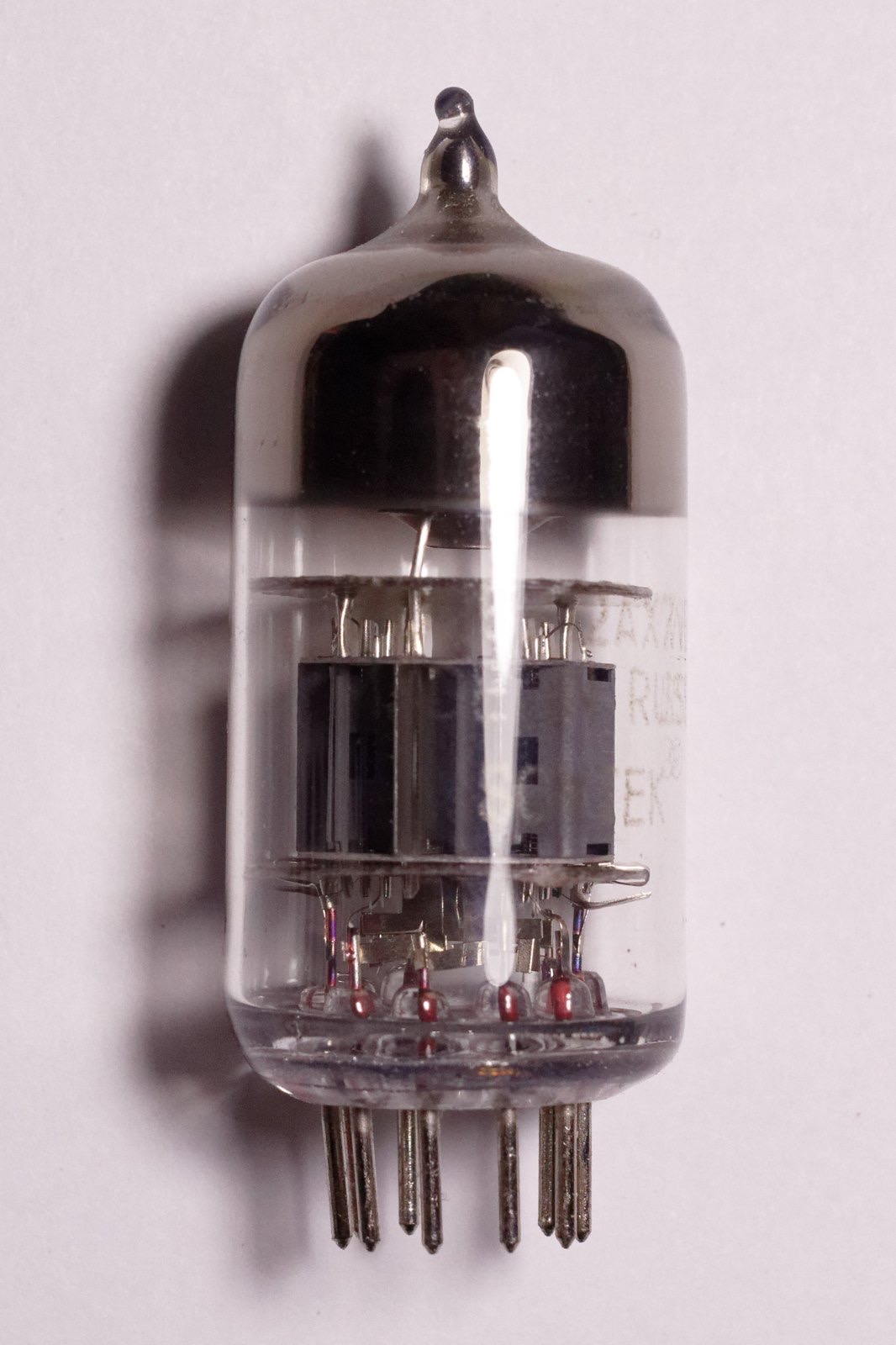
This small tube is called the 12AX7.
Plug a guitar into an amp and turn up the controls. The sound grows thicker and hotter, then begins to distort in a pleasing way. This little tube sits at the entrance to that familiar rock-guitar distortion.
It began as an ordinary component, made in the 1940s for home radios and phonographs. Nearly 80 years later, factories around the world are still making it.
📝 About this story
This article draws on books, vacuum-tube documentation, and specialist explainers. It aims to stick to the facts, though sources differ on details such as the exact date and place of the tube’s development. Those differences are noted in the text. References appear at the end.
Chapter 1 — The Vacuum Tube as a “Valve”
Controlling a flow of electricity with a small force
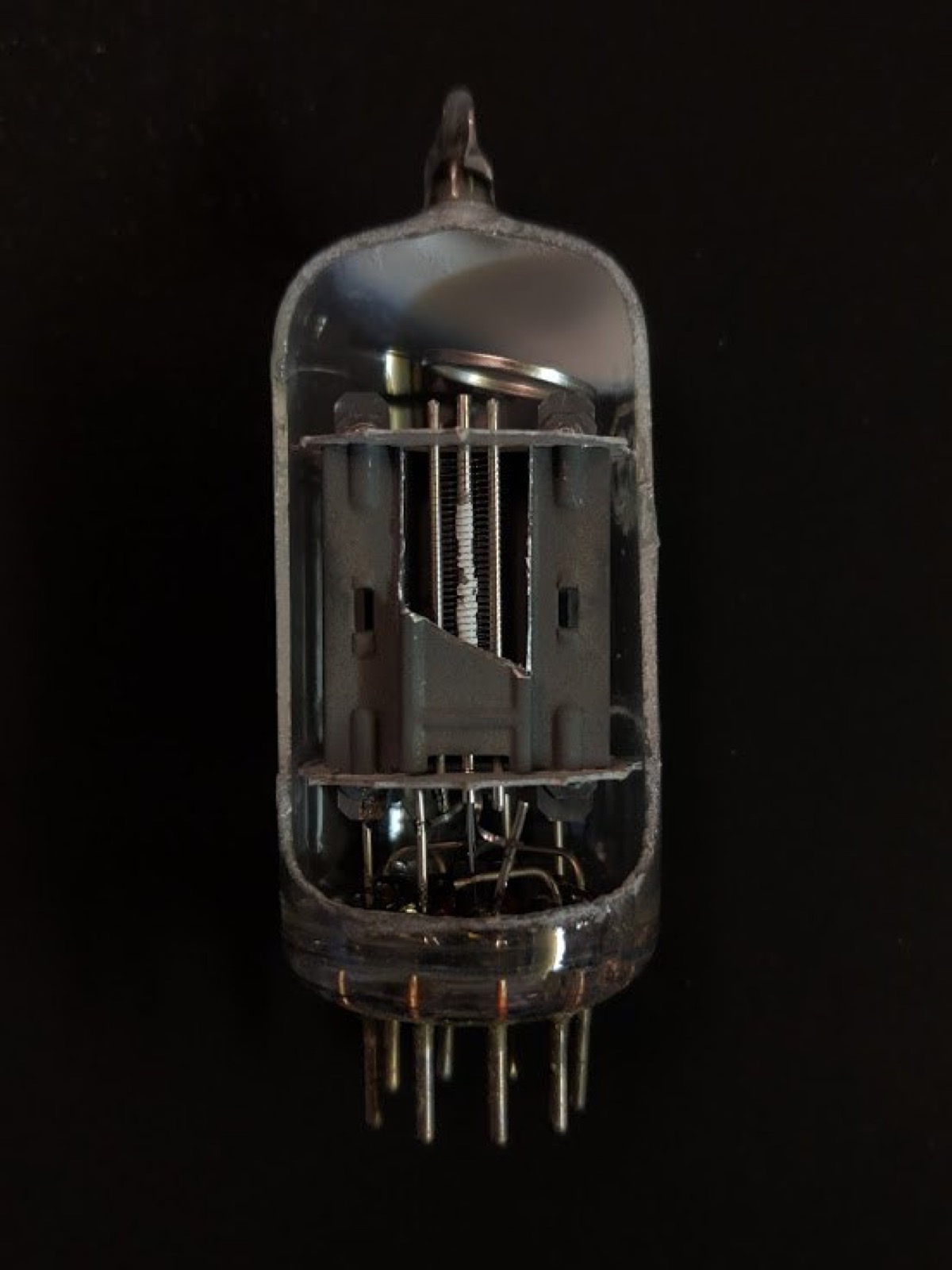
A vacuum tube controls the flow of electricity inside a glass envelope from which the air has been removed.
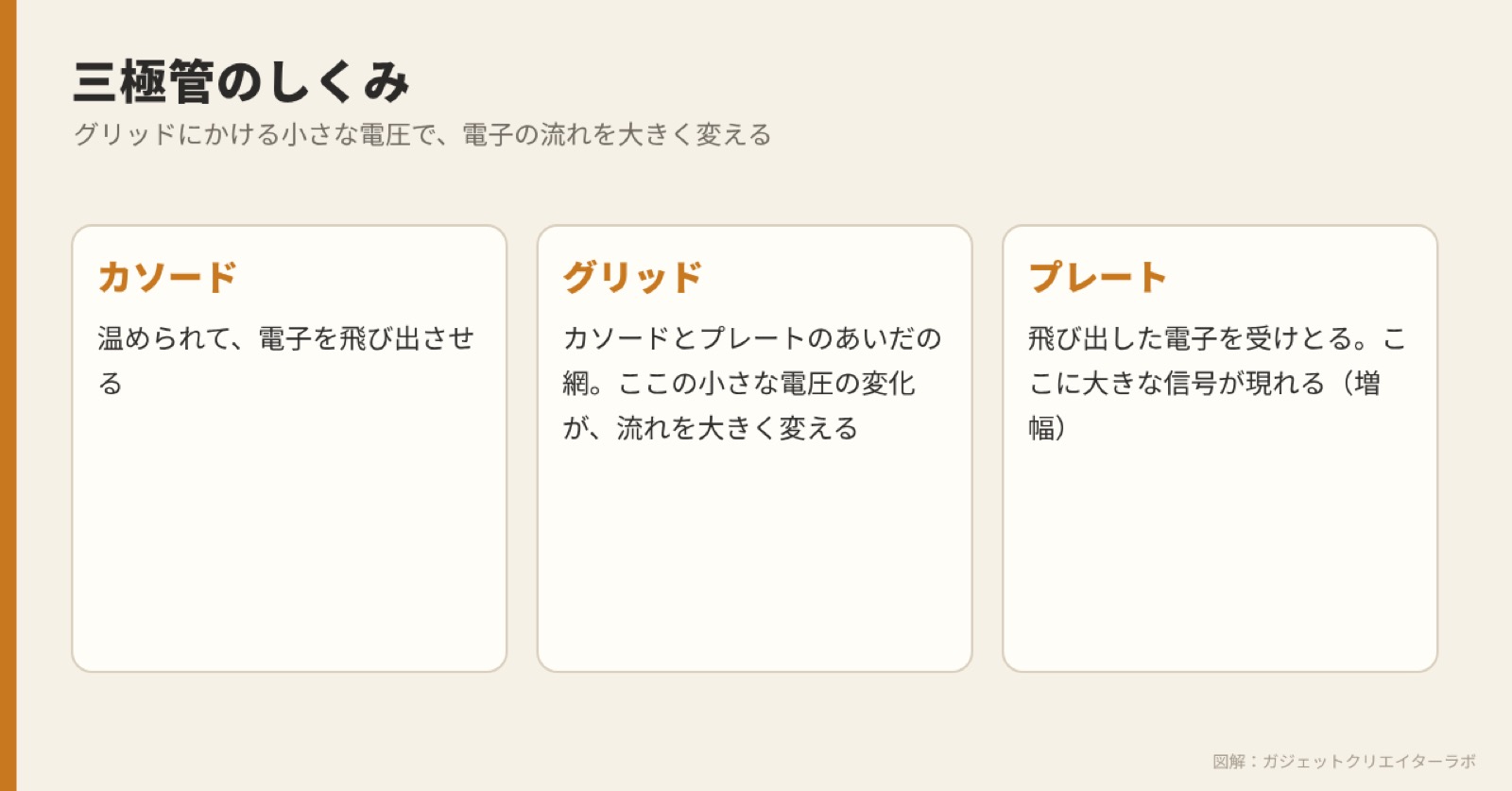
The most basic type, the triode, has three parts:
- Cathode: heated so it releases electrons
- Plate: receives the electrons that have been released
- Grid: a mesh between them; a small voltage applied here can greatly change the flow of electrons
Change the voltage on the grid just a little, and the current flowing to the plate changes a lot. In other words, a small signal can become a much larger one. That is amplification by a vacuum tube.
The amplification factor, “μ” (mu)
A tube’s ability to make a signal larger is often described by its amplification factor (μ, or mu).
The higher the μ, the more a small signal can be amplified. That matters when you’re working with tiny signals, such as those from a guitar or microphone.
Two triodes in one tube
There’s one more thing to know. Some tubes contain two triodes inside a single glass envelope. These are called dual triodes.
The 12AX7 is one of them.
(The rest of this story follows the 12AX7 from its origins at RCA to the meaning of μ = 100, then to its place at the heart of guitar-amp distortion.)
Chapter 2 — A High-Gain Dual Triode Born at RCA
Around 1946, in New Jersey
The 12AX7 is generally said to have been developed around 1946 by engineers at RCA, a major American electronics company.
Sources place the work either in Camden, New Jersey, or at RCA’s plant in Harrison, in the same state. Its development number was reportedly A-4522.
1947: introduced as the “12AX7”
In 1947, the tube appeared under the name 12AX7.
According to some sources, RCA registered the 12AX7 with the American industry association’s tube list on September 15, 1947. Other sources give May.
Designed to replace the 6SL7
The 12AX7 was conceived as a replacement for the 6SL7, a dual triode used in audio equipment.
The 6SL7 was a tall, large tube. The 12AX7 was a much smaller miniature tube, ideal for building more compact radios, phonographs, and amplifiers.
The 12AX7’s internal structure is described as resembling two triode sections from another tube, the 6AV6, placed side by side.
What the name means
The name “12AX7” follows the American system for naming vacuum tubes:
- The first “12” indicates the heater voltage, about 12.6 volts.
- The middle “AX” is a code that distinguishes the type.
- The final “7” indicates the number of electrodes used inside the tube.
The 12AX7’s heater can also be wired to run at about 6.3 volts. This flexible design made it useful in household equipment and many other machines.
Chapter 3 — μ = 100: What “High Gain” Means
A high amplification factor
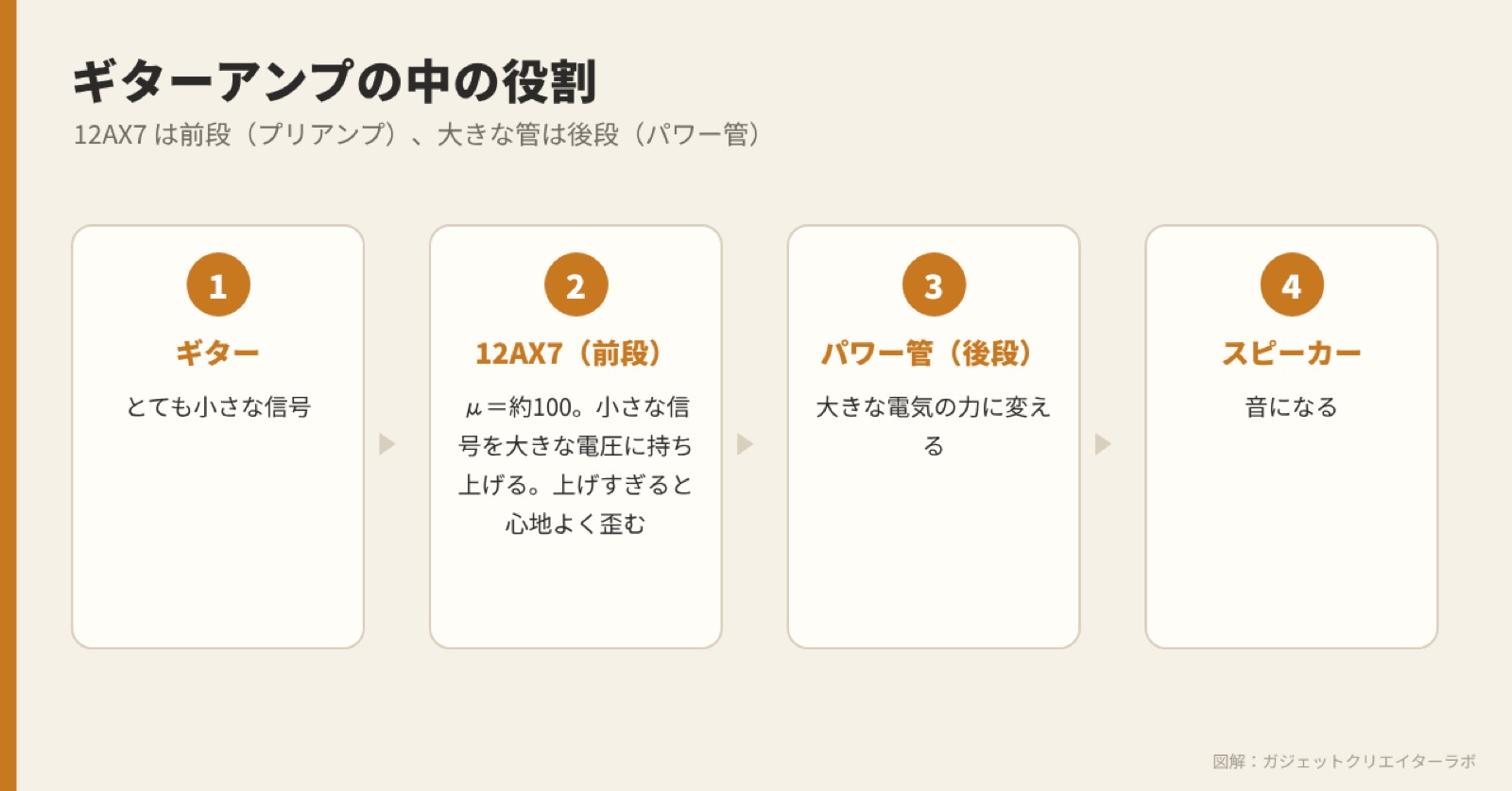
The 12AX7’s defining feature is its very high amplification factor, with μ of about 100.
Other dual triodes have μ values around 20 or 60. The 12AX7 is an especially strong amplifier among them.
The first step for a small signal
On the other hand, the 12AX7 cannot handle a large amount of current. It isn’t built to deliver high power. Its strength is raising a small signal to a higher voltage.
That’s why the 12AX7 has most often been used in an amplifier’s preamplifier stages:
- Where a guitar or microphone signal first enters
- Before and after the circuits that shape the tone
In Europe, it’s called “ECC83”
In Europe, the 12AX7 is known as the ECC83. It’s the European designation for the same tube.
An improved version, the 12AX7A, appeared later. These types are generally interchangeable.
Chapter 4 — The Guitar Amp Connection
From the late 1940s onward
The late 1940s, when the 12AX7 was developed, were also the years when electric guitars and guitar amplifiers began to spread.
A guitar’s signal is small, so it takes a tube with plenty of gain to amplify it. Small, high-gain, and readily available, the 12AX7 was a natural fit for the front end of a guitar amp.
One guide says that from the late 1940s onward, nearly every American and British amplifier maker used this tube. Fender and Marshall were among them.
“Distortion” began as a “failure”
An amplifier’s original job was to make the source sound louder without changing it. Distortion happened when the amp was pushed beyond its limits. It was, in a sense, a sound of “failure.”
But guitarists found something appealing in the sound of vacuum tubes distorting as they were pushed past their limits with the controls turned all the way up.
Because the 12AX7 has high gain, stacking several stages quickly makes a guitar signal much larger. When the signal becomes too large for the tubes to handle, the tops of its waveform flatten gradually.
That gentle flattening is often described as sounding soft, thick, and pleasing to the ear. It became one source of the distorted guitar sound in rock.
The era of designing distortion
Amplifier makers eventually began designing circuits to create this distortion deliberately. By stacking several 12AX7 stages, they could get plenty of distortion even at lower volumes.
A little tube originally made for home radios had become the heart of the guitar’s tone.
Chapter 5 — Why It’s Still Being Made
As vacuum tubes disappeared
From the 1960s into the 1970s, transistors and integrated circuits replaced the vacuum tubes inside radios, televisions, and stereos.
Many tubes went out of production and disappeared.
The tube guitarists kept alive
The 12AX7, however, did not disappear.
One source calls it “one of the few small-signal vacuum tubes that has been continuously manufactured since its introduction.” The reason was the guitar amp.
Guitarists held on to the sound of tube amplifiers. As long as manufacturers kept building tube guitar amps, they needed 12AX7s for their preamp stages.
The 12AX7 today
Today, 12AX7s are made in factories in several countries, including Russia and Slovakia. Players say different manufacturers’ tubes can have slightly different tonal qualities, and guitarists often debate which 12AX7 sounds best.
One guide notes that some modern tubes have a gain factor slightly above the design value of 100.
Chapter 6 — Living Well with a Tube Amp
Here are a few tips for using a tube amp or effect that contains a 12AX7.
1. Give it a little time after switching on
A vacuum tube needs to warm up before it produces its intended sound. It’s a good idea to wait a few minutes after turning the amp on before you start playing. (If the amp has a standby switch, follow the instructions in its manual.)
2. “Ping” or “clang” could be a sign from the tube
If tapping the amp makes a “knock knock” sound, or turning up the volume produces a “ping,” a preamp tube may have become sensitive to vibration. This is called microphonics. If it’s a concern, ask a dealer or a qualified repair technician.
3. Have a specialist handle replacement
Small tubes such as the 12AX7 are said to last longer than power tubes. Still, a thinner sound or increased noise may be a sign that it’s time for a replacement.
Some parts inside a tube amp retain high voltage even after the power is off. Always leave work inside the amp to a qualified specialist.
4. Try different tubes and enjoy the changes
Once you’re comfortable, swapping in a 12AX7 from another manufacturer and listening for differences is part of the fun of owning a tube amp. The differences may be subtle, but they can help you find your own sound.
Epilogue — A Radio Part at the Heart of Rock
In the 1940s, a glass tube about the size of a fingertip was created to make home radios and phonographs smaller.
Its ability to amplify strongly lifted the guitar’s tiny signal. Then, when pushed past its limit, its gentle distortion became part of the sound of rock itself.
As other vacuum tubes disappeared one after another, guitarists helped keep the 12AX7 alive. It is still being made today.
The next time you hear a hot, distorted guitar, take a moment to remember: at the entrance to that sound, a little glass tube born nearly 80 years ago may still be glowing orange.
Timeline of the 12AX7
- Around 1946: RCA engineers develop the tube under the development number A-4522.
- 1947: Registered and released as the 12AX7 (sources give September 15 or May).
- From the late 1940s: Begins appearing in the preamp stages of American and British guitar amplifiers.
- 1960s–1970s: Transistors and integrated circuits replace vacuum tubes in many electronic devices.
- Later: The improved 12AX7A appears. In Europe, the tube is known as the ECC83.
- Today: Still made in countries including Russia and Slovakia, and used in guitar amps and audio equipment.
References
- Wikipedia (English), “12AX7” and “ECC83”
- Effectrode, “The 12AX7 Tube: The Cornerstone of Guitar Tone”
- Tube Amp Doctor, “A complete guide to the 12AX7A tube”
- TubeMaze, “A brief history of 12AX7 tubes”
Photo credits
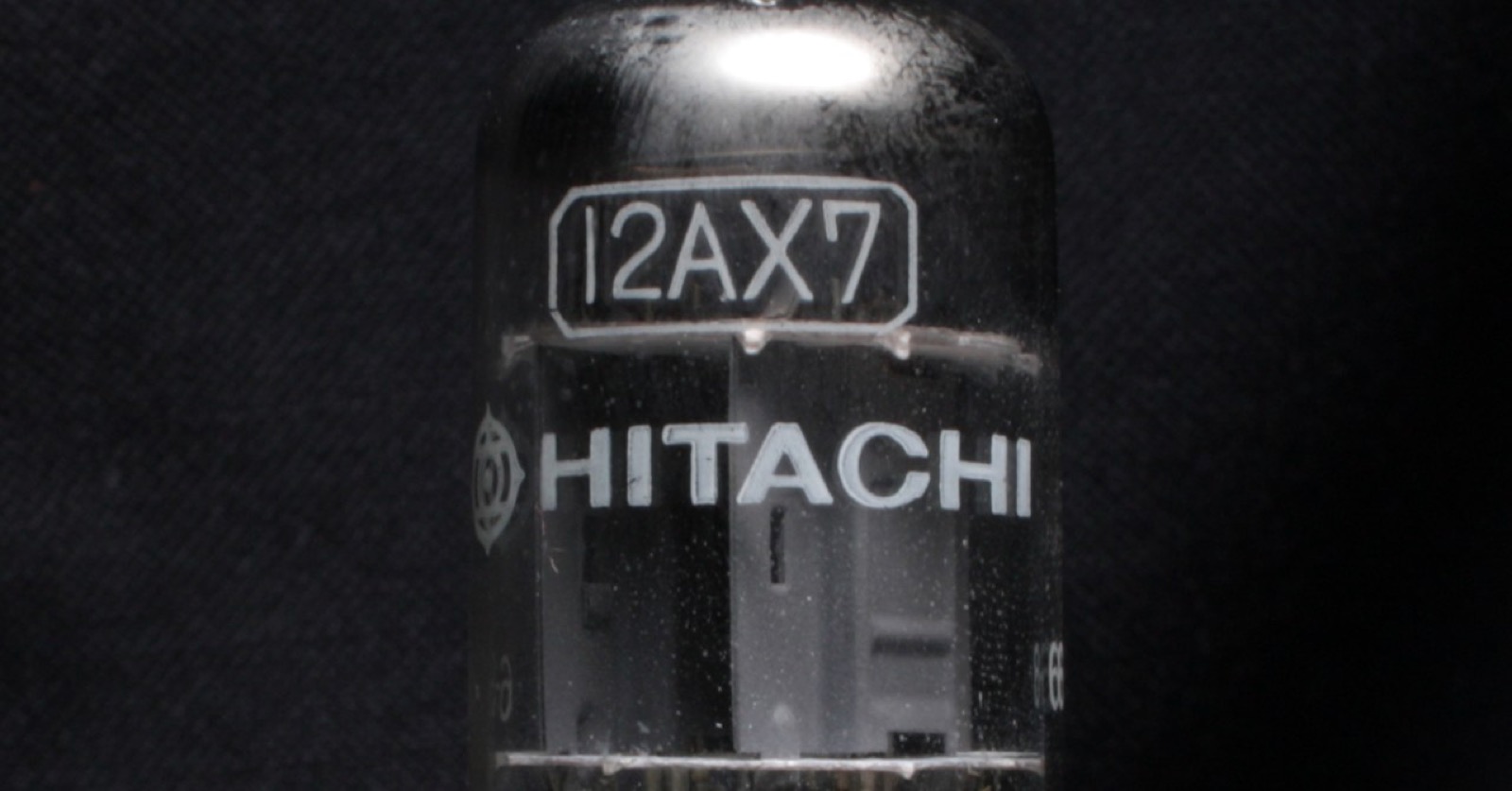
- Header image, “Hitachi 12AX7,” Olli Niemitalo (cropped) / Wikimedia Commons / CC0
- “12ax7 cutaway view,” TubeTimeUS / Wikimedia Commons / CC BY-SA 4.0
- “7025-12AX7 Sovtek 2000 02,” Retired electrician / Wikimedia Commons / CC0
Licenses: CC BY-SA 4.0, https://creativecommons.org/licenses/by-sa/4.0/ ; CC0, https://creativecommons.org/publicdomain/zero/1.0/.
About the illustrations
- All illustrations in this article were created by Gadget Creators Lab.