The Aerospace Engineer Who Brought ’80s Drums to Life — AMS RMX16 and DMX
☕ A coffee-length story about a classic piece of gear
About a 10-minute read. Set the research aside and enjoy this as a story.
“Boom—BANG!” A drum sound blooms across a huge space, then vanishes in an instant. That sound, heard on hit records throughout the 1980s, came from a box built by former aerospace engineers in a small town in northern England.
💡 What you’ll learn
- Why AMS, a company founded by aerospace engineers, created the digital delay DMX
- How the RMX16’s Nonlin program made drums bloom and disappear
- How to think about using gated reverb in a modern DAW
Prologue — Big, Then Gone
Listen to a hit from the 1980s and you may notice a distinctive quality in the drums.
The moment a snare or tom is struck, its sound fills a huge room. Then, before the reverberation can trail off for long, it cuts out cleanly.
The impact of a large space and the tightness of a sharply controlled rhythm—two things that normally seem at odds—happen at once.
For studio engineers at the time, this was a remarkably new sound. And there was a machine that could call it up at the press of a button.
It was the digital reverb RMX16, made by the British company AMS.
The people who founded AMS had worked not in music, but in aerospace engineering.
📝 About this story
This story draws on books and articles I’ve read, trade-press coverage, and manufacturers’ materials. I’ve tried to stick to the facts. Sources sometimes differ by about a year on product release dates; where that happens, I point it out in the text. Sources are listed at the end.
Chapter 1 — Reverb and Delay: Machines That Shape a Room
Recorded Sound Is Dry
A sound recorded close to a microphone has little room ambience. It comes across as dry. Left that way, it can feel a little lifeless, as if you’re listening in a small room.
So engineers add ambience after recording. Two kinds of effects do this:
- Reverb creates the reverberation of a large room or hall.
- Delay repeats a sound after a short pause, creating an echo.
Before the Digital Era
Through the 1970s, engineers mainly created ambience with physical methods:
- Playing sound through a speaker in a reverberant room, or echo chamber, and recording it again
- Vibrating a large sheet of metal or a spring, as in plate and spring reverbs
- Delaying sound with tape, as in tape echo
Making Reverb with Numbers
In the latter half of the 1970s, a new approach arrived. Audio could be converted into digital numbers, then delayed or turned into reverberation through computation.
That required technology capable of converting sound into numbers quickly and performing a large number of calculations accurately in an instant. The people with those skills came from an unexpected field.
(From here on, this is the story of the company they founded, its pioneering digital delay and reverb, and the “Nonlin” effect that helped define the sound of ’80s drums.)
Chapter 2 — Aerospace Engineers in Burnley
1976, Northern England
In 1976, a company was founded in Burnley, a town in Lancashire in northern England.
It was AMS (Advanced Music Systems).
Its founders were Mark Crabtree and Stuart Nevison, both aerospace engineers. In its own history, the company identifies Crabtree as its founder and says that Nevison and Peter Unsworth, a colleague from the same field, joined him.
Why Aerospace Engineers?
In aviation, large amounts of information have to be processed instantly and accurately. A small mistake can lead to a serious accident.
Digital audio called for those same abilities: convert sound into numbers precisely, process it without delay, then turn it back into sound.
Technology honed in the skies would go on to create new kinds of reverberation in the studio.
Chapter 3 — DMX: Echoes Made of Numbers
1978: DMX 15-80
AMS’s first major product was the DMX 15-80, released in 1978.
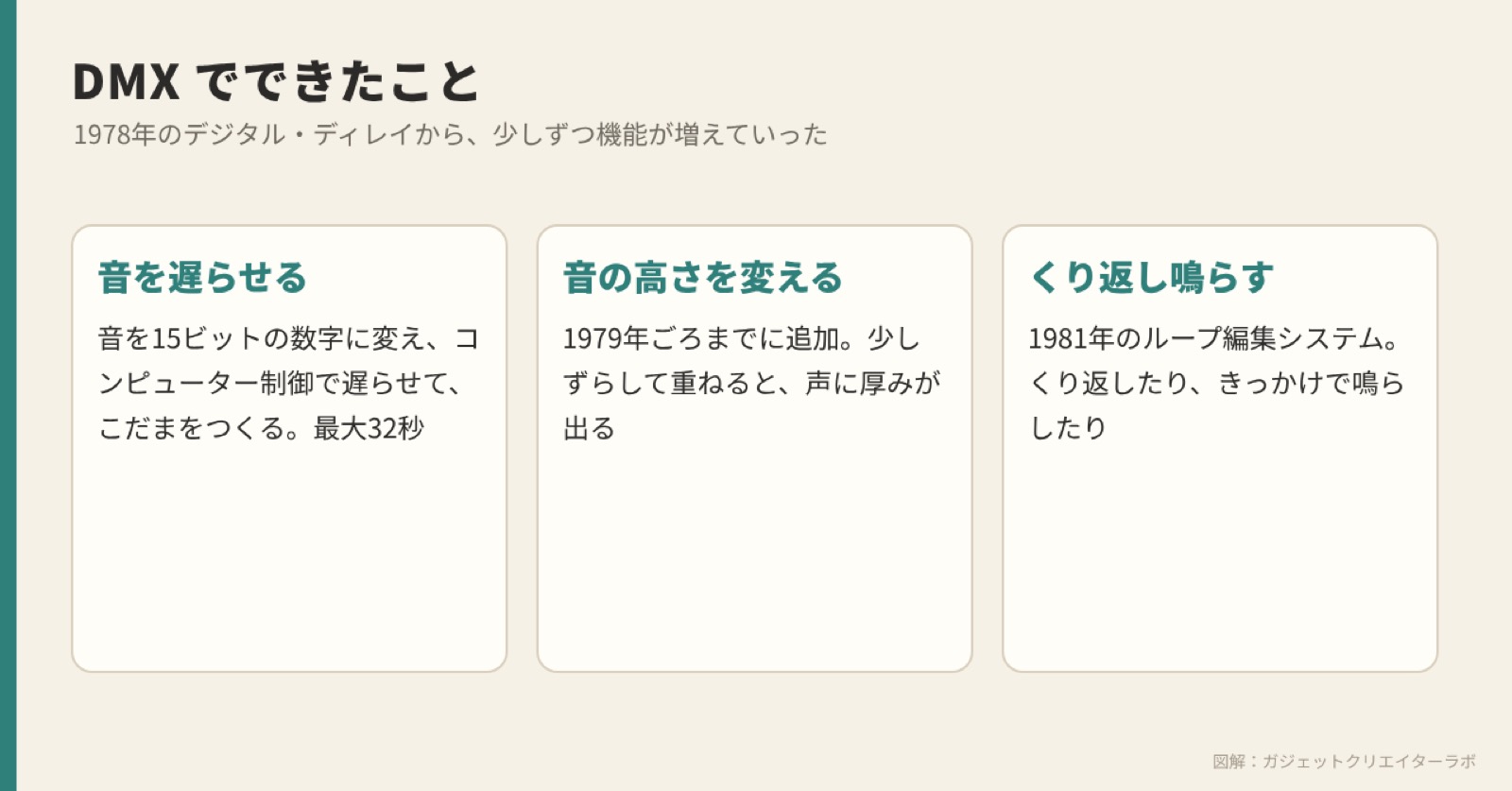
It was a 15-bit digital delay. The machine converted sound into 15-bit numbers, then used a microprocessor to control the delay and create echoes.
A two-channel stereo version, the DMX 15-80S, followed soon afterward. Some sources date the stereo model’s arrival to 1980.
Changing Pitch, Too
The DMX did more than delay sound.
By around 1979, it had gained a pitch-shifting function. It could also delay sound for as long as 32 seconds.
Shift a voice’s pitch just slightly and layer it over the original, and it can sound as if two people are singing. The DMX’s pitch function became a useful way to make a vocal sound thicker.
The Magic of a Loop
In 1981, a loop editing system was added.
A section of sound could repeat continuously, or play only when triggered. It brought something close to what we now call a sampler into a delay unit.
Chapter 4 — RMX16: The Shock of Nonlin
Moving into Digital Reverb
After delay, AMS took on reverb.
In 1981, the company announced a digital reverb called the DMX15R. It was considered one of the very early digital reverbs controlled by a microprocessor and capable of handling the full range from high to low frequencies.
An improved version became the RMX16. Most sources place its introduction in 1981, while some give 1982.
A Range of Rooms
The RMX16 came loaded with programs that created different kinds of reverberation:
- Hall: a long, spacious sound like a concert hall
- Plate: a bright, dense sound like a metal plate reverb
- Room: a short, natural-sounding room
- Ambience: a very short effect that adds a sense of air
- Nonlin: an unusual sound unlike natural reverberation
Of these, Ambience and especially Nonlin became famous.
Nonlin 2: An Unnatural Decay
“Nonlin” is said to be short for “nonlinear.”
With ordinary reverb, the sound gradually gets quieter after the source stops. Nonlin behaves differently: it stays at about the same level for a while, then suddenly cuts off.
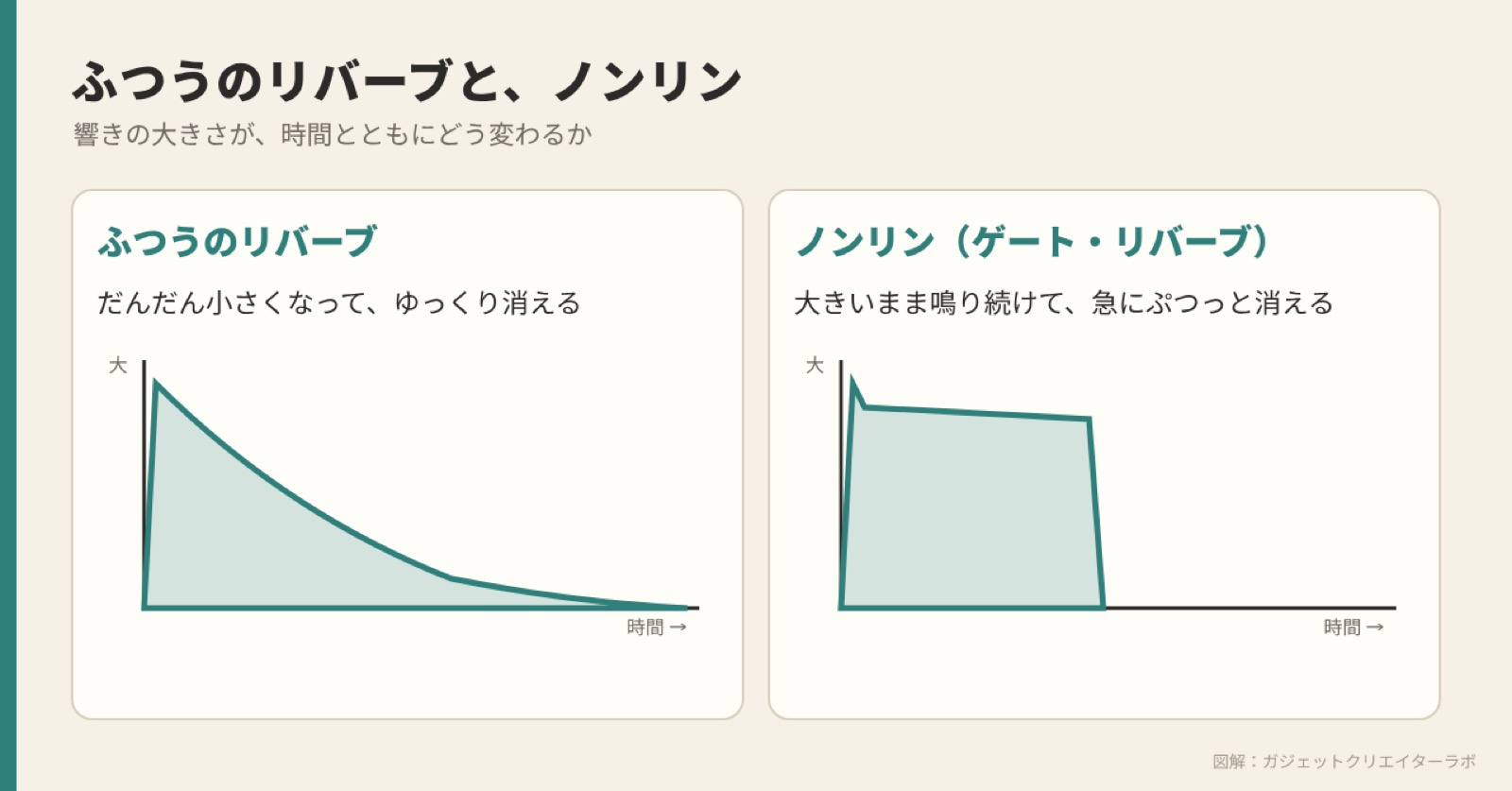
That was the “big, then gone” drum sound introduced in the prologue.
The Sound of “In the Air Tonight,” at the Press of a Button
The sound grew out of a recording technique used in studios.
A microphone picks up the sound of the drums in the room. A compressor crushes that signal hard, and a “gate” abruptly cuts it when it falls below a certain level. The result is a huge reverberant sound that ends suddenly.
The sound is famously associated with Phil Collins’s drums on “In the Air Tonight.” The RMX16’s Nonlin 2 is said to have reproduced that effect through digital computation.
A sound that once required an elaborate room and a chain of equipment could now be called up with one button. Gated reverb became one of the signature drum sounds of ’80s pop and rock.
A Rival: Lexicon
Around the same time, America’s Lexicon 224 was also widely used as a landmark digital reverb.
Many engineers are said to have preferred the Lexicon for natural-sounding spaces such as halls and plates. But for distinctive effects like Nonlin and Ambience, AMS had a strong presence of its own.
In ’80s studios, the two makers were rivals with different strengths.
Chapter 5 — AMS After RMX16
Siemens, Then Neve
The 1990s brought a major change for AMS.
According to published accounts, German industrial giant Siemens acquired AMS in 1990. Siemens already owned Neve, the distinguished British maker of recording consoles.
AMS and Neve came together as AMS Neve. Sources give different dates for the merger, ranging from 1992 to 1995.
By the middle of the 1990s, Mark Crabtree is said to have bought the company back from Siemens. A company started by aerospace engineers and a renowned console maker now share a history that continues under one roof.
The RMX16 Returns
In 2020, AMS Neve announced new hardware based on the RMX16. Plugins recreating the RMX16 have also appeared.
That ’80s drum sound is still just one button away, now inside a computer.
Chapter 6 — Using Gated Reverb Today
Here are a few tips for using an effect like the RMX16’s Nonlin gated reverb.
1. Use Just a Little on Snare and Toms
Gated reverb is an attention-grabbing sound. It’s usually best to send it to snare or toms, rather than applying it across the whole track.
2. Set the Decay to Fit the Tempo
Set the length of the reverb to suit the song’s tempo. A tight cutoff just before the next beat can make the rhythm feel more focused.
3. For an ’80s Sound, Go Big
For a bold ’80s effect, turn up the reverb amount and commit to it. To blend the sound naturally into a modern track, use less and add only a touch of impact.
4. Try Ambience, Too
The RMX16’s other popular program, Ambience, creates a very short reverb that can add a sense of air to a dry sound. Add just enough to a vocal or acoustic guitar that you can barely hear it, and the sound can feel much more natural.
Epilogue — Reverb from the Skies
In a small town in northern England, a company began with a group of aerospace engineers. They brought the fast, precise calculation skills they had honed in aviation into the world of sound.
The DMX made echoes from numbers. The RMX16 created reverberation unlike anything in nature.
Nonlin became the sound of ’80s drums, and it remains a sound that instantly brings that era to mind.
The next time you hear a drum on an ’80s hit bloom across a huge space and then vanish, remember that the effect may have come from the calculations inside a box born of aerospace technology.
AMS Timeline
- 1976: Mark Crabtree and Stuart Nevison found AMS in Burnley, England.
- 1978: The 15-bit digital delay DMX 15-80 appears. A stereo DMX 15-80S follows; some sources date it to 1980.
- Around 1979: The DMX gains pitch shifting.
- 1981: Loop editing is added to the DMX; AMS announces the DMX15R digital reverb.
- 1981–82: The RMX16 appears. Its Nonlin 2 gated reverb helps define the sound of ’80s drums.
- 1990: Siemens acquires AMS, according to published accounts.
- Around 1992–95: AMS joins with Neve to become AMS Neve; sources differ on the year.
- Mid-1990s: Crabtree is said to buy the company back.
- 2020: New hardware based on the RMX16 is announced.
References
- Wikipedia (English edition), “Advanced Music Systems”
- Mix, “Classic Tracks” articles
- Sound On Sound, “UA RMX16” review and related coverage
- Sonicstate, “NAMM 2020: The AMS RMX16 Returns”
- MusicRadar, “AMS Neve RMX16” review
- Vintage Digital, “AMS RMX16”
Photo credits
- Header image, “Coach House control room (53720408036)” — Steve Knight from Halstead, United Kingdom (cropped) / Wikimedia Commons / CC BY 2.0
About the illustrations
- All diagrams in this article were created by Gadget Creators Lab.