Honda CB750: The Four-Pipe Bike That Changed the World
☕ A coffee-length story — about a 12-minute read.
💡 What you’ll learn
- Why Honda developed a 750 cc heavyweight motorcycle
- What mass-produced inline-four power and a front disc brake made possible
- How “nanahan” became shorthand for a large motorcycle
At the end of the 1960s, when people talked about motorcycle speed, the world looked to Europe. British tradition, German solidity, and American displacement had each shaped their own markets. Then a Japanese manufacturer brought a new answer: the Honda Dream CB750 FOUR, launched in 1969.
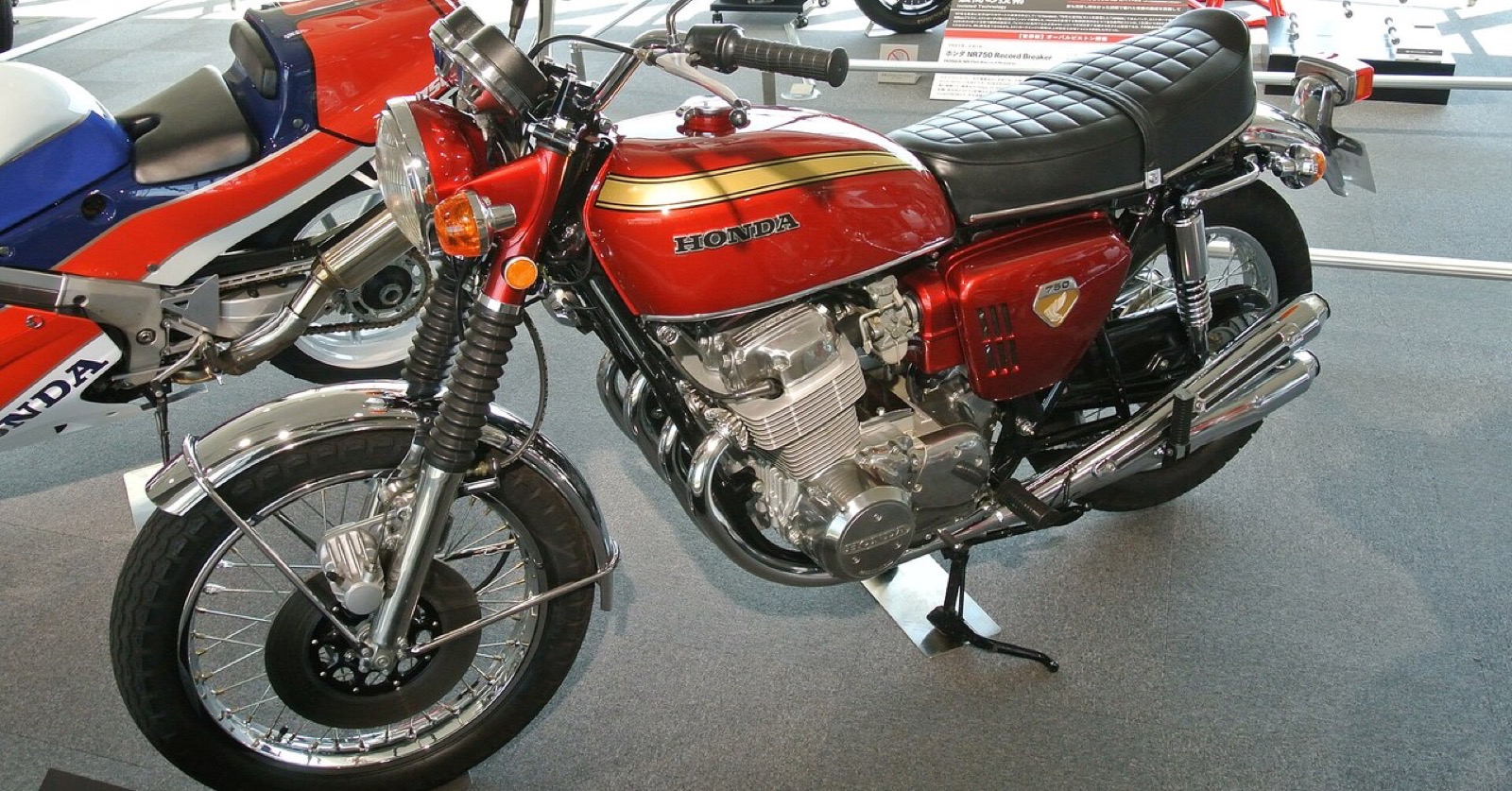
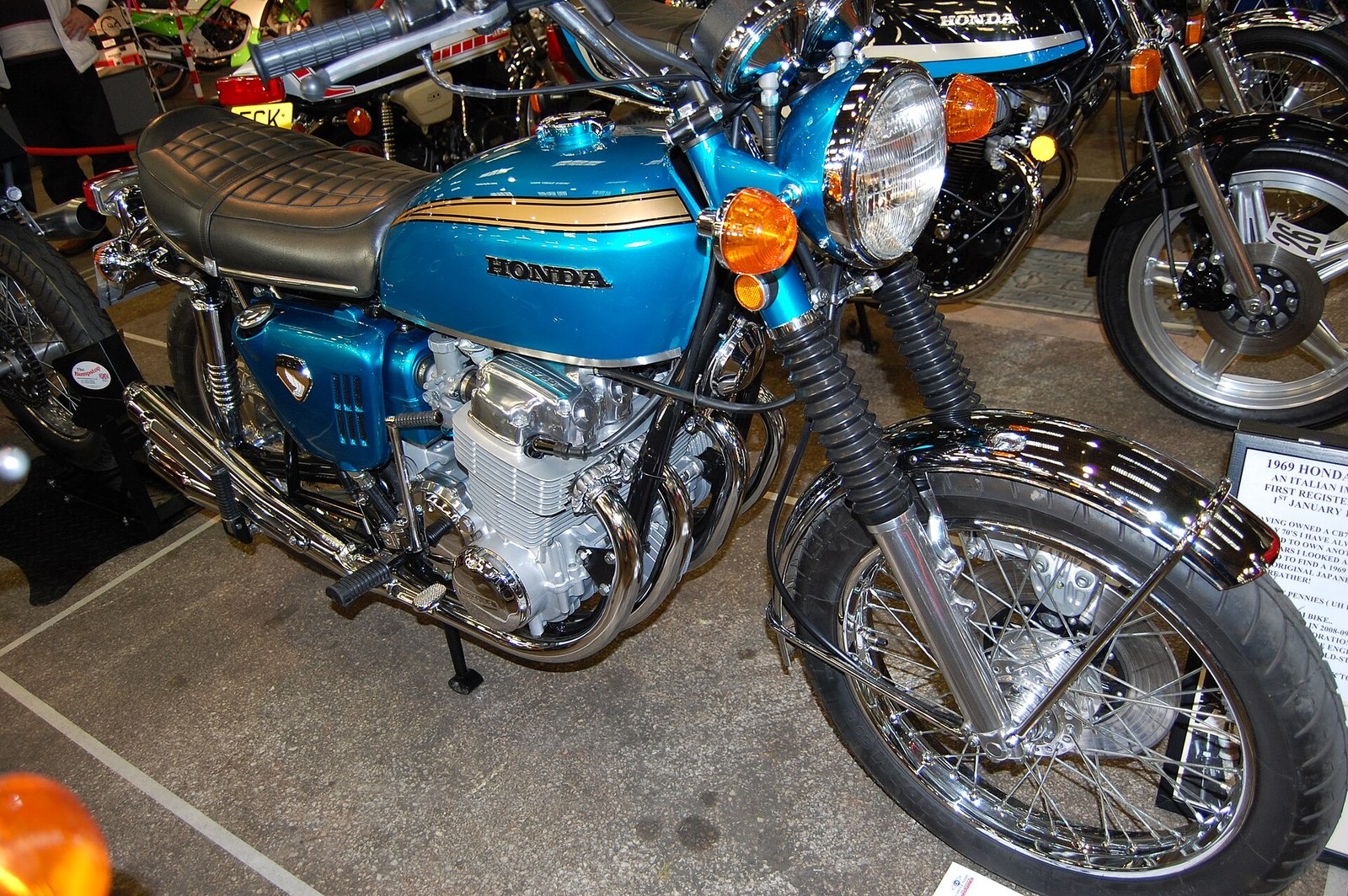
Four exhaust pipes ran beneath its broad tank. It had an air-cooled, four-stroke inline-four engine and a disc brake on the front wheel. Even at a standstill, it projected a different kind of presence from the middleweight bikes people knew. But the CB750 mattered for more than its novel hardware. Honda was trying to bring racing technology to a mass-produced road bike and make a large sport motorcycle available to riders around the world.
Prologue — What four exhaust pipes announced
When the CB750 FOUR appeared at the Tokyo Motor Show, its imposing stance and four mufflers—two on each side—drew a crowd. Honda had spent years refining multi-cylinder engines in motorcycle Grand Prix racing. The new machine made clear that the company intended to bring that experience to a production motorcycle.
Its displacement was exceptionally large for a mass-produced bike of the time, and its peak output was 67 horsepower. It also had a hydraulic disc brake on the front wheel. Some motorcycles already had larger engines. What made the CB750 special was the way it brought performance, ease of use, quality, and the ability to build and supply the bike together in one package.
Chapter 1 — The world market asks for a bigger motorcycle
Honda was already selling motorcycles around the world, led by the Super Cub. But North America and Europe had room for a large sport bike suited to riders who enjoyed highways and long-distance travel. Honda’s exports were growing, yet its lineup did not include enough large-displacement sport models. Dealers in the United States were also asking for bigger, higher-performance motorcycles.
Honda could have answered by enlarging an existing engine. Instead, it chose a layout that signaled high performance around the world: four cylinders and four exhaust pipes. The goal was to bring the smoothness and rising revs of a Grand Prix multi-cylinder engine to a production bike, while making it easy to build and service as well as fast.
The development team got underway in earnest in 1968. About 20 people set out to bring the motorcycle to market the following year. In a short time, they had to consider the engine, chassis, brakes, tires, and chain as one system. They were not simply assembling familiar parts; they were designing a complete motorcycle that could withstand more power and speed.
The team also considered the handlebars and the bike’s overall appearance with North American riders in mind. Adapting to a market meant more than matching the tastes of an export destination. Riding position over long distances, fuel capacity, a serviceable dealer network, and a dependable supply of replacement parts all shaped the product. The CB750 marked a new stage: designing a motorcycle to be chosen in markets around the world, rather than simply building one in Japan and shipping it abroad.
The key was Honda’s ambition to extend the mass-production expertise it had built with small motorcycles into large sport bikes. The aim was to keep making bikes to consistent standards, not to create rare, hand-built machines. A large-engined model would not be confined to a few experienced specialists. Dealers would sell it, parts would remain available, and riders around the world would put it on the road. That vision stood behind the CB750’s development.
Chapter 2 — Putting four cylinders and a disc brake into production
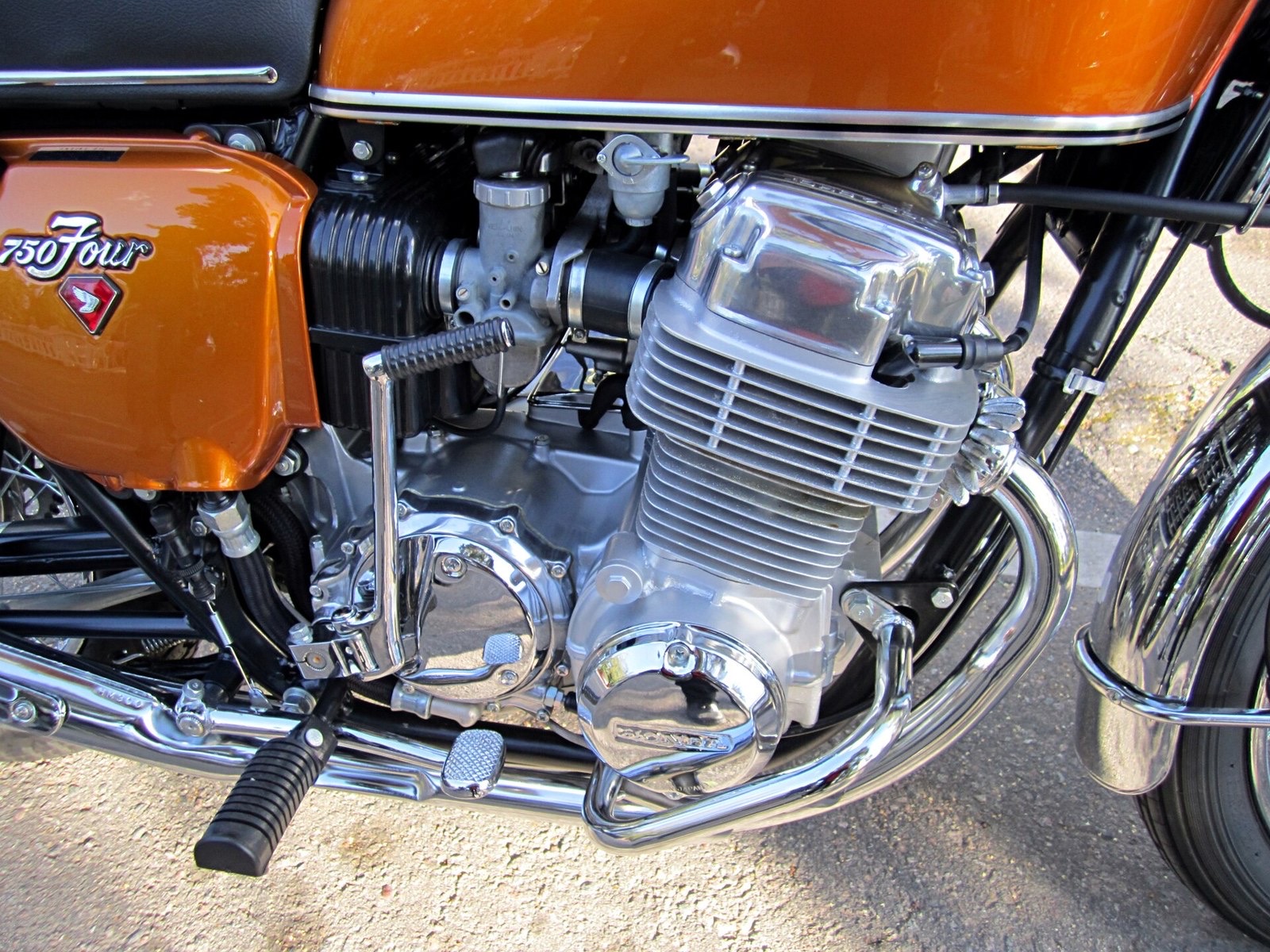
The CB750 FOUR was powered by an air-cooled, four-stroke SOHC inline-four with a displacement of 736 cc. Four pistons worked in sequence, producing a smoothness and high-revving character unlike a single- or twin-cylinder engine. The challenge was to machine four cylinders precisely, combine their power through one crankshaft, shed heat, and maintain durability. The design was only part of the job; manufacturing technology had to produce parts to the same standard again and again.
Prototypes were developed alongside a production line planned almost from scratch. The crankshaft in particular required new equipment and processes. The factory had little precedent for making such a part consistently, so Honda engineers even visited automobile manufacturers to learn about production methods. At first, output was only a few motorcycles a day. When orders far exceeded expectations, the company had to review and expand its equipment quickly. To bring an idea to market, engineers had to turn drawings into reliable factory procedures.
The other defining feature was the hydraulic disc brake on the front wheel. Brakes are essential not only for going fast but for controlling speed safely. Compared with a conventional drum brake, a disc sheds heat more readily and can deliver more consistent braking under repeated hard use. But practical details still needed work, including pad wear and brake squeal.
During development, the team debated whether to use a drum or disc brake. The disc was new, and continuing tests could delay the launch. Honda chose it anyway and set about solving the problems one by one. The company wanted new equipment to work on the road and in mass production, not merely look impressive in a catalog. That decision reflected Honda’s approach to development.
A prototype shown at the 1968 Tokyo Motor Show drew a strong response. The CB750 FOUR went on sale in July 1969. Between the reveal and the showroom, the team still had to tune the brakes, prove engine durability, prepare machining equipment, and secure production capacity. Behind the dramatic debut was a long stretch of practical manufacturing work.
Bringing performance into everyday reach
A large-displacement motorcycle is about more than speed. It can shorten a long journey, make cruising feel effortless, and open up new distances to the rider. But if weight, heat, fuel consumption, and maintenance demands become too great, only a few people can manage it. The CB750 set out to deliver high performance along with the reliability and support expected of a mass-produced motorcycle.
That is why peak horsepower alone cannot tell the whole story. Would the engine start easily? Were the clutch and gearbox manageable? Did the brakes work consistently? Could the bike be serviced after a long trip? Could a dealer get the necessary parts? Bringing all these everyday details together was essential to making a large motorcycle part of a broader market.
Chapter 3 — “Nanahan,” a number that became a symbol
After the CB750 FOUR arrived, people in Japan increasingly called the 750 cc class “nanahan.” The word began as a quick way to say the displacement, but it became a term for large motorcycles. The presence of a machine beyond the ordinary middleweight class, its ability to cover long distances, and the appeal of owning one all came to be wrapped up in that single word.
Japan’s licensing system and market at the time also shaped the name’s meaning. Other markets had different displacement limits and ways of dividing motorcycle classes. In Japan, 750 cc came to occupy a special place as the symbol of a heavyweight bike, and the CB750 helped cement that association. Later accounts often sum it up by calling the bike “the original nanahan,” but the class was shaped by competition among manufacturers, regulations, and rider culture together.
The CB750 also represented a direct challenge by a Japanese manufacturer to European heavyweight motorcycles, matching their performance with mass-production quality. Its smooth four-cylinder engine, disc brake, and imposing appearance overturned the idea that Japanese bikes were small and purely practical. As Honda established itself in the large-displacement market, other Japanese manufacturers accelerated development of high-performance heavyweight bikes, giving riders more choices.
The market changed in ways beyond the motorcycles themselves. Dealers equipped to sell large bikes, service expertise, specialist magazines, and parts distribution all grew. Riders also found more places to share information. When a remarkable new motorcycle enters a market, a culture grows around owning it. The CB750’s impact stimulated later models and expanded both the community of riders choosing large bikes and the support systems behind them.
Chapter 4 — Taking racing memories to the road
Honda’s decision to pursue multi-cylinder engines grew in part from its effort to compete in Grand Prix racing. Experience with high-revving engines and precision machining in the 1960s gave the CB750’s development a technical foundation. But a race bike and a production motorcycle are not the same. Racing rewards the highest possible performance over a limited time; a road bike must also be durable, affordable, serviceable, and manageable.
Bringing racing experience to the road did not mean reusing parts unchanged. It meant adapting ideas and engineering knowledge into a system that could work for years on public roads. Precision parts to support high revs, engine cooling, and chassis stability all needed attention. The team kept adjusting lessons from racing to suit the conditions of everyday riding.
Even riders who knew nothing about Honda’s racing program could feel its engineering in the CB750. The four exhaust pipes were not just decoration; they displayed the multi-cylinder layout. Once underway, the sound, vibration, and feel of acceleration offered a different experience from a single or twin. The fact that riders could feel the results of the engineering for themselves was part of the bike’s appeal.
At the same time, describing the CB750 only as a “race-bred” motorcycle overlooks the work of mass production. Without parts supply, factory capacity, and a service network after the sale, racing knowledge would have remained in a prototype. To become a company that could keep selling large motorcycles in markets around the world, Honda had to bring development, manufacturing, and sales together in one continuous effort.
Chapter 5 — Later models grow the heavyweight sport era
The CB750’s success was not an endpoint for Honda. It was the starting point for a broader heavyweight lineup. Later CB models continued with different displacements and designs, including higher-output motorcycles and bikes for other uses. Other manufacturers introduced large motorcycles with their own technologies and character, and riders around the world began to see Japanese companies as major players in the market.
The important point is not that every later motorcycle was a copy of the CB750. Manufacturers made different choices about air or water cooling, cylinder count, dimensions, and whether a bike was intended for touring or sport riding. Still, the CB750 showed that the market would embrace a mass-produced 750 cc inline-four. It changed both manufacturers’ development targets and customers’ expectations.
Buyers gained more ways to choose, too. They could weigh styling, riding position, engine character, brakes, and suspension. Different personalities began to appear within the broad category of large-displacement motorcycles. Competition was no longer just about performance figures; it also meant offering a particular kind of ride on a particular kind of road.
The popularity of the 750 cc class also left a strong memory shaped by Japan’s own history. As licensing rules changed, 750 cc was sometimes remembered as a barrier to aspire to, while the differences between domestic and export models drew interest. Rules, products, and culture combined to give the displacement a meaning beyond its number. To understand the CB750’s history, it helps to look at the machine and the rules of its time together.
Chapter 6 — Looking at the CB750 today
Compared with modern motorcycles, the CB750 FOUR has no electronic controls or lightweight materials, and its brakes and tires differ from those of today. It would be unfair to judge the technology of its time solely by modern standards. The CB750 was Honda’s answer to a different question: how could a company build a world-class heavyweight sport motorcycle using the parts, machining equipment, roads, and rider gear of the 1960s?
When you look at one, notice more than the engine. The line from tank to seat, four exhaust pipes, large front disc, and wide handlebars all deserve attention. Each was chosen in response to performance and market needs, and together they made the model instantly recognizable. Function and appearance worked together to create the impression of one complete product.
If you encounter a CB750 as a classic bike, remember that details vary by year and specification. You cannot call every example an “early model” without checking its type within the series, destination market, and any modifications. When describing a preserved or displayed bike, check its production year and specification as well as its model name. The longer a model remains popular, the more rewarding it becomes to trace its changes over time.
Epilogue — Turning a big dream into a production motorcycle
The CB750 FOUR is a story about technology—the first mass-produced motorcycle to bring four cylinders and a disc brake together—and a story about a company creating a product for the global market. The development team translated racing knowledge into a road motorcycle, factories established processes for making new parts, and the sales network delivered the bikes and their parts to riders in many places.
As a result, a 750 cc heavyweight was no longer an exotic machine from a distant country. It became a mass-produced motorcycle from a Japanese manufacturer, available to riders around the world. “Nanahan” remains in people’s memory not just as a displacement, but as a symbol of the moment when the possibilities of motorcycling expanded.
The four mufflers may be the first thing you notice when you stand in front of a CB750. Behind them are the voices of riders seeking performance, engineers taking on the world, and factory workers finding ways to make it all at scale. The challenge was not just to dream of speed, but to give that dream a form many people could own. The CB750 carried that enormous undertaking on two wheels.
Photo credits
- Header image, “Honda CB750.jpg”: Rainmaker47 (cropped) / Wikimedia Commons / CC BY-SA 3.0 (https://creativecommons.org/licenses/by-sa/3.0)
- “Flickr - ronsaunders47 - HONDA CB750. 1969-2003. 750cc FOUR CYLINDER..jpg”: Ronald Saunders / Wikimedia Commons / CC BY-SA 2.0 (https://creativecommons.org/licenses/by-sa/2.0)
- “Honda CB750 Four K1 1971 Engine.jpg”: Khaosaming / Wikimedia Commons / CC BY-SA 3.0 (https://creativecommons.org/licenses/by-sa/3.0)