The Honda NSR250R — When Two-Stroke Race Replicas Ruled the Road
☕ GC Lab’s Motorcycle History
A series tracing the people and events behind iconic machines. This time, we follow the Honda NSR250R through an era fueled by the excitement of road racing.
💡 What you’ll learn
- The era when race replicas captured riders’ imaginations
- How the NSR250R evolved from the MC16 to the MC28
- PGM, the card key, and why the bike remains popular
Open a Japanese motorcycle magazine from the 1980s and you’ll find rows of fully faired machines in vivid colors. Race replicas—bikes that seemed to bring the look of a circuit racer onto public roads—became the dream of young riders. At the heart of that world was the Honda NSR250R.
Its displacement was 250cc, but that number alone can’t explain its presence. There was a high-revving two-stroke V-twin, an RC Valve system that controlled exhaust flow, and electronic controls incorporating technology refined in racing. With each redesign, the NSR brought production bikes closer to the world of competition.
From the MC16, introduced in 1986, through the MC18, MC21, and MC28, each model code brought changes to the chassis and controls—and the mood of the era shifted, too. Let’s trace the bike’s connection to the NSR Grand Prix racer, explore the four generations, and look at the turning point for two-stroke sport bikes.
Chapter 1 — The Race Replica Fever
In 1980s Japan, interest in the Road Racing World Championship—often called the WGP—was growing. Japanese manufacturers competed across classes, and the machines ridden by the world’s top racers became familiar through magazines and television. Racing technology was finding its way into production bikes just as demand for racer-inspired styling was heating up. Motorcycles known as race replicas became hugely popular.
A race replica was more than a bike dressed to look like a racer. It brought ideas prized in competition onto public roads: aerodynamic fairings, a lightweight chassis, and suspension suited to spirited riding. But a street bike also had to meet other demands, including durability, serviceability, lights, and noise limits. The challenge was to make a production motorcycle work—not simply transplant a circuit racer’s speed.
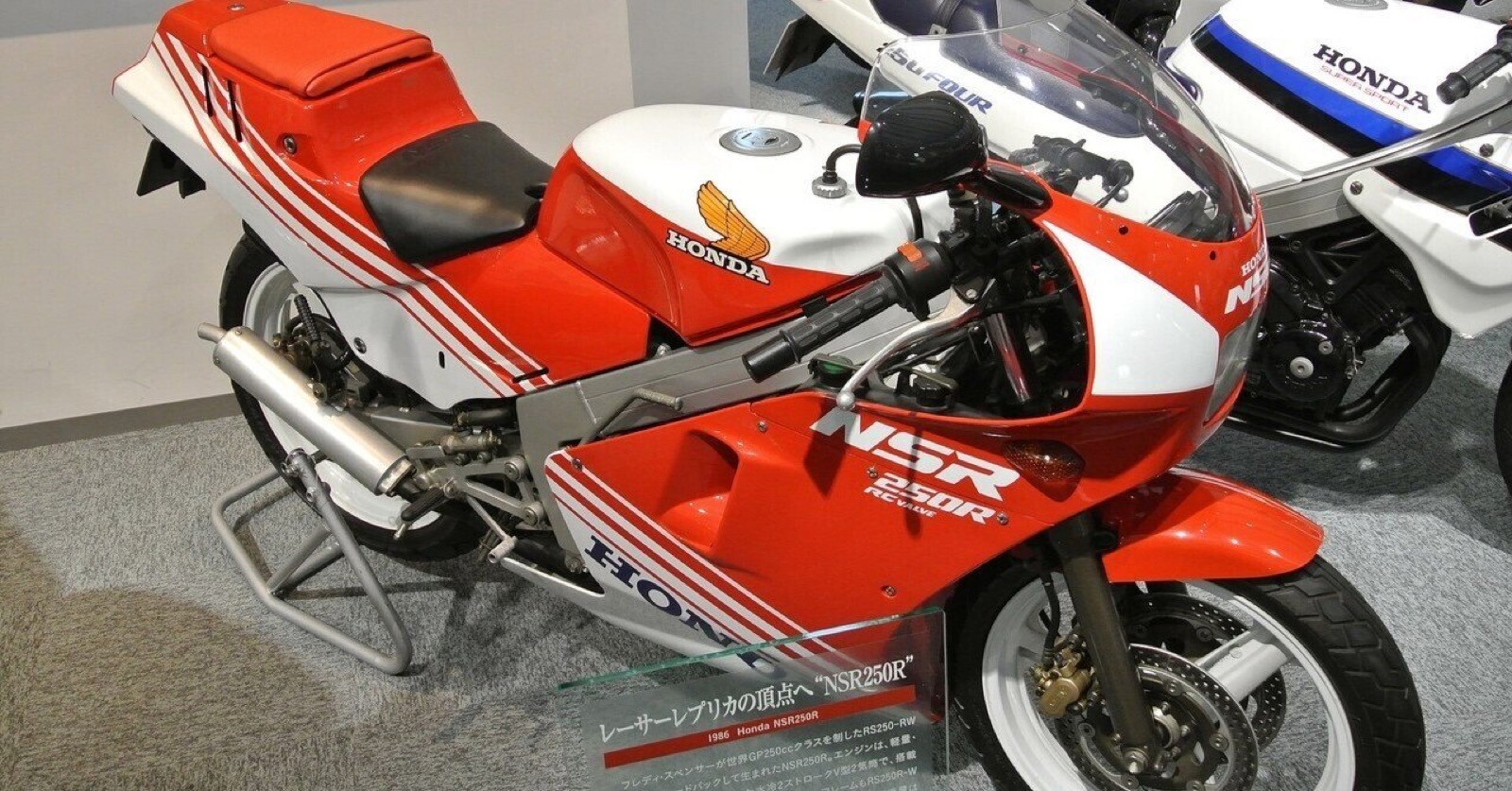
Honda had already introduced the NS250R, a two-stroke 250cc sport bike. Its successor, the NSR250R, arrived in 1986 and made a stronger connection to technology developed in the World Grand Prix. Honda positioned it as a two-stroke supersport with a 90-degree V-twin, incorporating technology from World GP road racing.
The Grand Prix racer and the street bike did not share the exact same machine just because both carried the name NSR. A race bike was built around competition rules; a road bike had to meet different requirements for safety equipment, mass production, and durability. Even so, the two were closely linked through their engine concepts, development goals, colors, and shared identity. Riding the production bike offered a way to experience the technology and stories of racing.
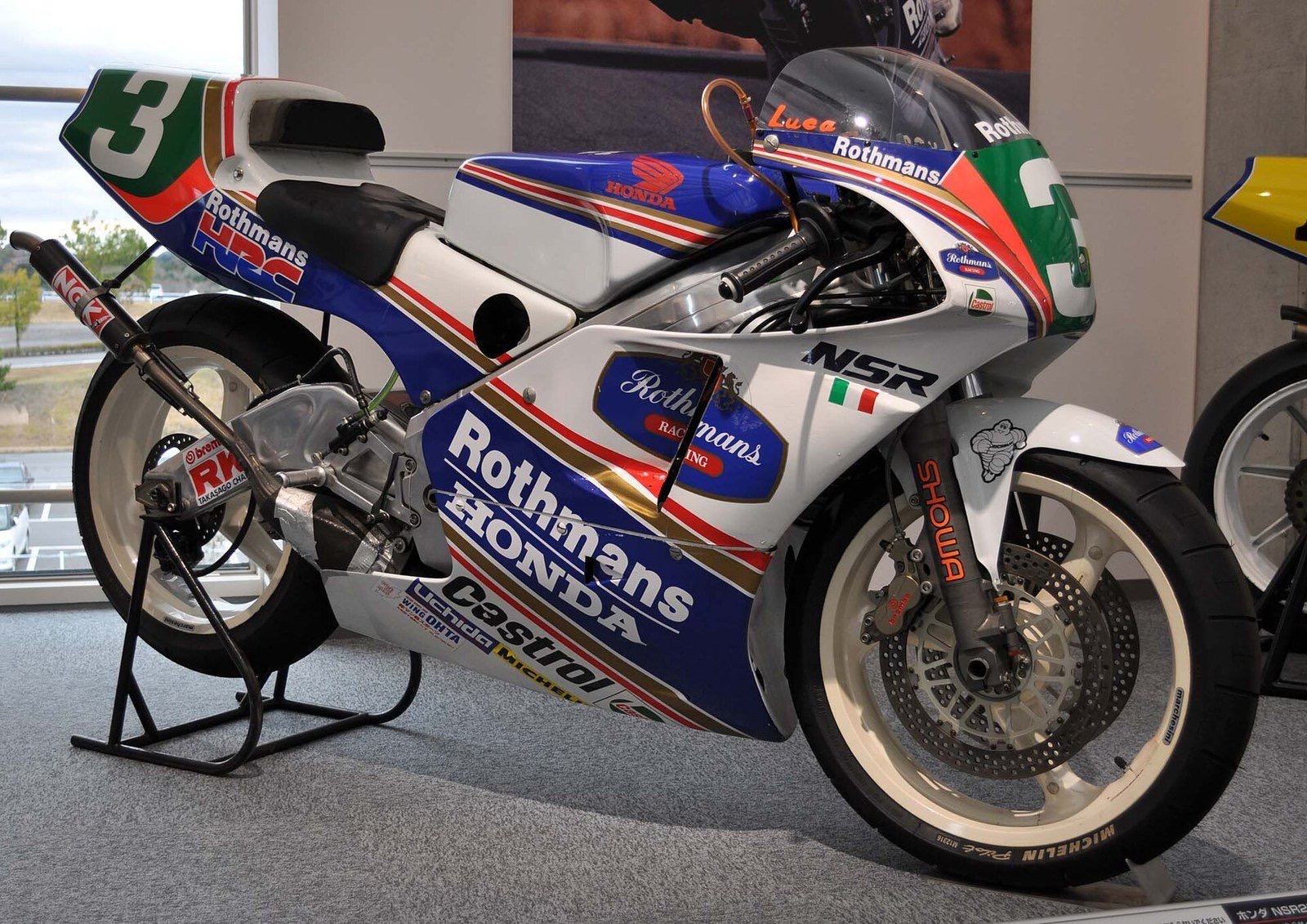
The success of Grand Prix machines also spurred development in road sports bikes. Honda’s NSR250, raced in the WGP 250cc class, was a competition machine built around low weight, cornering agility, and the sharp power of a two-stroke engine. By carrying the same series name, the production NSR250R translated that racing effort for street use.
Race replicas were special for more than their performance figures. They let owners feel closer to the world of racing. Full fairings, graphics that recalled race numbers, and the names of racing riders all helped. Motorcycle magazines covered new production models and racing on the same pages, connecting the circuit and the street as parts of one culture.
Chapter 2 — MC16: Where the NSR250R Began
The first NSR250R carried the model code MC16. Introduced in 1986, it was powered by a liquid-cooled, two-stroke 90-degree V-twin. Placing the cylinders in a V helped Honda balance engine width and center of gravity while targeting the power needed for sport riding. An aluminum frame completed the package as a serious sport bike in the 250cc class.
A two-stroke engine has a combustion stroke with every crankshaft revolution. Its layout is relatively simple compared with a four-stroke, making low weight and high output easier to pursue. But combustion and exhaust are harder to control, and fuel economy, emissions, and noise can be challenging. When the engine enters its power band—the rev range where it accelerates strongly—its character can seem to change all at once.
To make a street-going two-stroke easier to manage, engineers had to consider the exhaust flow as well as the fuel-air mixture. The NSR250R’s engine used an RC Valve system with variable exhaust timing. It adjusted how the exhaust ports worked at low and high revs, shaping power across a wider range. The system helped make the changing nature of a two-stroke more manageable, from city streets to high revs.
The first MC16 did not have the complex electronics of later models. But it established the NSR250R’s defining direction: a V-twin, an aluminum frame, and an RC Valve. The goal was not just speed on a racetrack; riders also had to be able to use that performance on the road. The first model laid a foundation that could be developed further, generation by generation.
In the mid-1980s, manufacturers were competing fiercely with two-stroke race replicas in the 250cc class. Riders compared more than model names and claimed peak horsepower. They looked at weight, cornering behavior, and the rev range where the engine delivered its power. The NSR250R was not a finished product that appeared fully formed at launch. It became a model revised year after year in the heat of competition.
Chapter 3 — MC18: Electronics Refine the Ride
The MC18, introduced as a 1988 model, brought a major advance in engine control. The key was an electronic system called PGM. The 1989 model moved to PGM-II and also adopted PGM carburetors, with computer assistance for the carburetors. PGM was Honda’s name for its electronic control systems. Using sensor data, it adjusted fuel delivery, ignition, and the operation of the exhaust system. This generation made clear that electronics could manage the characteristics of a two-stroke engine in finer detail.
The word “carburetor” may bring to mind a purely mechanical device. PGM carburetors retained the basic functions of a conventional carburetor while adding computer assistance. The system controlled fuel delivery in response to engine speed and throttle position, shaping power to suit riding conditions. Electronics were brought in to balance performance with ease of use.
On the MC18, electronic control expanded to include the ignition system and RC Valve. That made it possible to tune the engine’s behavior more precisely across its rev range. This was not the same technology as today’s fuel-injected engines. It was a system of the time, combining carburetor-based fuel delivery with adjustments from sensors and a control unit.
The styling and chassis were revised as well, and details varied by year and specification. The distinctions between 1988 and 1989 models, nicknames, and domestic and export versions became a subject of close attention among NSR fans. When comparing used bikes or photographs, it helps to check frame numbers and component configurations, not just paint schemes. “MC18” does not mean every bike was sold in exactly the same form.
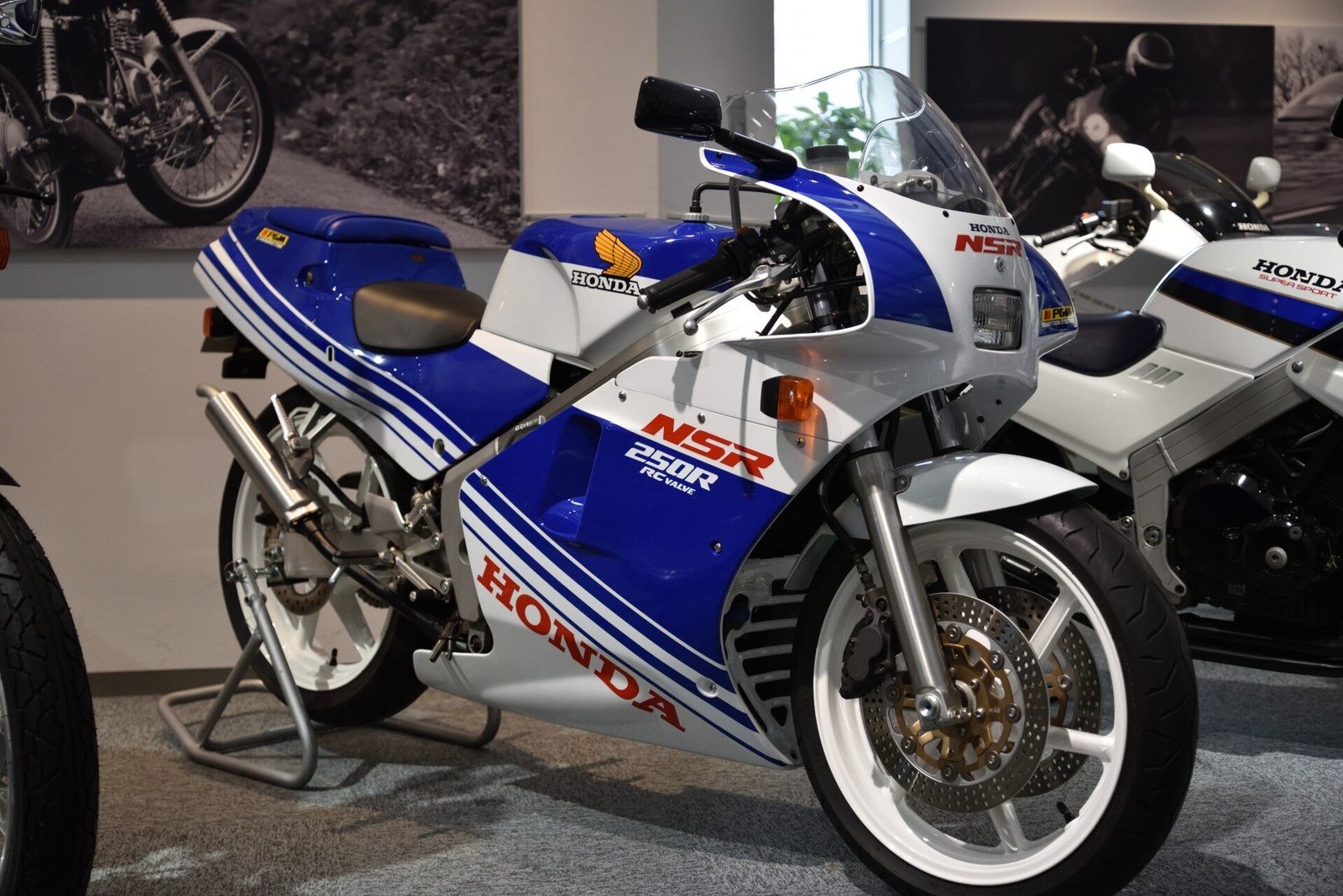
The MC18’s significance was not simply a higher output. Honda integrated electronic controls to make the sharp power of a two-stroke easier for the rider to use. At the same time, emissions and fuel economy were becoming more pressing concerns. Electronics were a way not only to pursue speed, but also to manage the engine’s complex behavior.
In the race replica world, people often focus on visible details such as the fairing and frame. But the riding experience also depends on controls that are harder to see: moving valves to match the rev range, adjusting ignition timing, and delivering fuel in response to the throttle. The MC18 signaled the start of an era in which mechanical and electronic systems worked together to shape the ride.
Chapter 4 — MC21: The Gull-Arm and a More Refined Package
Introduced as a 1990 model, the MC21 brought further revisions to the chassis. Its rear swingarm was an asymmetrical “Gull-Arm.” Viewed from the side, it bends in an arch, a design that takes into account the surrounding parts, including the chain and exhaust system. Its distinctive shape became one of the features that set later NSR models apart.
Engine control advanced to PGM-III. Over successive generations, PGM developed its ability to respond to the engine’s condition. The MC21 refined the balance between engine character and chassis, pursuing not just speed but a more manageable ride. Honda worked on the complete sequence of entering a corner, changing direction, and driving out of it, including chassis rigidity, suspension, and brakes.
Some model years offered SE and SP versions alongside the standard model. Equipment and character varied, with differences in brakes, suspension, dry clutch, and colors. Names and specifications differed by year and market, so it is not safe to assume that every MC21 had the same equipment. Even today, when discussing a bike, it’s important to check its year and actual components rather than identify its specification by the “SE” or “SP” label alone.
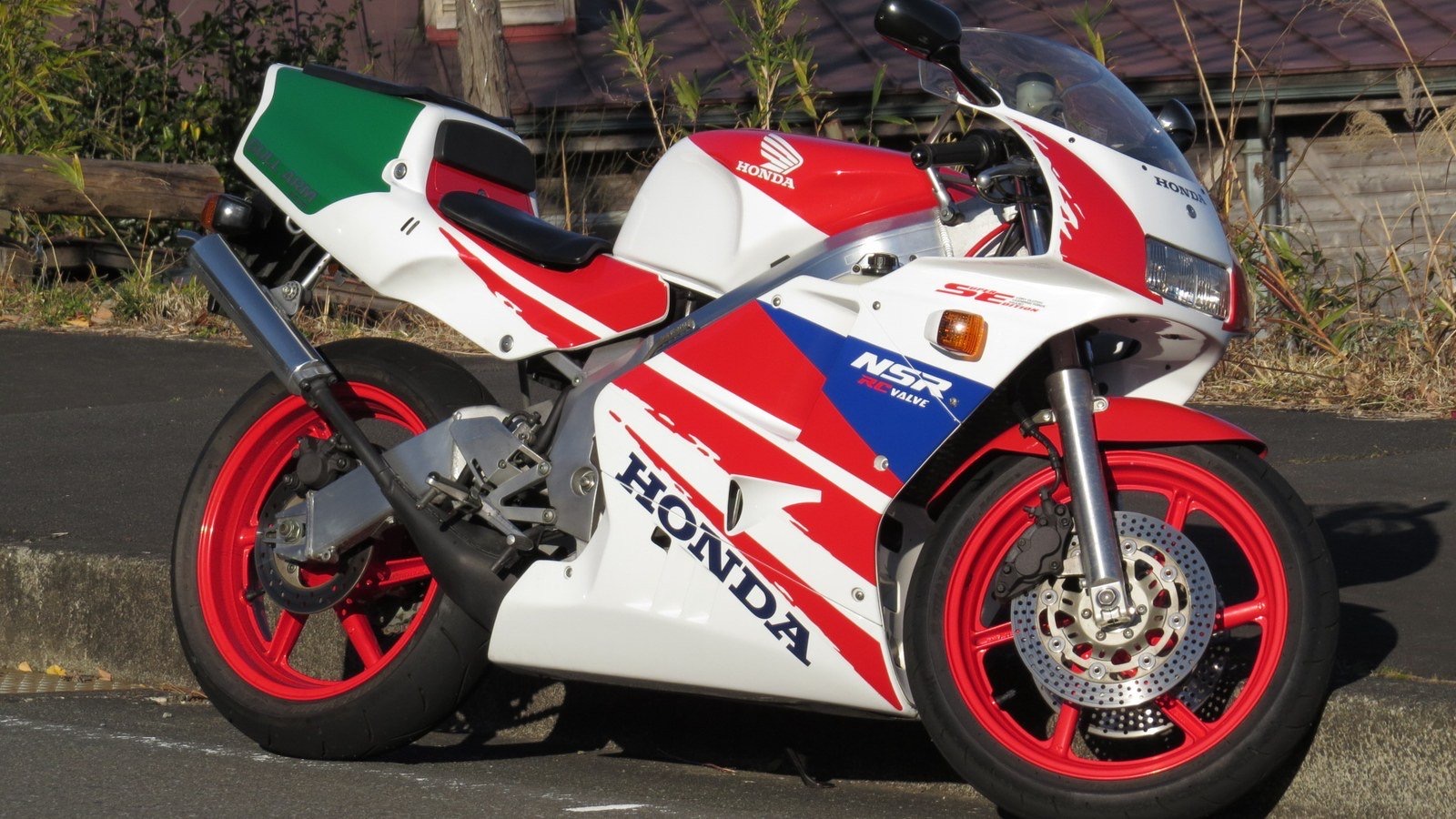
The MC21 arrived as the race replica contest was reaching maturity. The focus was shifting from adding new technology for its own sake to applying what Honda had learned from earlier generations and refining the character of the whole bike. A frame that could handle the engine’s instant response, a swingarm that shaped the rear wheel’s movement, and a riding position that carried the rider’s input: the balance of the whole package mattered more than any one part.
Meanwhile, the environment around two-stroke bikes was beginning to change. Meeting emissions regulations was becoming more difficult year by year, and manufacturers were expected to develop complete vehicles with fuel economy and environmental performance in mind. Meeting the rules while retaining high performance called for finer control of combustion and exhaust. The MC21’s refinement was not only an effort to go faster; it was also an attempt to face the challenges ahead.
Chapter 5 — MC28: Pro-Arm and Card Key
Introduced in 1994, the MC28 is known as the final generation of the NSR250R. The most visible change was its single-sided Pro-Arm swingarm. Supporting the rear wheel from one side brought to mind Honda’s endurance racer, the RVF, and transformed the NSR250R’s appearance. It also gave the bike a distinctive look and made wheel removal a different proposition.
Engine control advanced to PGM-IV. The electronic control unit managed the engine, including ignition and the exhaust system. It carried the series’ goal of making two-stroke power easier to use through to its final generation. As stricter emissions regulations loomed, control precision became important to both performance and environmental compliance.
The card key is one of the MC28’s signature features. Instead of a conventional metal key, it used a dedicated card to activate the PGM unit. Carrying the card, inserting it into the bike’s reader, and starting the engine felt remarkably advanced at the time. Because the card and control unit worked as a pair, this was not a system where simply duplicating a key was enough.
The card key brought a sense of convenience and cutting-edge technology, but it can also complicate ownership today. Owners of an older electronic bike have to consider a lost card, a failed PGM unit, and parts availability. Rare specifications can require specialist knowledge to source parts or make repairs. It remains an appealing feature, but maintaining the bike calls for careful checks.
The MC28 also came in standard, SE, and SP variations. The SP is known as a more sporting version, with features such as a dry clutch and special colors, but equipment and naming vary by year. When buying or inspecting one, check the individual bike’s frame number, engine, suspension, and card key rather than relying on its bodywork alone.
The MC28 represented one destination for two-stroke 250cc sport bike technology: sophisticated engine control, a single-sided swingarm, and a dedicated card key. It was a road-going production bike that eagerly adopted the latest technology. At the same time, tighter emissions regulations and changes in the market were making it harder to keep building high-performance two-strokes like this.
Chapter 6 — The Link to the Grand Prix Racer
The NSR250R’s name has its roots in Honda’s road racing program. In the World GP 250cc class, racers paired lightweight chassis with sharp two-stroke engines. Honda contested titles with the NSR250, carrying experience gained by riders and engineers on the circuit into the next round of development.
The production NSR250R did not simply use the same parts as the race bike. A competition engine had different durability and service interval requirements, and it did not need the same ease of use on public roads. Production bikes, meanwhile, had to meet requirements for lights, emissions, and noise. Their design goals were different. Even so, ideas refined in racing found their way into the street bike through the V-twin layout, the RC Valve, and the development of electronic controls.
The term “race replica” also describes a way of turning admiration into a product. A bike could wear the colors of a beloved Grand Prix machine, share its series name, and echo its shape and riding posture. Owners could feel connected to the world of racing as they rode on public roads. People loved the NSR250R for its story as well as its performance.
Chapter 7 — The Two-Stroke Era Comes to an End
Two-stroke engines make it easier to get high output from a lightweight package, but their combustion process makes emissions and fuel economy harder to manage. Their design can allow unburned fuel-air mixture to escape through the exhaust port, so meeting regulations requires careful work on combustion, exhaust, and control. Even as electronic controls advanced, the development effort needed to combine high performance with stricter environmental standards kept growing.
At the same time, four-stroke engine performance and control technology were advancing. Fuel injection and exhaust-cleaning technologies became more common, and sport bikes gradually shifted toward four-strokes. Market preferences changed, too, and manufacturers revised their lineups to suit regulations and sales conditions. The decline of high-performance two-strokes came from changes in technology and the market as well as from regulation.
The NSR250R series received no new model after the MC28. Pinning its end of production to a single year can obscure differences between markets and final specifications, but no road-going successor to the NSR250R appeared after the mid-1990s. The race replica boom cooled, and ideas about what made a high-performance bike changed as well.
Still, the NSR250R’s place in motorcycle culture did not fade. Its lightweight chassis, two-stroke acceleration, the sound of the RC Valve operating, and the differences between generations are still talked about. Its fans include people who remember it as a new bike and riders who discovered it later. Parts and maintenance have become more difficult, but people continue to preserve and restore these machines.
Chapter 8 — Why It Still Captures People’s Imagination
Nostalgia alone cannot explain the NSR250R’s popularity. From the MC16 through the MC28, the same model name spans four distinct periods of technology, giving riders the pleasure of choosing a generation to suit their taste. The early model’s nimble feel, the MC18’s electronic controls, the MC21’s refinement, and the MC28’s Pro-Arm and card key all have a story to tell.
The feel of a two-stroke engine is also different from that of a modern bike. The relationship between revs and the power band, the exhaust note, the smell of oil, and the response to throttle input all make the machine’s character easy to feel directly. Of course, older bikes can fall short of modern ones in ease of use and environmental performance. Keeping one in good condition also takes specialist knowledge and access to parts. Some riders find the appeal in that work as well as in the experience of riding an older sport bike.
When comparing preserved bikes or used examples, it’s important not to judge by paint alone. Model code, year, frame and engine numbers, the condition of the PGM or card key, and modifications can all affect a bike’s value and maintenance prospects. On an older two-stroke, wear items, electrical components, and the engine’s internal condition also need checking. The more historically desirable a bike is, the more carefully its individual condition deserves to be assessed.
The race replica boom was never just a craze for speed. It was a culture in which racing technology reached production bikes and riders could draw closer to the world they admired. The NSR250R carries the energy and technology of that era in one machine. Even in a garage or museum, looking at the bike can reveal, beyond its colors, the racers that lapped the circuit and the work that went into its development.
Epilogue — Keeping the Two-Stroke Memory Alive
The NSR250R was more than a bike that brought two-stroke speed to public roads. It was a series that carried the foundation laid by the MC16 into the MC18’s electronic controls, the MC21’s chassis refinement, and the MC28’s advanced features. Follow the changes from one generation to the next and you can read not only the story of engines and frames, but also the performance demands and regulations of each era.
The World GP NSR250 and the production NSR250R served different purposes, yet they were linked by technology and aspiration. Racing speed was translated into a street bike, letting riders feel part of that story on city streets and mountain roads. That relationship helped build the culture of the race replica.
Even now, when new two-strokes have all but disappeared, the NSR250R is not a relic of the past. As long as people maintain these bikes, document them, and pass them on, their mechanical memory lives on. Look at the small control unit behind the fairing or the card key that anticipated its time, and you can glimpse the future the engineers once imagined.
Photo credits
- Header image, “Honda NSR250R in the Honda Collection Hall” — Rainmaker47 (cropped) / Wikimedia Commons / CC BY-SA 3.0 (https://creativecommons.org/licenses/by-sa/3.0)
- “Honda NSR250R 1988” — Rikita / Wikimedia Commons / CC BY-SA 4.0 (https://creativecommons.org/licenses/by-sa/4.0)
- “1991 Honda NSR250R SE” — Y Sekiai / Wikimedia Commons / CC BY-SA 3.0 (https://creativecommons.org/licenses/by-sa/3.0)
- “Honda NSR250 1991” — Rikita / Wikimedia Commons / CC BY-SA 3.0 (https://creativecommons.org/licenses/by-sa/3.0)