The Little Box at Your Feet That Became the World Standard: BOSS Compact Pedals
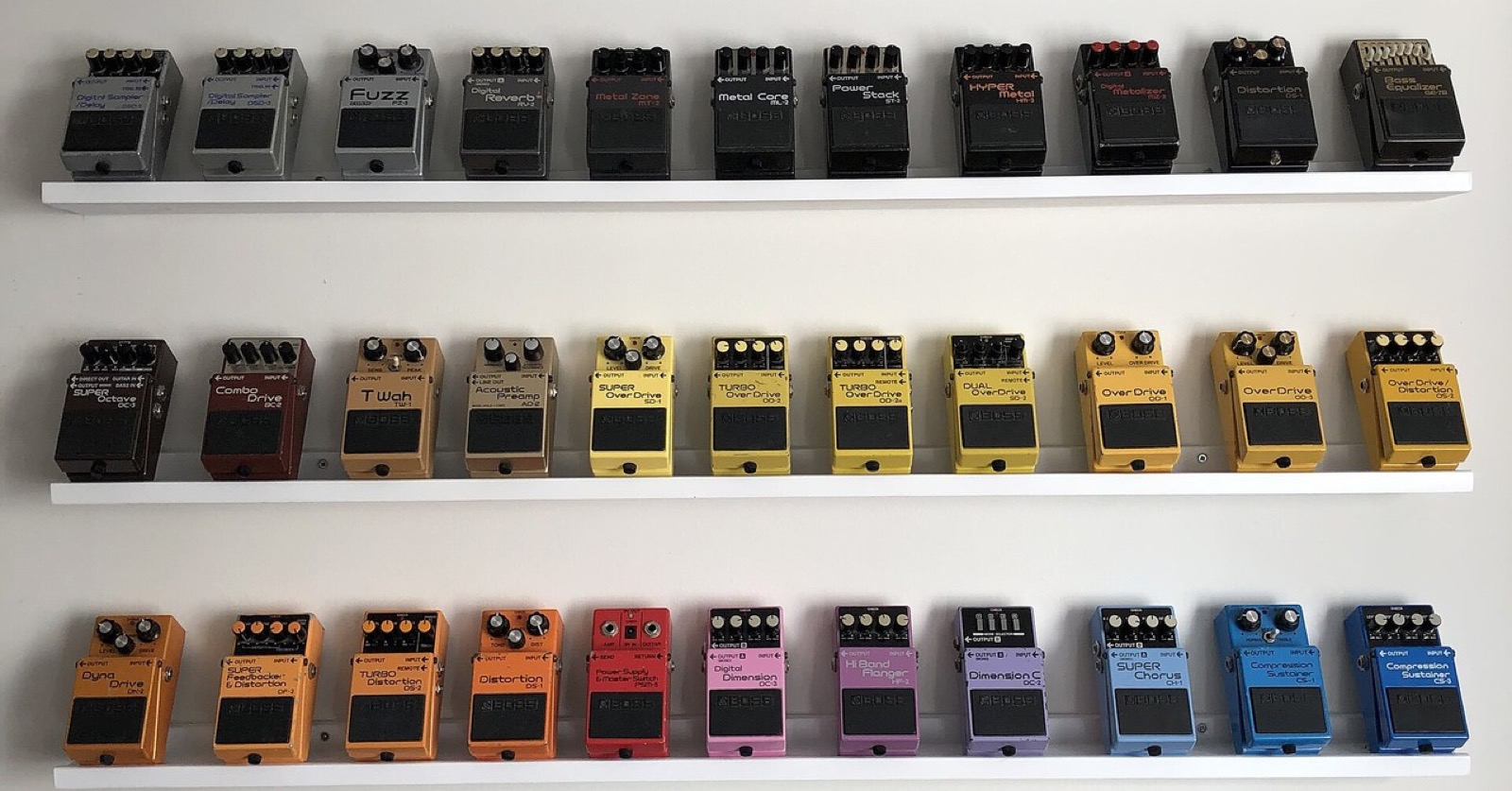
☕ A coffee-length story — about a 15-minute read. This is the tale of a palm-sized box that has been made in almost exactly the same shape since 1977.
Prologue — Colourful Boxes on a Music Store Wall
Picture the effects section of a music store. Along the wall runs a row of small boxes, all the same shape.
Yellow, orange, light blue, white, purple, green. The colours are all over the place, but the shape is identical: a metal box small enough to sit in your hand, with a big pedal at the front and a row of knobs at the back.
These are BOSS compact pedals.
If you play guitar, you have almost certainly stepped on one at some point. You'll find this shape on the floor of small clubs, on the pedalboards of world-famous guitarists, and in the clubroom of a high school band.
What's remarkable is that the shape has barely changed since 1977. A box designed nearly fifty years ago is still being made exactly as it was — and pedalboards around the world came to be sized around it.
This is the story of how a small development team in Japan created a “standard” for the space at a guitarist's feet.
Chapter 1 — When Effects Were Big and Awkward
The guitarist's floor in the early '70s
In the early 1970s, the floor at a guitarist's feet was a much less convenient place than it is today.
Many effects units were large and heavy. Some ran off a household wall socket; others used batteries, and changing the battery meant unscrewing the bottom plate with a screwdriver. Pedals that made a loud “click” or “pop” when you stepped on them were nothing unusual.
Every maker had its own size, its own shape, its own way of connecting things. Try to line several up on stage and the floor filled with boxes and cables.
An effects company born inside Roland
In 1972, an electronic instrument company called Roland was founded in Osaka. Roland quickly began making guitar effects as well: the AS-1 Sustainer for longer notes, a fuzz with the cheerful name AF-100 “Bee Baa,” and the AP-7 Jet Phaser, which swirled the sound like a passing jet. One after another, these pedals came out between 1972 and 1974.
But the pedals of this era all came in different shapes and sizes. And inside Roland, effects were just one product among many. The idea grew that guitarists' feet deserved a dedicated team of their own.
In the spring of 1973, a company specialising in effects and guitar products was set up in Osaka as Roland's research and development arm. Its name was MEG Electronics — the initials of “Music Engineering Group.”
The name “BOSS”
But it was felt that “MEG” might not strike much of a chord with guitarists. Something with more punch was needed.
The choice was BOSS. Short, strong, and readable in any country.
In 1974, the first product bearing the BOSS name and logo came out for the American market: the B-100, a pickup and preamp for acoustic guitars. It was made in small numbers and sold only in the U.S.
The company itself was later renamed “BOSS Corporation” in 1979.