The Tube Guardians Who Kept the Airwaves from Overloading — Gates Sta-Level, RCA BA-6A and Altec 436C
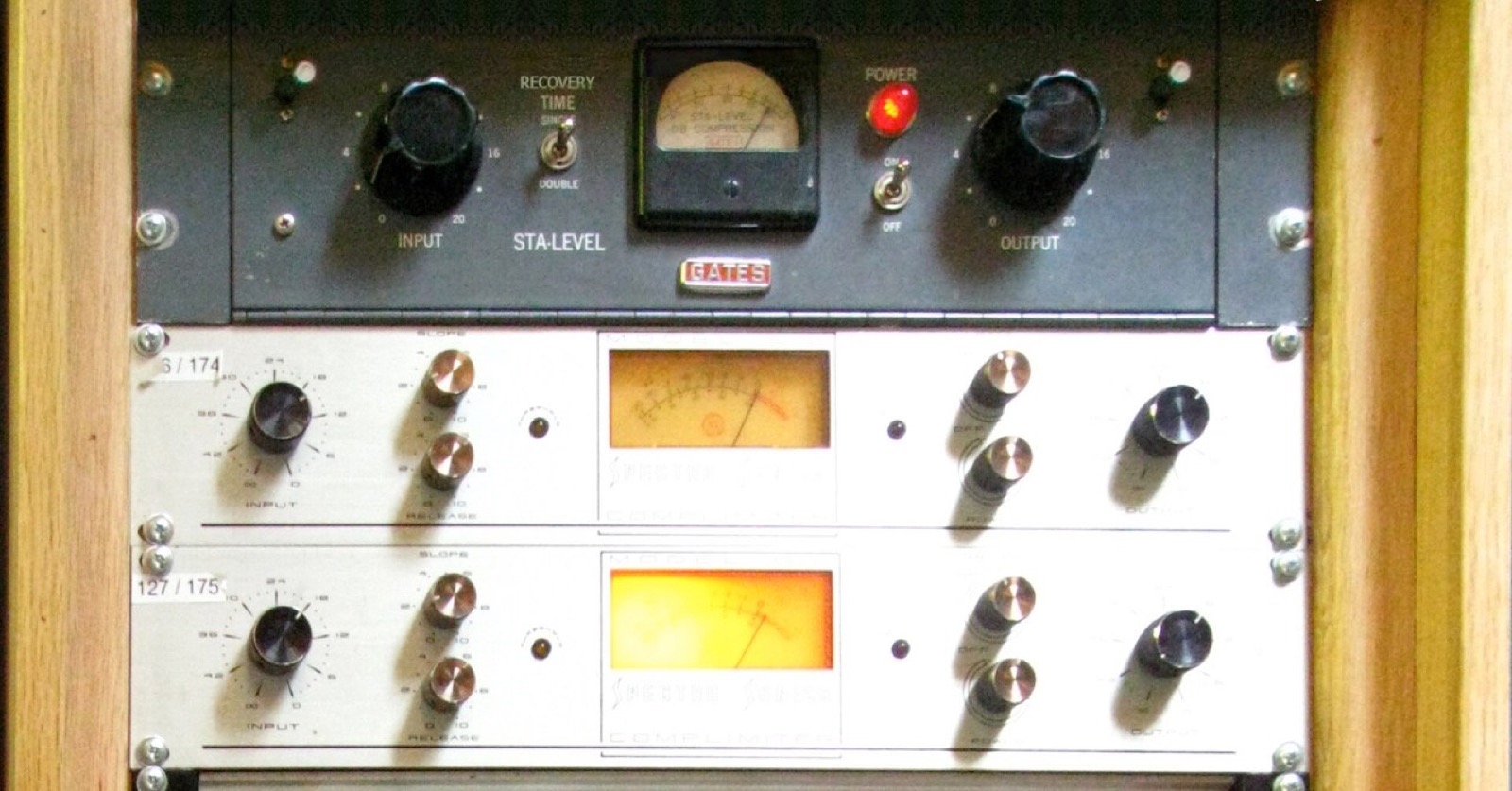
☕ A coffee-length story — about a 10-minute read. Enjoy this as a story, not a research assignment. Many pieces of gear now called “vintage classic compressors” in studios were born as safety devices for radio stations, not as music tools.
💡 What you’ll learn
- Why 1950s radio stations needed “guardians” to control volume
- How variable-mu tubes smoothly turn down the level
- What makes the Sta-Level, BA-6A and 436C distinctive, plus four tips for using them as plugins today
Prologue — The Night the Needle Hit the Stop
Imagine a night like this.
It’s 1950s America. A late-night live broadcast is underway at a small-town radio station.
The announcer at the microphone suddenly bursts into loud laughter. At that instant, the meter in the machine room swings hard to the right and hits the stop.
The engineer clicks his tongue in frustration.
When a voice gets too loud, the signal can “overflow” the airwaves. The broadcast distorts, and sometimes it even interferes with stations on neighboring frequencies.
But an engineer can’t keep a hand on the volume knob all night.
“If only there were a machine that could gently turn down just the loud moments, automatically.”
That wish gave rise to the vacuum-tube broadcast limiter.
📝 About this story
This is a narrative based on books I’ve read, documentation for the original equipment, trade magazines, and dealers’ explanations. I’ve tried to stick to the facts. References are listed at the end.
Chapter 1 — Why Radio Stations Needed a Guardian
Radio waves have a ceiling
Radio signals have a defined range. The louder the sound, the more the signal swings, but it must stay within that range.
Going beyond it is called overmodulation. When that happens:
- The broadcast distorts.
- Stations on neighboring frequencies can suffer interference.
That’s a problem.
Limiters and compressors
Radio stations installed two kinds of equipment:
- Limiter: holds the signal down so it doesn’t exceed a set level.
- Compressor: turns loud sounds down a little, reducing the difference between loud and quiet sounds.
Both automatically lower the volume when the sound gets too loud.

For a radio station, this wasn’t a tool for adding musical “color.” It was a safety device that protected the broadcast.
Chapter 2 — Changing Level with Variable-Mu Tubes
A curious property of vacuum tubes
Many 1950s broadcast limiters controlled level with vacuum tubes.
A tube’s amplification changes when you change the voltage applied to a part called the “grid.” Tubes designed to make that change gradual are called remote-cutoff tubes, or variable-mu tubes.
Mu (μ) is a symbol for amplification. Variable mu means the mu can be varied.
When a loud sound arrives, change the voltage
Here’s how it works:
- Take a portion of the incoming audio and monitor its level.
- As the sound gets louder, change the voltage applied to the tube accordingly.
- The tube’s gain drops, gently lowering the volume.
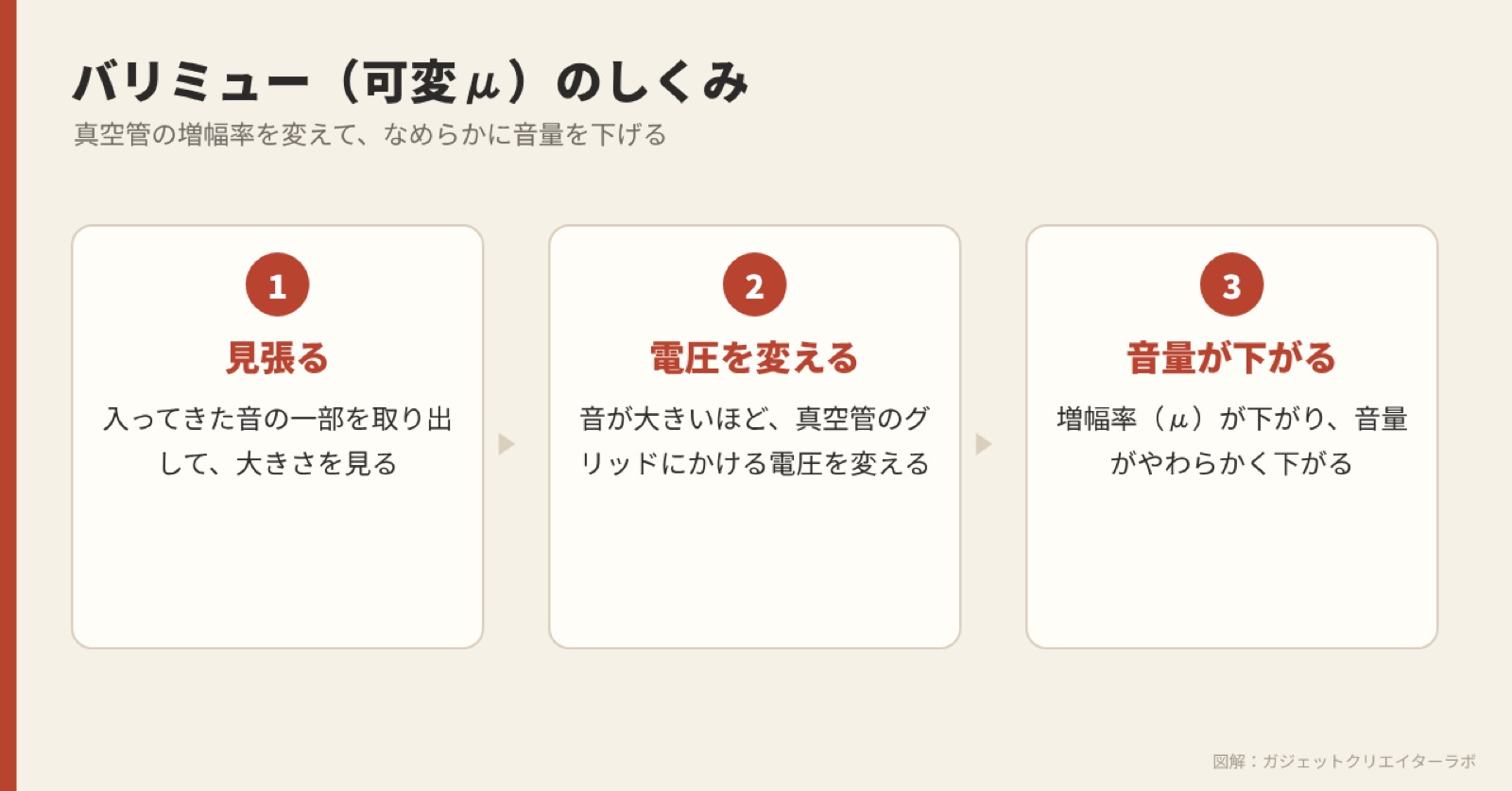
Because the tube’s own characteristics let it change level smoothly, variable-mu compressors are said to have:
- A soft, gradual response to level changes
- A sound that stays natural, even under heavy compression
That’s why they would later become beloved in music.
The 6386 tube
One variable-mu tube commonly used in broadcast limiters was the 6386, developed by General Electric (GE).
In 1955, GE’s broadcast equipment division built the BA-9B, nicknamed the “Uni-Level,” a limiter using the 6386. It worked well, but had very few controls. The input and output levels were set with resistors on an internal terminal strip—a notably no-frills design.
Chapter 3 — Gates Sta-Level: A Broadcast Workhorse
1956, Quincy, Illinois
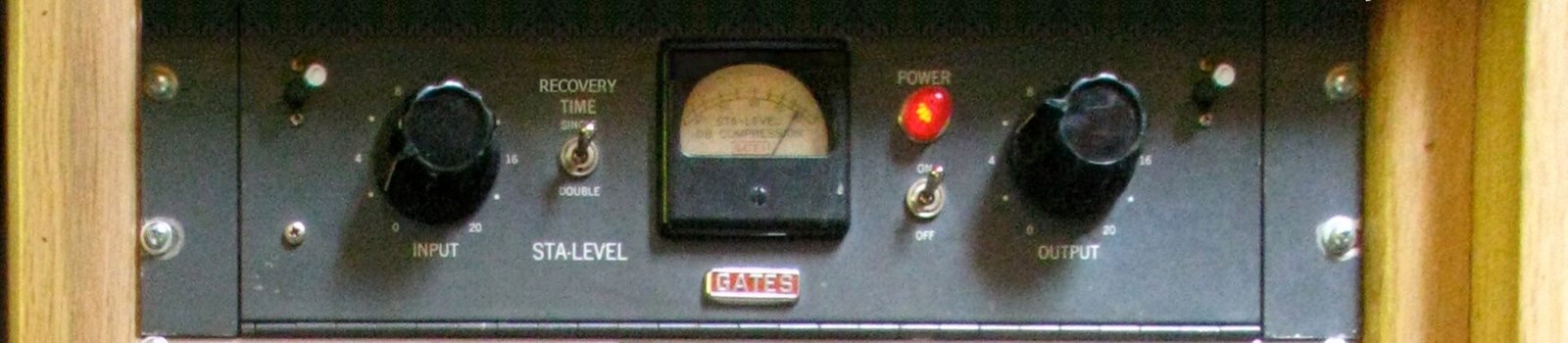
The year after GE’s Uni-Level, in 1956, Gates Radio, a broadcast equipment maker in Quincy, Illinois, introduced a machine of its own.
The Sta-Level. Its model number was M5167.
It was an automatic gain-control amplifier designed to keep broadcast audio at a steady level.
A more usable guardian
The Sta-Level’s front panel had:
- Input and output controls
- A single/double switch to choose how quickly the level recovered after being turned down
- A large meter showing the amount of gain reduction, up to 45 dB
- A power switch
Compared with the Uni-Level, this was a machine you could really operate.
Turning it down “slowly, and a lot”
The Sta-Level excelled at turning loud sounds down slowly and deeply. It could smooth the changing levels of a voice or an entire program, like a broad, relaxed hand evening things out.
That “deep yet natural” character would later make it useful for recording vocals and bass. An era would arrive when Sta-Levels were pulled from radio station storerooms and placed on studio racks.
Chapter 4 — RCA BA-6A and Altec 436C
RCA BA-6A — Nine tubes
RCA, a major radio and television company, also built limiters for broadcasters. One of them was the BA-6A.
According to RCA documentation, the BA-6A:
- Was used ahead of the transmitters for AM and FM radio, as well as television audio
- Automatically kept audio peaks from exceeding a preset level
- Used three balanced amplifier stages and nine vacuum tubes, including rectifier and voltage-regulator tubes
It was designed to work without specially selected tubes, another notable feature: it used readily available tube types.
The BA-6A appeared around 1951 and is often discussed as a variable-mu unit using the 6386.
Altec 436C — A compressor for public-address systems

Another machine that remains popular today is the Altec 436C.
Altec was an American maker known for speakers used in theaters and movie houses. The 436C was a variable-mu compressor built for public-address systems in places such as halls and factories.
The 436C had a couple of quirks:
- The harder you compressed, the louder the output could become.
- The original circuit had no output control.
So people using one today make adjustments, such as adding an external component to lower the level. It isn’t perfect, but people love the thick sound it produces under heavy compression.
Names with little surviving documentation
Other makers of tube broadcast limiters included Federal and Langevin. Since little documentation survives for either, I’ll leave it at the names here.
Chapter 5 — Using These Broadcast Guardians Today
Plugins based on the Sta-Level, BA-6A and 436C, as well as reissued hardware, are available today. Here are a few tips for using these “broadcast-born” variable-mu compressors.
1. “Go deep, stay natural”
Variable-mu compressors are known for staying smooth even when you compress deeply. On vocals, try enough compression to show about 5–10 dB of gain reduction on the meter. It can even out level differences and bring the voice forward.
2. Start with a “slow” recovery
Broadcast machines were generally set for a slow recovery. If recovery is too fast, the level can seem to breathe—“whoosh, whoosh.” Start on the slower side, then adjust to fit the tempo.
3. Watch the output level
Some machines, like the 436C, can get louder as you compress more. After the compressor, be sure to match the output level before comparing the sound with and without compression. That keeps you from falling into the trap of assuming the louder version sounds better.
4. Use just a touch on the whole mix
Broadcast limiters were originally designed to work on an entire program. If you’re using one across a whole song, a little is enough—just 1–2 dB of meter movement.
Epilogue — When a Safety Device Became an Instrument
These tube guardians spent their nights watching levels so the signal wouldn’t overflow the airwaves. They weren’t built to make music sound beautiful.
But people making music eventually discovered the appeal of their smooth, tube-based way of turning down the level: a sound that could feel “thick and gently held together.”
From radio station storerooms to studio racks. That was the moment a safety device became an instrument.
The next time you hear a voice that sounds thick, smooth, and cohesive, remember: somewhere in its sound may be the bloodline of a tube guardian that once watched a meter in a late-night radio station.
A Timeline of Tube Broadcast Limiters
- Around 1951: The RCA BA-6A appears.
- 1955: GE builds the BA-9B “Uni-Level,” a limiter using the 6386.
- 1956: Gates Radio introduces the Sta-Level (M5167).
- 1950s–1960s: Variable-mu compressors such as the Altec 436C are used in public-address systems and at radio stations.
- Later: Equipment retired by broadcasters begins to be used as “classic compressors” in recording studios.
- Today: These designs are available again as plugins and reissued hardware.
References
- Telos Alliance, “Vintage Audio: The Sta-Level Turns 60”
- History of Recording, “RCA BA-6A Limiting Amplifier” (RCA documentation)
- Preservation Sound, “Altec 436C style compressor build,” and others
- Vintage King, “RCA BA-6A” product description
- Related reviews in Sound On Sound
Photo credits
- Header image, “Comp. rack (Supernatural),” by eyeliam from Portland, United States (cropped) / Wikimedia Commons / CC BY 2.0
- “Gates Sta-Level - Comp. rack (Supernatural),” by eyeliam from Portland, United States (modified by Clusternote) / Wikimedia Commons / CC BY 4.0
- “Altec 436c Compressor Amplifier - Comp. rack (Supernatural),” by eyeliam from Portland, United States (modified by Clusternote) / Wikimedia Commons / CC BY 4.0
License: CC BY 2.0 https://creativecommons.org/licenses/by/2.0/ and CC BY 4.0 https://creativecommons.org/licenses/by/4.0/.
About the illustrations
- All diagrams in this article were created by Gadget Creator Lab.