The SLR That Belonged to Everyone — Canon AE-1
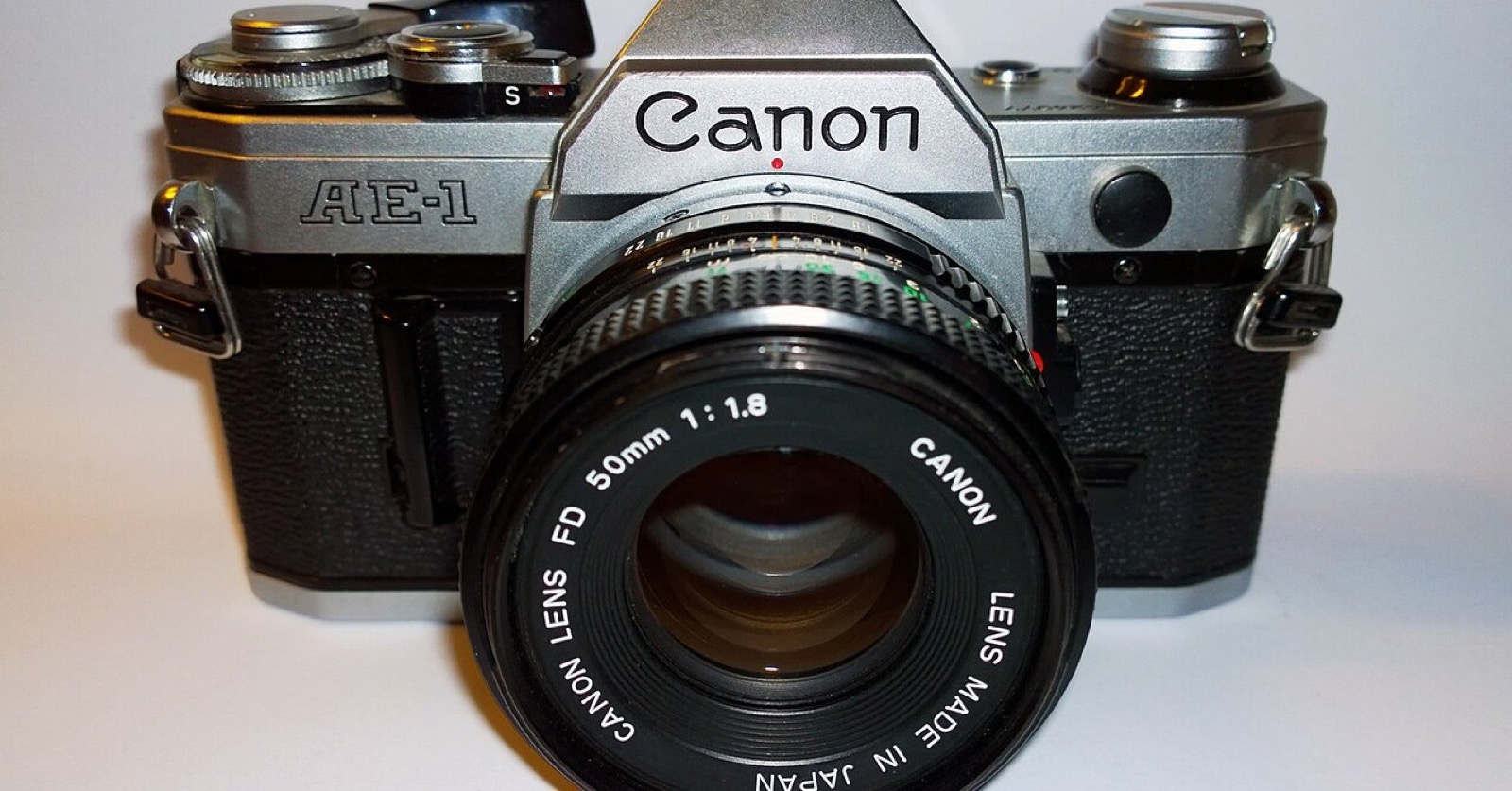
☕ A coffee-length story — about a 20-minute read. A side trip in our camera history series: this time, not a company but a single camera. The Canon AE-1 of 1976, which put a tiny computer inside a camera and turned the SLR into "everyone's tool."
What you will find here:
- What the "X project," launched in the middle of the oil shock, was
- Why putting a microcomputer in a camera made it cheaper to build
- The boom set off by "the continuous-shooting SLR" and a TV campaign
- How the AE-1's sound is still clicking in your pocket today
Prologue — 2026: a camera turns fifty
In the spring of 2026, a camera celebrated its fiftieth birthday.
The Canon AE-1, a 35mm SLR born in April 1976.
A silver top cover and a black body. Pick it up, and it feels a little lighter than it looks. Set the lens aperture ring to the "A" mark, choose a shutter speed on the top dial, and press the shutter button.
"Pashan" — a slightly dry, lively sound.
In just about a year and a half after its launch, this camera reached a million units. The SLR, until then a tool for people who knew a lot about photography, spread all at once into the hands of students and of parents taking family snapshots.
And fifty years on, it still sits on the shelves of used-camera shops and hangs from the necks of young people who have just started shooting film.
Even more interesting, this camera's shutter sound reaches the ears of people who don't own a camera at all, almost every day. Let's save that story for the end.
This is the story of the camera that put a "brain" inside and made the SLR belong to everyone.
Chapter 1 — The oil shock and the "X project"
The SLR was still a tool for experts
The early 1970s. The SLR had already become the flagship product of Japan's camera makers.
But most of them were tools for people who knew photography well. You measured the light with the meter inside the camera, then watched a needle in the viewfinder while setting the shutter speed and aperture yourself. At Canon, manual-exposure SLRs like the "FTb" were the heart of the lineup.
SLRs with "AE" — automatic exposure, where the camera decides the brightness for you — already existed. But they sat toward the top in both features and price, and were not made in large numbers.
The SLR was not yet something anyone could casually buy.
Automatic exposure had already begun
Automatic exposure itself did not start with the AE-1.
In 1965, Konica released the "Autoreflex," an SLR that set the aperture automatically once you chose a shutter speed. Canon itself created a new lens mount, the "FD mount," in 1971. FD lenses were designed with an eye to letting the camera move the aperture automatically.
In 1973, Canon also released the "EF," a shutter-priority auto-exposure SLR using that FD mount. The EF was a solidly built, black-bodied camera for advanced users.
In other words, Canon already had both the automatic-exposure technology and the lenses to make use of it. What it lacked was a way to build it "at a price that could reach a lot of people."
Pay rose more than 35% two years running
Then a great wave hit.
The first oil shock of 1973. Oil prices shot up, and Japan fell into a state of soaring prices called "kyoran bukka" — crazy inflation.
Canon employees' pay is said to have risen by more than 35% two years in a row. For a manufacturer, a sudden jump in labor and material costs is a heavy blow. Keep making cameras the same way, and their prices would only climb. And at higher prices, cameras would stop selling.
How could you make good cameras cheaply, and in large numbers? Within Canon, the answer that grew louder was: "Let's automate the camera."
The "New Model X Development Plan," with over a hundred people
January 1974. Inside Canon, more than a hundred people were gathered across departmental lines. What began was the "New Model X Development Plan."
The goals were clear. Anyone should be able to shoot without failing. And it had to offer high value for money.
An SLR with features for advanced users, yet sold at a price ordinary people could reach. To achieve both, Canon chose a path that changed the conventions of camera making.
Electronic components, precision mechanics, optics, and computers. Canon would combine them and rebuild the "insides" of the camera.