See It the Moment You Shoot — The Casio QV-10, the Original LCD Digital Camera
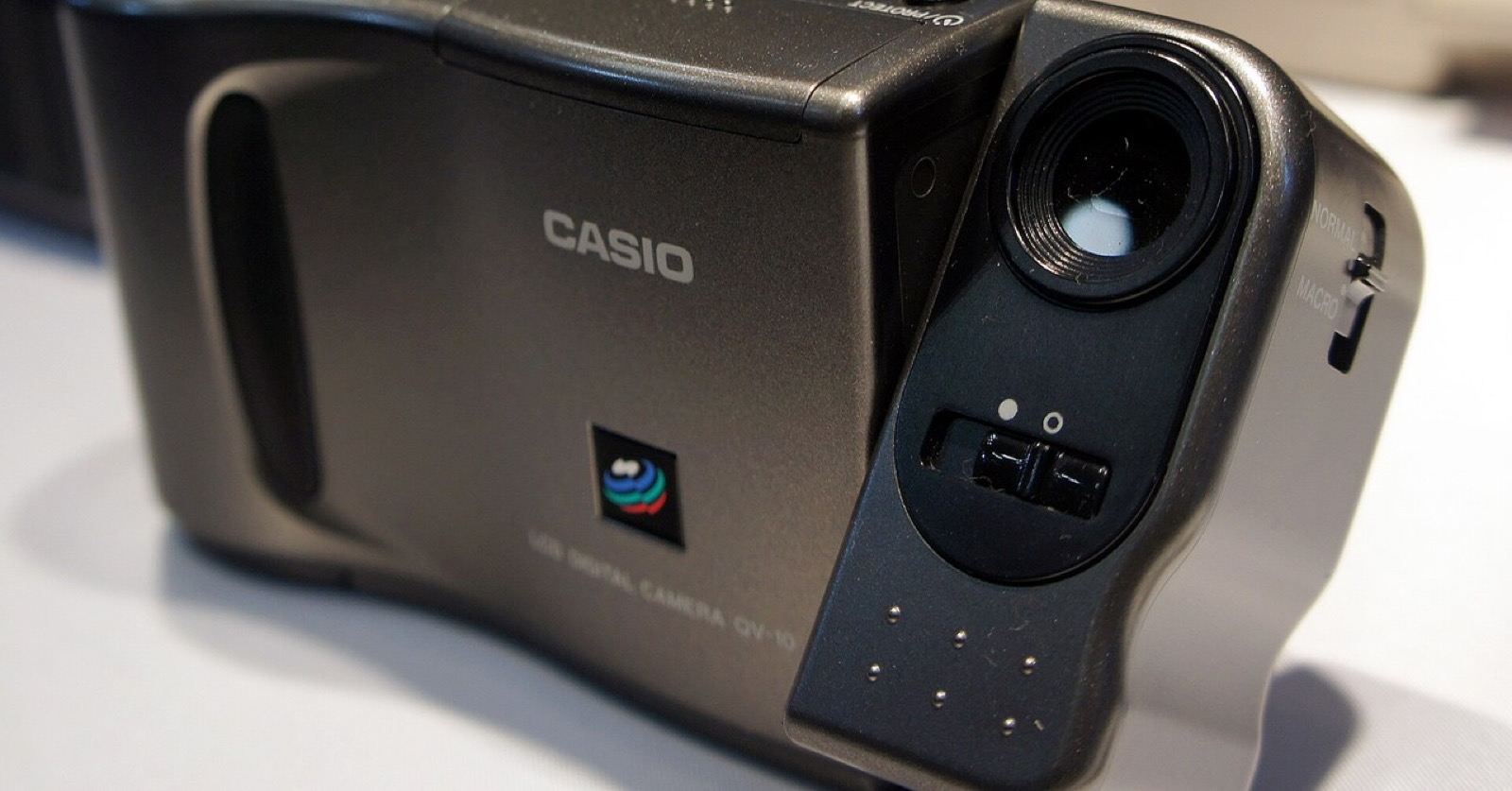
☕ A coffee-length story — about a 20-minute read. A side trip in our camera history series: this time, a single camera. Our subject is the Casio QV-10, a palm-sized digital camera released in 1995 by a company known for calculators and watches — the camera that made "seeing your picture on the spot" something everyone takes for granted.
What you will find here:
- What kinds of "electronic cameras" came before the QV-10
- A camera that did not sell, and a prototype that was "hot and heavy"
- A project that began not as a camera but as a "TV with a camera"
- How a 65,000-yen camera changed the way people enjoy photographs
Prologue — "Let me see"
Spring, 1995. In a corner of an electronics store in Tokyo, an unfamiliar little machine went on display.
A flat silver box that fit in the palm of your hand. There was no lens on the front; instead, at one end of the box was a round section that could swivel. On the back, a small screen, like a tiny television.
Point the lens at someone and press the button, and the picture from that instant appeared on the screen on the back right away.
Today, there is nothing remarkable about that. But for people at the time, it was a small sensation.
Until then, a photograph was something you had to wait for. You finished a roll of film, took it to the photo shop, and came back a few days later to pick it up. Only when you opened the envelope did you find that someone had blinked, or that the focus was off. That was what photography was.
This little machine suddenly reduced that waiting time to zero.
You could show the picture, right there, to the person you had just photographed. "Let me see." "Take another one." People naturally gathered around the camera, and conversations started.
The machine was the Casio QV-10. It was made not by a camera company but by Casio Computer, known for its calculators and wristwatches.
It is said that the QV-10 was the first digital camera ordinary people could buy that had an LCD screen on the back for viewing the pictures you took. It sits deep at the root of the way we enjoy photographs on our smartphones today. And behind its birth lay a camera that did not sell, a hot and heavy prototype, and a little bit of clever thinking.
Chapter 1 — Dreaming of a camera without film
Making pictures with electronics
The dream of taking pictures without film existed long before the QV-10.
In 1975, at Kodak's laboratory in the United States, an experimental camera was built that used an image sensor — a component that turns light into electrical signals — and recorded images onto a cassette tape. But it was a research device, nothing like a product you could sell.
In the 1980s, Japanese manufacturers announced one camera after another of a type called the "electronic still camera." The image received by the sensor was recorded as an analog signal on a small floppy disk and viewed by connecting the camera to a television. After Sony announced its prototype "Mavica" in 1981, many companies began working on this new kind of camera.
The important point is that these cameras were not "digital." They recorded images not as numbers — zeros and ones — but in the form of electrical waves. You could look at them on a TV, but handling them on a computer, or sending them far away as they were, was not easy.
Casio's VS-101
Casio was one of the companies that rode this wave.
In 1987, Casio released the electronic still camera VS-101. It recorded images on a floppy disk, needed no film, and let you see your pictures right away on a television. It was even designed with sending images far away over telephone lines in mind.
The idea was far ahead of its time. But the VS-101 did not sell.
It was about the size of a video camera and cost 128,000 yen. And it could not record video — only still pictures. "It looks like a video camera, but it only takes photos?" For most people, it was hard to understand what the camera was for.
One of the engineers at the center of its development was Hiroyuki Suetaka. After the VS-101 failed, it is said that a mood spread through the company: "Let's give up on electronic cameras."
Chapter 2 — "Hot" and "Heavy"
What if it were digital?
Even so, Suetaka and his colleagues did not give up.
Recording in analog made the images hard to use on a computer. So why not make the image digital — numbers — from the start, and record it in semiconductor memory? Then it could be brought straight into a computer and copied any number of times without degrading.
Casio was not alone in this thinking. In 1988, Fujifilm announced the "DS-1P," a camera that recorded images digitally onto a semiconductor memory card. The following year, Fujifilm put a digital camera on sale in Japan, and in 1990 an American company also began selling one. In 1994, Apple's digital camera, the "QuickTake 100," appeared as well.
But these cameras were expensive, or meant for professional work, or lacked a screen to view the pictures you had just taken. To see your photographs, you had to connect the camera to a computer.
A hot, heavy prototype
In 1991, Casio built a prototype camera that recorded digitally: the DC-90.
But this prototype had a big problem. It was packed with electronic components, and it got hot. And it was heavy. Inside the company, it is said, the prototype was nicknamed "Atsuko" and "Omoko" — roughly "Miss Hot" and "Miss Heavy."
To let the heat out, they put a fan inside the machine. But then there was no room left to mount a viewfinder. With no viewfinder, you could not tell what you were photographing.
Stuck, the development team tried a makeshift solution: they attached one of Casio's own pocket-sized LCD televisions to the outside of the prototype. The idea was to show the scene the lens was capturing on the LCD screen, and shoot while watching it.
The fun of being able to see
That makeshift solution led to an unexpected discovery.
You could shoot while watching the scene on the LCD screen. And the picture you took appeared on that screen immediately.
When they tried it, it was simply fun. Shoot, look right away, show someone, shoot again. It was a completely new experience, one no film camera could offer.
Here the development team became convinced of one thing: a digital camera must have an LCD screen built in from the very beginning.
Casio was a company that had spent years refining its LCD technology in calculators, watches, and small LCD televisions. That strength — one camera makers did not have — was about to come into its own.
Chapter 3 — The clever trick of a "TV with a camera"
Camera projects don't get approved
Still, this was right after the failure of the VS-101. Saying "I want to make a new camera" was not an easy way to get a project approved inside the company.
Here the other key figure enters the story: Jin Nakayama. Nakayama was a product planner at Casio who had worked on products such as pocket LCD televisions.
What to make after the pocket LCD TV? Thinking it over, Nakayama hit on the idea of combining a color LCD screen with the functions of a camera.
And inside the company, he advanced the project as a "TV with a camera." Present it as a camera, and people would inevitably say, "Are we going to repeat that failure?" But as "a new kind of television," people would listen.
Someone who later heard this story praised it as a typically Casio piece of clever thinking — finding a way forward even when cornered. A prototype TV with a camera (the RS-20) was actually built. It was never released, however.
The 1993 proposal
In 1993, Nakayama put together a handwritten product proposal. It already described something quite close to the finished product.
The proposal rested on three pillars:
- Visual memo: take notes with photographs, the way you take notes with words
- Visual communication: show and send photographs to one another, connecting people
- Visual data bank: store and organize photographs to use later
What Nakayama wanted was not to "make a film camera digital." It was to make a new tool for communication using photographs — to turn a photograph from a "work" into "material for conversation."
It is said that the proposal already included much of what today's smartphones can do. Only one use — taking pictures of yourself — was something nobody had yet thought of.
Dropping the TV, heading for the PC
As development went on, the shape of the product gradually changed.
The part that received TV broadcasts — the tuner — was removed. Instead, connecting to a personal computer became a major pillar.
In fact, the idea of connecting to a computer had come up during development. While developing the camera, the team read the image data out to a computer to check it. If they could do that, why not let customers do the same?
And so the QV-10 came into the world not as a "camera," but as a machine for bringing images into a personal computer.
Chapter 4 — The machine called QV-10
March 10, 1995
Announced on November 14, 1994, the QV-10 went on sale on March 10, 1995. The price was 65,000 yen (before tax).
Let us look inside:
- Image sensor: a 250,000-pixel CCD
- Picture size: 320×240 dots
- Storage: 96 pictures in 2MB of built-in memory
- Screen: a 1.8-inch color LCD
- Lens: fixed focus, needing no focusing, with an aperture of f/2.8
- Power: four AA batteries
By today's standards, these are tiny numbers. A 320×240 picture, shown on a modern smartphone screen, would be about the size of a postage stamp. There was no flash, and no swappable memory card. It went through batteries so quickly that it was sometimes called "the camera that drinks batteries."
But this pragmatism is exactly what made the 65,000-yen price possible. At the time, machines for bringing images into a computer often cost over 100,000 yen. The QV-10, which even came with an LCD screen, was actually one of the more affordable among them.
A lens that swivels
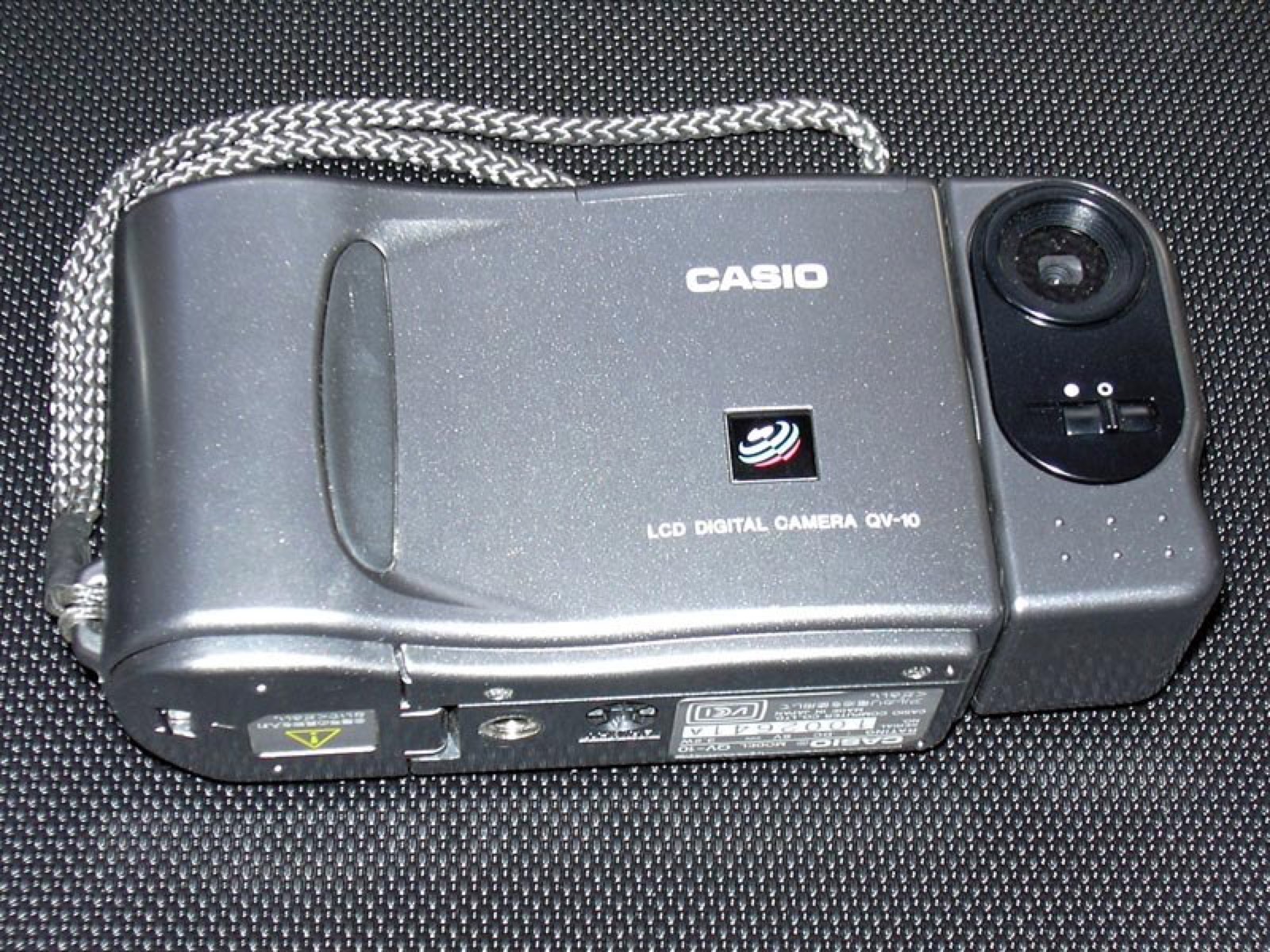
The most eye-catching thing about the QV-10's shape is the swiveling lens section at one end of the body.
The lens section alone could be rotated. Point it forward, and you could photograph the scene in front of you. Point it up, and you could hold the camera at your chest and shoot over the heads of a crowd. And point it backward, and you could photograph yourself while watching the screen.
Remember that the proposal never mentioned taking pictures of yourself. Going beyond what its makers had imagined, the people who used the camera discovered new ways to use it.
The pictures could be shown not only on the LCD screen but also on a television, connected by cable, so everyone could look together on a big screen. The kit for connecting to a computer was sold separately.
The year 1995
The year the QV-10 went on sale, 1995, was a special year for personal computers.
That autumn, Microsoft released Windows 95, and personal computers began spreading into homes in Japan too. Around the same time, the internet spread from a small circle of specialists to ordinary people.
Looking at photos on a computer, storing them, sending them to someone. The QV-10 arrived just in time, right at the moment those uses were about to begin.
Chapter 5 — A 200,000-unit hit
Production couldn't keep up
The QV-10 sold.
At first, the plan was to make about 3,000 units a month. But orders quickly surpassed that, and production was raised to more than 10,000 a month. Within about a year, some 200,000 units are said to have been sold.
The company that had been told "electronic cameras don't sell" after the VS-101 now had a product so popular it could hardly make enough.
People gather around the camera
People who look back on that time recall that carrying a QV-10 made you the center of attention wherever you went.
Show someone the picture right there, and their face would light up. "Take one of me too," they would say. One story even tells of someone showing a QV-10 in the cafeteria of an American movie studio, where actors crowded around and asked to be photographed.
The photograph was no longer only for the person taking it; it became something to enjoy together with the person being photographed. The "visual communication" Nakayama had written in his proposal meant exactly scenes like this.
The QV-10 as a work tool
The QV-10 also began to be used on the job.
Photograph a product, bring it straight into the computer, and paste it into a document. Record a construction site, or the scene of an accident. Photograph a property and show it to a client.
No time or money spent on developing film. If you missed a shot, you could retake it on the spot. The first pillar of the proposal — "taking notes with photographs" — was taking shape too.
Chapter 6 — After the QV
The race for pixels
Seeing the QV-10's success, many companies entered the world of digital cameras.
In 1996, Casio released the QV-10A, with a new color and a fix for an image defect, and also the QV-100, which could take 640×480 pictures. But other companies kept raising pixel counts, aiming for image quality that could rival film cameras. Camera makers, electronics makers, computer makers — digital cameras entered an era of fierce competition.
Casio held on to its belief in "ways of enjoying photos that only digital can offer." Photographs were a tool for communication, so film-like image quality was not needed. But in the middle of the pixel race, that thinking was hard to sell, and Casio's digital cameras went through a difficult period. Nakayama himself later looked back on this period as "a big failure."
Back again with EXILIM
Casio's comeback came in 2002.
It released the EXILIM EX-S1, a very thin camera about the size of a business card — a camera you could always keep in your pocket and carry anywhere. It was like giving shape once again to the QV-10's idea: shoot anytime, and show right away.
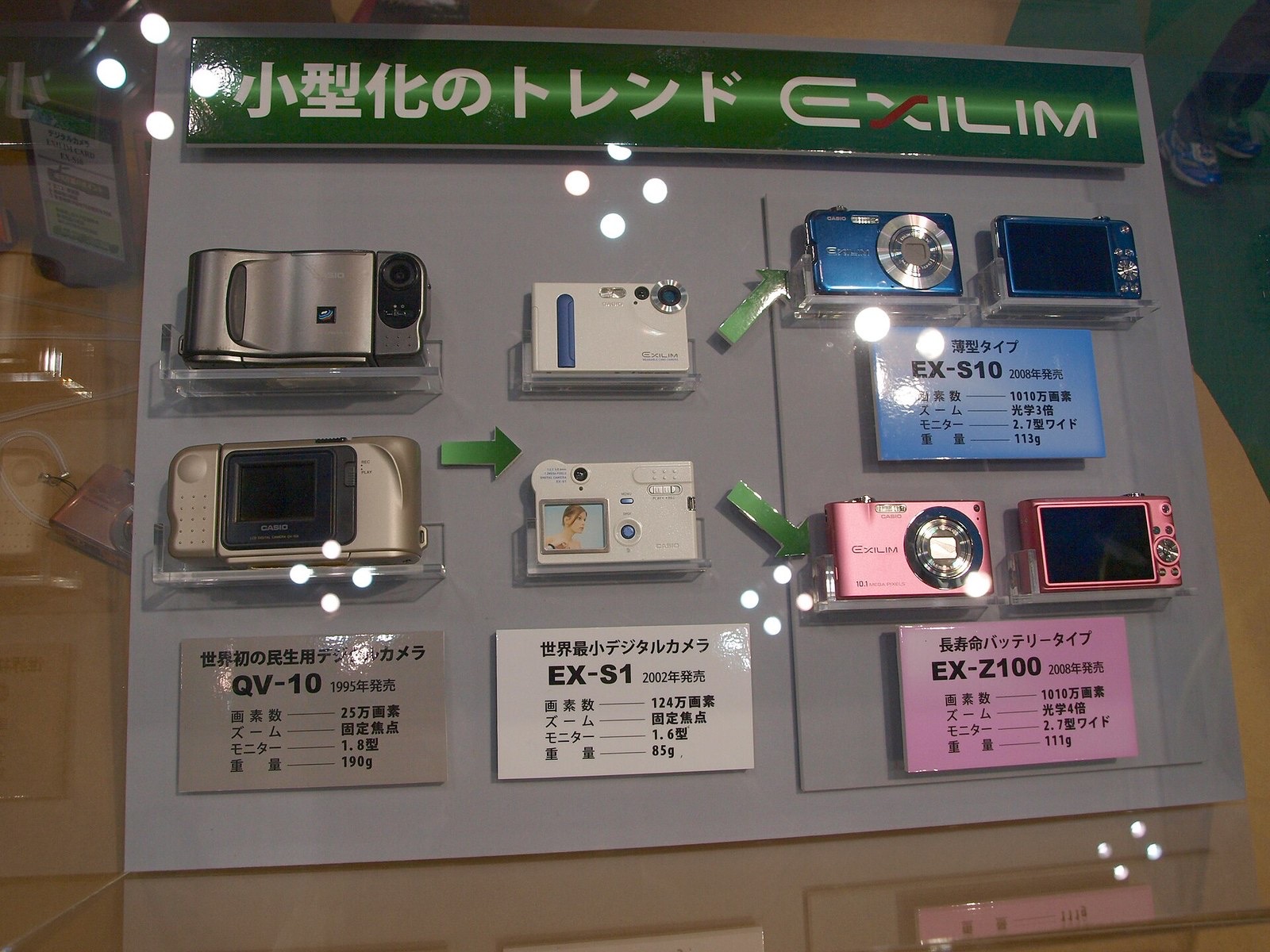
The EX-Z3 of 2003 packed a zoom lens and a large LCD into a thin body and became a hit around the world. The EX-F1 of 2008 astonished the photography world with high-speed shooting at 60 frames per second.
Because it was not a camera company, it could make cameras camera companies would never think of. That was Casio's way, running all the way from the QV-10.
2012: Future Technology Heritage
In 2012, the QV-10 was registered by the National Museum of Nature and Science in Ueno, Tokyo, as an "Essential Historical Material for Science and Technology" (Future Technology Heritage) — recognized as something that played an important role in the history of Japanese science and technology.
And then, leaving cameras behind
But the times moved on.
From around 2007, mobile phones with cameras, and then smartphones, spread rapidly. Always in your pocket, able to show a picture the moment you take it, and to send it straight to someone. It was exactly the future that the QV-10's proposal had described.
Ironically, as that future came true, the place for small digital cameras gradually shrank. In May 2018, Casio announced that it was withdrawing from the market for consumer compact digital cameras.
It was twenty-three years after the QV-10.
Epilogue — On the other side of the screen
How many photographs do we take in a single day now?
We photograph our meals. We photograph scenery. We stand side by side with friends and photograph ourselves. We check each picture on the screen right away and retake it on the spot if it didn't turn out. We send the ones we like to someone, then and there.
In each of those gestures, there is a small silver box from 1995.
A camera that did not sell. A hot, heavy prototype. An LCD television attached from the outside. A project pushed through not as a "camera" but as a "television." And a single handwritten proposal that imagined people showing each other photographs and laughing together.
The QV-10 did not earn its place in history through camera performance. It was a machine that changed the way we enjoy photographs.
The next time you take a picture with your smartphone and turn the screen toward someone — "Look!" — take a moment to remember that the first thing to give that gesture a shape was a small camera from a calculator company.
Casio QV-10 timeline
- 1975: An experimental camera using an image sensor is built at Kodak's laboratory
- 1981: Sony announces its prototype electronic still camera, the "Mavica"
- 1987: Casio's electronic still camera VS-101 (128,000 yen)
- 1988: Fujifilm announces the DS-1P, which records to a memory card
- 1991: Casio's prototype DC-90 ("Hot" and "Heavy")
- 1993: Jin Nakayama's handwritten proposal
- 1994: Apple's QuickTake 100; in November, Casio announces the QV-10
- March 1995: The QV-10 goes on sale (65,000 yen); Windows 95 arrives in the autumn
- 1996: QV-10A, QV-100
- 2002: The first EXILIM, the EX-S1
- 2003: EXILIM EX-Z3
- 2008: EXILIM EX-F1
- 2012: The QV-10 becomes Future Technology Heritage at the National Museum of Nature and Science
- 2018: Casio withdraws from consumer compact digital cameras
Photo credits
- Header, “Casio QV-10 CP+ 2011.jpg” (cropped): Photo: Morio / Wikimedia Commons / CC BY-SA 3.0
- “QV-10.jpg”: Photo: Noische at Japanese Wikipedia / Wikimedia Commons / CC BY-SA 3.0
- “Casio QV-10, EX-S1, EX-S10 and EX-Z100 20081211.jpg”: Photo: Junpei Abe / Wikimedia Commons / CC BY 2.0