The Box That Let You Change Pitch at Will — Eventide Harmonizer
☕ A coffee-length story — about a 12-minute read.
David Bowie’s snare, R2-D2’s voice, Eddie Van Halen’s guitar. Three very different sounds, all shaped by the same box.
Prologue — “It’s a machine that plays with time”
In 1976, at a recording studio in France, a producer showed David Bowie and Brian Eno a new machine. The studio was housed in a renovated old château.
The producer was Tony Visconti. The machine he had just acquired could raise or lower the pitch of a recorded sound without changing its speed. At the time, it seemed like magic.
A drummer hits the snare.
The sound goes “doooom,” sinking lower and lower.
You can hear that strange, sinking snare on Bowie’s 1977 album Low. The box behind it was the Eventide H910 Harmonizer.
📝 About this story
This story draws on books, interviews, and manufacturer materials I’ve read over the years. I’ve tried to stick to the facts, but I wasn’t there in the studios at the time, so some nicknames and commonly repeated stories may have made their way in. Accounts that are uncertain are separated into “Legend & Lore” sections, and the sources are listed at the end.
Chapter 1 — From a Studio Basement
Eventide was founded in New York in 1971.
There were three founders: recording engineer Stephen Katz, inventor Richard Factor, and businessman and patent attorney Orville Green.
Their first workspace was the basement of Sound Exchange, the recording studio Green owned. The company’s original name was “Eventide Clock Works.” It sounds like the name of a workshop full of ingenious mechanisms.
The world’s first rack-mounted effect
In 1971, they released their first product, the Instant Phaser.
A phaser makes a sound swirl with a “whoosh.” Before then, producing that effect in a studio took a lot of work: you ran two tape machines at once and pressed a finger against one reel to alter its speed.
The Instant Phaser did the job with the push of a button. It also fit neatly into a studio equipment rack. It is often described as the first rack-mounted effect made for recording studios.
A digital box that delayed sound
That same year, Eventide released another machine: the 1745 Digital Delay Line, which stored sound digitally and played it back a little later.
The machine made a name for itself in the summer of 1973 at the Summer Jam, a massive outdoor concert in Watkins Glen, New York. The crowd was said to number as many as 600,000.
The venue was so large that towers of speakers were set up far from the stage. But sound takes time to travel through the air. If the distant speakers played their signal as soon as it arrived, it would be out of sync with the sound coming from the stage.
The 1745 delayed the signal for the distant speakers until it lined up with the stage sound. Digital delay technology helped the enormous crowd hear the show in sync.
Chapter 2 — H910: The Box That Changed Pitch
In 1974, Richard Factor gave a project to Tony Agnello, a young engineer who had just joined the company.
“Build a machine that can make harmony vocals to go with a singer.”
Agnello was the first person at Eventide with a college degree in electrical engineering.
The prototype had a keyboard
That fall, Eventide showed a prototype at the Audio Engineering Society (AES) convention in the United States.
It looked nothing like the product that came later: a musical keyboard attached to a handmade box with its wiring exposed. Pressing a key changed the singer’s pitch to match that note.
One person said to have tried the prototype was Jon Anderson, lead singer of the progressive rock band Yes.
1975: The H910 goes on sale
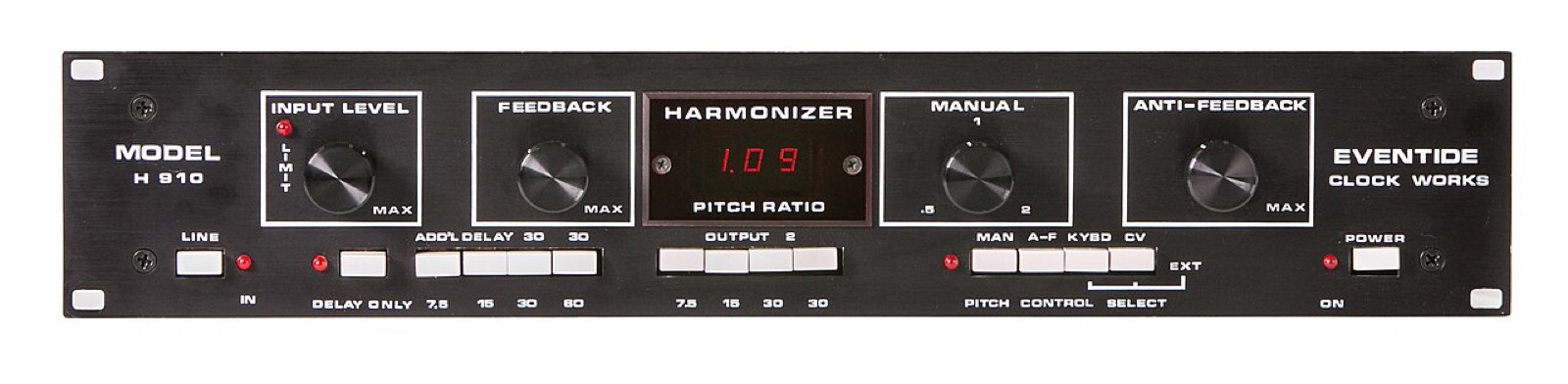
In 1975, the production H910 Harmonizer finally went on sale. It cost $1,600.
It could:
- Shift pitch up or down by as much as one octave
- Delay the sound by up to 112.5 milliseconds
- Feed the output back into the input
Speeding up tape raises the pitch, but it also makes the sound faster. The H910 could change pitch while keeping the speed the same. That was the breakthrough.
Eventide registered “Harmonizer” as a trademark in 1976 and still owns it today.
Chapter 3 — The Many Sounds the H910 Changed
The H910 found its way into places no one would have expected.
Fast-forwarding I Love Lucy
One of its first customers was, surprisingly, a television station.
A New York station was speeding up reruns of the popular American sitcom I Love Lucy just enough to fit them into the broadcast schedule. But speeding up the playback also raised the actors’ voices, making them sound shrill.
The H910 brought the pitch back down while leaving the faster timing intact. Viewers probably never noticed that the show had been sped up.
R2-D2’s voice
The film Star Wars premiered in 1977. The H910 was also used to create the beeps and whistles of R2-D2, the little droid.
Bowie’s sinking snare
Remember Bowie’s Low from the prologue? Visconti lowered the H910’s pitch by about a semitone and turned up the feedback, making the sound repeat as it sank lower and lower.
The harder drummer Dennis Davis hit the snare, the farther it seemed to sink.
That drum sound was unlike anything people had heard before, and it went on to influence rock and pop music.
Van Halen’s guitar and AC/DC’s snare
Guitarist Eddie Van Halen was known for using two H910s to spread his guitar sound across the stereo field. Layering sounds shifted just slightly in pitch can make one guitar feel wider and fuller, almost as if two guitars were playing.
The H910 is also said to have been used to shape the snare sound on AC/DC’s 1980 album Back in Black.
🏷 Legend & Lore — “910” comes after “909”?
There’s a story behind the H910’s model number.
The Beatles recorded a song called “One After 909.” One version of the story says that the “910” in H910 was a nod to that title.
Was that really the inspiration, or was it a coincidence? No one knows for sure, but it’s a story that has lived on as something music-loving engineers might have come up with.
🏷 Legend & Lore — Which was the world’s first digital audio device?
There’s another company that lays claim to the title of the world’s first professional digital audio device: Lexicon, which released the digital delay Delta T-101 in 1971.
Eventide and Lexicon were two East Coast companies building machines that delayed sound digitally in the same year. Which one was truly first depends on how you define “first.”
What’s certain is that the two companies helped shape the history of digital effects side by side.
Chapter 4 — H3000: A Harmonizer That “Understood” Music
After the H910’s success, Eventide continued to release new machines.
In 1979 came the H949, which offered finer pitch adjustment. In 1982, the company released the SP2016 digital reverb.
The SP2016 included a forward-thinking idea: Eventide published a software development kit (SDK) so other companies and engineers could create effects that ran inside the unit.
It was an early version of the idea of adding effects to a host machine—the same basic concept behind the plug-ins we now use on computers.
1986: The H3000
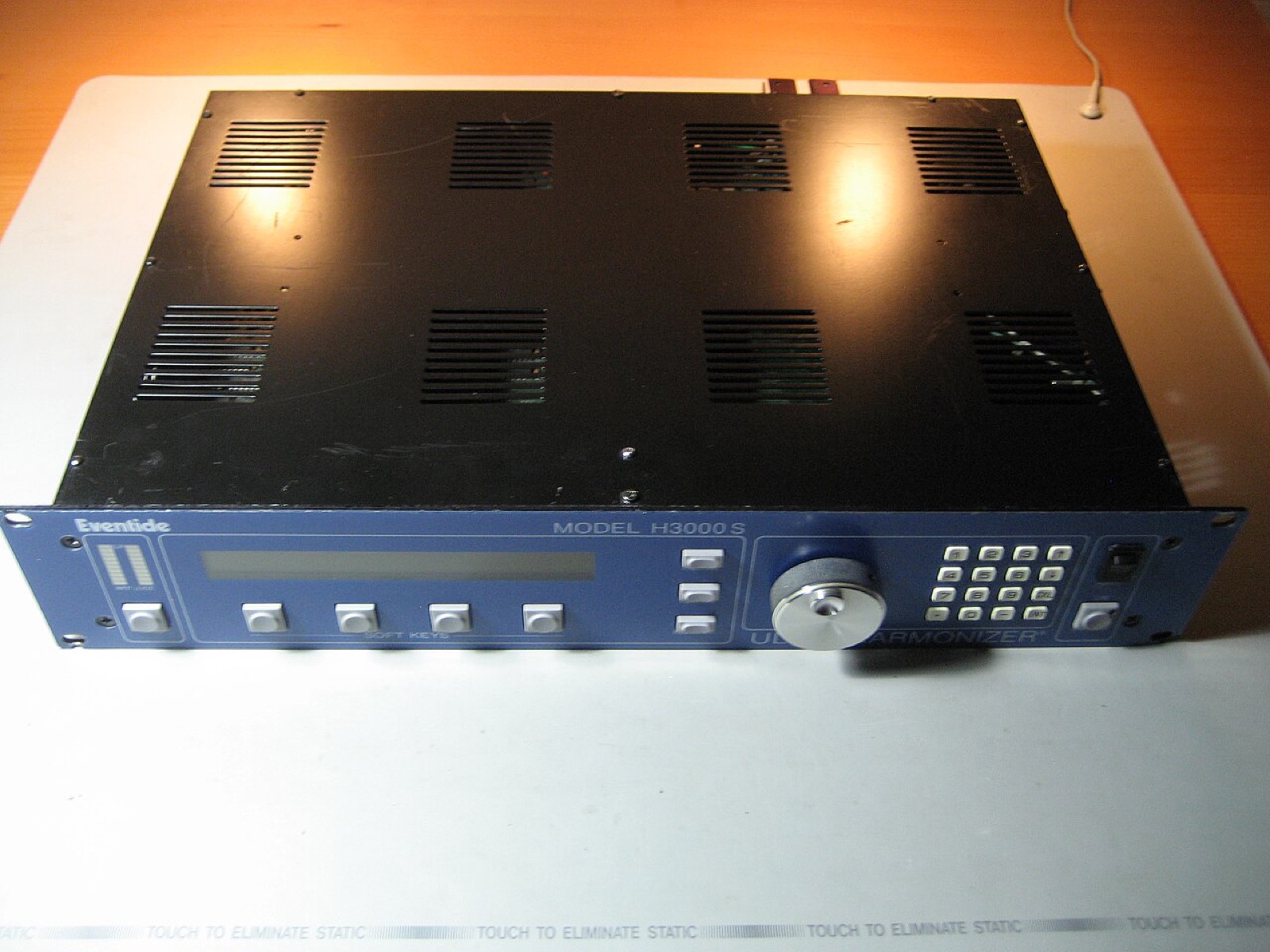
Then, in 1986, Eventide introduced one of its signature products: the H3000 Ultra-Harmonizer.
What made the H3000 special was its ability to understand a song’s key.
Say you want to add a harmony a third above a melody in C major. If you simply shift every note up by four semitones, some of the new notes will fall outside the key and sound wrong.
Set the song’s key on the H3000, and it would choose the right harmony note from the scale automatically. Eventide called this “intelligent pitch shifting.” It was the first feature of its kind.
From the late 1980s through the ’90s, the H3000 became a studio staple. Later models such as the H3500 carried the idea forward, and Eventide became synonymous with pitch effects and spatial processing.
Eventide at your feet
In the 2000s, Eventide made its way onto guitarists’ pedalboards.
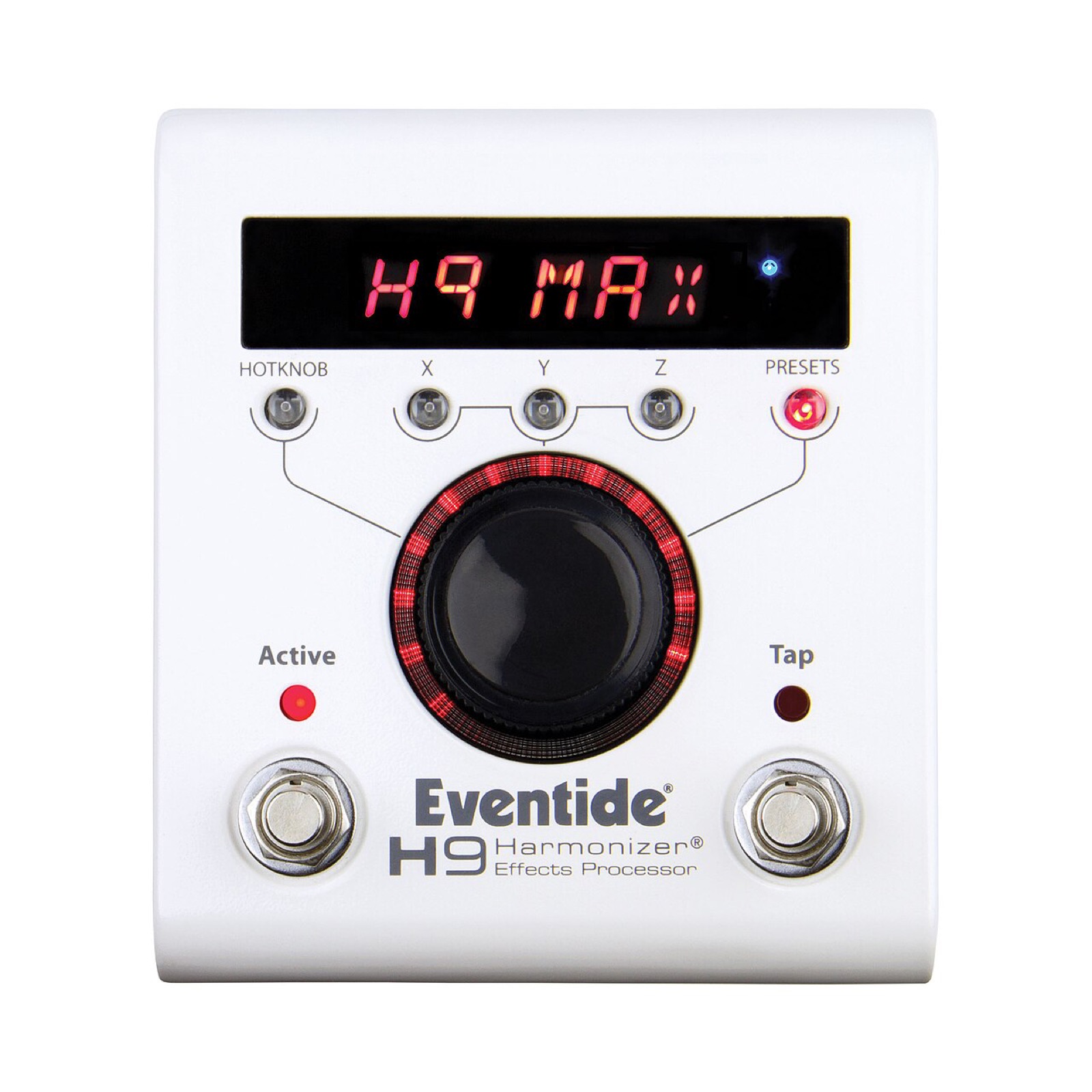
In 2007, the company introduced its “Stompbox” line of guitar effects. It included the delay-focused TimeFactor, the modulation-focused ModFactor, the pitch-focused PitchFactor, and eventually the do-it-all H9.
The “magic box” that once lived in a studio rack could now sit at a guitarist’s feet.
Eventide beyond music
Surprisingly, Eventide has also made equipment for uses outside music:
- Radio delay systems that let broadcasters cut prohibited words during live shows
- Call recording systems for police, fire departments, and other services
- Moving-map navigation displays for small aircraft
Technology for “delaying sound” and “recording sound” has proved useful in some unexpected places.
Chapter 5 — Trying a Harmonizer
Today, you can also get Eventide Harmonizers as plug-ins. That makes it easy to try the H910 and H3000 sounds on a computer.
Here’s one of the classic techniques used by professionals.
Thicken a vocal with tiny pitch shifts
One of the best-known tricks is called micro-pitch shifting.
- Put a Harmonizer on a send from your vocal track.
- Raise the pitch just a little on the left side, perhaps by about +8 cents.
- Lower it just a little on the right side, perhaps by about −8 cents.
- Add a short delay to each side, around 10–20 milliseconds.
The shift is tiny—less than a semitone (100 cents). But it can spread a single vocal across the stereo field and give it the fullness of several people singing together.
It’s the same idea Eddie Van Halen used to widen his guitar sound with two H910s.
The trick is to keep it subtle
Push the shift too far and the voice starts to wobble, almost as if the singer were drunk.
Stop when you can barely tell whether the effect is on, then switch it on and off to compare. If the vocal feels lonely when you turn it off, you’ve probably found the right amount.
Epilogue — A Box That Took Hold of Time
Store sound digitally, delay it, and change its pitch. Today, even a smartphone app can do that.
But in the 1970s, it was magic. A small company born in a basement turned that magic into a box anyone could use.
It corrected timing across a concert venue, restored voices on television, gave a robot its voice, and made rock drums sink into the mix.
The next time you hear harmony added to a karaoke vocal or someone’s voice shifted in a video, take a moment to remember the Harmonizer that started near the beginning of that story—in the basement of a New York recording studio.
Eventide Timeline
- 1971 — Stephen Katz, Richard Factor, and Orville Green found Eventide in New York; the company releases the Instant Phaser and 1745 Digital Delay.
- 1973 — The 1745 is used at Summer Jam in Watkins Glen.
- 1974 — Eventide releases the Omnipressor compressor and shows a Harmonizer prototype at AES.
- 1975 — The H910 Harmonizer goes on sale for $1,600.
- 1976 — Eventide registers “Harmonizer” as a trademark.
- 1977 — The H910 is used on Bowie’s Low and in Star Wars.
- 1979 — The H949 is released.
- 1982 — The SP2016 digital reverb is released.
- 1986 — The H3000 Ultra-Harmonizer is released.
- 2002 — The Eclipse is released.
- 2007 — Eventide releases its “Stompbox” pedal line.
- 2007 — The H910 is inducted into the TECnology Hall of Fame.
Sources
- Wikipedia, “Eventide, Inc.” (English edition)
- Reverb, “Eventide: From Studios to Stompboxes”
- Mix, “Eventide H910 Harmonizer” (TECnology Hall of Fame)
- Valhalla DSP, “Early pitch shifting: The Eventide H910 Harmonizer”
- CDM, “The story of the Eventide gear that transformed music”
Photo credits
- Header image, “Eventide H3000 SE Ultra-Harmonizer” (Photo: John R. Southern / Wikimedia Commons / CC BY-SA 2.0)
- H910, 1975 (Photo: Nalzatron / Wikimedia Commons / CC BY-SA 4.0)
- Eventide H9 pedal (Photo: Nalzatron / Wikimedia Commons / CC BY-SA 4.0)
Licenses: CC BY-SA 2.0 and CC BY-SA 4.0.