Eddie Van Halen: The Frankenstein Guitar, the Brown Sound, and a New Way to Play
☕ A coffee-length story — about a 15-minute read. Enjoy the stories behind the sounds and machines, and how they were used.
💡 In this story:
- Eddie's path from discovering the guitar to shaping Van Halen
- The story behind the Frankenstein guitar and the Brown Sound
- Tapping, landmark performances, and his influence on guitar design
In 1978, drop the needle on a record and the first thing you hear is a short guitar cue. Then the amp growls, and a sound like fingers striking the strings races through a rising and falling melody. The track is “Eruption,” an instrumental lasting barely two minutes on the album Van Halen.
Great guitarists had come before him. Fast runs, hammer-ons, and picking were nothing new. Yet Eddie Van Halen brought together the daring move of taking his right hand to the fretboard, melodies that sang, and the force of a tight band. He did more than show off technique: he showed listeners the kind of landscape a guitar could create.
Eddie looked for his own answers by combining whatever parts he could get, rather than simply choosing a finished product. Neither his guitars nor his amps were bound by convention. This is the story of a boy who moved from the Netherlands to California and helped reshape the sound of rock with a guitar he kept modifying.
Prologue — 1978: The Door “Eruption” Opened
Van Halen’s debut album came out in February 1978. Eddie’s guitar gave the hard-driving band a distinct edge. The record showed his range in one place: sharp riffs, rhythms that supported the vocals, and a solo piece like “Eruption.”
“Eruption” began as a guitar solo Eddie played live, rather than as a standalone epic planned for the album. Producer Ted Templeman is said to have suggested recording it for the record. The take was built around a single performance. Instead of the polish of a heavily constructed studio piece, it retains the feeling of a spark flying onstage.
The passage that catches the ear midway through is two-handed tapping: Eddie’s right-hand fingers strike the strings against the fretboard. He adds high notes with his right hand to notes fretted by his left, moving both hands in turn to create a range that seems impossible for one guitar. The technique had precedents, but Eddie made it vivid by marrying it to the big sound of rock in a short, striking phrase.
His innovation was more than introducing an unusual technique. He bends a string at the end of a phrase, carries the sound forward without breaking it, and returns to the chord without losing momentum. The whole performance becomes a story, including the way it comes back to the band’s song after the spotlight moment. Listeners began copying not only the finger movements, but the freedom of the idea behind them.
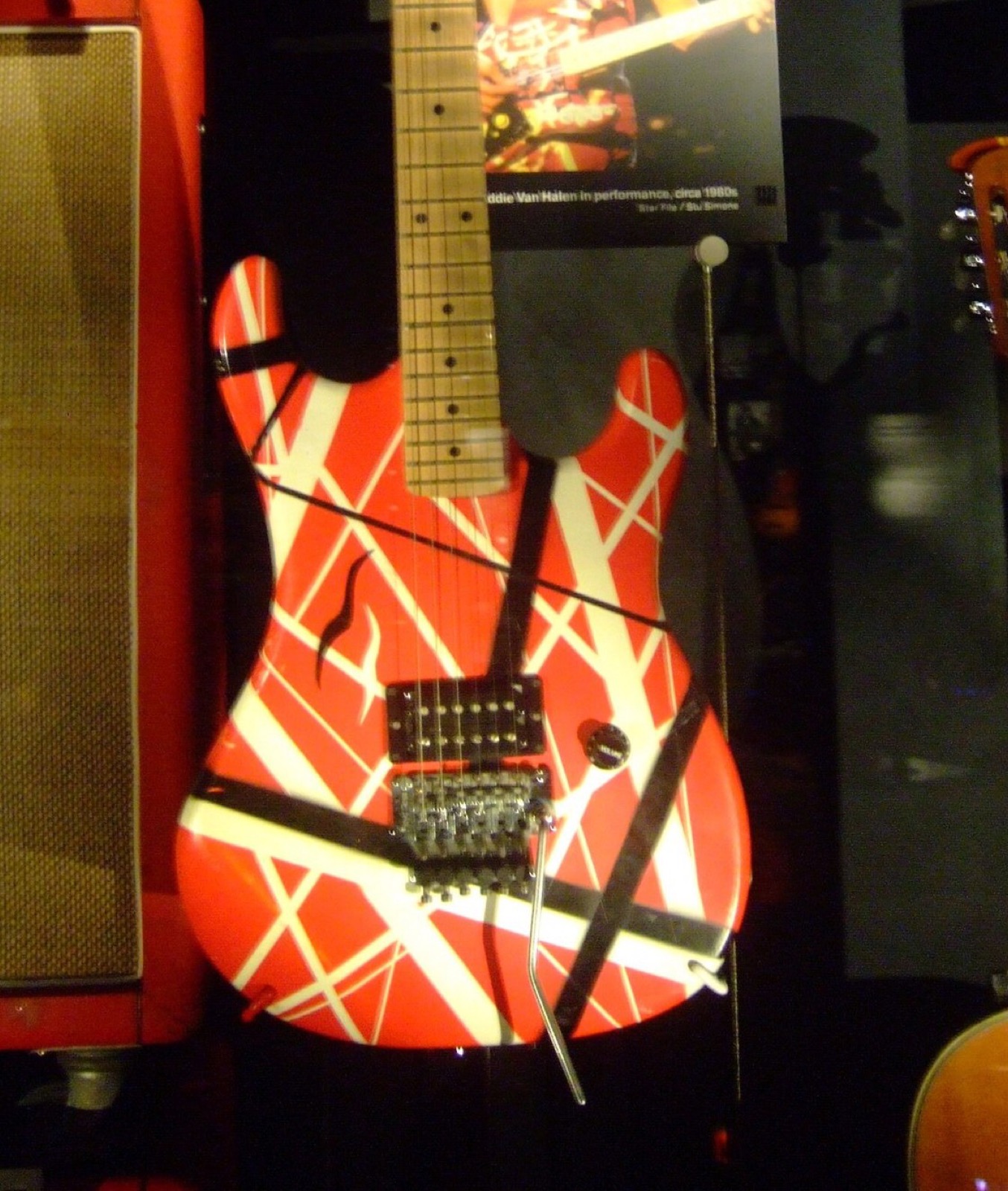
“Eruption” expanded what a guitar could do and helped define the band’s identity. But that sound did not appear out of nowhere. Behind it were two brothers from a musical family and years of playing in the city where they settled.
Chapter 1 — From the Netherlands to Pasadena, from Piano to Guitar
Edward Lodewijk Van Halen was born in Amsterdam in 1955 and grew up in Nijmegen, the Netherlands. His father, Jan, was a musician who played clarinet and saxophone. Eddie and his older brother Alex spent their early years there before the family moved to the United States in the early 1960s. They made their new home in Pasadena, California.
The brothers studied classical piano. Eddie entered piano competitions, developing an ear for learning music by listening and a feel for shaping melodies at the keyboard. Eddie got a drum kit first, while Alex played guitar. The familiar story goes that when Alex proved he could play Eddie’s drums brilliantly, Eddie switched to guitar. That swap helped lay the foundation for the band’s powerful rhythm section.
Calling the brothers “guitar prodigies from the start” would hide the years of practice and trial and error. Eddie brought his musical instincts from piano to guitar, listening to records of the day and searching for a way to play that suited his hands. His admiration for Eric Clapton and his close study of Clapton’s records were among the musical starting points he later described.
The brothers formed bands with school friends, continuing to play as the names and lineups changed. They eventually brought in David Lee Roth and Michael Anthony, honing their craft at local clubs and parties. Playing in front of audiences taught them how to connect songs, manage volume, and balance flashy playing with vocals.
By the mid-1970s, simply keeping a band going in clubs around Los Angeles was a major competition. Van Halen refined its original songs and built a stronger live presence. The band earned a local following, caught the attention of record-company people, and signed with Warner Bros. Ted Templeman produced their debut album.
The album sessions put the energy of the performance first, with minimal layering and polishing after the fact. Keeping the band’s sound alive as they played together captured the unity they had built onstage. Eddie’s guitar was at the center, but it cannot be separated from Alex’s drums, Michael’s bass, or Roth’s singing. Listeners heard the guitar revolution as the sound of a four-piece band.