Twenty Tubes and the Beatles’ Drums — Fairchild 660
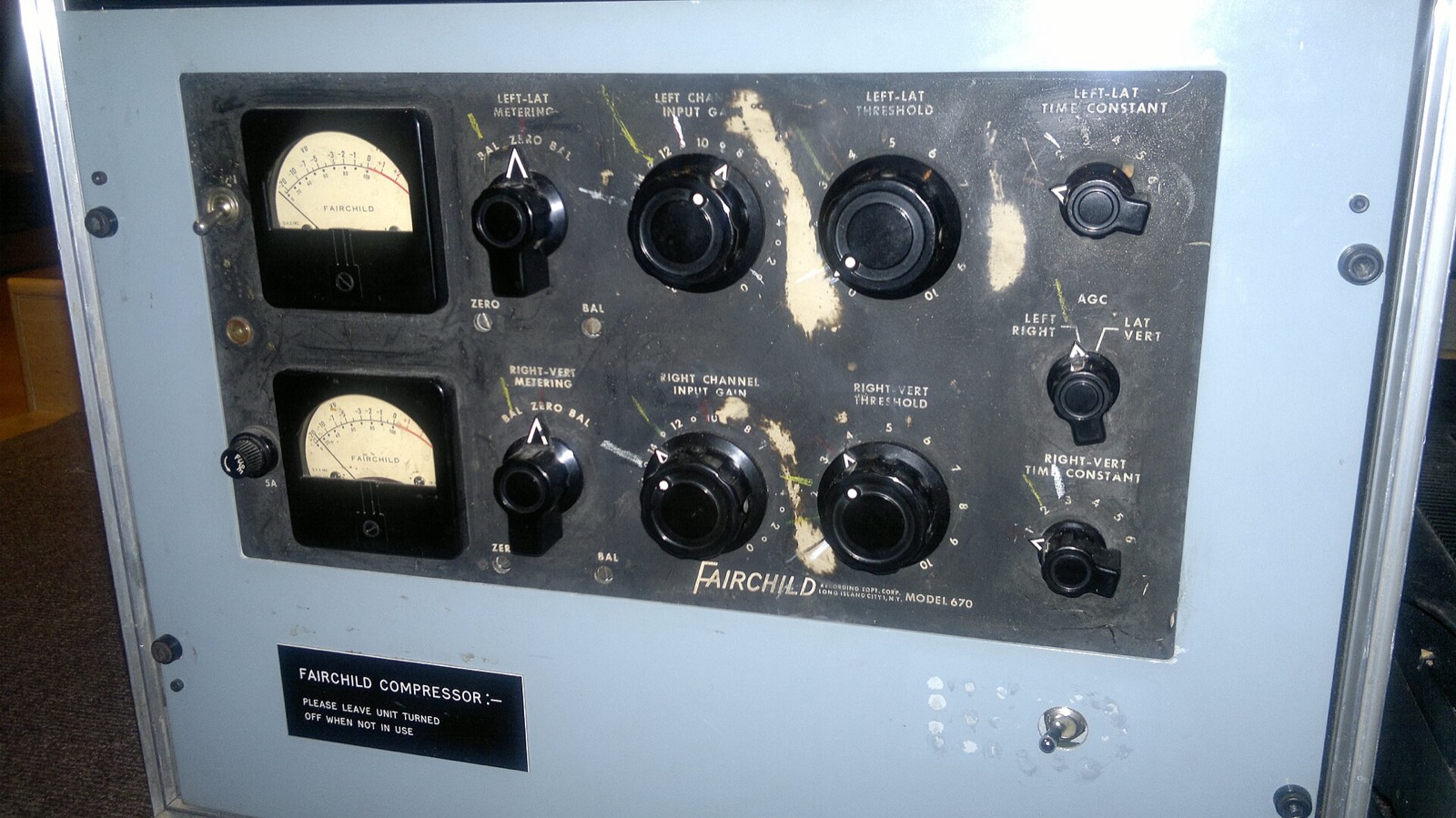
Prologue — Abbey Road, 1966
In 1966, at Abbey Road Studios in London, a young engineer named Geoff Emerick ran Ringo Starr’s drums through a large gray box.
It was the American-made Fairchild 660 limiter. Packed with vacuum tubes, it was a beast to lift.
Emerick later recalled hearing the drums come back through the speakers and realizing they had become a sound no one had ever heard before.
The box that changed the sound of Beatles recordings had begun with a request from a brilliant guitarist: “I wish I had something like this.”
This is the story of what is sometimes called the world’s most expensive compressor, with vintage units occasionally fetching several million yen.
📝 About this story
This account draws on books, interviews, and manufacturer materials I’ve read over many years. I’ve tried to stick to the facts, but I wasn’t there, so nicknames and received wisdom may have found their way in. I’ve separated stories with multiple versions into “Legend & Lore” sections, and listed the references at the end.
Chapter 1 — Les Paul’s Request
A virtuoso guitarist and an engineer
The first person in the Fairchild story is Les Paul. Best known for the electric guitar that bears his name, he was also a pioneer of multitrack recording.
An engineer named Rein Narma built a mixer for an Ampex eight-track tape recorder for Les Paul.
Pleased with the mixer, Paul gave Narma another assignment: “Could you make me a compressor/limiter, too?”
Sherman Fairchild
Les Paul had another important friend: businessman Sherman Fairchild.
Fairchild bought the rights to Narma’s limiter design and brought Narma into his company, Fairchild Recording Equipment Corporation, as its chief engineer.
The first ten were hand-built by Narma
Narma is said to have assembled the first ten units himself. Their destinations were an impressive group:
- No. 1: Rudy Van Gelder, known for recording the legendary jazz label Blue Note
- No. 2: Olmsted Sound Studios in New York
- No. 3: Les Paul and Mary Ford
A legendary jazz engineer and the original client, Les Paul. From the moment it was born, Fairchild was at the cutting edge of recording.
Now let’s look at the moment the 660 and 670 were born—and the more than 60 years that followed.
Chapter 2 — 1959: The 660, a “Smart” Limiter
A level guard that “thinks for itself”
Fairchild began producing the 660 in 1959. Some sources describe it as “the first intelligent, automatic volume-control limiter.”
The 660 offered two ways to work:
- As a compressor: A 2:1 ratio, starting to ease in 5 dB below the usual level
- As a limiter: A 30:1 ratio, stopping the signal firmly at 10 dB above the usual level
One ten-thousandth of a second
The 660 was said to clamp down firmly within one ten-thousandth of a second of the start of a sound.
Its other major feature was its release. The 660 had six release settings, three of which automatically varied the recovery speed to follow the audio. According to the literature, it was “the first compressor/limiter with an automatically variable release time.”
Three controls
The 660’s main controls were:
- INPUT GAIN: The level of the incoming signal
- THRESHOLD: The point where compression begins
- TIME CONSTANT: Selects among the six release settings
💡 Tip
Fairchild compressors are widely considered a defining example of the variable-mu design. They control level by changing the amount of amplification in the vacuum tubes themselves. This is one reason they’re said to work smoothly and make a sound feel “bigger and more cohesive.”
Chapter 3 — The 670, a Beast with 20 Tubes
Stereo twins
The 670, a two-channel version, followed soon after the 660.
The two channels could be used as separate limiters, and the 670 also had a special mode for cutting record grooves.
Protecting the record groove
A stereo record encodes sound through a combination of left-right (lateral) and up-down (vertical) movement in the groove. The 670 was said to be the only piece of equipment that could control the lateral and vertical components independently.
By keeping the cutting stylus from jumping out of the groove when the signal got too loud, the 670 also served as a guardian of the record-cutting era.
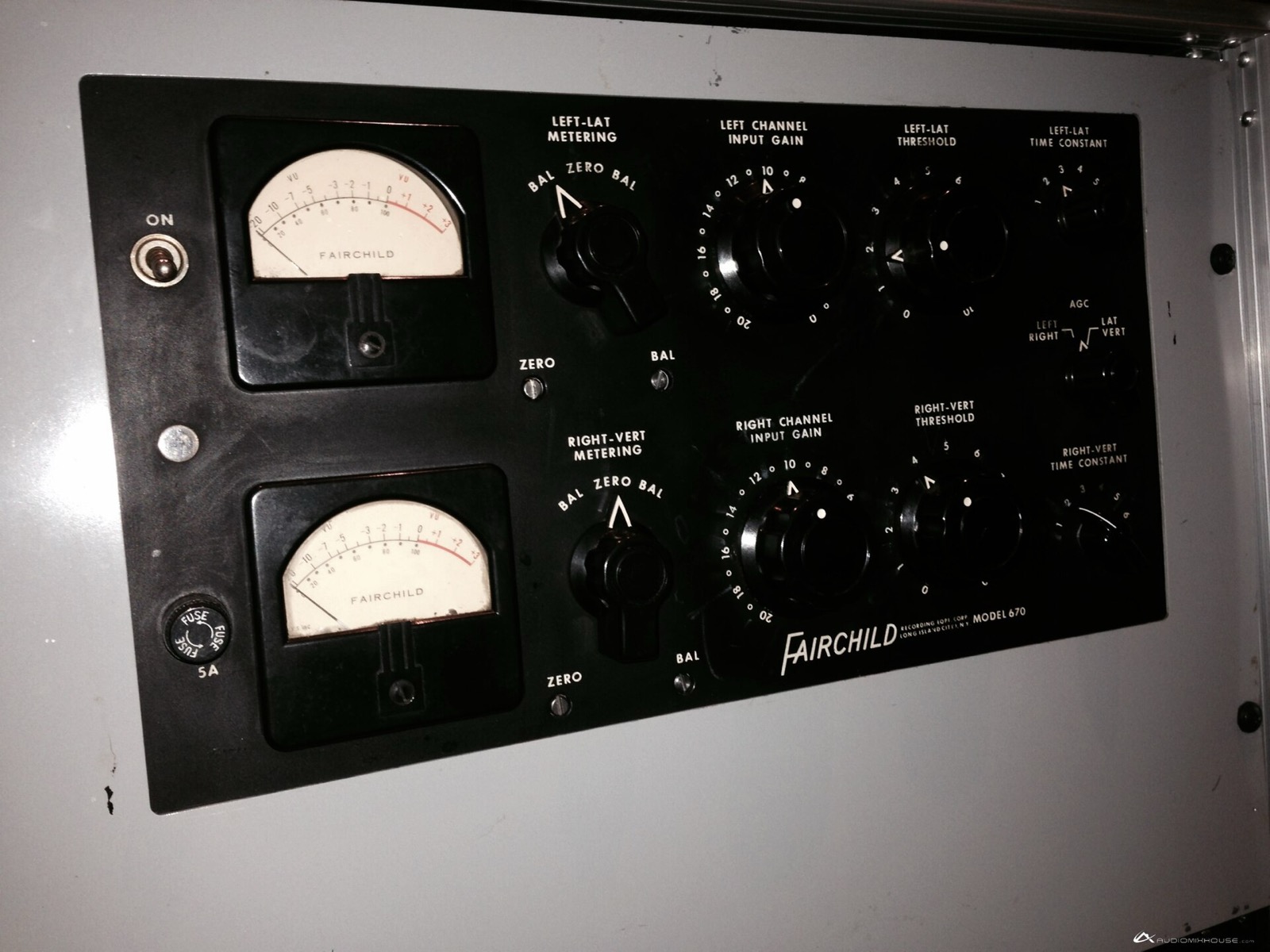
A beast on the inside
The 670’s innards are astonishing:
- Vacuum tubes: 20
- Transformers: 11
- Inductors (coils): 2
- Rack height: About 35 cm (14 inches)
- Weight: About 29 kg (65 pounds)
That is an extraordinary number of components for a single compressor—far beyond what you would expect in an ordinary dynamics unit. Those figures convey the scale: twenty tubes, eleven transformers, and two coils in a unit weighing about 29 kg. Even by the standards of vintage studio equipment, it is an imposing machine. In time, the 670’s sheer size would help make it one of the most expensive pieces of vintage gear.
Chapter 4 — Abbey Road and the Beatles
Hearing the sound in America
Here’s how the Fairchild is said to have made its way into Beatles recordings.
Peter Bown, an engineer at Abbey Road Studios, heard a Fairchild at Capitol Records in the United States. Abbey Road liked the sound and bought 12 units of the 660.
Beatles vocals, then Ringo’s drums
Abbey Road’s Fairchild units are said to have been used mainly on Beatles vocals.
Then, in 1966, Geoff Emerick began using the Fairchild 660 on Ringo Starr’s drums. The line about a sound “no one had ever heard before,” mentioned in the prologue, is Emerick’s recollection of that moment.
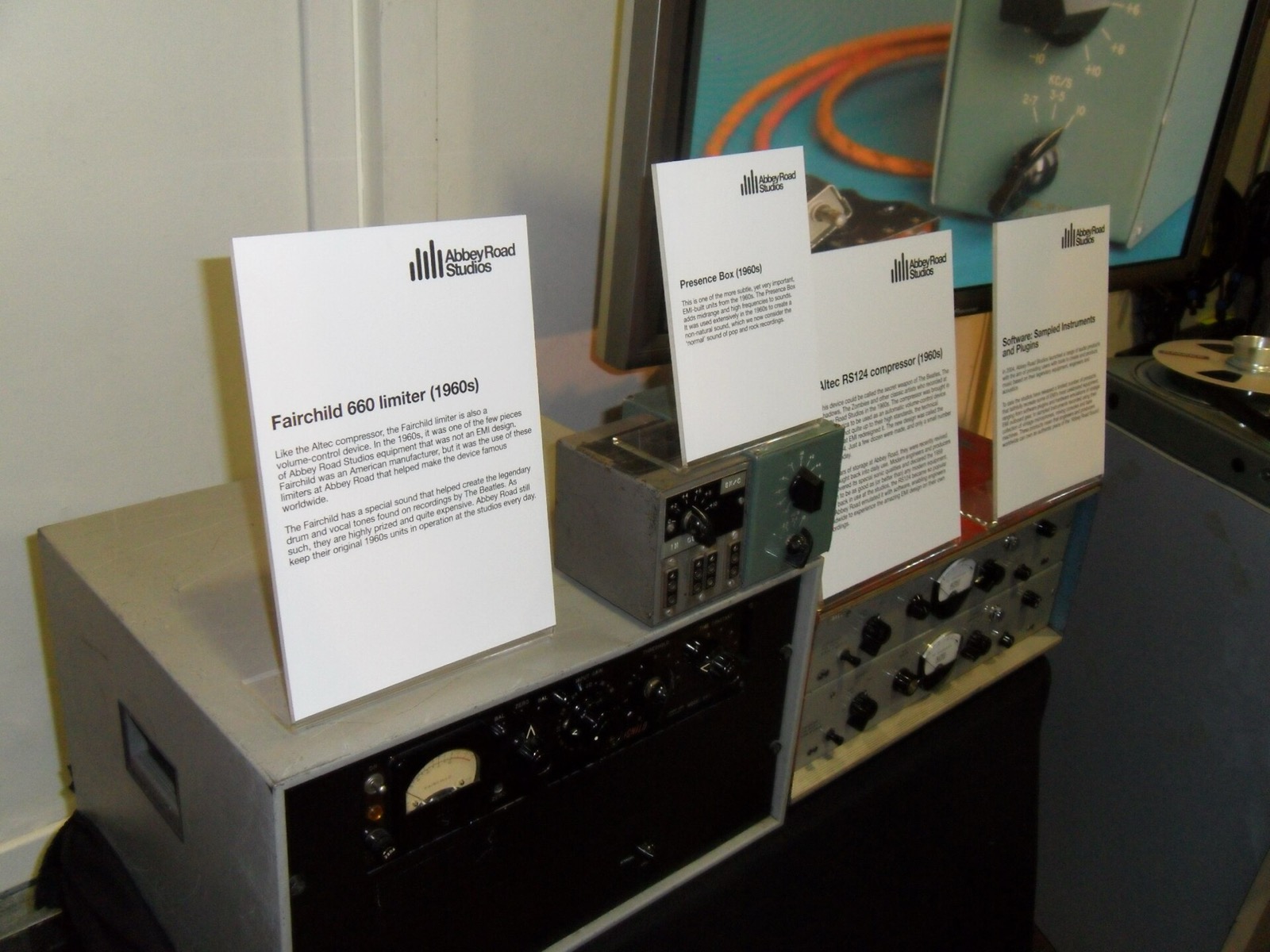
As of 2014, Abbey Road was said to still have eight original 660s.
After the Beatles
The engineers who loved the Fairchild sound didn’t stop with the Beatles’ era:
- Producer Chris Thomas, whose credits include Pete Townshend’s solo work
- Engineer Jack Joseph Puig
- Engineer Tom Elmhirst, who is reported to have used one on Amy Winehouse’s “Rehab” and Adele’s “Hello”
From the Beatles in the ’60s to Adele in the 2010s, Fairchild helped shape the sound of hit records for more than half a century.
🎙 Legend & Lore ①: Is it really a “million-dollar compressor”?
The Fairchild is sometimes called “the most expensive compressor in the world.”
One source puts the used-market price at more than $20,000 for a 660 and $30,000–$40,000 for a 670. The source also notes that these figures lack a clearly identified citation, and actual sale prices vary widely with condition and provenance.
What’s certain is that few were made, and few surviving units are in good condition. Scarce gear, abundant legends—it’s no surprise that prices climb.
Chapter 5 — The Legend Moves to the Screen
Hall of Fame
In 2007, the Fairchild 670 was inducted into the TECnology Hall of Fame, an audio industry hall of fame.
The Fairchild sound within reach
For most people, an original is out of reach. Today, though, several manufacturers offer plug-ins based on the Fairchild.
You can bring up the beast with its 20 vacuum tubes in a DAW with one click. The engineers of 1959 would surely be surprised.
There are also plenty of hardware units based on Fairchild circuits. Some have the same weight and number of tubes as the original; others are smaller and more affordable.
💡 Tip
When using a plug-in or clone, pay attention to the difference between “compressor” (2:1) and “limiter” (30:1), as well as the six release settings. That can help bring out the Fairchild character. The usual advice is to go easy and let it “caress” the sound.
Epilogue — From a Guitarist’s Request to Adele
It all began with Les Paul asking, “Could you make me a compressor, too?”
One engineer hand-built ten units. They shaped jazz records, made their way to Abbey Road, and changed the sound of the Beatles’ voices and drums. Sixty years later, that sound had reached Adele’s voice, too.
Twenty vacuum tubes and eleven transformers. Inside that 29-kilogram gray box may have been the enduring desire of everyone who records music: to get a great sound.
The next time you see the name Fairchild, remember the moment in 1966 when Ringo’s drums first rang out that way at Abbey Road.
Fairchild Timeline
- The 1950s: Rein Narma builds a mixer for Les Paul, who then asks him to make a compressor/limiter.
- 1959: Fairchild begins producing the 660.
- Soon afterward: The two-channel 670 appears.
- The 1960s: Abbey Road buys 12 660s, which are used on Beatles vocals.
- 1966: Geoff Emerick begins using the 660 on Ringo Starr’s drums.
- 2007: The Fairchild 670 is inducted into the TECnology Hall of Fame.
- 2014: Abbey Road is reported to still have eight original 660s.
References
- Wikipedia, “Fairchild 670” and “Fairchild 660” (English editions)
- Abbey Road Studios exhibit text (Fairchild 660 limiter)
- Interviews with Geoff Emerick, Tom Elmhirst, and others
Photo credits
- Header image, “Fairchild Model 670 Compressor” — mac morrison / Wikimedia Commons / CC BY 2.0
- “Fairchild 670 Compressor at Audio Mix House” — Audio Mix House / Wikimedia Commons / CC BY 2.0
- “Fairchild 660 limiter (1960s), EMI Presence Box (1960s), Altec RS124 compressor (1960s), Abbey Road Studios” — Josephenus P. Riley / Wikimedia Commons / CC BY 2.0
License: CC BY 2.0 https://creativecommons.org/licenses/by/2.0/