The Man Who Gave Up His Name and Built the ‘Red Sound’ Again — Focusrite
☕ A coffee-length story — about a 12-minute read. This is a story to enjoy, not a research paper. Why is there a red audio interface on so many home recordists’ desks? It began with a legendary engineer’s second chance.
Prologue — The Little Red Box on Your Desk
Take a look at the desk of someone recording vocals or instruments at home today, and chances are you’ll see the same thing.
A little red metal box, small enough to hold in one hand. Two sockets for a microphone and guitar, a few knobs, and a single USB cable connecting it to a computer.
It’s the Scarlett by Focusrite.
It’s often the first piece of gear people buy when they start recording. It’s a perennial favorite—the one people say you can’t go wrong with.
But trace this little red box back to its ancestors, and you arrive at an unexpected figure.
He created Neve, one of the world’s most famous recording console brands. He was Rupert Neve, a man who gave up the company that bore his name.
📝 About this story
This story draws on books, interviews, and manufacturer materials I’ve read over the years. I’ve tried to stick to the facts, but I wasn’t there, so some nicknames and commonly repeated stories may have slipped in. Disputed accounts are set apart in Legend & Lore sections, and the references are listed at the end.
Chapter 1 — The Engineer Who Let Go of His Name
Rupert Neve was born in England in 1926.
In the 1960s, the company he named after himself, Neve, reached the top of the recording-console world. The legendary 1073 microphone preamp and equalizer is still heard in studios around the globe.
But in the 1970s, Neve let the company go. It passed from one owner to another, and by the 1980s it belonged to Siemens, a major German corporation.
Neve stayed involved with his old company as a consultant for a while, but eventually that relationship ended, too.
The sign bearing his name no longer belonged to him. Still, he had sounds left to build.
In 1985, Neve started a new company. He called it Focusrite.
What followed was a commission from the Beatles’ producer, the legendary Forte console, a company’s collapse, and the journey of the “red sound” to desks around the world.
Chapter 2 — A Commission from George Martin
The new company’s first major project came from a famous client.
Sir George Martin, the towering figure in British music best known as the Beatles’ producer.
Martin had a studio called AIR Montserrat on the Caribbean island of Montserrat. Paul McCartney, the Rolling Stones, Elton John, and other stars traveled there to record at the legendary studio in the tropics.
The studio had a Neve console. But Martin wanted something even better.
“Build me the finest microphone preamp and equalizer you can, with no compromises.”
Neve answered that request with the ISA 110.
ISA 110 — Where It All Began
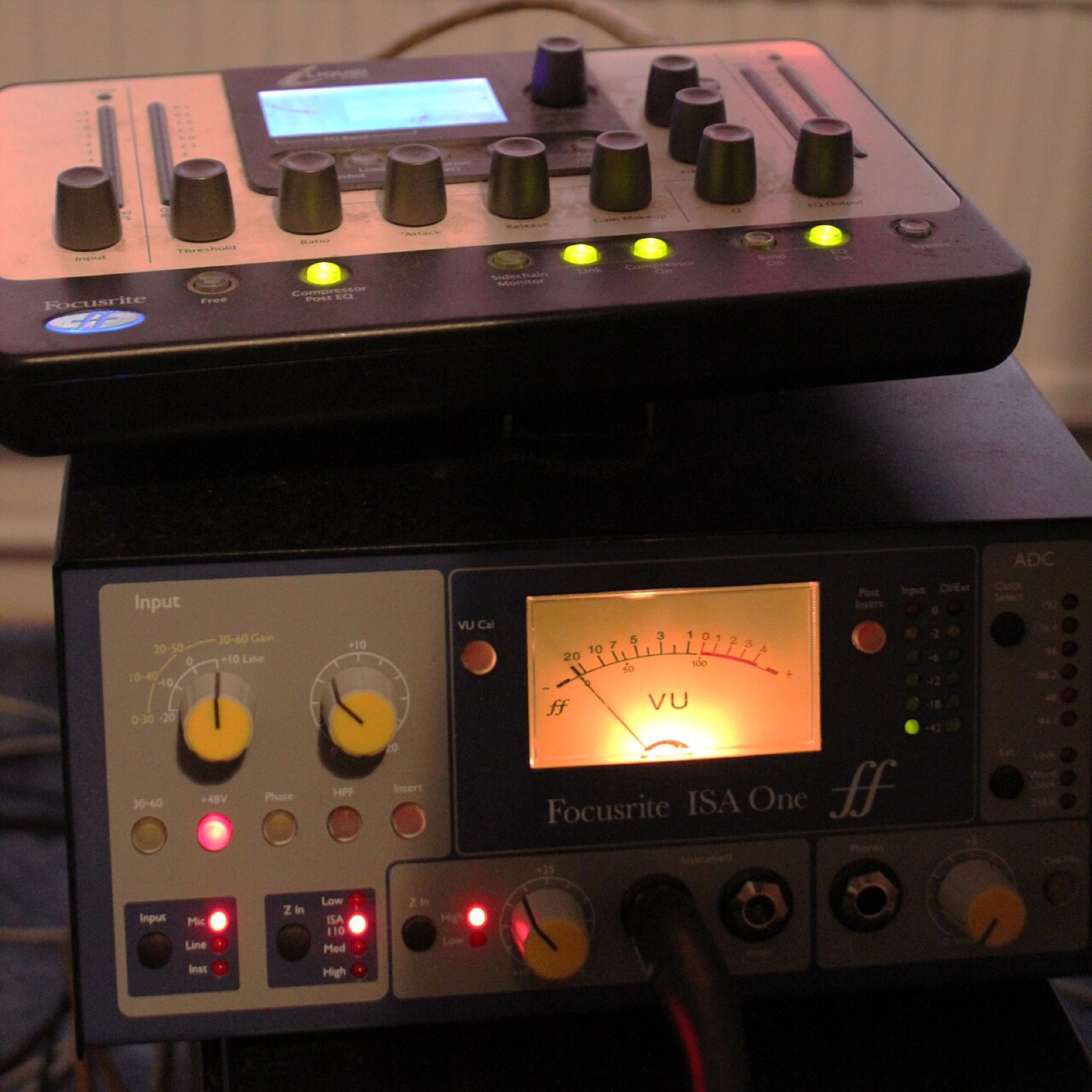
The ISA 110 combined a preamp to boost a microphone’s signal with an equalizer to shape its tone in a single module.
At the microphone input, it used a transformer from Lundahl, a Swedish manufacturer. Transformers are components that can add a distinctive sense of weight and sheen to a sound. Neve paired it with equalizer circuitry he had refined over many years.
The result had a character that would later be called “the Focusrite sound.”
- The highs open up softly, stretching out until you can almost see the air around them.
- They stay smooth, without turning harsh or piercing.
- Vocals and instruments come forward with clear, defined edges.
If the Neve 1073 sounds “thick and warm,” the ISA 110 sounds “bright and clear.” They came from the same engineer, but aimed in slightly different directions. That’s part of what makes the contrast interesting.
The ISA 110 modules are said to still be at work at AIR Lyndhurst Studios in London.
“I Prefer This to the SSL Input”
Word about the ISA 110 spread quickly.
SSL consoles were all the rage in studios at the time. But some studios began using ISA 110 racks in place of the SSL at the recording input—the first point in the signal chain.
“Use the convenient SSL console, sure. But use Focusrite for the microphone sound.”
That’s how special the ISA 110 sounded.
Chapter 3 — The Dream Console, Forte, and a Sudden End
As its reputation grew, customers began asking for more.
“Don’t just make modules. Build us a whole console.”
Neve assembled a team. Their workplace was an abandoned village school near Newmarket in Suffolk, eastern England. In its old classrooms, the engineers set to work on a massive console.
Alongside the ISA 110, they developed new modules such as the ISA 115 and ISA 130. These came together in a large-format console.
They called it Forte, a musical term meaning “loud” or “strong.”
Two Consoles, Then Liquidation
Forte consoles went to Electric Lady Studios in New York and Master Rock in London. Electric Lady was the legendary studio built by Jimi Hendrix.
But the dream console began draining the company’s resources.
The digital control system needed to run the console fell behind schedule. Money and time ran short. In January 1989, Focusrite went into liquidation.
Less than four years after its founding, Neve’s “second try” came to a temporary end.
🏷 Legend & Lore — How Many Fortes Were Made?
Sources disagree about how many Forte consoles were built.
Some accounts say there were only two. Others say eight were ordered, or that eight were built. What’s clear is that consoles went to Electric Lady and Master Rock—and that they were all handmade and produced in very small numbers.
Today, Forte is remembered as a “phantom console.”
Chapter 4 — The Man Who Carried It Forward: Phil Dudderidge
Someone stepped in quickly to pick up the fallen company’s assets.
Phil Dudderidge was one of the people behind Soundcraft, a British console manufacturer.
In April 1989, Dudderidge bought Focusrite’s assets and formed a new company, Focusrite Audio Engineering.
He wanted to preserve the circuits Neve had left behind. He rebuilt and continued selling the ISA 110 and ISA 130, then created a new console around them.
The Focusrite Studio Console, introduced in 1990, earned a strong reputation. Only about ten were made, though. It remains a celebrated piece of gear known to a select few.
1993 — The “Red” Series
Then, in 1993, Focusrite released the series that would define the company’s identity.
The Red series.
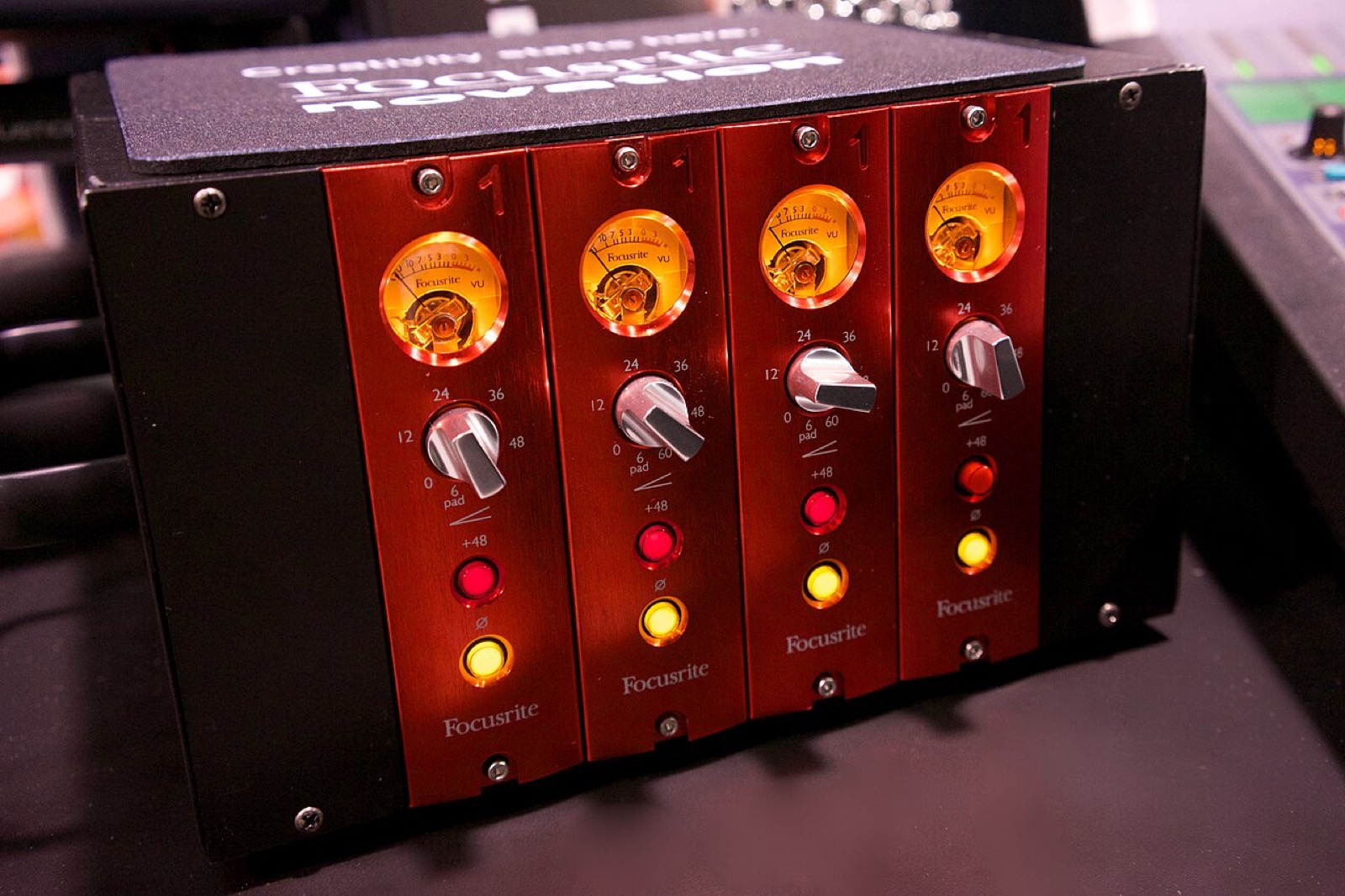
These units had thick aluminum front panels finished in vivid red. Inside were further refinements of the ISA 110 and ISA 130 circuits, in a lineup that included microphone preamps, equalizers, and compressors.
The header.jpg image shows the Red 1, a later compact module that brought the series’ circuitry into a smaller format.
The red born here became Focusrite’s signature color. The red Scarlett on desks today is a grandchild of those celebrated machines.
Chapter 5 — From Studios to Everyone’s Desk
Recording changed dramatically in the 2000s.
The era of recording at home on a personal computer, rather than in a large studio, had arrived.
Focusrite moved with the shift. After the Saffire line, which connected to computers over FireWire, it released the USB-connected Scarlett line around 2011.
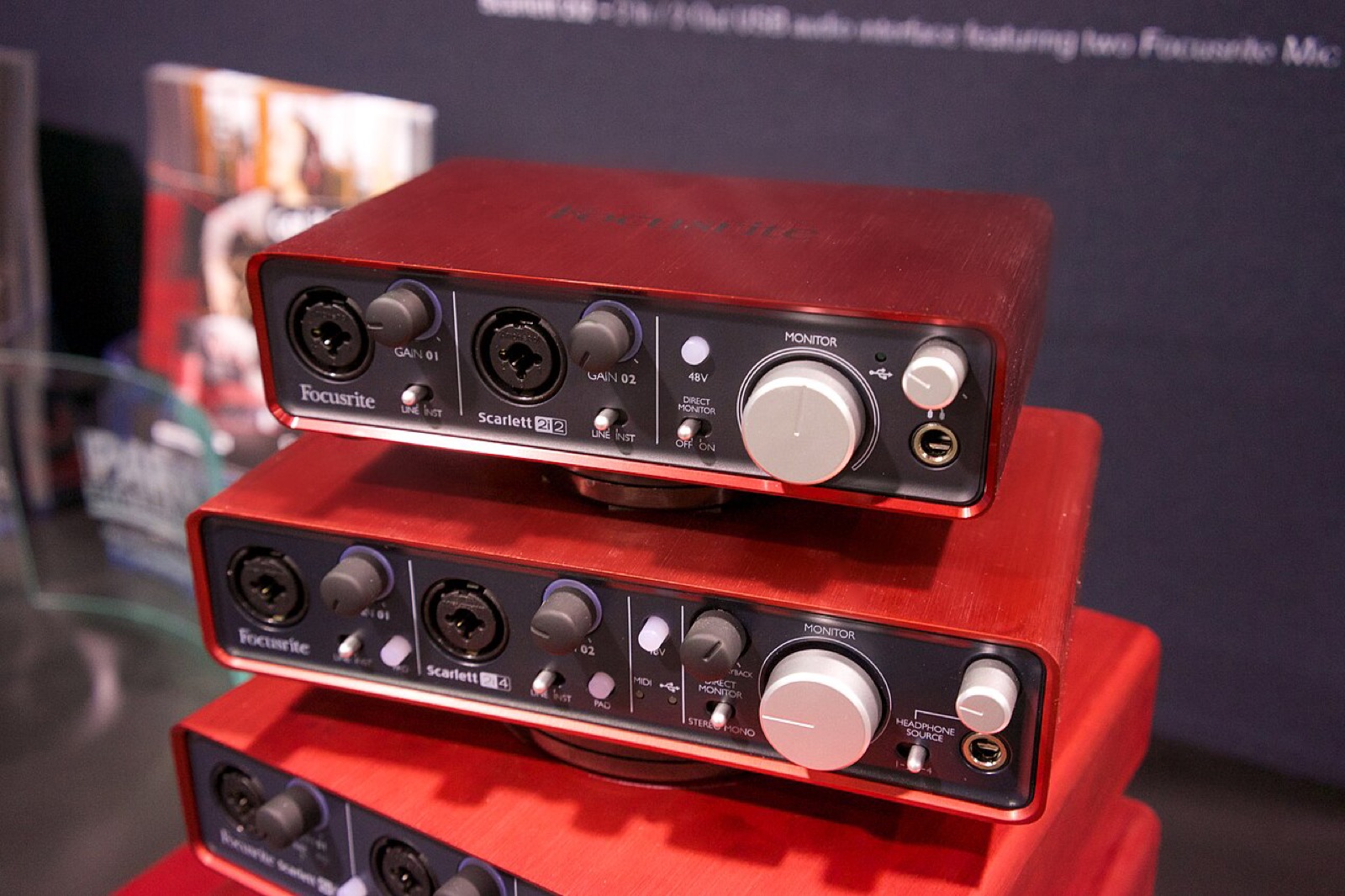
The first model, the Scarlett 2i2, wore a red aluminum body instead of the black metal boxes that came before it. It carried the Red series’ color forward in a look you could recognize as Focusrite at a glance.
The “Best-Selling” Interface
Scarlett sales took off.
The company said that more than four million people were using Scarlett as of 2021. The music magazine Sound On Sound called it “probably the world’s best-selling computer audio interface.” The “probably” is a fair touch: the company doesn’t publish exact sales figures.
In August 2023, the fourth generation of Scarlett arrived.
The Company Grew, Too
Focusrite grew into a much larger company as well.
- 2004: Acquired Novation, a synthesizer manufacturer.
- 2014: Listed on the London Stock Exchange’s AIM market.
- 2019: Acquired ADAM Audio, a studio monitor maker, and Martin Audio, a PA speaker company.
- 2021: Acquired Sequential, the legendary synthesizer maker.
The small company that once built consoles in a school classroom had become a major music equipment group.
Chapter 6 — A Few Tips for Using a Scarlett
Here are a few pointers for getting started with a Scarlett.
Keep the Input in the Green
Connect a microphone or guitar, then raise the gain knob a little at a time. The light around the knob is fine while it’s green. If it turns red, your signal is clipping.
Aim for the light to stay just in the green at your loudest vocal or instrument level. Recording a little quieter than you think you need is fine—you can turn it up later.
Try the “AIR” Button
Scarlett models from the third generation onward have an AIR button.
According to the manufacturer, it recreates the character of Focusrite preamps that use transformers, including the ISA 110. Press it, and the highs brighten softly while vocals come forward.
Try it on acoustic guitar or a voice that sounds a little dull. With one button, you can get a hint of the sound made for George Martin in 1985.
Set Guitar to “INST”
When plugging an electric guitar or bass straight in, press the INST button. If you forget, the sound may be quiet or muddy. It’s one of the most common snags for first-time users.
Epilogue — What the Red Really Means
Rupert Neve didn’t stop building gear after leaving Focusrite. He moved to the United States, kept making equipment with a new company, and died in February 2021 at the age of 94.
Focusrite issued a message of thanks after his death. More than 30 years after its founder had left, the company was still honoring his name and his circuits.
An engineer gave up his name and built a sound again from scratch. In the hands of those who carried it forward, that sound took on a red finish and spread around the world.
That little red box on your desk today gets its color from the Red series of 1993—and, further back, from the uncompromising sound created in 1985 for a studio on a Caribbean island.
Focusrite Timeline
- 1926: Rupert Neve is born.
- 1985: Neve founds Focusrite and develops the ISA 110 at George Martin’s request.
- Late 1980s: Develops the large-format Forte console; units go to Electric Lady Studios and Master Rock.
- January 1989: Focusrite goes into liquidation.
- April 1989: Phil Dudderidge acquires the assets and forms Focusrite Audio Engineering.
- 1990: The Focusrite Studio Console is introduced; about ten are made.
- 1993: The Red series is released.
- 2004: Acquires Novation.
- Around 2011: The Scarlett 2i2 is released.
- 2014: Lists on the AIM market.
- 2019: Acquires ADAM Audio and Martin Audio.
- 2021: Rupert Neve dies at 94; acquires Sequential.
- 2023: The fourth-generation Scarlett arrives.
References
- Wikipedia, “Focusrite” (English edition)
- Focusrite official site (“40 years of Focusrite,” “The story of Focusrite ISA,” and “Remembering Rupert Neve (1926–2021)”)
- Reverb, “The High-End History of Focusrite—From Handbuilt Consoles to Scarlett Interfaces”
- Bobby Owsinski, “The History of Focusrite Consoles”
- Sound On Sound (articles about the Scarlett series)
- MusicTech, “Focusrite Scarlett 4th Gen story”
Photo credits
- Header image, “Focusrite Red 1 500 Series Mic Pre - 2014 NAMM Show” — Matt Vanacoro / Wikimedia Commons / CC BY 2.0
- “Focusrite Liquid Mix & ISA One” — Tim Sheerman-Chase / Wikimedia Commons / CC BY 2.0
- “Focusrite Scarlett 2i2, 2i4, 6i6 USB2.0 Audio Interfaces - 2014 NAMM Show” — Matt Vanacoro / Wikimedia Commons / CC BY 2.0
License: CC BY 2.0 https://creativecommons.org/licenses/by/2.0/