The Gray Box Slotted into Radio Station Racks — Germany’s V72, V76 and Klangfilm
☕ A coffee-length story — about a 10-minute read. Enjoy it as a story, not a research assignment.
The first machine the Beatles’ voices passed through wasn’t built in a London studio. It was a small, plug-in amplifier designed for German radio stations.
💡 What you’ll learn
- Why broadcast amplifiers were designed as boxes that slid into racks
- How the V72 became the “voice entrance” to Abbey Road’s consoles
- How the V72 and V76 differ, and how to use a tube preamp today
Prologue — A quiet broadcast station after the war
Hamburg, West Germany, 1949.
Only a few years had passed since the war. Rubble still lay in parts of the city.
In those years, radio stations became essential to everyday life. News, music, drama. People wanted to hear voices and music again.
Broadcast engineers faced a challenge: how could every station handle sound in the same way and deliver the same quality?
One answer was a small gray metal box: an amplifier that slid into a rack like a drawer.
Its name was the V72.
📝 About this story
This story draws on books, trade-press articles, and material from manufacturers and dealers. It aims to stick to the facts, but records of German broadcast equipment can be sparse, and sources sometimes differ. Where they do, the text says so. Sources are listed at the end.
Chapter 1 — The machine that brought a microphone’s voice up
What is a preamp?
The electrical signal from a microphone is tiny. On its own, it can’t reach a recorder or broadcast equipment at a useful level.
That’s why you need a microphone preamplifier, or preamp. It brings the mic’s small signal up to a workable level.
A preamp is the “front door” of a recording. If the sound gets muddy here, no amount of work later can fully clean it up. That’s why a preamp’s sound can shape the character of an entire recording.
The demands of broadcasting
Broadcast preamps had to meet demands that studio gear didn’t always face:
- Run for hours every day without stopping
- Be quick to replace when something broke
- Follow the same standard at every station
To meet all three, German broadcasters chose a cartridge-style amplifier that slid into a rack.
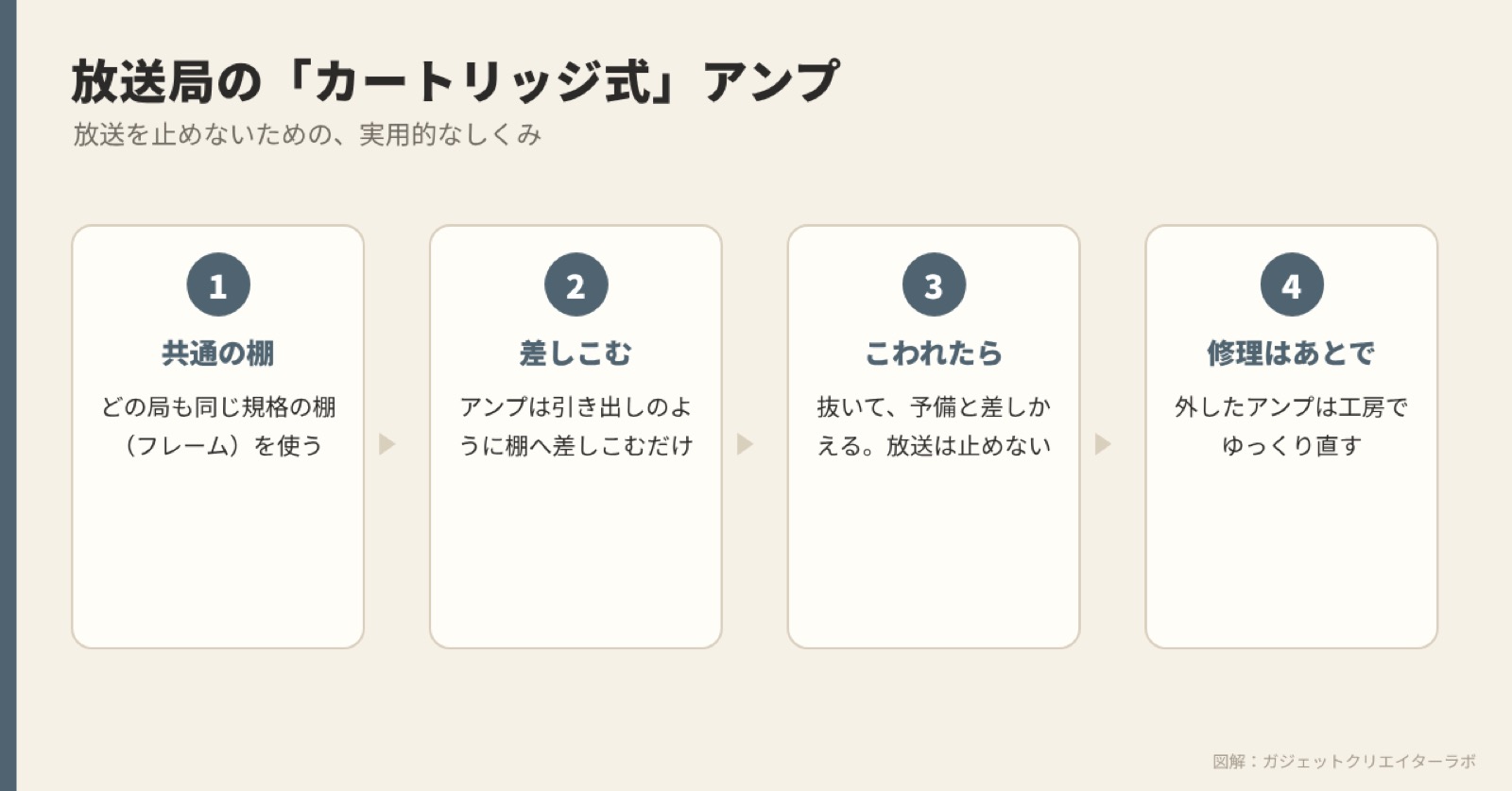
If one failed, you pulled it out and plugged in a spare. Repairs could wait until the unit was back at the workshop. It was a practical way to keep broadcasts on the air. The failed unit could be checked and repaired later, while the station continued working with its spare.
(Coming up: the broadcast research lab behind the V72, its journey to Abbey Road in London, the two-stage V76, and the story of Klangfilm, which began with movie sound.)