1959–1966 — The Day Four Men Arrived in America — The Beatles, Motown and ‘Sukiyaki’
Prologue — Sunday Night, 8 p.m., February 1964
Sunday night, February 9, 1964.
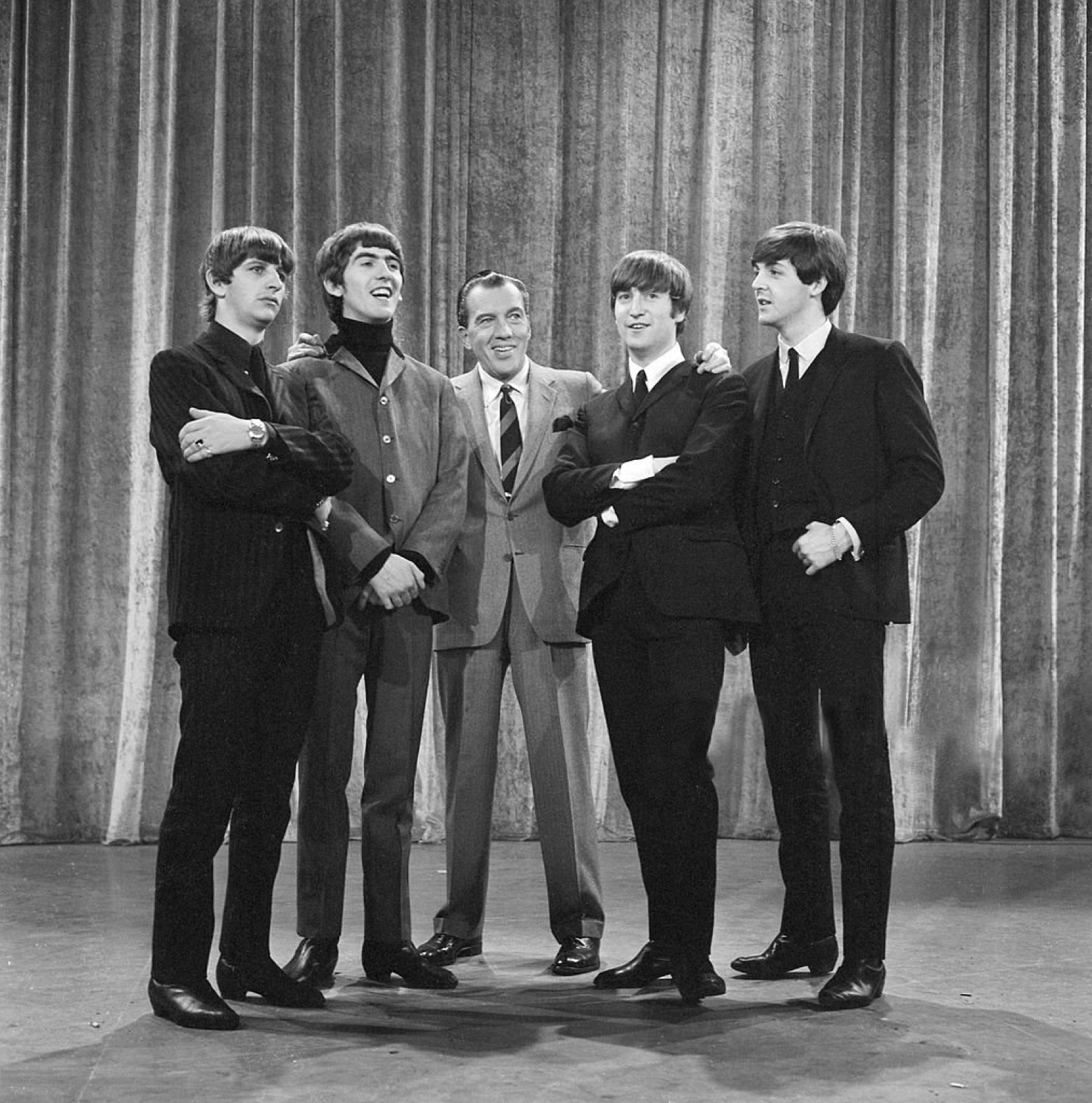
In homes across America, televisions were tuned to the same program: CBS’s popular The Ed Sullivan Show. That night’s guests were a British quartet who had landed at New York’s airport just two days earlier.
When the host introduced them, a scream of excitement rose from the studio audience. John Lennon, Paul McCartney, George Harrison, and Ringo Starr. Matching suits, hair falling over their foreheads. The Beatles.
An estimated 73 million people watched that night’s broadcast—more than a third of the U.S. population.
Just a few months earlier, in November 1963, America had been plunged into grief by the assassination of President Kennedy. As winter came to an end, the bright rock and roll brought over from Britain felt, some said, like opening a window to let in a fresh breeze.
Last time, we saw rock and roll born in America, then fall quiet for a while after Elvis enlisted. This time, it’s the story of how that flame grew in Britain before making its way back across the Atlantic and “landing” in America.
Chapter 1 — Harbor Town Kids and Piles of Records
Sailors’ Records in Liverpool
Liverpool, a port city in northwest England. Ships crossing the Atlantic between Britain and America called here, and American records are said to have arrived in the city early.
In the summer of 1957, 15-year-old Paul McCartney met the band of 16-year-old John Lennon while it was playing at a church fair. The two were obsessed with Elvis, Chuck Berry, Little Richard, and Buddy Holly—the stars of our last story.
The Hamburg Apprenticeship
In 1960, the Beatles got a job playing clubs in Hamburg, a port city in Germany. They spent months playing rock and roll for hours each day in front of drunken sailors. That “apprenticeship,” it’s said, taught them how to fire up a crowd and gave their sound real muscle.
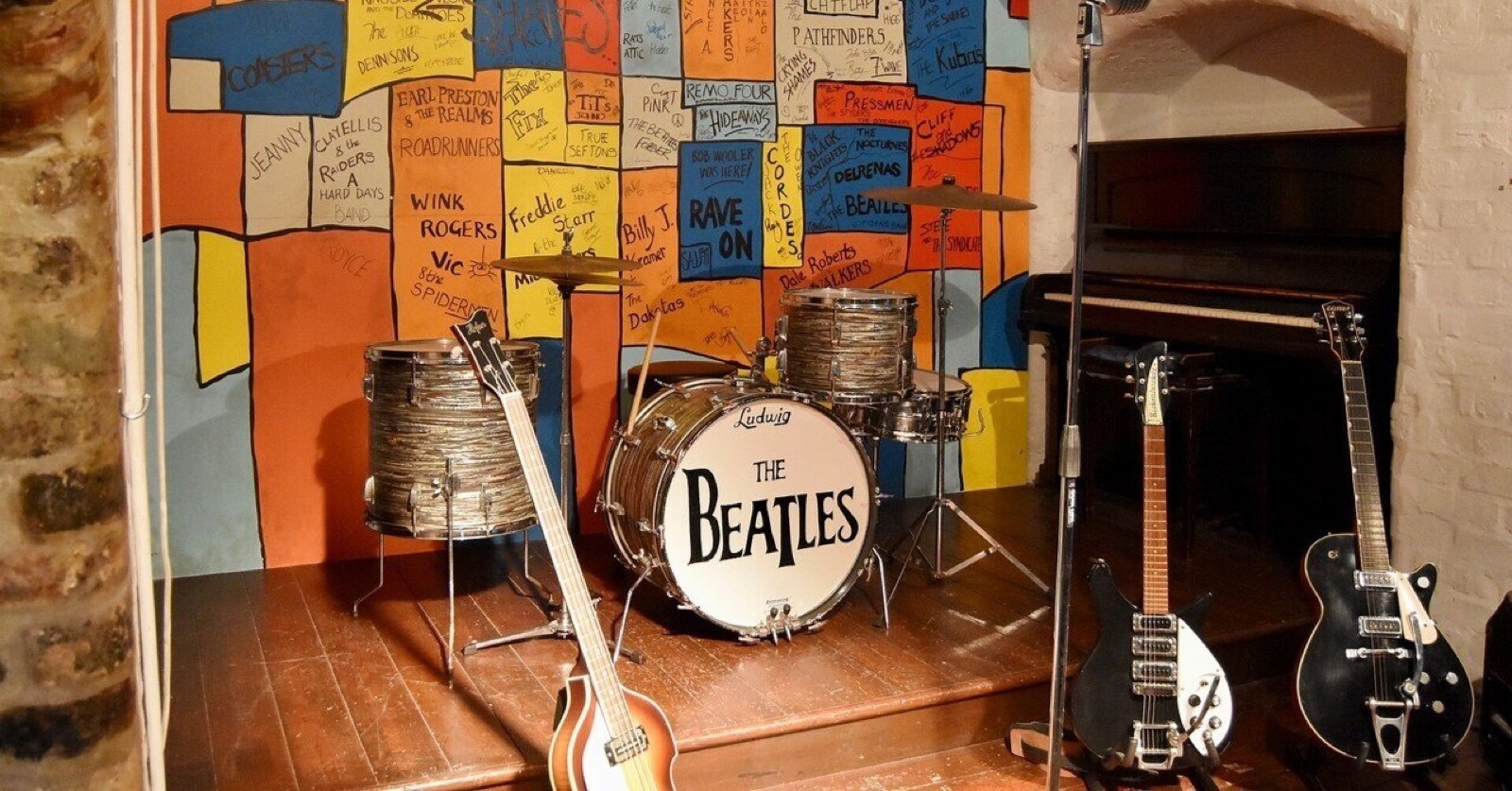
Back in Liverpool, the Cavern Club, a basement venue, became their home base. Brian Epstein, who ran a record store, saw them there. He would become their manager.
Abbey Road and George Martin
In 1962, the Beatles signed with EMI’s Parlophone label and began recording at EMI Studios in London, later known as Abbey Road Studios. Their producer was George Martin, who had worked on comedy records and other releases.
About a year after their debut single, “Love Me Do,” the Beatles had become a phenomenon in Britain. In October 1963, they recorded “I Want to Hold Your Hand” not on the two-track machine they had used before, but on a four-track tape recorder. Those “four lines” would go on to transform their music (more on that in Chapter 3).
April 1964 — The Top Five
In 1964, “I Want to Hold Your Hand” reached No. 1 in the U.S., and the Beatles’ appearance on The Ed Sullivan Show sent their popularity soaring.
Then, on the Billboard chart dated April 4, 1964, Beatles songs occupied all five top spots. It’s a record that still gets talked about as legend.
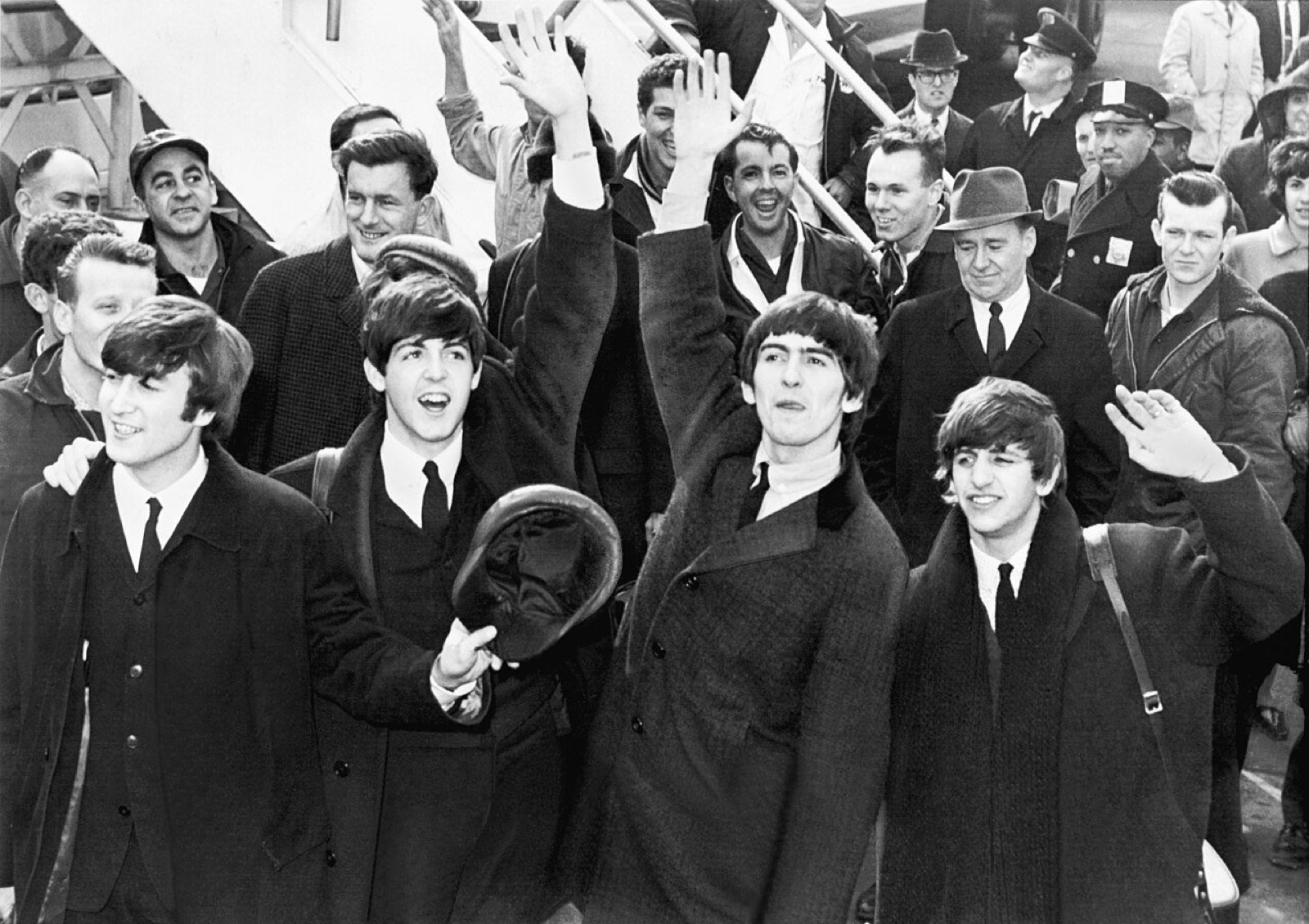
After the Beatles came the Rolling Stones, the Kinks, the Who, the Animals, and wave after wave of British bands on the American charts. The phenomenon became known as the British Invasion.
British kids who idolized Black American music reshaped it in their own way, then sent it back to America. Rock and roll had come home.
Chapter 2 — America Strikes Back: Motown and the Wall of Sound
America wasn’t simply being pushed aside by British bands. A new kind of “factory” and a new breed of craftspeople were building a sound of their own.
Hitsville in Detroit
In January 1959, in the automobile city of Detroit, a young man named Berry Gordy started a record company with $800 borrowed from his family. It would become Motown.
Gordy had worked in an auto plant. If cars could be assembled on a conveyor belt, why not make hit songs through a kind of assembly line? He built a hit-making system under one roof: songwriting teams, a house band, coaching in singing and stage presence, and meetings to decide which new songs to release.
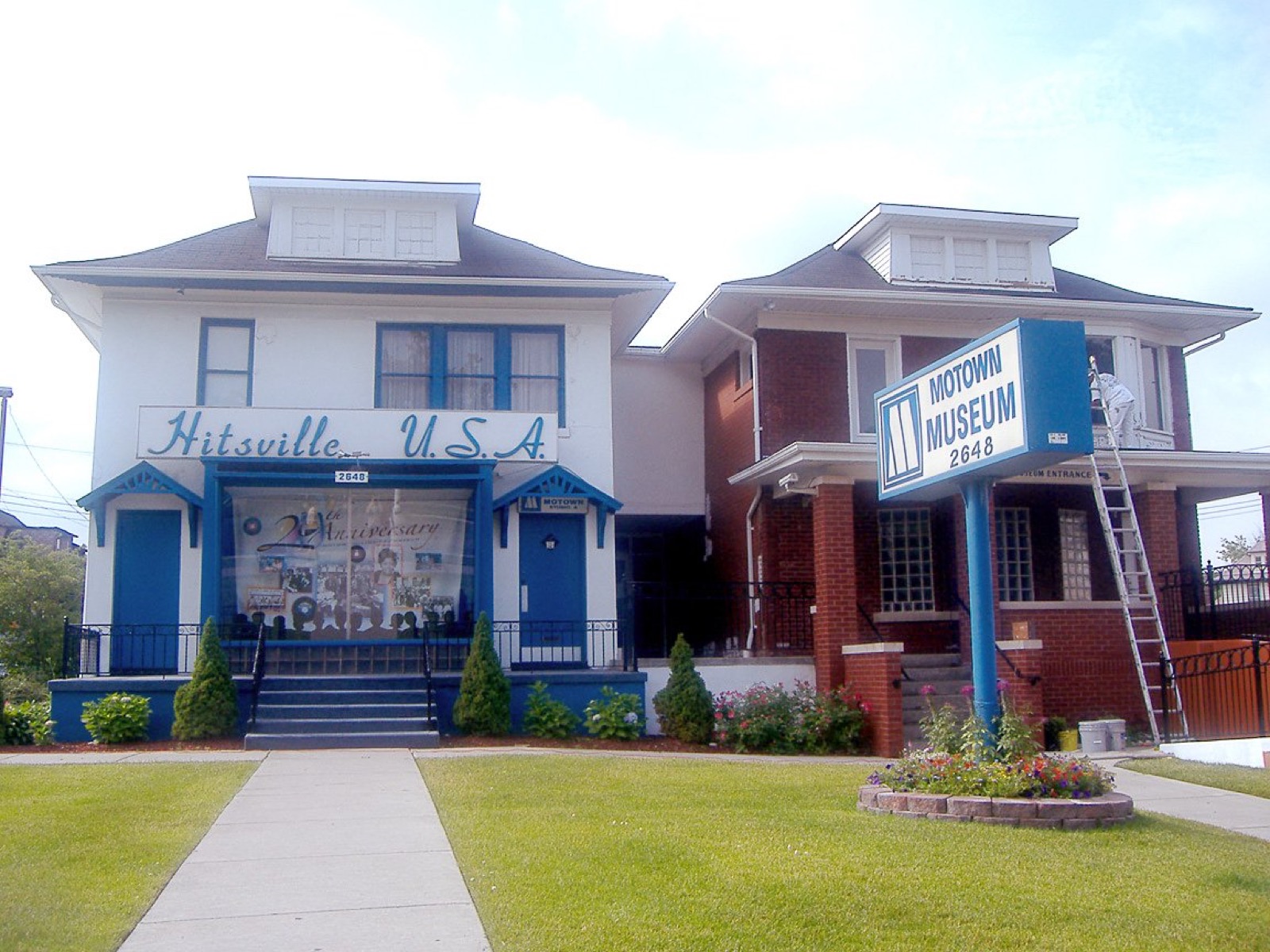
In front of the company’s headquarters stood a sign reading “HITSVILLE U.S.A.” In the small studio downstairs, the house band, the Funk Brothers, recorded performances for hundreds of songs.
The Supremes, the Temptations, Marvin Gaye, and Little Stevie Wonder, who scored a No. 1 hit at 13. Motown’s songs were loved by young Black and white listeners alike, and came to be called “the sound of young America.”
Phil Spector’s Wall of Sound
On the West Coast in Los Angeles, a young producer named Phil Spector was creating a new sound by a very different method.
Several guitars, several pianos, drums and percussion—musicians packed into one room, playing together. He sent that sound into the studio’s echo chamber, letting it reverberate until it became one huge mass of sound.
That was the Wall of Sound. The Ronettes’ “Be My Baby,” released in 1963, is a signature example. Many people will recognize the opening: boom, ba-boom, on the drums.
The Beach Boys and Pet Sounds
Brian Wilson of the Beach Boys was stunned by Spector’s sound. He stopped touring, stayed in the studio, and drew on dozens of musicians to create the 1966 album Pet Sounds.
The Beatles’ Rubber Soul had inspired Wilson to make it; then Pet Sounds inspired the Beatles in turn. Their back-and-forth across the ocean helped push pop music to a new level.
The Day Dylan Went Electric
A major upheaval was taking place in folk music, too.
July 1965, the Newport Folk Festival. Bob Dylan, a leading voice of a generation that sang about society with acoustic guitar, took the stage with an electric guitar and a band behind him. The audience is said to have booed—though another account says the sound was the problem.
But folk rock grew out of that moment, and rock songs that had something to say in their lyrics became the norm. That same year, the Byrds made a hit with Dylan’s song, colored by the sparkling sound of a Rickenbacker 12-string guitar.
Chapter 3 — Four Tracks and Bigger Amplifiers
The Magic of Four Tracks
One thing you can’t leave out when talking about recording in this era is the number of tape tracks.
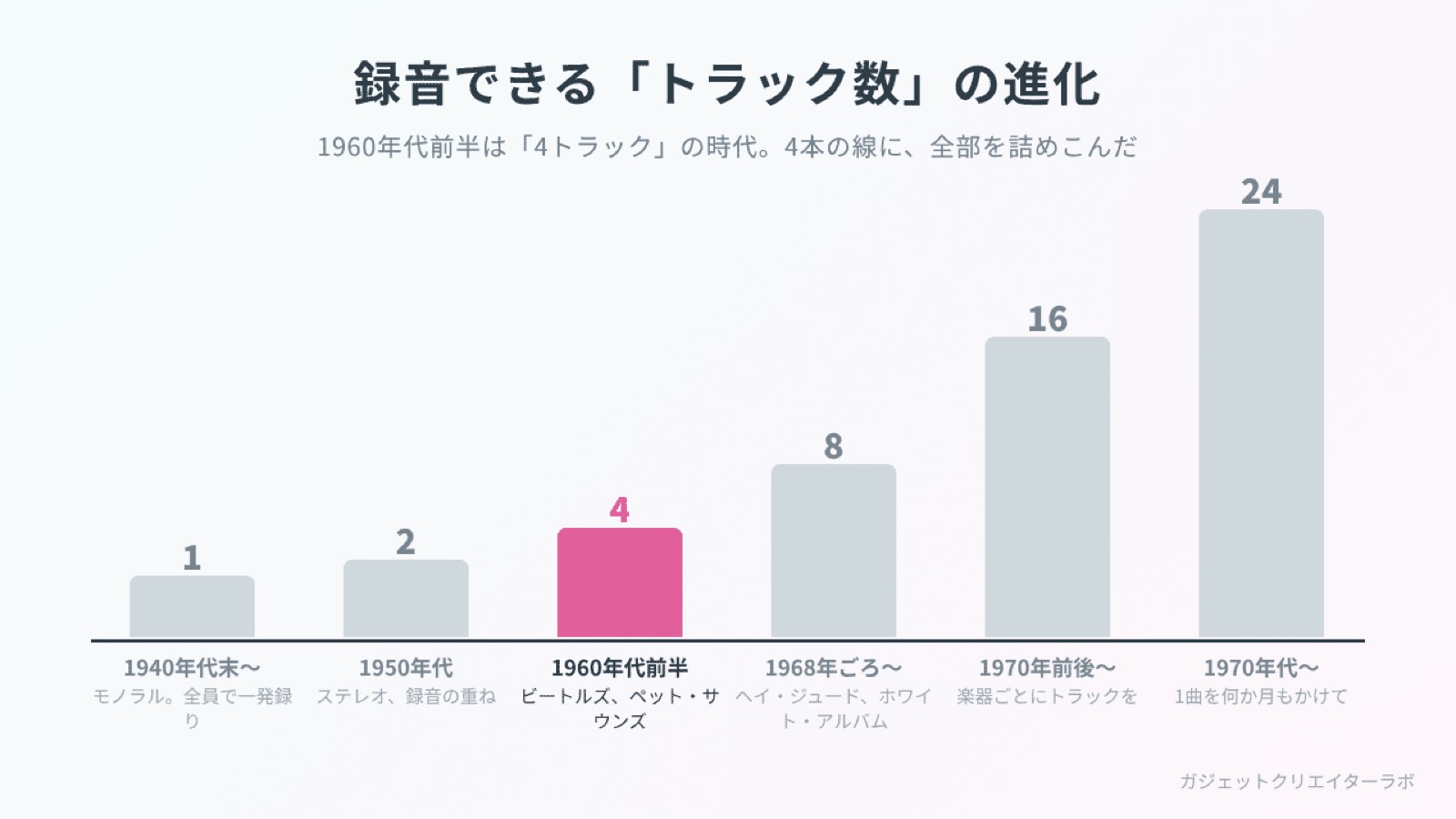
Many recordings in the 1950s were mono or two-track. The usual approach was to record the performance and vocals almost all at once.
With four tracks, you could, for example, put the rhythm on track one, another instrument on track two, the lead vocal on track three, and backing vocals on track four. It became much easier to redo just the vocal later or layer on harmonies.
For those of us used to dozens of tracks in today’s DAW sessions, four seems like very little. But to engineers back then, four tracks were a magic tool. Figuring out how to make the most of those four tracks became one of the big challenges of the next era.
Distortion Becomes a Deliberate Choice
In 1965, the Rolling Stones’ “(I Can’t Get No) Satisfaction” reached No. 1 in the U.S. That famous guitar riff had a buzzy, distorted sound run through an effect called fuzz.
Last time, we talked about the broken amplifier on “Rocket 88.” Until then, distortion was something you got when a machine wasn’t working properly. Now you could put a small box at your feet and create it on purpose, whenever you wanted.
When you add distortion or an amp simulator to a guitar in a DAW today, one of the roots of that sound is this idea of deliberately making it distort.
The Compact Cassette Arrives
Another small piece of gear was born in this era. In 1963, the Dutch company Philips introduced the Compact Cassette—the cassette tape.
At first, it was designed as a way to record speech. But this palm-sized tape recorder, one anyone could use, would eventually give rise to a culture of recording music yourself, carrying it around, and swapping it with friends. That story leads to a small Japanese-made machine we’ll talk about in Chapter 5.
Amplifiers Loud Enough to Beat the Screams
The Beatles’ popularity created a new problem onstage: the audience screamed so loudly that no one could hear the band play.
VOX, the British company whose amplifiers the Beatles used, built more powerful amps for them. Even so, in front of more than 50,000 people at New York’s Shea Stadium in 1965, the band members are said to have barely heard their own sound.
In 1966, the Beatles Stopped Touring
August 29, 1966, Candlestick Park in San Francisco. The Beatles played their final touring concert there.
Rather than play somewhere they couldn’t hear themselves over the screaming, they wanted to make music that could only be created in a studio. That was how the four of them had come to feel. Around this time, the music business was growing into a vast industry. In 1965, for example, the giant corporation CBS bought Fender, the guitar maker.
A band that began in a small club filled stadiums, then withdrew to the studio. That’s where the next story begins: the era when the studio itself became an instrument.
Chapter 4 — 🇯🇵 Meanwhile, in Japan
TV Music Shows and the Peanuts
In 1959, the twin-sister duo the Peanuts made their debut. That same year, the TV music show The Hit Parade began. Its “cover pop” performances—Japanese singers singing overseas hits in Japanese—became popular. The trend we talked about last time, of Japanese singers performing American music, blossomed on television.
“Sukiyaki” Reaches No. 1 in America
In 1961, Kyu Sakamoto released “Ue o Muite Arukō,” known in English as “Sukiyaki.” The lyrics were written by Rokusuke Ei and the music by Hachidai Nakamura. It’s a melody that holds brightness and sadness together, easy to whistle.
The song crossed the ocean and was introduced in English-speaking markets under the unrelated title “SUKIYAKI.” Apparently, the idea was to give it a Japanese word that would be easy to remember.
Then, in June 1963, the song—sung in Japanese—reached No. 1 on the U.S. Billboard chart. It stayed there for three straight weeks. This happened a little over six months before the Beatles landed in America.
The Electric Guitar Storm
In 1965, the American instrumental band the Ventures caused a sensation on tour in Japan. Young people across the country picked up electric guitars, imitating that “teke-teke-teke” tremolo sound. The electric guitar boom had arrived.
Japanese electric bands like Takeshi Terauchi and the Bunnys grew popular, and television even aired elimination contests for electric bands. Actor and singer Yūzō Kayama became a young people’s idol in films where he sang while playing electric guitar. His 1965 hit “Kimi to Itsumademo” was a huge success.
Some adults, meanwhile, called electric guitars delinquent, and some schools are said to have banned them. Rock and roll troubled grown-ups in Japan just as it had in America.
The Beatles Come to Japan in 1966
On June 29, 1966, the Beatles arrived in Japan. From June 30 to July 2, they gave five performances at the Nippon Budokan.
Some objected to holding a rock concert at a venue considered sacred to the martial arts. A large security force was deployed, and the shows took place under tight security.
Still, many young people who saw the real Beatles at the Budokan or watched the broadcasts thought, “I want to be in a band, too.” Around the same time, bands known as the Group Sounds were beginning to make their debuts in Japan. Their huge boom is a story for next time.
Epilogue — The Four Men Leave the Stage
In the summer of 1966, after finishing their final tour, the Beatles returned to a London studio.
It didn’t matter if they couldn’t reproduce it live. They could reverse the tape, bring in an orchestra, or use Indian instruments. They wanted to make sounds that could only be made in the studio.
From autumn into winter that year, they stayed in the studio for weeks, working on the recording of a song that would later be called “Strawberry Fields Forever.”
Rock and roll was on the verge of a major transformation—from music made for dancing into music made for close listening. Next time: 1967, the year the studio itself became an “instrument.”
1959–1966 Timeline
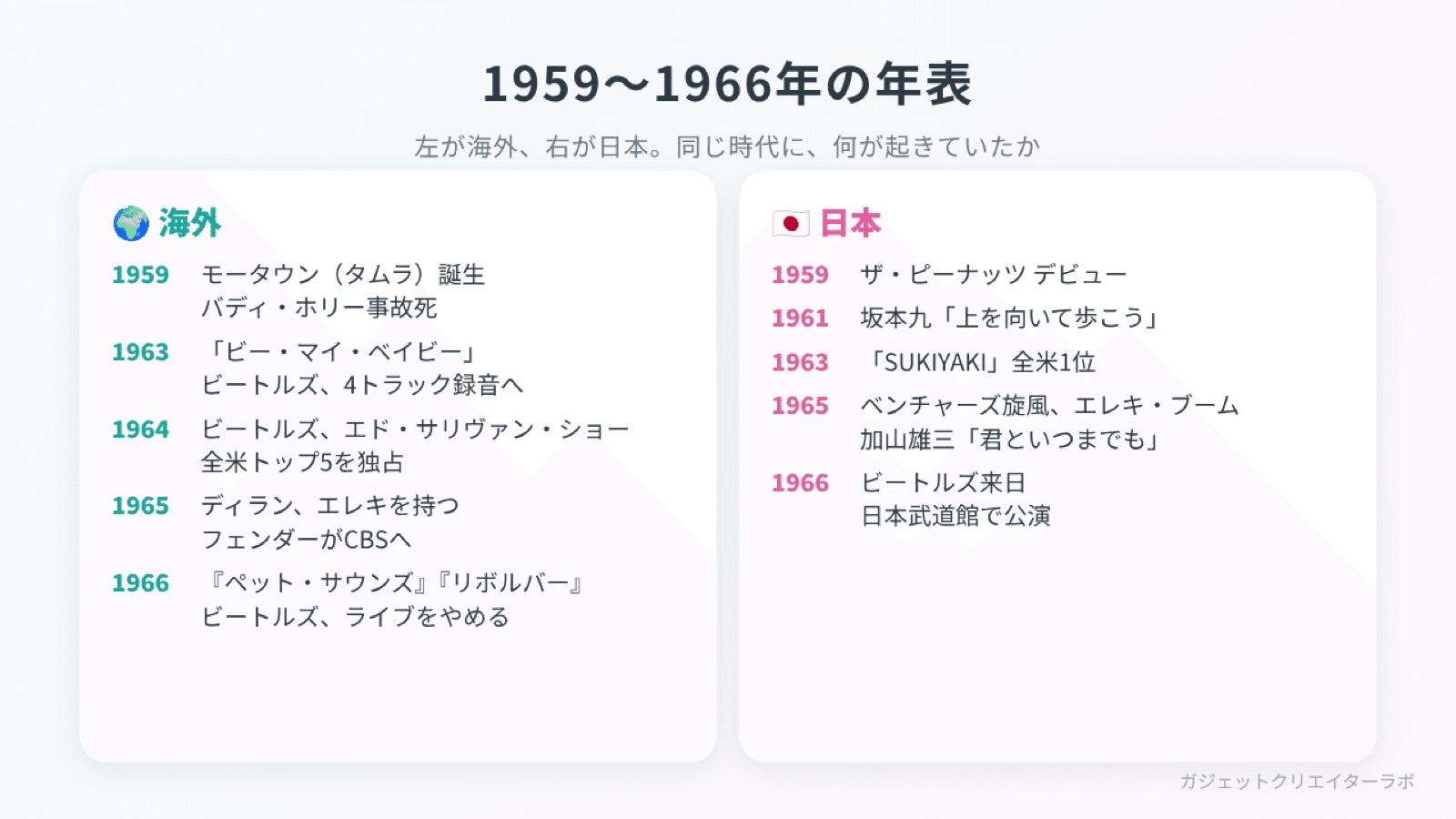
Overseas
- 1959: Motown (Tamla Records) is founded. Buddy Holly dies in a plane crash.
- 1962: The Beatles debut with “Love Me Do.”
- 1963: The Ronettes release “Be My Baby.” The Beatles record “I Want to Hold Your Hand” on four-track tape.
- 1964: The Beatles appear on The Ed Sullivan Show. In April, they occupy the top five spots on the U.S. chart.
- 1965: Dylan goes electric at Newport. The Byrds release “Mr. Tambourine Man.” CBS acquires Fender. The Beatles play Shea Stadium.
- 1966: Pet Sounds is released. The Beatles play their final touring concert.
Japan
- 1959: The Peanuts debut. The Hit Parade begins airing.
- 1961: Kyu Sakamoto releases “Ue o Muite Arukō.”
- 1963: “Sukiyaki” reaches No. 1 in the U.S. for three consecutive weeks.
- 1965: The Ventures’ Japanese tour sparks a boom in electric guitars. Yūzō Kayama releases “Kimi to Itsumademo.”
- 1966: The Beatles visit Japan and play five shows at the Nippon Budokan.
References
- Wikipedia (English): “The Beatles in the United States,” “The Ed Sullivan Show,” “British Invasion,” “Motown,” “Hitsville U.S.A.,” “The Funk Brothers,” “Wall of Sound,” “Pet Sounds,” “Electric Dylan controversy,” “The Beatles’ 1966 US tour”
- Wikipedia (Japanese): “Ue o Muite Arukō,” “The Peanuts,” “The Hit Parade,” “Electric guitar boom,” “The Beatles’ concerts in Japan”
Photo credits
- Header image, “Cavern Club (replica) - The Beatles Story, Liverpool” — Nick Amoscato / Wikimedia Commons / CC BY 2.0 (cropped)
- Diagram: created by the author
- Photo: The Beatles with Ed Sullivan (1964) — CBS Television / Public domain (Wikimedia Commons)
- Photo: The Beatles at the airport (1964) — United Press International / Public domain (Wikimedia Commons)
- Photo: Hitsville U.S.A. — Blob4000 / Public domain (Wikimedia Commons)