[HONDA Motorcycle History] A Legend Built to Cross the Desert — The Africa Twin and the Paris-Dakar
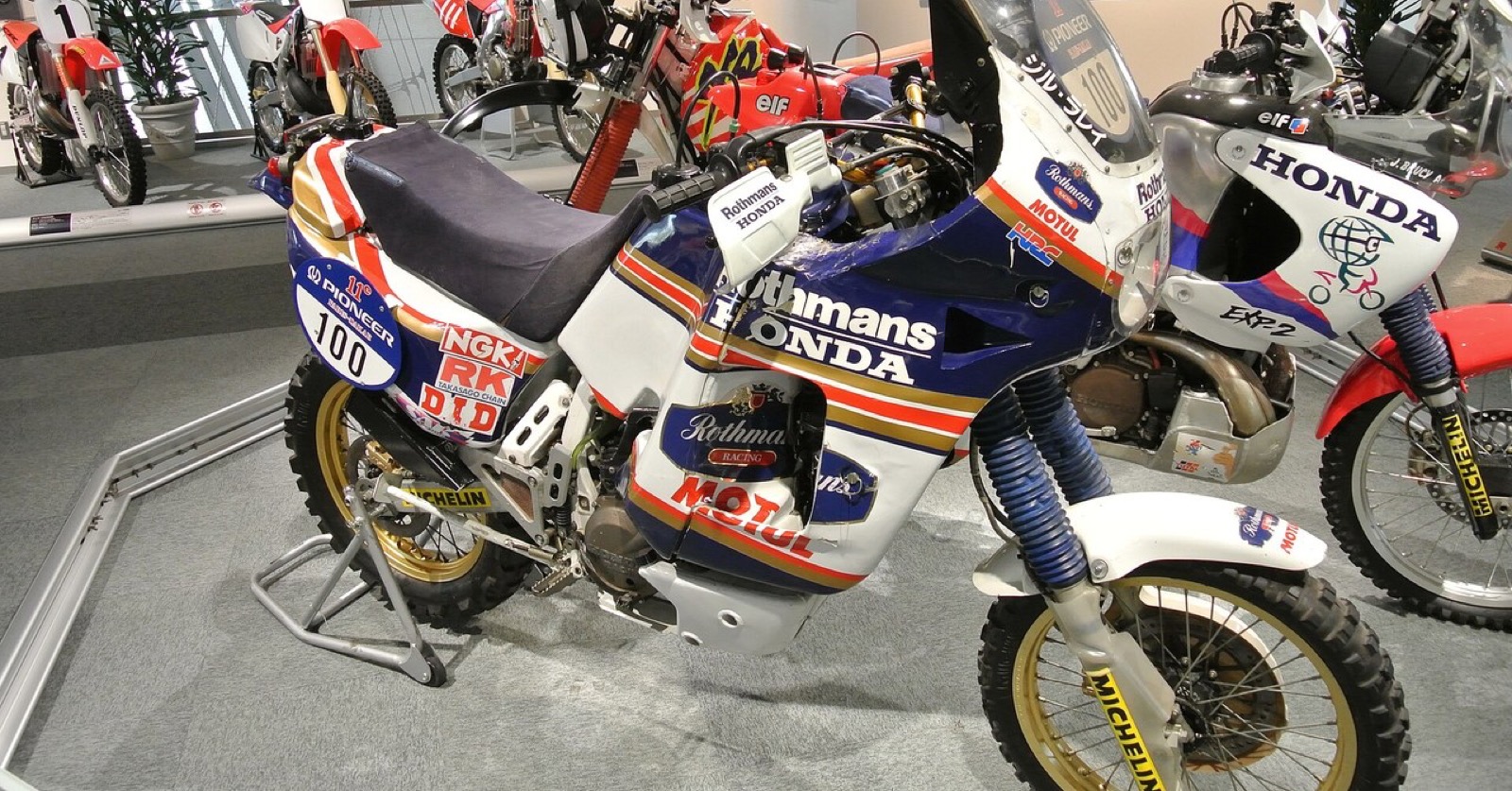
☕ A coffee-length story from GC Lab's "Motorcycle History" series, where we follow machines through the people and events behind them. This time: the factory machine Honda built to win the Paris-Dakar, once called the toughest rally in the world, and the "Africa Twin" that carried its blood onto ordinary roads.
💡 What you'll learn
- Why Honda gave up on single-cylinder engines and took on the desert with a twin
- How the four-time-winning factory NXR750 connects to the production Africa Twin
- How the Africa Twin disappeared, and came back in 2016
Prologue
A sea of sand as far as the eye can see. A single motorcycle crosses dunes that stretch to the horizon. No one is ahead of it anymore. There is no road. All the rider can rely on is a map, a compass, and instinct.
Leave a European city in winter, cross the Mediterranean, cross the Sahara, and head for Dakar, the capital of Senegal on the Atlantic coast. The distance was more than 10,000 km. The Paris-Dakar Rally, first held in 1979, would come to be called "the toughest motorsport in the world."
The sand changes completely from place to place, fine or coarse, soft or hard. It gets inside the engine and wears parts away. Fuel quality varies from town to town, and sometimes it is contaminated. Scorching days, freezing nights. The faster you go, the greater the danger. For machines and riders alike, this was literally a place where lives were on the line.
To win in this desert, Honda built a factory racing machine. And in 1988, a production bike that inherited that machine's look and technology went on sale. Its name was the "Africa Twin": a twin-cylinder bike for crossing the African desert. This is the story of a legend born for the desert.
Chapter 1 — The desert rally and the age of the single
The Paris-Dakar Rally was started by a Frenchman named Thierry Sabine. It is said that while riding a motorcycle in an African rally, Sabine got lost in the Libyan desert and wandered for days. The harshness of the desert, and its beauty. That experience gave birth to an outrageous rally running from Europe to the western tip of Africa.
The first event was in 1979. The winner was Yamaha's single-cylinder XT500. The XT500 won again in 1980. Its rider was a Frenchman, Cyril Neveu, a name that will come up again and again in this story.
In 1981 the winner was Germany's BMW, with a machine based on the R80G/S and its horizontally opposed twin.
Honda had entered that 1981 event through its French subsidiary, but with mechanical trouble it finished sixth. So in 1982 Honda got serious. Its Asaka research center handled the chassis and its racing division handled the engine, preparing a heavily modified 555 cc version of the XR500R. Neveu rode it, and he won. It was Honda's first victory in the Paris-Dakar's motorcycle division.
But in 1983 and 1984, BMW won again. BMW's engine was an 800 cc twin. The roughly 600 cc singles Honda was running could no longer keep up.
In 1985 Honda's engineers traveled to the rally to see it with their own eyes. That year Honda's machine, based on the XL600L, finished fifth, a full 3 hours 25 minutes behind the leader. The report from Honda France was harsh. Not enough power. Poor fuel economy. More than 10 kg heavier than the rival Yamaha single. And hard for a rider to service alone.
In a desert rally there are many moments when riders must fix their own machines. Ease of service mattered as much as speed.
A rally day begins before dawn. Riders navigate hundreds of kilometers of trackless terrain using a "roadbook," a booklet of route directions for the day. Their only landmarks are faint clues: a fork in a track, a dead tree, the shape of a rock. Take a wrong turn and you're lost in a sea of sand. At night they reach a camp called a "bivouac," fix their machines, sleep briefly, and set out again the next day. This goes on for more than two weeks.
What happens if your machine breaks in a place like that? You wait in the middle of the desert until a support truck arrives, while the clock keeps running. That's why not breaking, and being quick to fix when you do, was a big part of winning.