Made for Jazz, Loved Far Beyond It — Fender Jazz Bass
☕ A coffee-length story about a great instrument
About a 12-minute read. Set the research aside and enjoy this as a story.
Its name is the Jazz Bass. Yet this bass truly came into its own on rock and funk stages. And in the end, one young player pulled out its frets and made it a true “jazz instrument.”
Prologue — The Night the Frets Came Out
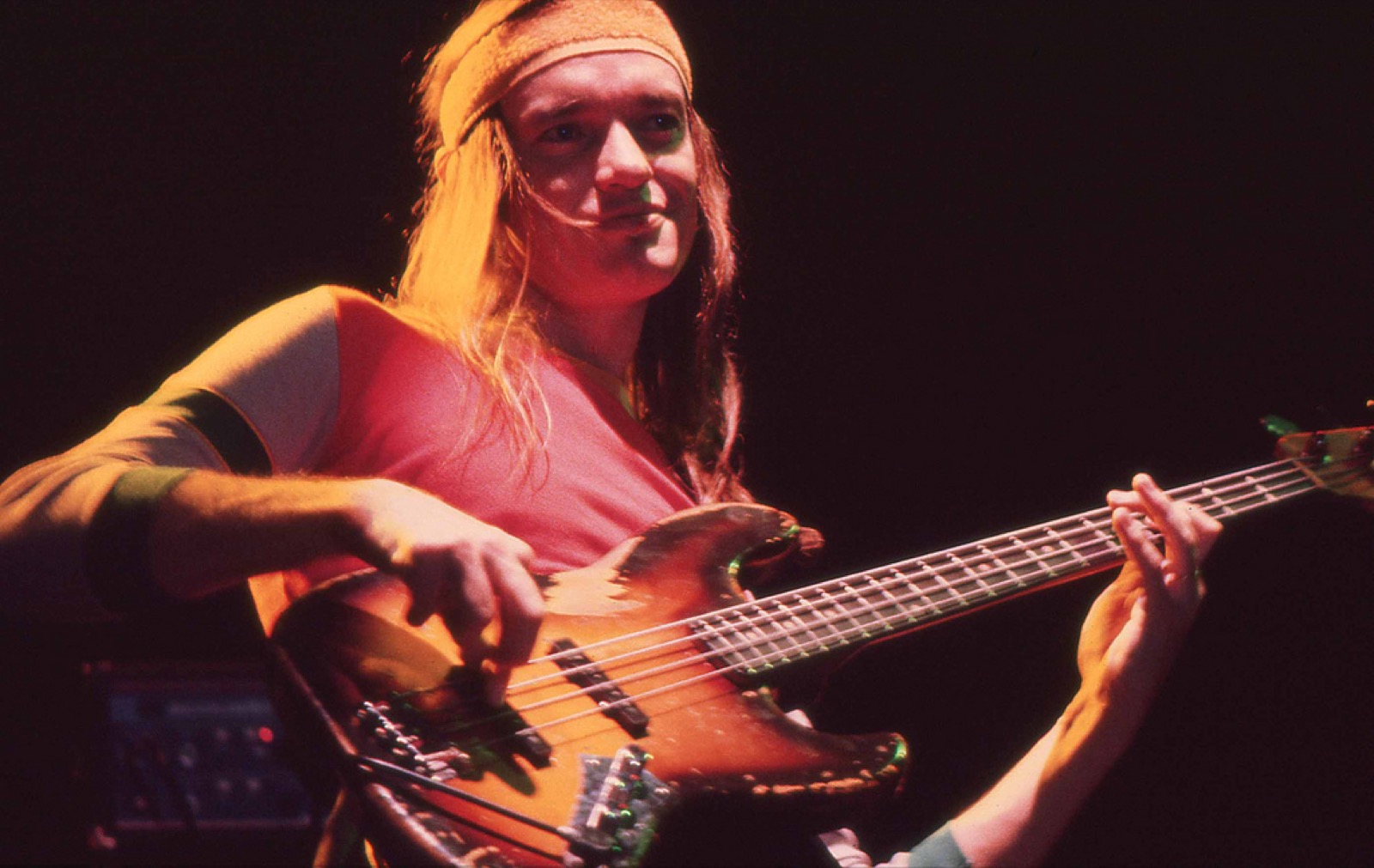
Around 1970, in Florida, a young bassist sat thinking hard as he stared at a bass he had bought secondhand.
It was a well-worn Fender bass made in the early 1960s. Before long, he did something bold: he pulled the metal frets out of the fingerboard, one by one.
Without frets, a bass can connect notes smoothly, like an upright bass. It can make a supple, expressive sound, almost as if someone were singing.
The young man was Jaco Pastorius. The bass in his hands was a Jazz Bass.
Made for jazz, loved in worlds beyond jazz, and finally turned into a true jazz instrument by one young player: this is the curious story of more than sixty years of the Jazz Bass.
📝 About this story
This story draws on books, interviews, and manufacturer materials I have read over many years. I have tried to keep it grounded in fact, but I was not there at the time, so nicknames and commonly repeated accounts may be mixed in. I separate stories with competing versions into a “Legend & Lore” section. Sources are listed at the end.
Chapter 1 — Outdoing the Big Brother
A “Deluxe Version” in Its Ninth Year
In 1951, Fender introduced the Precision Bass, the world’s first mass-produced electric bass. Nine years later, the electric bass had become a standard instrument in bands.
But bassists wanted more and more. “I want to play faster lines.” “I want more sounds to choose from.”
Leo Fender began work on a new bass, a step-up model to the Precision Bass. It arrived in 1960 as the Jazz Bass. At launch, it was reportedly positioned as a kind of deluxe version, priced above the Precision.
Why “Jazz”?
The name has a clear origin. Around this time, Fender wanted jazz musicians to play its instruments.
In fact, two years earlier, in 1958, Fender had released the Jazzmaster guitar with the same goal: a high-end electric guitar aimed at jazz guitarists.
But jazz guitarists held on to their traditional hollow-body guitars. The Jazzmaster found its players among surf musicians and, later, young alternative rock bands.
The Jazz Bass would follow a similar path.
So what made the Jazz Bass special, and why did it become so loved far beyond jazz? Let’s take a closer look.
Chapter 2 — A Slim Neck and Two Pickups
A Difference You Feel at Once
The first thing that surprises many new Jazz Bass players is its slim neck.
- Width at the nut, near the headstock: about 44 mm on a Precision Bass, compared with about 38 mm on a Jazz Bass
- The neck tapers sharply toward the headstock
A few millimeters make a striking difference in the hand. Players with smaller hands can wrap a thumb around the neck more easily, and fast lines are easier to play without stretching the fingers as far. This neck would help fuel the technical arms race among bassists that followed.
An Offset Body
The body shape is different from the Precision’s, too. Its waist is slightly offset from side to side, a design known as offset. Like the Jazzmaster, it was shaped to sit comfortably against the player’s body, whether played seated or standing.
Two Pickups, Three Sounds
The Jazz Bass’s defining feature is its two pickups.
- Near the neck (front): a thick, round tone, with a solid low end close to the Precision Bass sound
- Near the bridge (rear): a hard, focused tone with a pronounced, biting edge
- Both blended: a clean, cutting sound with a slight dip in the middle frequencies
That blended sound is what many people imagine as the “Jazz Bass tone.” It has a solid low end without clashing with other instruments, while quick lines remain clear.
The two pickups were also designed to cancel hum when turned up to similar levels. One bass could move from a thick sound to a hard-edged one with a simple turn of the controls. It was a very different approach from the straightforward Precision Bass.
How the Controls Changed
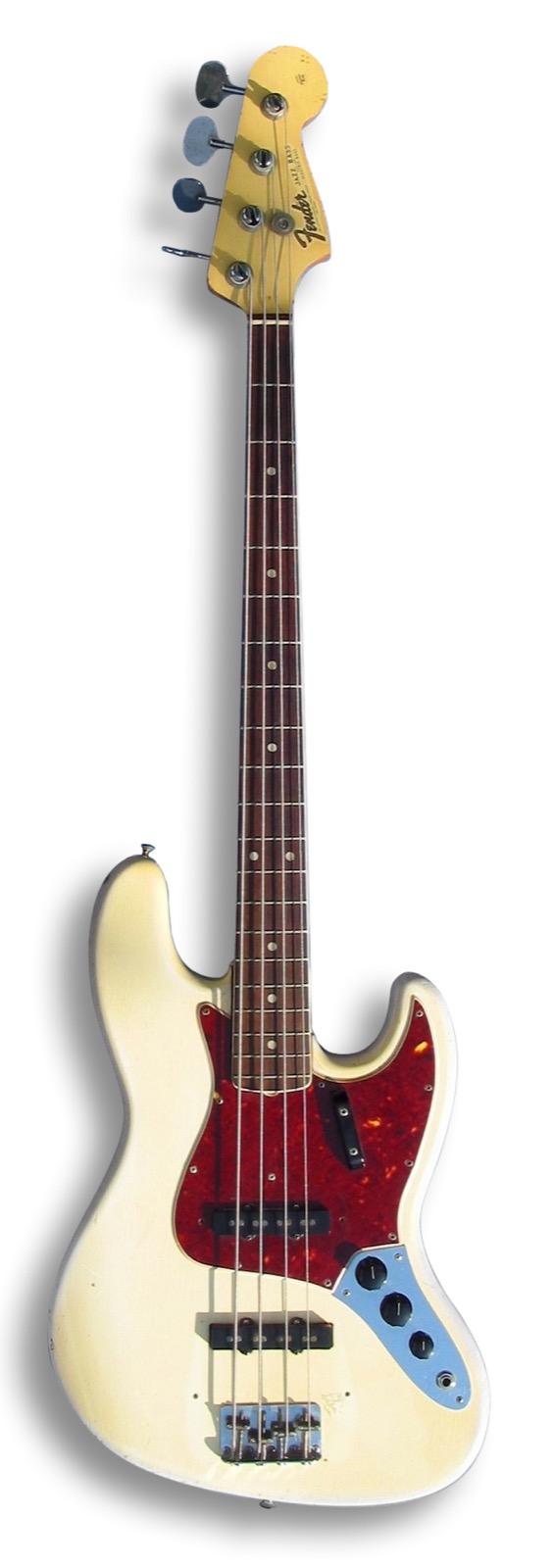
The first Jazz Bass had two stacked control knobs, with a “volume” and “tone” control for each pickup. Around 1962, Fender changed the layout to two volume controls and one tone control. That three-knob arrangement is the familiar face of the Jazz Bass today.
A New Look in Each Era
The Jazz Bass changed gradually over the years.
- Early 1960s: round dot markers on the fingerboard
- From the mid-1960s: decorative binding along the fingerboard, with white rectangular block markers
- 1970s: the bridge pickup moved slightly; people say this gave the bass a harder, brighter sound
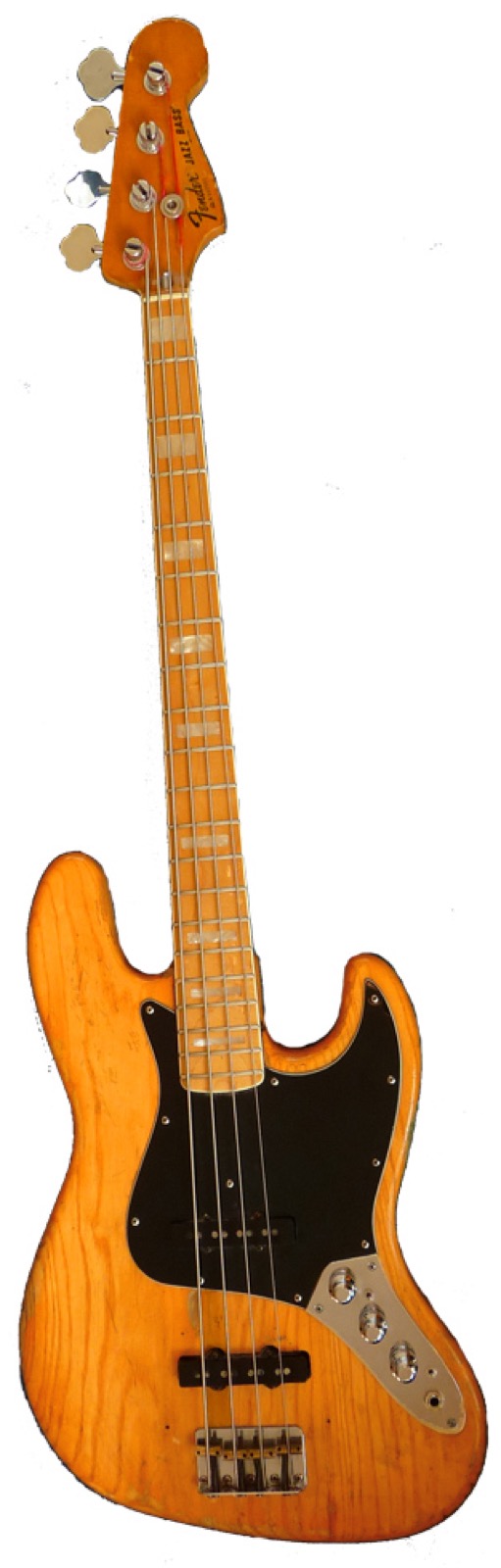
The hard, bright sound of the “1970s Jazz Bass” would later become closely associated with slap, or “chopper,” playing and turn into a sound of its own.
Chapter 3 — Beyond the World of Jazz
The Low End of Rock
A slim neck and a sound that cuts through: the first players to make the Jazz Bass their own were not jazz musicians, but rock bassists of the 1960s.
- Noel Redding (The Jimi Hendrix Experience)
- John Entwistle (The Who), whose thunderous bass showed that the bass could take center stage
- John Paul Jones (Led Zeppelin), whose flowing, singing bass lines pushed the band forward from below
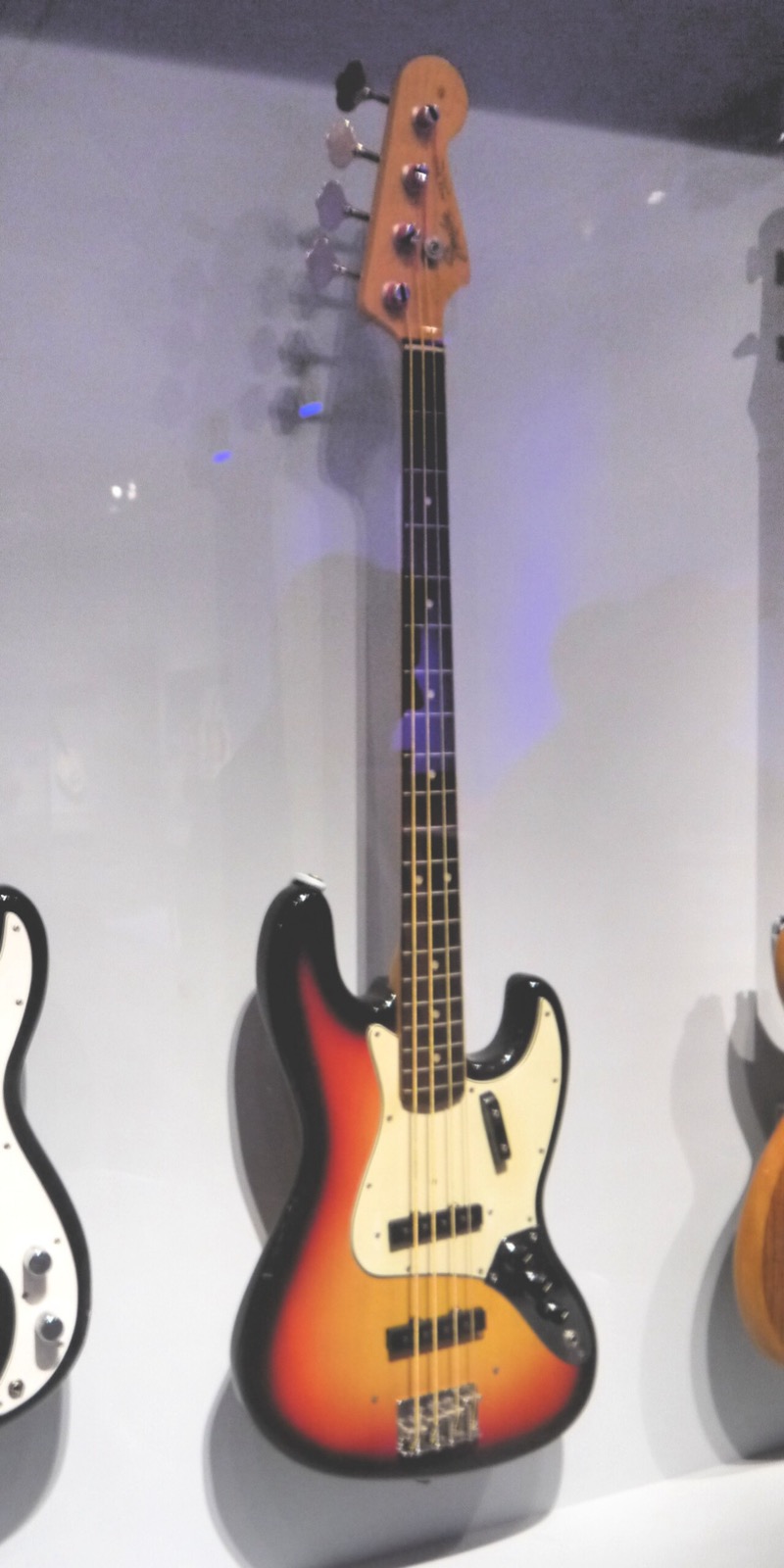
It was an era when guitar tones were getting thicker and more distorted. The Jazz Bass could still be heard clearly above them. That was its strength.
Striking the Strings with Your Thumb
At the end of the 1960s, bassist Larry Graham was playing with the funk band Sly and the Family Stone.
He popularized a way of playing in which the thumb strikes the strings and the index finger pulls and releases them. It later became known as slap, or “chopper,” technique.
Graham himself has said that he developed the approach while playing in a band without a drummer, trying to keep the rhythm in the drummer’s place.
The “bang!” of the thumb and the “pop!” of the finger had a percussive quality that paired perfectly with the hard, focused sound of the Jazz Bass’s bridge pickup.
Marcus Miller’s Signature Sound
From the late 1970s into the 1980s, Marcus Miller refined slap playing, making it more dazzling and more musical.
The 1970s Jazz Bass he played for many years, and the bright, even slap tone he drew from it, became a model for many bassists—the sound many people came to think of as “the Jazz Bass sound.” Even now, many players trying out a Jazz Bass in a music store start by thumping the strings with their thumbs. Marcus may be one reason why.
Chapter 4 — Jaco Pastorius
A Prodigy from Florida
In the mid-1970s, an extraordinary bassist appeared on the jazz fusion scene: Jaco Pastorius, the young man from our prologue.
Jaco was so confident that he called himself “the world’s greatest bass player.” Then he amazed the world with playing that lived up to the claim.
The Fretless Jazz Bass
Jaco’s signature instrument was the fretless Jazz Bass from the prologue.
- He pulled the frets from an early-1960s Jazz Bass.
- He filled the slots with wooden putty.
- To keep the metal strings from wearing down the fingerboard, he coated it with a tough resin of the kind also used on boats.
Without frets, he could bend pitches freely with his fingertips and slide smoothly from note to note. With the bridge pickup turned up, the bass could sing with a “mwaang” sound, like a horn or a human voice.
With this bass, Jaco created sounds no one had heard before, both with the jazz fusion band Weather Report and on his solo records. He played melodies, sounded chords, and shaped tunes with harmonics—the bell-like high notes made by lightly touching a string. Jaco turned the assumption that the bass was “just an accompaniment instrument” upside down.
A bass made for jazz and loved far beyond it had, through one young player’s modification, finally become a lead instrument in jazz.
Gone at 35
Jaco’s life did not last long. He struggled with mental illness and alcohol, and died in 1987 at just 35.
His career lasted only a little over ten years. Still, the sound of his fretless Jazz Bass remains an inspiration to bassists around the world.
🎙 Legend & Lore — “Bass of Doom”
Among fans, Jaco’s beloved fretless Jazz Bass is nicknamed the “Bass of Doom.”
The story goes that the bass was once broken into pieces and repaired, then stolen in New York and lost for a long time. About twenty years later it was found, and—with help from a famous rock band’s bassist—returned to Jaco’s family.
The details vary a little from storyteller to storyteller. But the fact that one bass carries such a story may say something about the stature of Jaco himself.
Chapter 5 — A Few Things for Players
Listen for “That Jazz Bass Sound”
To get a feel for the Jazz Bass, start by listening.
- Weather Report: listen for moments when Jaco’s bass sings the melody or rings like a bell with harmonics
- Funk from the 1970s: follow the bass alone and pick out the “bang!” of the thumb and the “pop!” of the finger
- British rock from the 1960s and ’70s: notice how clearly the bass can be heard underneath the thundering guitars
If You’re Choosing a Jazz Bass
Here’s a quick summary of the instrument’s character.
- Slim neck: suited to players with smaller hands and anyone who wants to play fast lines
- Wide tonal range: blend the two pickups for anything from a thick tone to a hard-edged one
- A bass that steps forward: a great fit if you want your lines to sing or want to play slap
- A small tip: start with both pickups all the way up. Turn up the bridge pickup a little more for slap; favor the neck pickup for a thick fingerstyle tone.
If you’re torn between it and its big brother, the Precision Bass, try thinking in terms of “a sound that supports” or “a sound that sings.” Of course, either bass can do both. In the end, it comes down to picking one up and seeing if you love it.
Epilogue — The Players Outlasted the Name
More than sixty years later, the name “Jazz Bass” is still with us. But this bass has sounded in more than jazz clubs: in rock stadiums, on funk dance floors, and in small live houses in Japan.
The people who made it chose its name. The people who played it decided where it belonged. Some struck the strings with their thumbs; one player pulled out the frets.
Next time you hear a bass come to the front of a song, look up what the player is holding. There’s a good chance you’ll find a bass with “jazz” in its name.
Jazz Bass Timeline
- 1951: Fender introduces the Precision Bass
- 1958: Fender introduces the Jazzmaster, a guitar also aimed at “jazz”
- 1960: Jazz Bass released with stacked controls
- Around 1962: the controls change to three knobs
- Mid-1960s: fingerboard binding and rectangular block markers appear
- Late 1960s: Larry Graham popularizes slap technique
- 1960s–’70s: the instrument spreads among rock bassists
- Mid-1970s: Jaco Pastorius emerges with a fretless Jazz Bass
- 1970s–’80s: Marcus Miller’s slap sound helps establish the “Jazz Bass sound”
- 1987: Jaco Pastorius dies at age 35
References
- Wikipedia, “Fender Jazz Bass,” “Fender Jazzmaster,” “Jaco Pastorius,” “Larry Graham,” and “Marcus Miller” (English editions)
- Fender official website, “Jazz Bass History”
- J. W. Black and Albert Molinaro, The Fender Bass: An Illustrated History (Hal Leonard, 2001)
- Bill Milkowski, Jaco: The Extraordinary and Tragic Life of Jaco Pastorius (1995)
Photo credits
- Header image, “Jaco Pastorius with bass 1980” — Chris Hakkens / Wikimedia Commons / CC BY 2.0
- “Fender Jazz-Bass 1966” — Th. Ott / Wikimedia Commons / CC BY-SA 3.0
- “70’s Fender Jazz Bass” — Octagon / Wikimedia Commons / Public domain
- “John Entwistle (The Who)’s 1965 Fender Jazz Bass - Play It Loud. MET” — Eden, Janine and Jim / Wikimedia Commons / CC BY 2.0
Licenses: CC BY 2.0 · CC BY-SA 3.0