[KAWASAKI Motorcycle History] From Ships and Airplanes to Motorcycles — How Kawasaki and Meguro Came Together in the W1
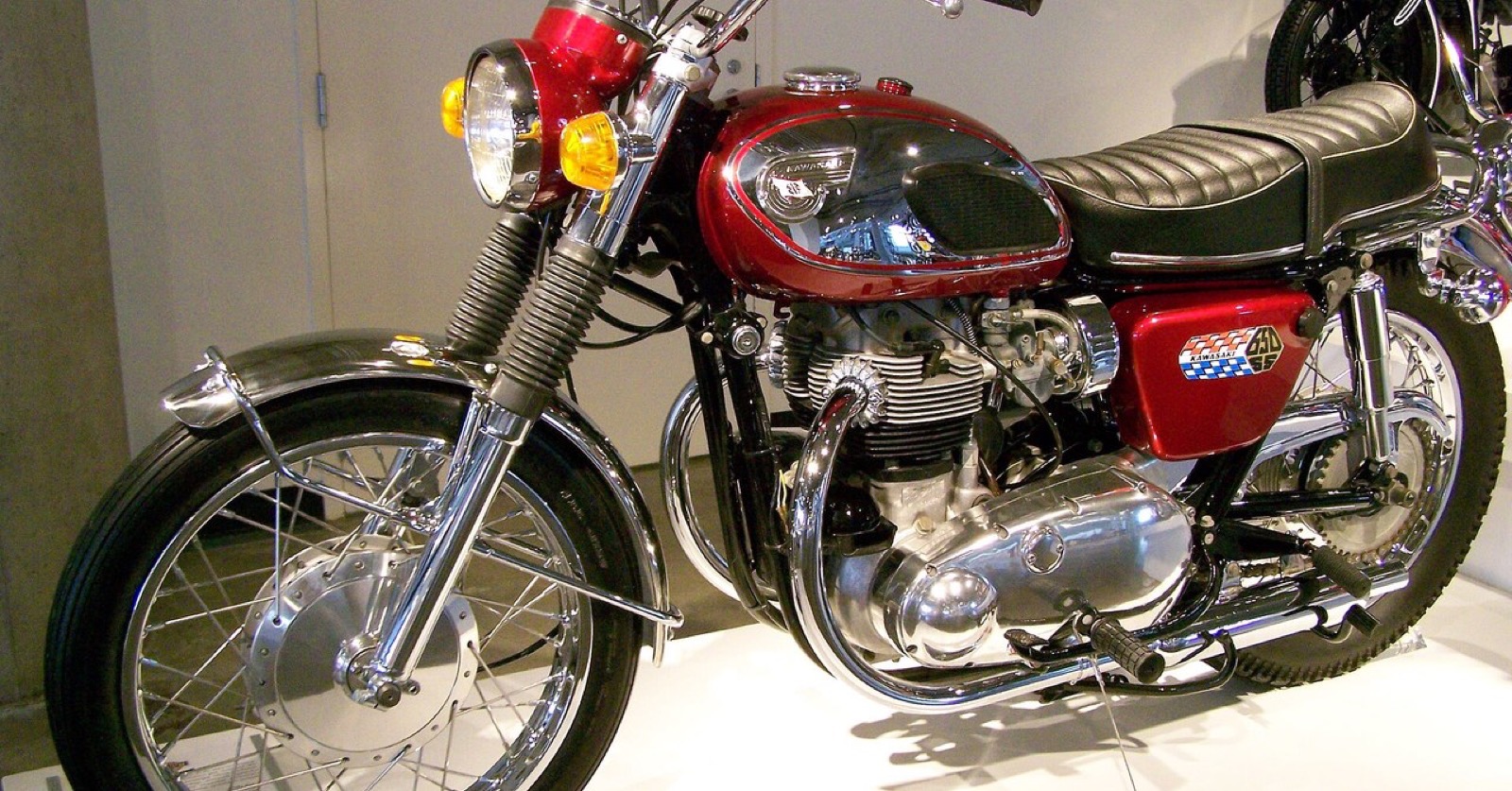
☕ A coffee-length story from GC Lab's "Motorcycle History" series, where we follow machines through the people and events behind them. This time: how Kawasaki, a builder of ships and airplanes, met Meguro, a veteran motorcycle maker born in Tokyo's Meguro district, and how Kawasaki motorcycles came to be.
💡 What you'll learn
- How Kawasaki went from a shipyard, through airplanes, to building motorcycle engines
- How Meguro grew from a transmission workshop into a maker known for police bikes and racing wins at Asama
- How the two companies joined hands, giving birth to the "Red Tank" and the W1
Prologue
October 1957. The sound of motorcycle engines echoed at the foot of Mount Asama in Gunma Prefecture.
It was the 2nd Asama Volcano Race. The course was nothing more than volcanic ash along the mountainside, leveled with a roller. One lap was 19.2 km. Every lap threw up clouds of dust, turning machines and riders alike a shade of gray.
In the biggest-displacement class, the machines out front were "Meguros." The result: first and second, and fourth as well. A veteran maker born in Tokyo's Meguro district, which had been building big motorcycles since before the war, showed what it was made of.
Yet within about seven years, the name of this proud company would disappear from the list of motorcycle makers. The company that carried Meguro on came from an entirely different world: one that had built ships, and built airplanes. Kawasaki.
This is the story of how two completely different streams, Kawasaki with its sea and sky technology and Meguro, which began as a transmission workshop, came together to create Kawasaki motorcycles.
Chapter 1 — A Satsuma merchant and Western ships
The story goes back to the end of the Edo period.
In 1837, Shozo Kawasaki was born in the castle town of Kagoshima, in the Satsuma domain. From about 15 he worked in the shop of a merchant who served the Satsuma lords, and at 17 he moved to its branch in Nagasaki. Nagasaki was the port that served as Japan's window to the outside world, and there the young Shozo saw the world beyond the sea, and its ships.
Shozo later opened his own shop in Osaka and went into business with ships. But a ship loaded with his cargo sank in a storm, it is said, and that business failed. In the Meiji era he moved to Tokyo and, as vice president of a mail steamship company, worked to open a route between Tokyo and the Ryukyu Islands. Shozo later said he had been through many accidents at sea in his life. Each one taught him the difference between Japan's traditional ships and Western ones. Western ships were roomy, stable and fast. What Japan needed first, he came to believe, was to build Western-style ships that far surpassed traditional Japanese vessels.
In 1878, Shozo opened a shipyard in Tsukiji, Tokyo. In 1881 he opened another in Hyogo, Kobe, and in 1886 he moved the whole business to Kobe. The following year he acquired the government-run Hyogo shipyard, which became the foundation of what is now Kawasaki Heavy Industries.
In 1896, Shozo turned his privately run shipyard into a corporation: Kawasaki Dockyard Co., Ltd. He did not become president himself, stepping back as an adviser. The first president was Kojiro Matsukata, son of the Meiji statesman Masayoshi Matsukata, a man later known for collecting a great deal of Western art, a collection that became the basis of Japan's National Museum of Western Art. The company emblem was designed around the character "川" (kawa), taken from Shozo's name.
The first thing the new corporation took on was a large dry dock for ships of around 6,000 gross tons. The dry dock at Kobe was completed in 1902, and Kawasaki grew into a yard that could build large ships one after another. In 1906 it completed Japan's first submarine. The first large warship built by a private Japanese shipyard was also a Kawasaki ship.
Kawasaki's work didn't stop at ships. Its Hyogo works built locomotives and railcars, and in 1926 it built the Eitai Bridge over the Sumida River in Tokyo. In 1933 it even built and sold an automobile, the "Rokko-go." Cutting, bending and assembling steel into big things that move: those skills spread to all kinds of vehicles. After the sea, Kawasaki turned its eyes to the sky.