[KAWASAKI Motorcycle History] A Longing for British Twins, Built in Japan — The Pulse of a Twin from the "Dabu-Wan" to the W650 and W800
☕ A coffee-length story from GC Lab's "Motorcycle History" series, where we follow machines through the people and events behind them. This time: how Kawasaki's "W," born from a longing for British twins, vanished, returned 25 years later with a completely new engine, and is still running today.
💡 What you'll learn
- Why the "Dabu-Wan" moved its gearshift from the right foot to the left
- Why the W650 went out of its way to use a costly bevel-gear drive
- How the W name survived despite reaching "the end" again and again
Prologue
In February 1999, Kawasaki released a new motorcycle called the W650.
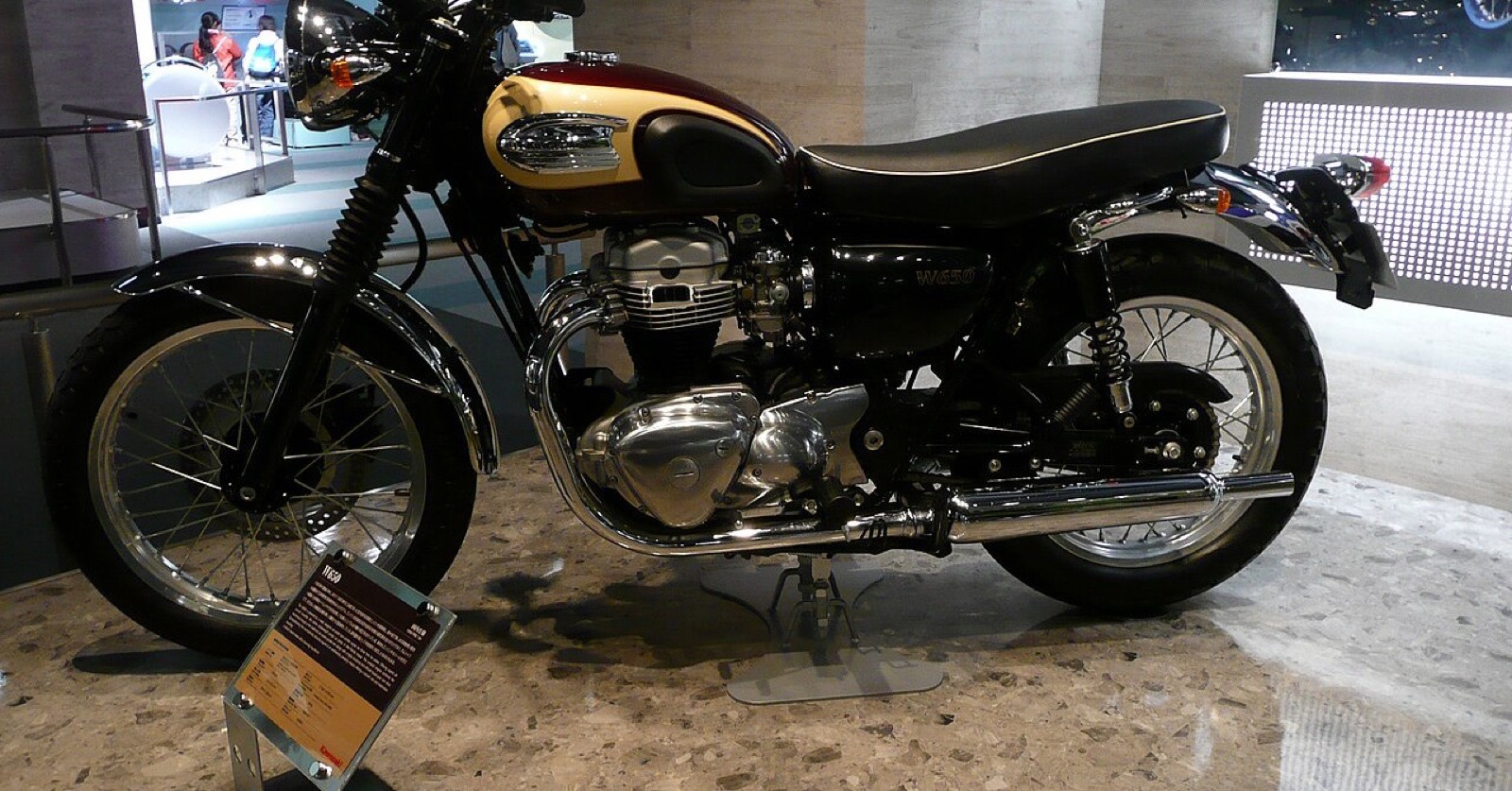
A round headlight, a swelling fuel tank, thin spoked wheels, and, rising neatly up the side of the engine, a slender tube. Many people seeing it for the first time may have hesitated for a moment: was this a new bike, or a beautifully restored British machine from forty years earlier?
In 1999 the motorcycle world was buzzing about big sport bikes approaching 300 km/h. Liquid-cooled fours, aluminum frames, fairings slicing through the wind. Into that world came an air-cooled twin with a kick-starter and old-fashioned style, designed entirely from scratch.
The name "W" had a long history. In 1966, the Kawasaki 650-W1 was born, inheriting the technology of Meguro. Its nickname was "Dabu-Wan," Japanese for "W-one." It was the largest-displacement motorcycle made in Japan at the time. The story of its birth is told in another article.
This time, we pick up from there. How did the Dabu-Wan grow, and why did it disappear? And 25 years later, why did Kawasaki build the W again in a way that cost so much time and money? Let's follow the pulse of a twin that began as a longing for British bikes, from the W1 to the W800 and beyond.
Chapter 1 — The "British twin" the world longed for
The W's story can't be told without the longing for British motorcycles.
From the 1950s into the early 1960s, Britain ruled the motorcycle world. Triumph, BSA, Norton. Their "vertical twins," with two cylinders standing side by side at around 500 to 650 cc, were hugely popular, especially in America. Triumph's Bonneville, introduced in 1959, was the archetype.
British twins of that era shared a few features that were almost rules. A "360-degree crank," in which both pistons rise and fall together. The regular thud, thud of exhaust and pulse that came from it. And a layout with the gear pedal on the right and the rear brake on the left, the opposite of Japanese bikes today.
A word on how a 360-degree crank works. The two pistons rise together and fall together, but they don't fire at the same moment. With each turn of the crank, the left and right cylinders fire once in turn. So the firing interval is always even, a steady rhythm like a single-cylinder engine beating twice as fast. Vibration tends to be strong, but the pulse that reaches the rider's body is unmistakable. That pulse is what drew so many riders in.
Japanese makers took these British bikes as their models. Meguro's twin, the Stamina K, is said to have been modeled on a BSA twin. When Meguro joined Kawasaki, the K2 was enlarged into the 650-W1 of 1966, at 624 cc. It is said to have appeared at the 1965 Tokyo Motor Show under the name "X650."
The W1 was aimed at America, where big twins were popular. It looked a lot like the British twins, too. Even its right-foot shift was a British inheritance. A Japanese maker had taken on Britain, the king of the motorcycle world, head-on.
But the W1 was not received in America as well as had been hoped. In Japan, on the other hand, this big, heavy machine with its powerful pulse won passionate fans. From here, the W would grow up alongside Japanese riders.