Kawasaki Z1: The New York Steak That Took to the World’s Roads
☕ A coffee-length story — about a 12-minute read.
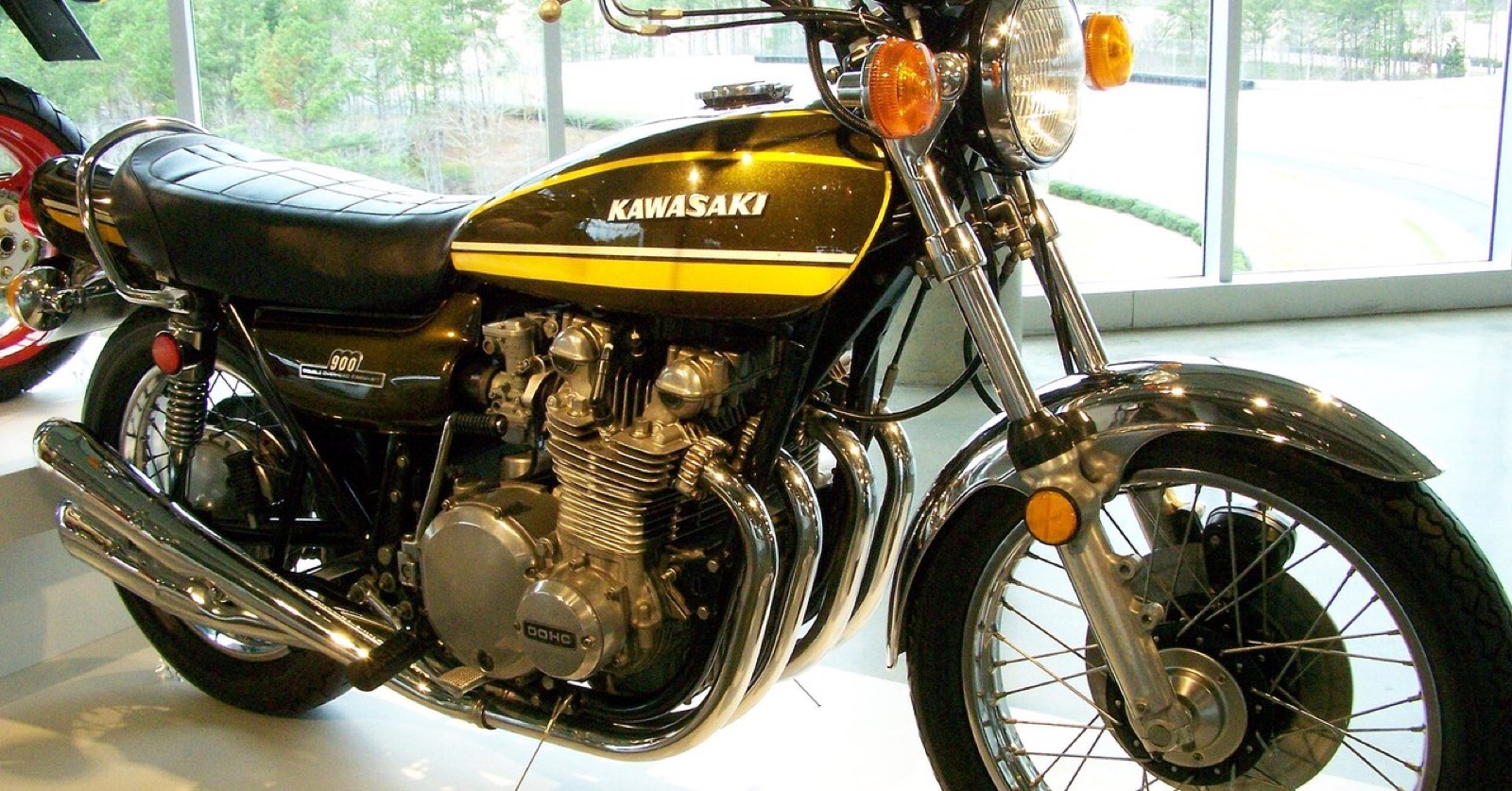
In the fall of 1972, a motorcycle appeared through the crowd at a show in Cologne, West Germany. It had a deep-colored tank, four exhaust pipes, and a front disc brake. Above its engine sat two camshafts in a DOHC arrangement. Displacement: 903 cc. Its name was the 900 Super4. Riders around the world would come to know it as the Kawasaki Z1.
The specifications alone made it something special. But what made the Z1’s arrival truly dramatic was more than the numbers. Honda’s CB750 had already drawn attention in the big-bike world. Kawasaki reworked its plans in the Honda’s wake, building something larger, faster, and more imposing. The Z1 was a motorcycle whose story changed course when a rival appeared.
Seen finished, it might look as if it was born a winner. Behind it were decisions to halt development, increase displacement, adopt a strange in-house code name, and bet on the American market. The Z1’s history is both the story of a landmark motorcycle’s development and a record of postwar Japanese manufacturers stepping onto the world stage.
Chapter 1 — Honda moves first; Kawasaki gives chase
In the 1960s, Kawasaki carved out a distinct place in motorcycling. Its most memorable model was the H1, better known as the Mach III, powered by an air-cooled two-stroke triple. Famous for its explosive acceleration, it introduced Kawasaki to young American riders. That two-stroke punch was the sound of Kawasaki at the time.
But two-stroke thrills alone would not make Kawasaki a leader in big bikes. Riders covering long distances and maintaining their machines day to day also valued ease of use, durability, and smooth power. Kawasaki had experience with large four-strokes through models such as the W series. For its next flagship, the company wanted more than outright speed: it wanted an all-around motorcycle that would command respect around the world.
That ambition set a large-displacement four-cylinder project in motion. The project that would become the Z1 initially targeted the 750 cc class. Japanese manufacturers did not yet dominate the big-bike world. Building a large engine, raising performance, and delivering it to American riders demanded corporate resolve as well as engineering skill.
As the project progressed, Honda unveiled the CB750 Four at the 1968 Tokyo Motor Show. It was a groundbreaking production 750-class inline-four, with a front disc brake and an effort to combine high performance with manageable handling. Riders around the world were startled that a Japanese maker had built such a large motorcycle. The conventions of big bikes were about to change.
For Kawasaki, this was more than the arrival of a competitor. The company worried that releasing its existing project unchanged might not capture the world’s attention. Honda had planted its flag first; the challenger needed to stand apart on the same ground. The development team reconsidered its 750-class plan and steered toward greater displacement.
Increasing displacement affects engine dimensions and weight, cooling, vibration, frame stiffness, brakes, and tires. Change one number and the design of the whole motorcycle has to be reconsidered. Bringing that change into production also requires repeated testing and refinement.
The developers were not aiming to build a bike just a little bigger than the CB750. They wanted a large four-cylinder that could turn freely, combining comfortable high-speed cruising with strong acceleration. It had to look imposing and make riders feel they were on something exceptional. The moment it reached the market, it should announce itself as a flagship Kawasaki had built in earnest.
Its development code name was “New York Steak.” Before the model even had a proper name, its sights were fixed squarely on the American market. Picture a new motorcycle with a huge tank and four mufflers on a New York street. That bold image suits the project.
🎙 Legend & Lore
The “Steak” in the name is said to come from a large steak the development team ate in the United States. The finer details are disputed, but a name that evokes a thick, filling meal suits a 903 cc flagship.