The Teletronix LA-2A: Taming Sound with Light
☕ A coffee-length story — about a 12-minute read. Enjoy it as a story, not a research paper.
Prologue — A Los Angeles radio station in the 1950s
In the early 1950s, an engineer sat in the control room at KMGM, a Los Angeles radio station, with one hand on the fader.
When a voice got louder, he pulled it down. When it grew softer, he pushed it up. He repeated the same movements by hand throughout every broadcast. At the time, that was simply part of running a radio show.
But the engineer had a thought.
“Wouldn’t it be great if a machine could do this automatically?”
His name was Jim Lawrence. Around the same time, in a very different place, he was also involved in research on optical sensors for missiles.
The tedious handwork of a radio station and the technology of light developed for missiles came together. Their unlikely meeting gave us one of the most famous compressors in the world.
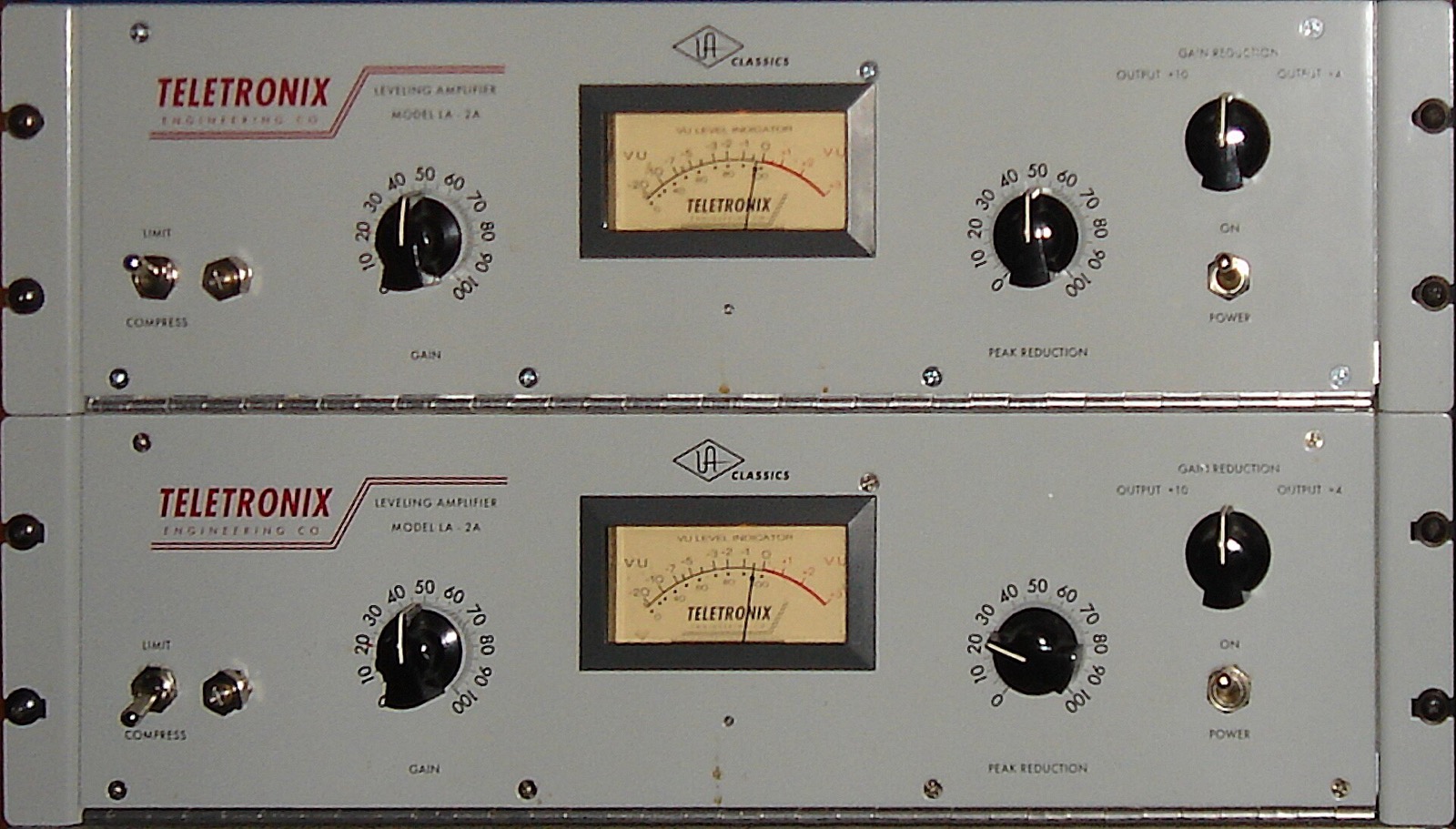
Its model number: LA-2A.
About this story
This account draws on books and articles I have read over the years, magazine interviews, company materials, and recollections from people who knew the period. I have tried to stick to facts confirmed by more than one source. I was not there myself, though, so familiar industry lore may have made its way in. I separate stories that conflict or are told as legends into Legend & Lore sections. The sources I consulted are listed at the end.
I have a compressor descended from the LA-2A in my own studio: a Warm Audio WA-2A. I wanted to know where that curious box with just two main knobs came from. That is why I wrote this story.
Chapter 1 — The man behind the LA-2A
A radio station and a missile laboratory
James F. Lawrence II, known as Jim Lawrence, was an engineer who worked at a radio station.
He had another job, too: at the Jet Propulsion Laboratory (JPL), part of the California Institute of Technology. Lawrence is said to have worked on optical sensors for the Titan program, the United States’ intercontinental ballistic missile project.
Some components change the way they conduct electricity depending on the intensity of the light that reaches them. That technology would later become the heart of the LA-2A.
Teletronix is founded in 1958
In 1958, Lawrence founded Teletronix Engineering Company in Pasadena, California. At first, the company made equipment for broadcasters, including transmitter components.
Lawrence set out to build the machine he had dreamed of back in his radio days: a device that could level audio automatically. He called it a leveling amplifier—an amplifier that smooths out the volume.
The LA-1 and LA-2
- LA-1: The first model. Only about 100 were reportedly made. The singer and actor Gene Autry is said to have liked using one.
- LA-2: An improved version. Major American broadcasters CBS and RCA adopted it.
Lawrence’s equipment earned a reputation in broadcasting, and he kept refining the design. Then, in 1962, he completed the model that would make history.
Now let’s look at the moment the LA-2A was born—and the more than 60 years that followed.