The Man Who Couldn’t Play Guitar but Changed the Sound of the World — Leo Fender
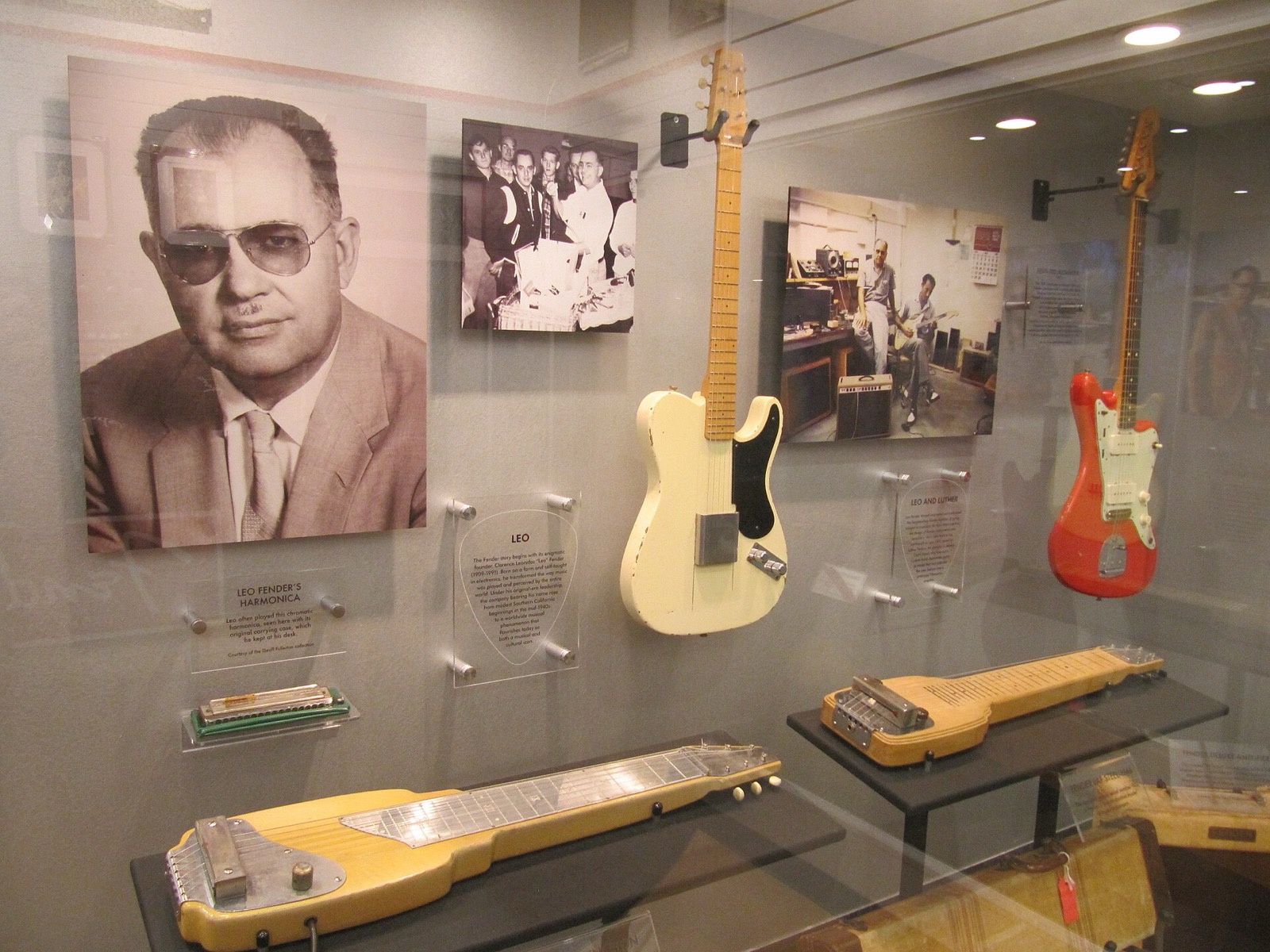
Prologue: Fullerton, March 1991
March 1991. Fullerton, California. In a small factory in a town still marked by its orange groves, an 81-year-old man sat at his desk, as he did every day.
Before him lay a guitar pickup blueprint. For decades he had spent nearly every day drawing plans, building prototypes, and revising them.
And yet, they say, this man could barely play guitar.
The guitars he made still ring out on stages around the world: the Telecaster, Stratocaster, Precision Bass, and Jazz Bass. Rock, blues, country, funk: it is no exaggeration to say that this man helped shape the sound of twentieth-century music itself.
His name was Leo Fender.
Let’s turn the clock back about eighty years. The setting is still Fullerton. A boy who has lost an eye is trying to build a radio from a pile of discarded parts.
About this story
This story draws on books, interviews, and manufacturer materials I have read over the years. It is written as faithfully to the facts as possible, though I was not there, and some commonly used names or received accounts may have found their way in. Stories with competing versions are separated into “Legend & Lore” sections; sources are listed at the end.
Chapter 1: The Radio Boy in the Orange Groves
Born on an orchard farm in 1909
On August 10, 1909, Clarence Leonidas Fender was born on a farm between Anaheim and Fullerton, California. He would become known around the world simply as Leo.
His family grew oranges and other fruit. He was a country boy, growing up in a quiet farming community in an era when electricity was still a novelty.
The loss of his left eye
When Leo was eight, a tumor developed in his left eye, and it had to be removed. He wore a glass eye for the rest of his life. It is said that when World War II began, this kept him from military service.
Losing an eye can make it harder to judge distance. Perhaps that meant more time at a workbench with tiny parts, and less time playing baseball or sports.
His uncle’s radio
A story often told about Leo’s first fascination with electronics begins when he was fourteen. He visited an uncle who ran an auto electrical shop in Santa Maria, California.
There he saw a radio his uncle had assembled entirely from surplus parts—parts that were meant to be thrown away, brought together to make sound. The boy was captivated, and before long he was building radios of his own.
The bookkeeper who tinkered
After graduating from Fullerton High School in 1928, Leo studied accounting at a local junior college. He later delivered ice and then worked as a bookkeeper, spending his days with numbers.
But he never gave up tinkering with radios. He repaired neighbors’ sets and built and rented out public-address systems for local gatherings and dances. The day job with numbers and the hobby with electricity would both support his work as a maker.
The Great Depression and a radio shop
The Great Depression hit the United States in the 1930s, and Leo lost his accounting job.
He made a bold move: he borrowed $600 and opened his own shop, Fender’s Radio Service, in Fullerton in 1938.
He repaired radios and amplifiers and rented out PA systems. Local musicians began coming in with broken amplifiers and instruments.
They had plenty to complain about: “The amps break all the time.” “The guitar isn’t loud enough.” “There’s too much feedback.”
Leo wrote down each complaint, one by one.
A man who couldn’t play guitar knew guitarists’ frustrations better than anyone. That unlikely situation was where it all began.
Now let’s follow the story of how a radio repairman became an instrument maker.