The Inventor's Company That Bet on Big Film — Mamiya
☕ A coffee-length story — about a 25-minute read. Part of our series on the history of camera makers, this time featuring the company whose name became almost a byword for "medium format" in Japan. From inventor Seiichi Mamiya's Mamiya Six to the studio workhorse RB67, the 645, and on into the digital age: the story of a company that stayed loyal to big film.
What you will find here:
- Why the man who built a cash register went on to found a camera company
- How the Mamiya Six focused by moving the film instead of the lens
- A twin-lens reflex with interchangeable lenses, a press camera for reporters, and the RB67 for the studio
- What happened to a company that stepped away from 35mm and bet on medium format
Prologue — The black box in the studio
At the back of a photo studio, a large black box sits on a tripod.
A heavy, square body that will never fit in your palm. Flip open the hood on top, and a big, bright image floats on the ground glass. The photographer looks down at it from waist height and turns a knob on the side, slowly extending the bellows.
Once the focus is set, the photographer rotates the film magazine on the back by 90 degrees. The camera body itself does not move — and yet a horizontal picture has become a vertical one.
Inside the lens, there is a quiet "click." What lands on the film is a big rectangle, 6 by 7 centimeters. Compared with a single frame of 35mm film, that is more than four times the area.
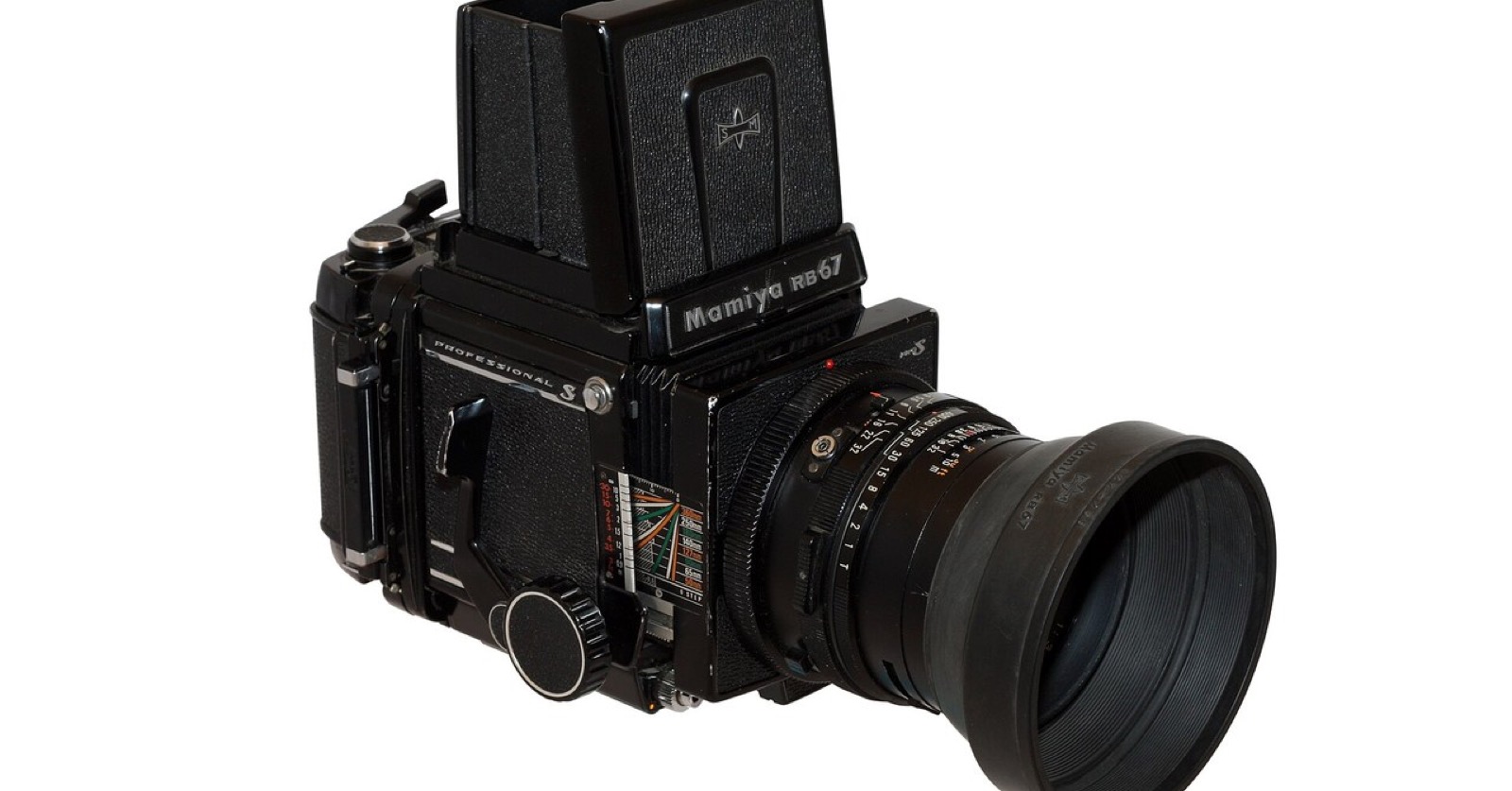
The camera is the Mamiya RB67. Born in 1970, it was built for nearly forty years and used in studios all over the world.
Big film, fine-grained pictures. In an era when one small, light camera after another appeared, there was a Japanese company that kept walking straight down that other road.
At its beginning stood a man who, before he ever founded a camera company, had invented an entirely different kind of machine.
Chapter 1 — The inventor who built a cash register
A boy obsessed with photography
Mamiya's founder, Seiichi Mamiya, was born in 1899.
His father, Katsusaburo Mamiya, is said to have been a businessman who also loved inventing new things. Perhaps it ran in the family: from childhood, Seiichi was fascinated by both machines and photography.
By middle school he was already hooked on photography. He sent his pictures to contests in photo magazines and was selected again and again — so often, the story goes, that people called him a "contest raider."
A man who took pictures, and at the same time a man who designed machines. Where those two met, the future Mamiya company would be born.
A cash register made in Japan
Yet the first thing Seiichi Mamiya became known for was not a camera.
In the late Taisho era, in the 1920s, he worked on a machine for recording the money going in and out of a shop: the cash register. At the time, almost all the cash registers used in Japan were imported from America and elsewhere. Could one be made in Japan?
In the late 1920s, Mamiya is said to have completed a domestically built cash register and helped set up a company to manufacture it. That company later became linked to the Japanese arm of a foreign cash-register maker.
A machine that counted and recorded numbers precisely with countless gears and levers. The skills sharpened by designing it would eventually turn toward cameras.
In the age of the Leica
In the 1930s, the small German camera called the Leica was the talk of Japan's photography enthusiasts too. Mamiya was in the thick of the latest camera trends, even forming a circle of Leica lovers with fellow photographers.
Then, in the late 1930s, Mamiya left the cash-register business and threw himself into camera development. What he focused on was not 35mm like the Leica, but cameras using the larger 120 film.
120 film is roll film about 6 centimeters wide, often called "Brownie" film in Japan. Because each frame is large, the grain stays unobtrusive even when you enlarge it, and the pictures look smooth.
Mamiya was thinking of a folding camera that used this film — but one that focused in a completely different way from any other camera.