The Orchestra That Played from Tape: The Mellotron and the Rock of the '60s and '70s
☕ A coffee-length story — about a 15-minute read. This is the tale of a strange instrument with a strip of tape hidden under every key, each one holding a recording of a real instrument. It was born in a Californian living room, grew up in an English factory, and kept on sounding through the great rock records.
Prologue — A Flute That Lasts Eight Seconds
November 1966. At Abbey Road Studios in London, the Beatles were starting work on a new song.
It would become "Strawberry Fields Forever".
The song opens with a soft, slightly breathy flute.
It sounds like a flute, and yet not quite. The pitch wavers ever so slightly, as if it were playing somewhere far back in a memory.
The player was Paul McCartney.
But there was no flautist in the studio. Paul was sitting at a big wooden cabinet with a piano-style keyboard.
Press a key, and somewhere underneath it a strip of tape — carrying a recording of a real flute — starts to move.
Let go, and a spring pulls the tape back to where it started.
And even if you hold the key down, the note stops after about eight seconds. That is simply as long as the tape is.
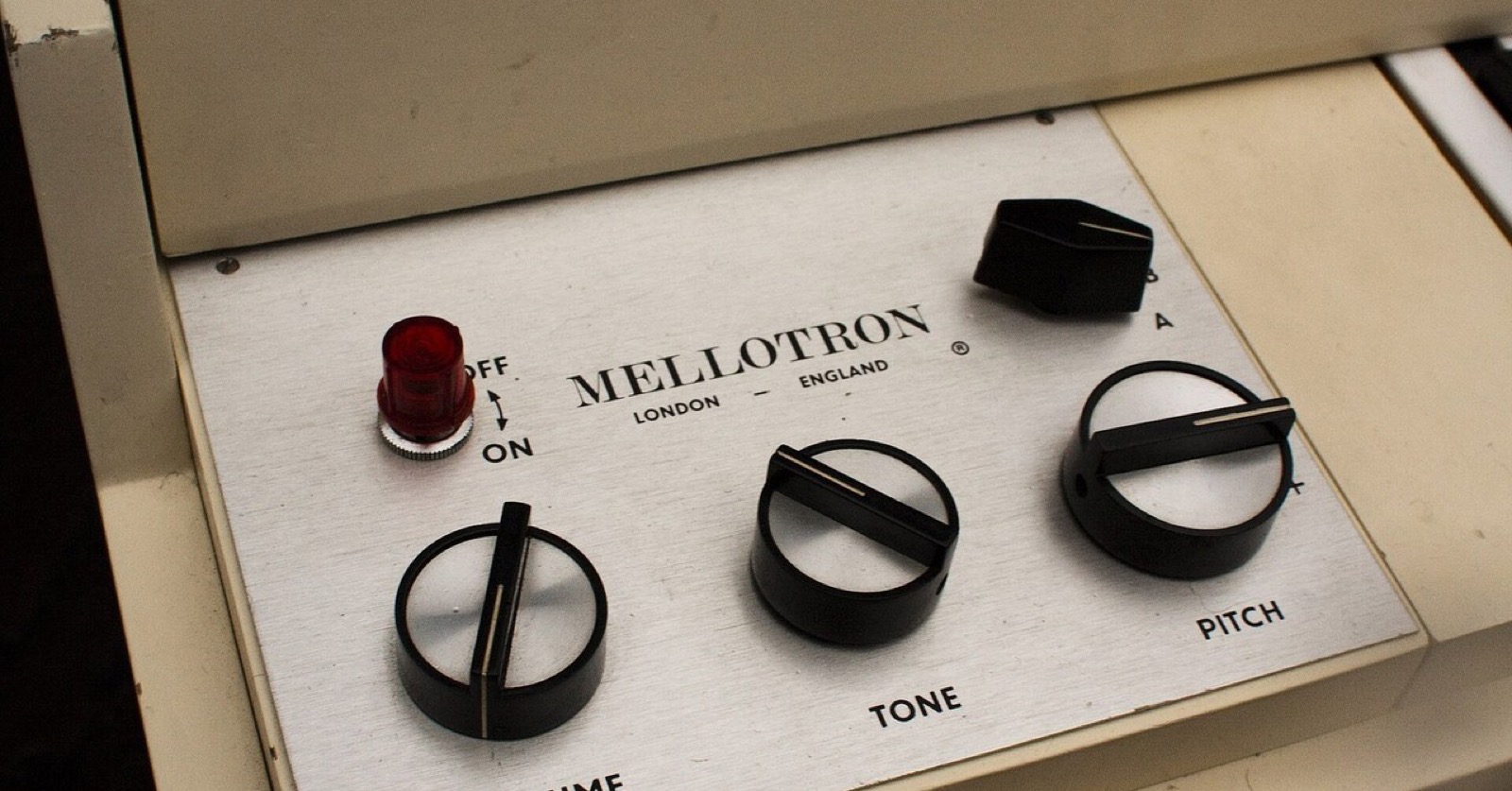
The instrument was called the Mellotron.
On paper, it was a terribly awkward instrument. Heavy, temperamental, and every note ran out after eight seconds.
Yet from the late 1960s through the 1970s, this box played the part of "the orchestra" on record after record of classic rock.
This is the story of an invention born in a Californian living room, which crossed the ocean, took a new name in England, and ended up shaping the sound of rock.
Chapter 1 — An Organ in the Living Room, and a Tape Recorder
A man who played back his own playing
The story begins on America's West Coast.
There was a man named Harry Chamberlin.
He liked to play the organ at home, record himself, and listen back.
One day an idea came to him.
What if you could call up recorded instruments from a keyboard, at whatever pitch you wanted? Then you could play at home with a whole band, or an orchestra, behind you.
Put one strip of recorded tape under each key of a piano keyboard.
Press the key, and that tape plays.
Line up a tape of a violin playing C, a tape of a violin playing D, and so on, one for every note, and you can play the violin from a keyboard.
In today's terms, this is exactly the idea behind the sampler.
Only this was an age with no computers and no digital memory, and he set out to do it with nothing but magnetic tape and mechanics.
A recording studio in a closet
Chamberlin is said to have turned a walk-in closet in his house into a recording room and spent long days shut away in it.
He built prototypes from the late 1940s, and in the 1950s he began selling an instrument bearing his own name: the Chamberlin.
What he had in mind was not a rock band.
It was a family gathered in the living room, singing along to big band standards. It was meant to be a home instrument.
Chamberlin also made a machine called the Rhythmate, which played tapes of recorded drum patterns — a distant ancestor of today's drum machines.
A small, handmade business
Chamberlin's instruments were almost entirely handmade by him.
There was no big factory and no splashy advertising. He reportedly sold only a handful a month.
Handmade also meant weaknesses.
Each key had its own playback head, but the heads were not matched, so volume and tone varied from key to key. The tape paths drifted out of line. A hum crept into the sound.
When offers came to sell on a larger scale, Chamberlin is said to have turned them down.
His invention, made with his own hands. Perhaps that was simply the kind of man he was.
But that invention was about to cross the ocean without its inventor knowing.