The Oversized Pedal That Doubled the Swirl — Mu-Tron Bi-Phase
☕ A coffee-length story about a classic piece of gear
About a 10-minute read. Set the research aside and enjoy this as a story.
A box far too big to sit at your feet, with “two” swirling circuits inside. This is the story of the machine that sent the sounds of ’70s funk and dub into a wild, liquid wobble.
💡 What you’ll learn
- How a phaser creates its signature sweep (with diagrams)
- How a canceled guitar-synth project led to the Mu-Tron III and Bi-Phase
- How to combine two phasers, plus four tips for using one today
Prologue — Too Big to Call a Pedal
In the middle of the 1970s, a rather unusual effects unit appeared on music-store shelves.
Most effects pedals at a guitarist’s feet were small boxes, about the size of a hand. This one, though, was about as big as a stack of dictionaries. It was also exceptionally expensive for an effects unit of its time.
Still, it sold. It had a sound no other unit could make: a deep, rolling swirl that justified both its size and its price. At a time when effects were becoming a bigger part of a guitarist’s sound, the Bi-Phase made a striking impression wherever it appeared.
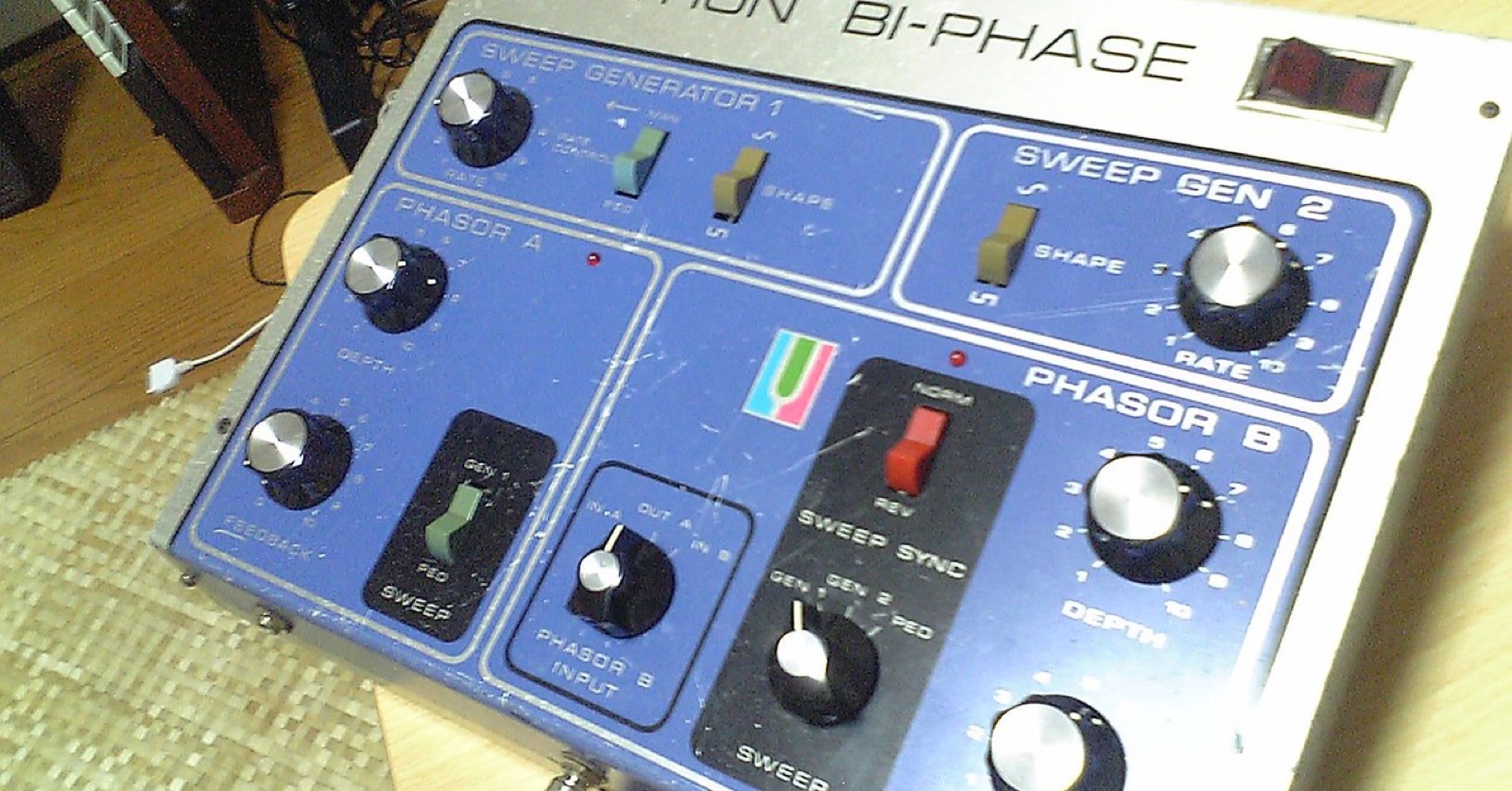
The Mu-Tron Bi-Phase.
“Bi” means “two.” True to its name, the unit held two complete circuits for creating that swirl.
📝 About this story
This story draws on books and articles I’ve read, trade-press coverage, recollections from the designer, and product information from retailers. I’ve tried to stick to the facts. Sources sometimes give different dates, such as the release year, and I point that out where it comes up. The references are listed at the end.
Chapter 1 — The Phaser’s Swirl
Shifting the sound, little by little
The Bi-Phase is a phaser, an effects unit that makes sound sweep and swirl.
A phaser gives you a slow “whoosh, whoosh”—a sound like a jet passing in the distance, or like something moving underwater. In ’70s music, phasers found their way onto guitars and keyboards, and sometimes even drums and vocals.
Moving dips in the spectrum
Here’s a simple explanation of how it works.
- Make a copy of the sound that’s shifted by a tiny amount; the amount of shift varies with pitch.
- Combine the original and the copy. At certain pitches, they cancel each other out, creating dips in the sound.
- Move those dips up and down slowly.
As the dips move, the sound’s color keeps changing. That’s the source of a phaser’s signature swirl. The effect doesn’t simply make the whole sound louder or quieter; it keeps reshaping which parts of the tone stand out as the sweep travels.

More stages, more swirl
A phaser is built by stacking several stages that shift the sound. The more stages it has, the more dips it creates, and the deeper and more complex the swirl becomes.
The Bi-Phase packed two six-stage phasers into one unit.
Chapter 2 — Two Engineers Strike Out on Their Own
A dream of building a synthesizer
The company behind the Bi-Phase, Musitronics, began with a project that was canceled.
Engineer Mike Beigel was developing a synthesizer at guitar maker Guild. But Guild’s new president showed no interest in the project.
So in 1972, Beigel teamed up with Aaron Newman, another engineer at Guild, and the two started their own company in Roslyn, New Jersey. That company was Musitronics.
Turning part of a synth into a pedal
The pair hit on the idea of pulling out one part of Beigel’s synthesizer and turning it into a standalone effects unit.
The result, released in the summer of 1972, was the Mu-Tron III, an envelope filter whose tone went “wah, wah” in response to how hard you played.
Stevie Wonder’s “Higher Ground”
Stevie Wonder gave the Mu-Tron III an enormous boost in popularity.
On his song “Higher Ground,” the clavinet has a bouncy, “kwa, kwa” sound. That sound was made with a Mu-Tron III.
One story goes that Stevie recorded a clavinet track with a Mu-Tron III Musitronics had sent him, then let the two founders know about it.
Chapter 3 — Bi-Phase: Two Phasers in One Box
Arriving in 1974
After the success of the Mu-Tron III, Musitronics introduced the Bi-Phase. It appeared around 1974.
Inside were two of Beigel’s optical phaser circuits in a single enclosure.
Two swirls, and how to combine them
The Bi-Phase’s appeal lay in how you could combine its two phasers.
- Use the two independently.
- Connect the output of the first to the input of the second and stack the sweeps.
- Set the sweep rates to match or run them independently.
It also had two sweep generators to control the rate. You could choose a smooth, undulating sine wave or a square wave that switched abruptly.

A knob to intensify the swirl
The Bi-Phase is also said to have been among the earliest phasers with a knob to adjust feedback, which controls the intensity of the sweep.
Turn up the feedback and the swirl becomes sharper and more pronounced. From a gentle shimmer to a wild, liquid sweep, the Bi-Phase could cover a lot of ground.
Controlling the sweep with your foot
You could also move the sweep with an optional foot pedal called the Opti-Pot. It, too, used light to control the effect. These pedals are very scarce today, so many players use substitutes.
A prototype for Mick Jagger
According to designer Mike Beigel’s own recollection, the first Bi-Phase prototype was handed to Mick Jagger of the Rolling Stones while the band was rehearsing for a tour.
Into the sound of dub
The Bi-Phase was used across genres. It’s especially associated with Lee “Scratch” Perry, the producer known for shaping the sound of Jamaican dub.
Sounds twist through space, swirl, and fade into the distance. The Bi-Phase’s deep sweep was a natural fit for dub’s strange, spacious world of sound.
Chapter 4 — A Great Machine Couldn’t Save the Company
The more they made, the less they earned
The Bi-Phase and Mu-Tron III sold well. The Bi-Phase cost $279.95 at the time, yet it was still popular.
Even so, Musitronics reportedly struggled to make much money. Every product cost too much to build.
The company tried to keep itself afloat by manufacturing designs from other people, including guitarist and gear designer Dan Armstrong and George Merriman.
Off to ARP
In 1978, Musitronics sold the Mu-Tron product line to synthesizer maker ARP. The company itself closed around 1979.
Mu-Tron returns
But the Mu-Tron name didn’t disappear.
The Mu-Tron III returned in 2014. The Bi-Phase was later reissued as the Bi-Phase II, with options to connect the two phasers in series, run them in parallel, or split them across a stereo signal.
Chapter 5 — Using a Phaser Today
Here are a few tips for using a phaser like the Bi-Phase.
1. Start with a slow sweep
If a phaser sweeps too quickly, the sound can feel restless. Start slow, then look for a rate that fits the tempo of the song. A full cycle over one or two bars can feel great.
2. Bring up feedback gradually
More feedback makes the sweep stronger and more distinctive. Turn it up when you want the effect to stand out; keep it lower when you want a subtler touch.
3. If you have two, split them left and right
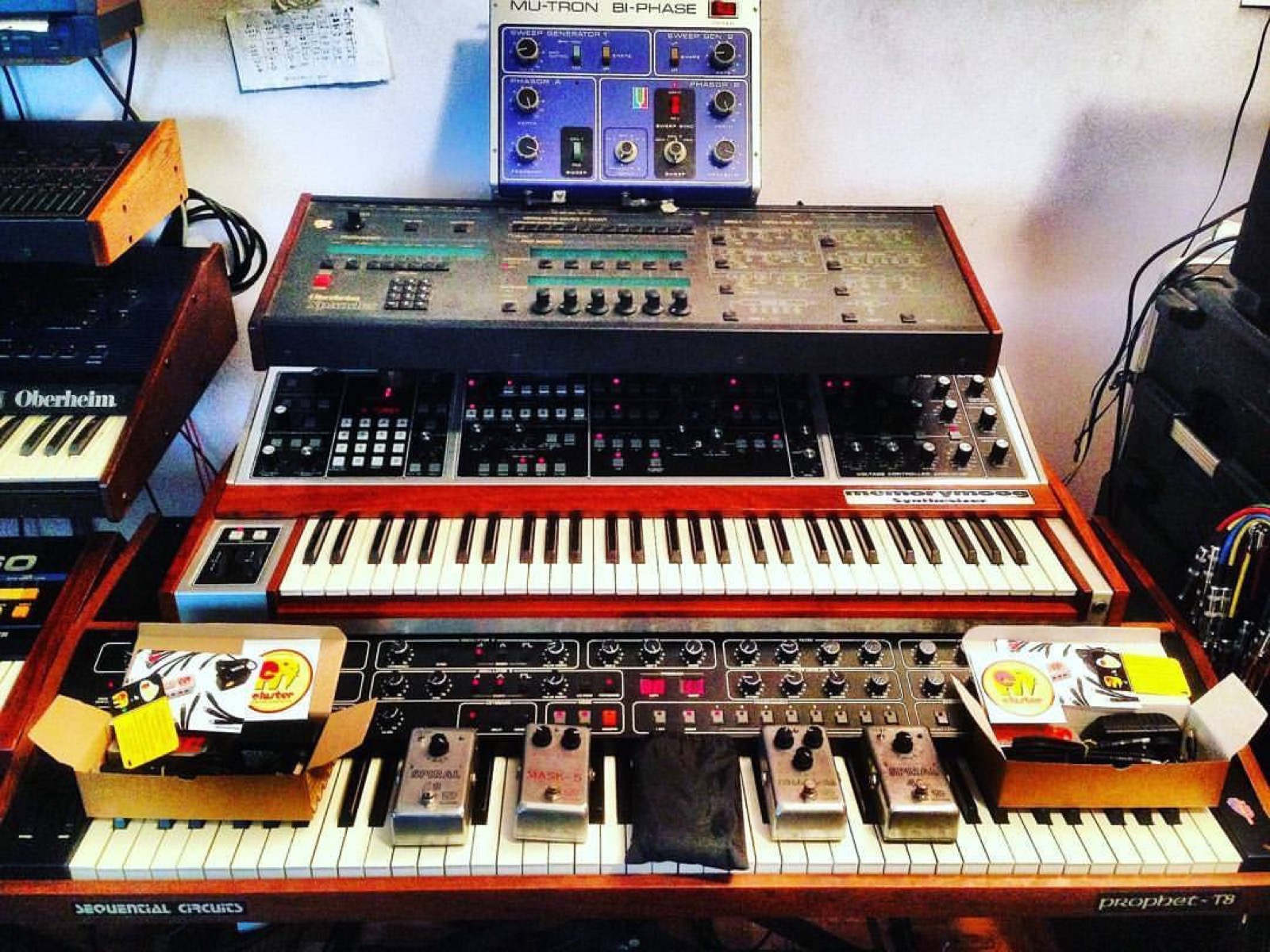
If you can use two phasers, put one on each side and set their sweep rates just slightly apart. The independent movement across the stereo field can sound wonderfully three-dimensional on headphones.
4. Try it on more than guitar
Phasers aren’t just for guitar. Try one on electric piano, synth pads, or drum hi-hats. You might find a new character in a sound you know well.
Epilogue — The Big Box That Doubled the Swirl
A guitar maker canceled a synthesizer project. From a piece of that dream came a company that created Stevie Wonder’s “kwa” sound—and then built a big box with two phaser sweeps inside.
Building a great machine and keeping a company alive aren’t always the same thing.
But the swirl Mu-Tron created is etched into funk and dub records. It still rolls on in reissued gear today.
The next time you hear a guitar or keyboard twisting and swirling, take a moment to remember: that sound may have come from a box with two sweeps inside, far too big to fit at your feet.
Mu-Tron Timeline
- 1972: Mike Beigel and Aaron Newman found Musitronics in Roslyn, New Jersey.
- Summer 1972: The Mu-Tron III envelope filter is born.
- 1973: The Mu-Tron III is used on Stevie Wonder’s “Higher Ground.”
- 1974: The Bi-Phase, with two phasers in one unit, arrives.
- 1978: Musitronics sells the Mu-Tron product line to ARP.
- Around 1979: Musitronics closes.
- 2014: The Mu-Tron III returns; the Bi-Phase II follows later.
References
- Wikipedia (English), “Mu-Tron”
- Premier Guitar, “Builder Profile: The Mu-Tron Story”
- mu-tron.com, Mike Beigel’s recollections, “The Stomping Ground: Musitronics, Mu-Tron, and the Gizmotron”
- Product guides from Soundgas and Perfect Circuit
Photo credits
- Header image, “Mu-Tron Bi-Phase,” kurisuuu (cropped) / Wikimedia Commons / CC BY 2.0
- “Effects units on synthesizer stack - Mu-tron Bi-Phase, Oberheim Xpander, Moog memorymoog, Sequencial Circuits Prophet-T8, etc - La Siesta del Fauno Estudio-Laboratorio (2016-07-05 18.38.58 by Andrés Galeotti),” Andrés Galeotti from Ciudad Autónoma de Buenos Aires, Argentina / Wikimedia Commons / CC BY 2.0
License: CC BY 2.0, https://creativecommons.org/licenses/by/2.0/
About the illustrations
- All diagrams in this article were created by Gadget Creator Lab.