High School Friends Who Defined the Stompbox in a Basement — MXR
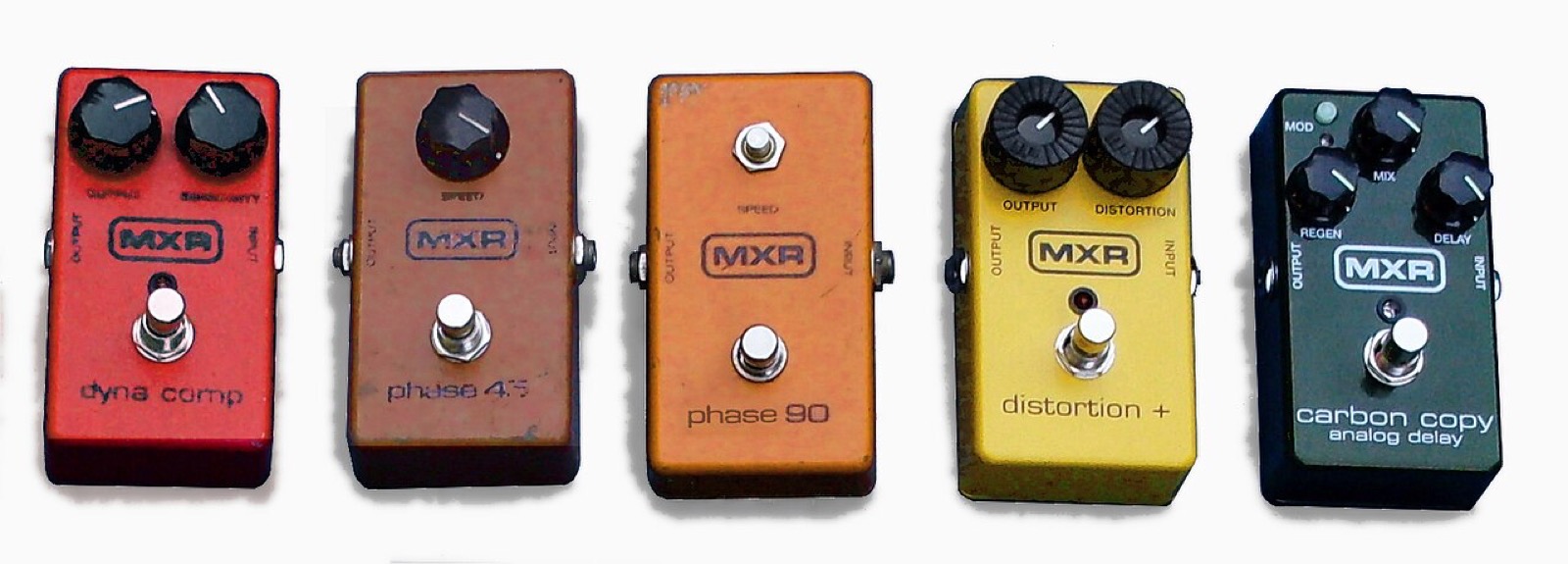
☕ A coffee-length story — about a 10-minute read. Read it as a story, not a research paper. The small metal boxes lined up at a guitarist’s feet were shaped by two young men who opened a repair shop in a basement in a small American city.
Prologue — The Small Boxes at Your Feet
Take a look at a guitarist’s pedalboard on a club stage.
Rows of colorful little metal boxes, each small enough to fit in your palm. Step on one, and the guitar sound swirls, distorts, or sustains. These are effects pedals.
There are thousands of pedals today, but many are roughly the same size and shape: a sturdy little metal box with a handful of knobs.
One of the companies that spread this design around the world was MXR, based in the United States.
It all began in a small basement in a modest city in upstate New York.
📝 About this story
This story draws on books, interviews, and manufacturer materials I’ve read over many years. I’ve tried to stick to the facts, but I wasn’t there, so some nicknames or commonly repeated accounts may have made their way in. Stories with competing versions are marked as “Legend & Lore.” Sources are listed at the end.
Chapter 1 — High School Friends in Rochester
In northwestern New York State sits Rochester, a manufacturing town known as the home of Kodak, the camera and film company.
At a high school near the city, two teenagers met: Keith Barr and Terry Sherwood.
They loved tinkering with electronics. Before long, they started an audio equipment repair shop called Audio Services in the basement of a rented apartment.
They repaired amplifiers, stereos, and musicians’ gear. As they kept at it, they noticed something:
“Guitarists want these tools, but no one’s making quite the right ones yet.”
1972: MXR Is Born
In 1972, the two set up a company to make their own products. It was called MXR. (It was formally incorporated as “MXR Innovations” in 1974.)
Many effects pedals at the time were bulky, fragile, and not particularly good-sounding. As repairmen, Barr and Sherwood had seen plenty of broken gear.
That made their goals clear:
- Small and easy to fit at your feet
- Rugged enough to survive being stomped on onstage
- Simple, with few knobs and no learning curve
- And great-sounding
Chapter 2 — The First Pedal: Phase 90
In 1974, MXR released its first effects pedal: the Phase 90.
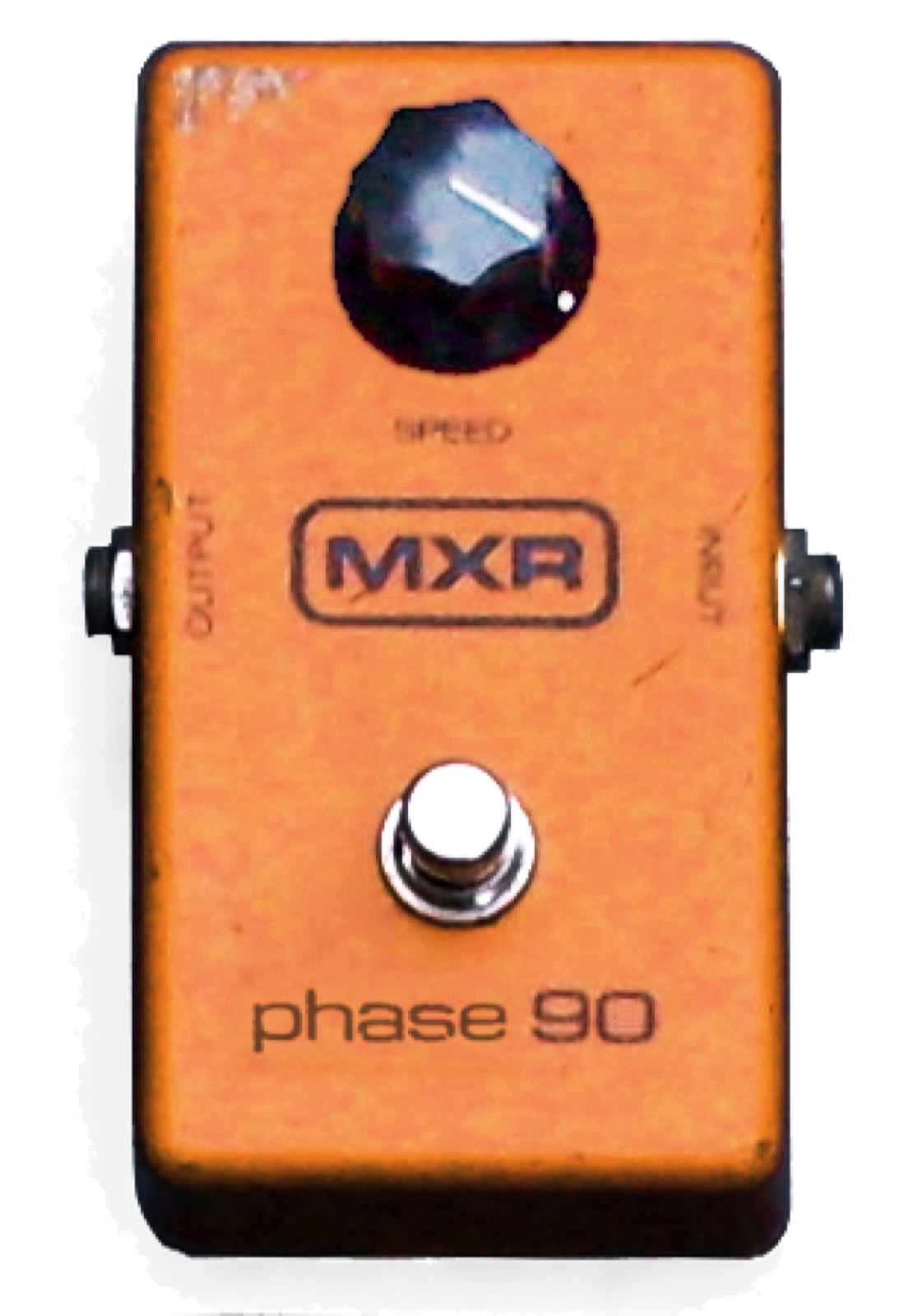
It was a vivid orange box with just one knob. Turn the knob labeled “Speed,” and the guitar starts to swirl in waves.
That effect is called phasing. It blends the original sound with a slightly delayed version of itself. Some frequencies cancel each other out while others reinforce each other, creating that sweeping motion.
One knob. No room to get lost. And wherever you set it, the sound feels musical.
The Phase 90 quickly became a guitarist’s staple.
Eddie Van Halen’s Orange Box
The guitarist who made the Phase 90 famous was Eddie Van Halen.
Eddie used one on Van Halen’s 1978 debut album and on the band’s second album. You can hear that guitar sound—sweeping and leaping across the speakers.
MXR still makes a special Phase 90 bearing Eddie’s signature.
The Rest of the Family
After the Phase 90, MXR introduced one classic after another:
- Dyna Comp: a compressor that evens out a signal’s volume for a more consistent, sustaining sound
- Distortion+: a pedal that gives a guitar a gritty distortion
- Blue Box: an unusual fuzz that mixes in a note one octave lower
- Phase 45: a phaser with a gentler sweep than the Phase 90
Each had just one or two knobs. The basic shape of today’s effects pedal—a small metal box with a few controls—was taking hold.
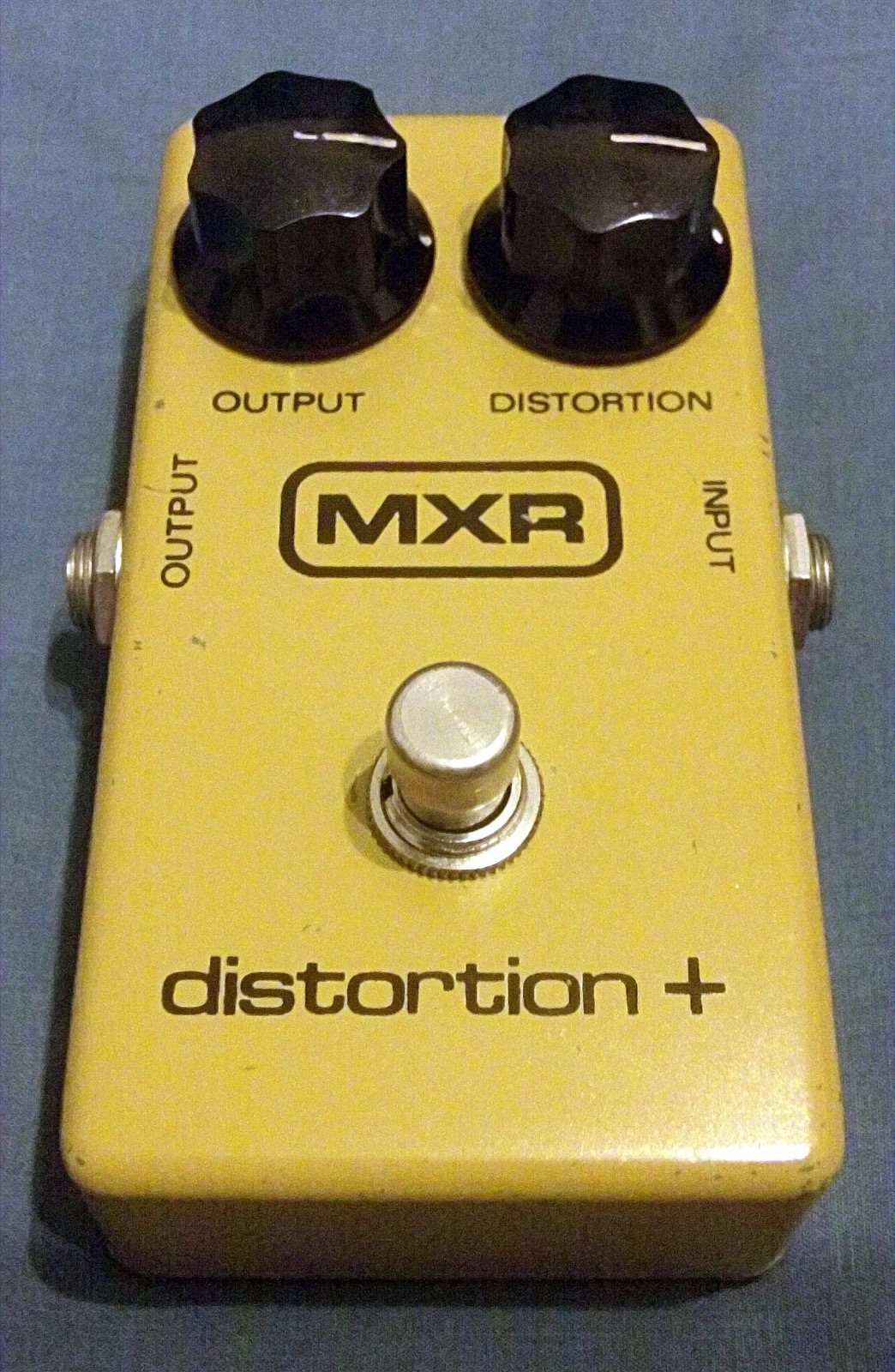
🏷 Legend & Lore: Early Pedals Had No Indicator Light
MXR pedals made before 1981 had no on/off indicator light (LED). They also had no jack for a power adapter; they ran on batteries alone.
Guitarists had to rely on their ears to tell whether a pedal was on or off. Those early models without lights are now highly sought after by collectors.
(For the record, early MXR pedals also lacked the “true bypass” feature found on many pedals today.)
Chapter 3 — From the Floor to the Studio Rack
MXR didn’t stop at floor pedals.
In 1976, the company released its first rack-mounted unit, the Digital Delay. With an added memory board, this full-featured digital delay could extend the echo time to as much as 1.28 seconds.
Musicians known to have used it include David Gilmour of Pink Floyd and Mike Rutherford of Genesis.
MXR followed with rack-mounted graphic equalizers, the Pitch Transposer, which shifted pitch, and the Flanger/Doubler, which created a sweeping effect. The company made its way into recording studios, too.
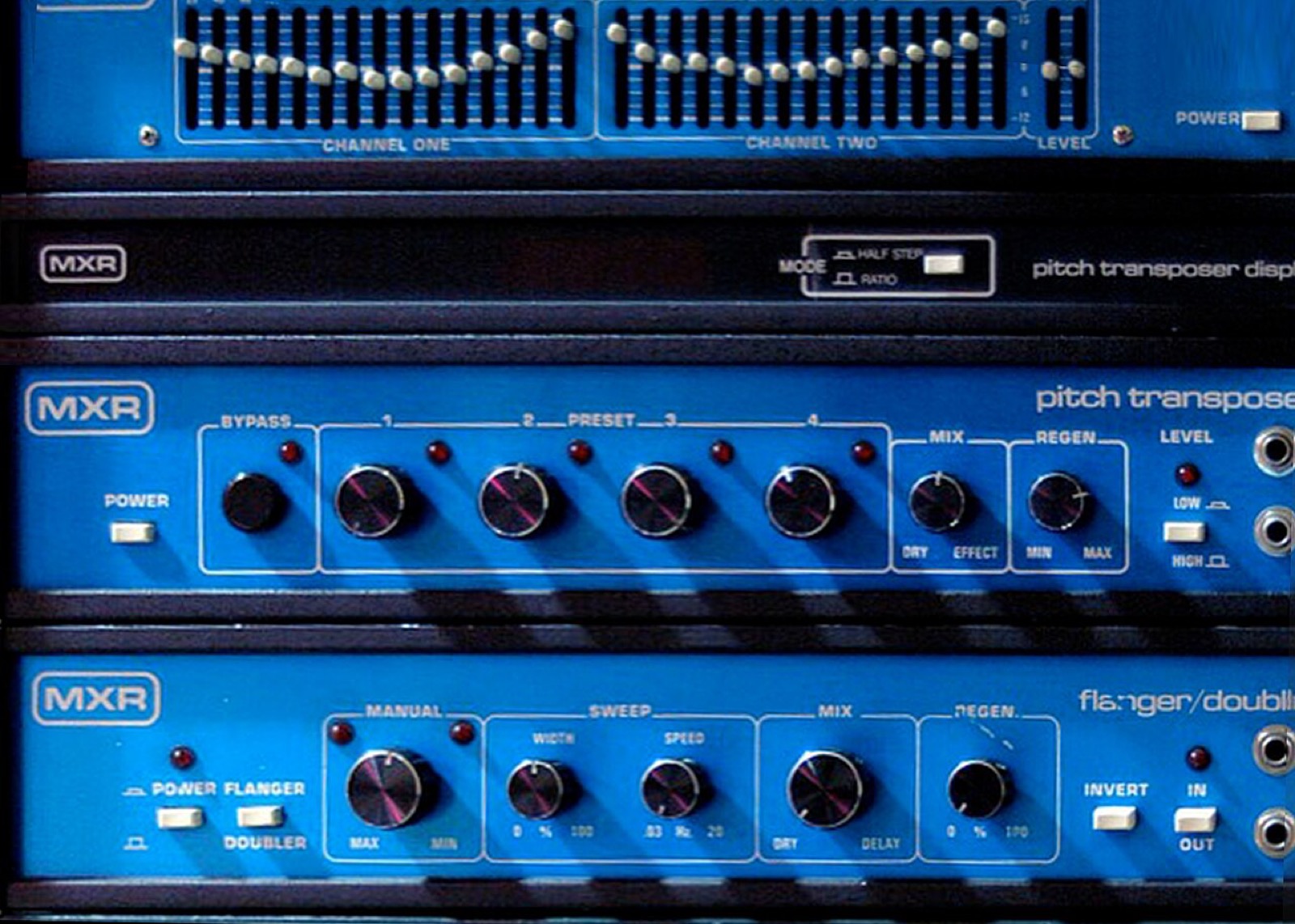
In 1983, MXR released the Omni, which packed several guitar and bass effects into one unit. That same year, the company even released the M-185 rhythm machine.
In about a decade, a company that started as a basement repair shop had grown into a manufacturer with products for everything from the stage floor to the studio.
Chapter 4 — The Company Ends, and the Name Returns
But the effects pedal world changed dramatically in the 1980s.
Companies around the world, including Japanese manufacturers, began releasing capable pedals at lower prices. MXR fought back with its plastic Commande series and a new 2000 series, but the competition remained tough.
In 1984, MXR stopped making pedals.
Jim Dunlop Carries the Brand Forward
In 1987, Jim Dunlop, known for guitar picks and strings, took over the MXR name.
Dunlop reissued classics such as the Phase 90, Dyna Comp, and Distortion+, and developed new pedals as well. Walk into a music store today and you’ll still see MXR pedals lined up on the shelves.
What Became of the Founders
The two founders each left their mark on the history of music gear in their own way.
Keith Barr later founded Alesis, a digital equipment maker. Its affordable digital reverbs and products such as ADAT, a digital recorder for multitrack recording at home, helped change music production.
Terry Sherwood and some of his MXR colleagues founded ART (Applied Research & Technology), which also became known for affordable audio equipment.
Both men held on to the same idea to the end: make good tools accessible to more people.
Chapter 5 — Your First Effects Pedal: A Few Pointers
Here are a few tips for getting started with MXR classics.
Start Slow with the Phase 90
The faster you set the phaser, the faster the sweep. Start slow, with the knob turned toward the left.
Strum a chord and let it sweep slowly; the sound can make the space around it feel bigger. Turn it up, and it gets much more psychedelic and dramatic. Pick a setting that suits the song.
Compressor Placement Matters
A compressor like the Dyna Comp usually goes right after the guitar, at the start of the chain. Once it evens out the volume, the signal can feed into distortion and modulation effects, helping the whole sound feel more consistent.
If you’re unsure, this is a good starting order:
Guitar → Compressor → Distortion → Phaser and other modulation effects → Delay → Amp
That’s only a starting point, of course. Change the order, and you may stumble on a sound you never expected. That’s part of the fun of effects pedals.
Epilogue — A Big Idea in a Small Box
Those little metal boxes lined up at a guitarist’s feet today, all with that familiar shape, came from two high school friends who repaired gear in a basement.
Their idea was simple: make it small, tough, easy to use, and great-sounding.
That simplicity may be why, 50 years later, orange Phase 90s are still being stomped on at stages around the world.
Next time you spot a row of pedals in a music store, remember that one of the starting points for all those colorful boxes was a basement in Rochester.
MXR Timeline
- 1972: Keith Barr and Terry Sherwood establish MXR
- 1974: Incorporated as “MXR Innovations”; releases its first pedal, the Phase 90
- 1970s: Introduces the Dyna Comp, Distortion+, Blue Box, Phase 45, and more
- 1976: Releases its first rack unit, the Digital Delay
- 1978: Phase 90 is used on Van Halen’s debut album
- 1981–84: Releases the plastic Commande series
- 1982–84: Releases the 2000 series
- 1983: Releases the Omni multi-effects unit and M-185 rhythm machine
- 1984: Ends pedal production
- 1987: Jim Dunlop acquires the MXR brand
References
- Wikipedia, “MXR” (English edition)
- Dunlop / MXR official website (product information and the Phase 90 story)
- Premier Guitar and Vintage Guitar (articles on MXR’s history)
Photo credits
- Header image, “MXR effect pedals 1” — Roadside Guitars (modified) / Wikimedia Commons / CC BY-SA 3.0
- “MXR M-101 Phase 90 (Box logo without LED)” — Roadside Guitars (modified) / Wikimedia Commons / CC BY-SA 3.0
- “1979 MXR Distortion +” — tpeck111 / Wikimedia Commons / CC BY-SA 3.0
- “MXR racks front @ Savage Audio” — Jake Mohan (modified) / Wikimedia Commons / CC BY 3.0
Licenses:
CC BY-SA 3.0 https://creativecommons.org/licenses/by-sa/3.0/
CC BY 3.0 https://creativecommons.org/licenses/by/3.0/