The Invention They Never Patented — Parametric EQ and GML 8200
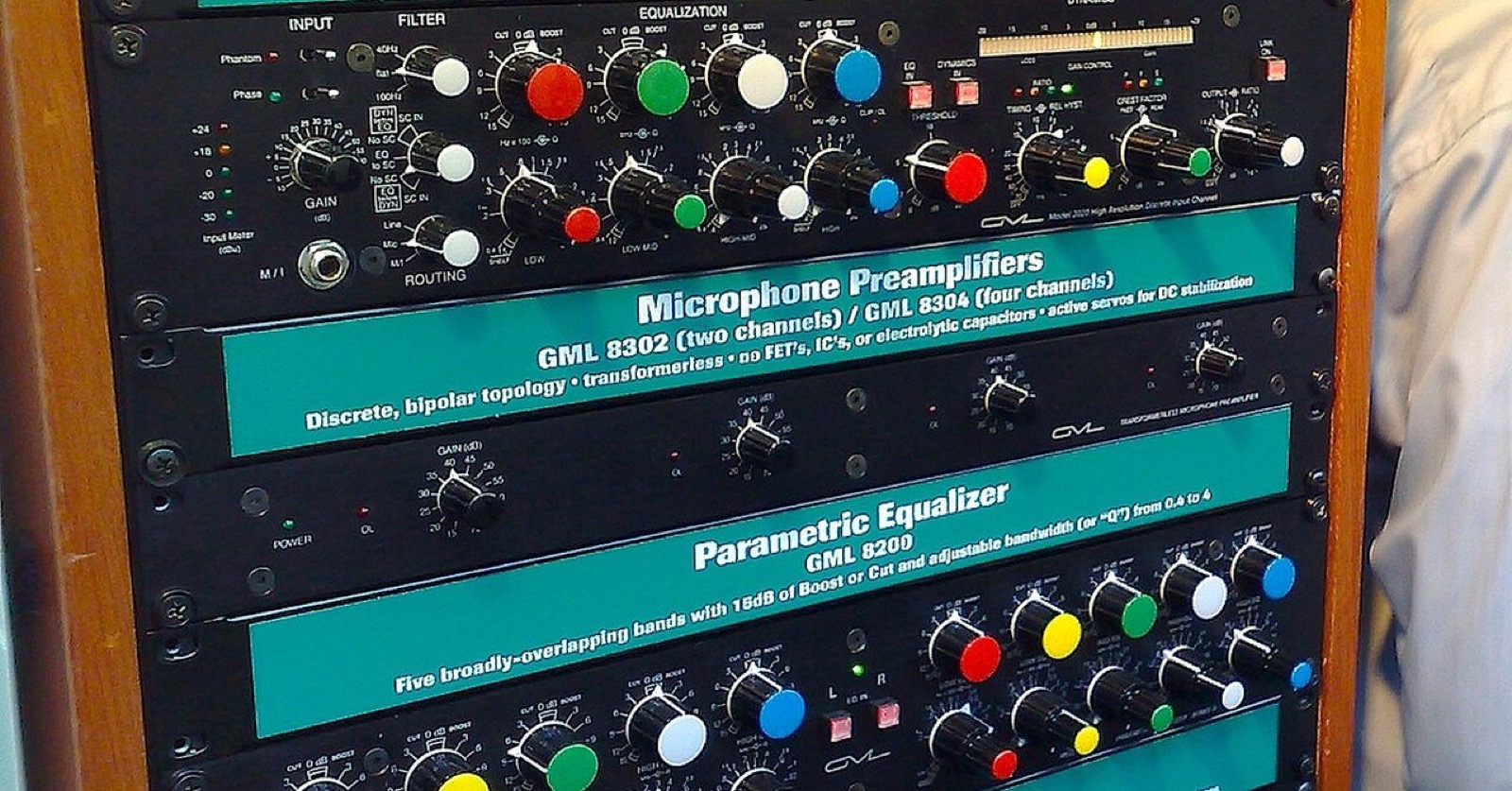
☕ A coffee-length story — about a 10-minute read. Enjoy it as a story, not a research paper. Today, almost every recording program includes a parametric EQ. The young engineers who introduced the idea to the world never patented the circuit or trademarked its name.
💡 What you’ll learn
- How the three controls on a parametric EQ—frequency, gain, and Q—changed what earlier equalizers could do
- How two young engineers developed the idea in the early 1970s and introduced it in a technical paper
- How one of those inventors, who never patented or trademarked the invention, built the GML 8200 under his own name in 1982
Prologue — A tool in every recording program
Anyone who makes music on a computer has probably seen this kind of screen.
Pitch runs along the horizontal axis; level runs vertically. A few points sit on the graph. Drag one, and the line forms a smooth hill or dip. Grab around the point, and the hill grows wider or narrower.
That’s a parametric equalizer, or parametric EQ.
It’s so familiar that we rarely stop to think that someone had to invent it.
Yet in the early 1970s, a pair of young engineers introduced this idea to the world and presented it in a paper at an audio engineering conference. One of them would later become a celebrated engineer—and build a classic piece of equipment through a company bearing his own name.
The GML 8200.
About this story
I’ve put this story together from books and articles I’ve read, trade magazine features, interviews with the people involved, and retailer explainers. Accounts differ on what should be called the “first parametric EQ,” so I point out those differences in the text. Sources are listed at the end.
Chapter 1 — What is an equalizer?
Changing the level at different pitches
An equalizer (EQ) splits sound by pitch, or frequency, and raises or lowers the level of each range.
- Bring up the low end a little to make a sound fuller.
- Turn down the mids that sound muddy to make it clearer.
- Boost the highs to make it brighter.
Think of it as seasoning food with salt and pepper. EQ is one of the most frequently used tools in recording and mixing.
Older EQs made you choose
Until the 1960s, many EQs let you choose only from a set of fixed frequencies.
A switch might offer 60, 100, 200 Hz, and a few other options. You picked the closest one and boosted or cut it. If the problem was right at 150 Hz, you couldn’t target it precisely.
Many EQs of the era also used components called inductors. They can give a circuit a distinctive, appealing sound, but they’re large and heavy, and they make it difficult to move the target frequency freely.
Chapter 2 — Three controls: what “parametric” means
Three parameters
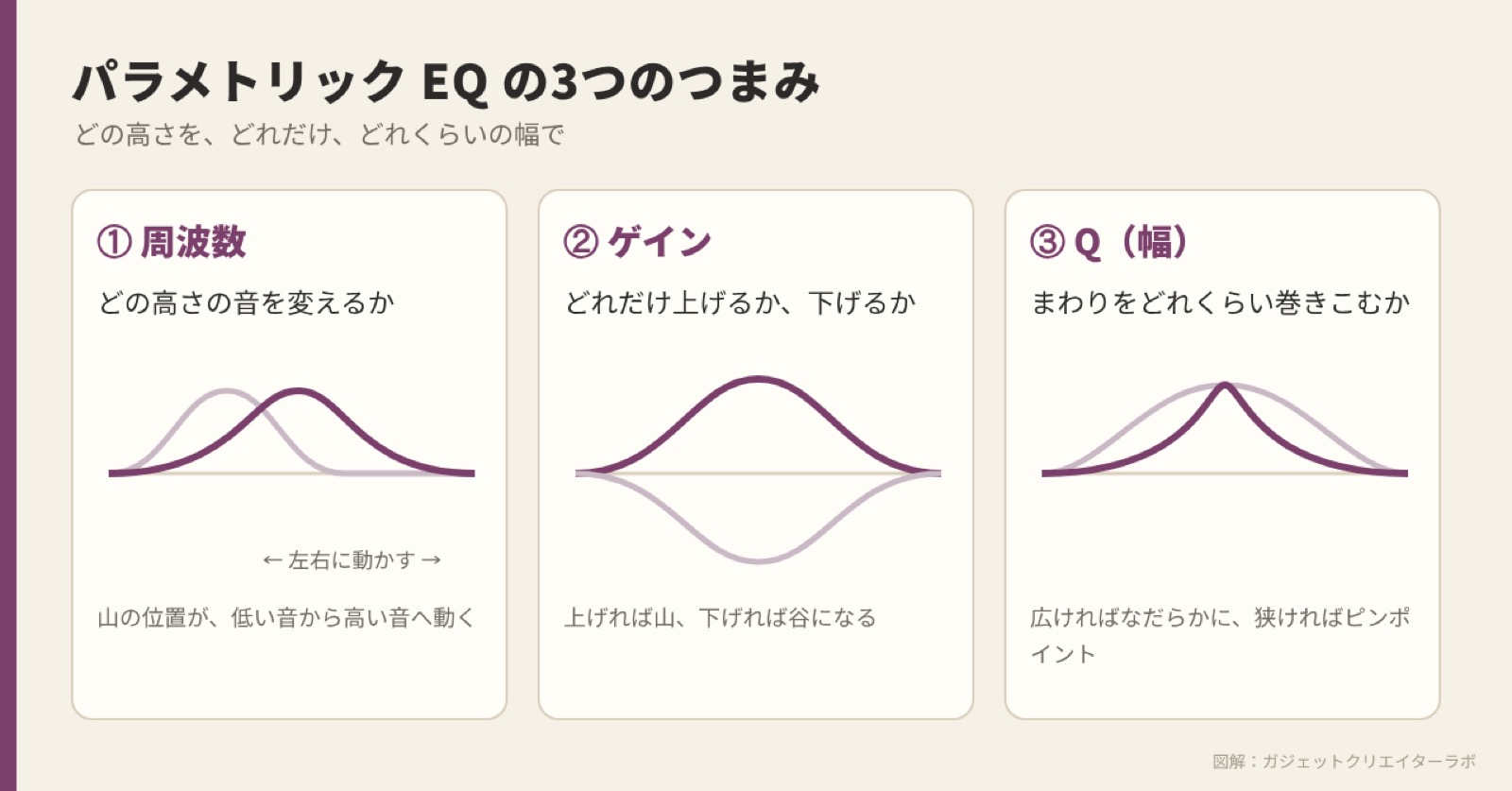
Parametric EQ solved that problem. For each point, you can smoothly and freely adjust three things, or parameters:
- Frequency: Which pitch to change
- Gain: How much to boost or cut it
- Q (bandwidth): How wide a range around it to affect
The freedom to change the width
One of the biggest advances was the ability to adjust Q, or the width of the affected range.
- Set a wide band to gently brighten or thicken an overall sound.
- Set a narrow band to notch out one piercing “eeee” tone with pinpoint precision.
From surgical cuts to broad strokes with a paintbrush, those three controls made it possible to shape sound almost any way you wanted.
Chapter 3 — Massenburg and Macneal
Young engineers at ITI
Two engineers involved in the birth of parametric EQ were George Massenburg and Burgess Macneal.
They worked at a company called ITI. Their goal was an EQ with no inductors and no selector switches. They wanted to combine small components so both frequency and bandwidth could be adjusted smoothly.
Macneal is said to have handled the overall design, while Massenburg worked on the amplifier and other circuit sections.
1971: A trade-show debut
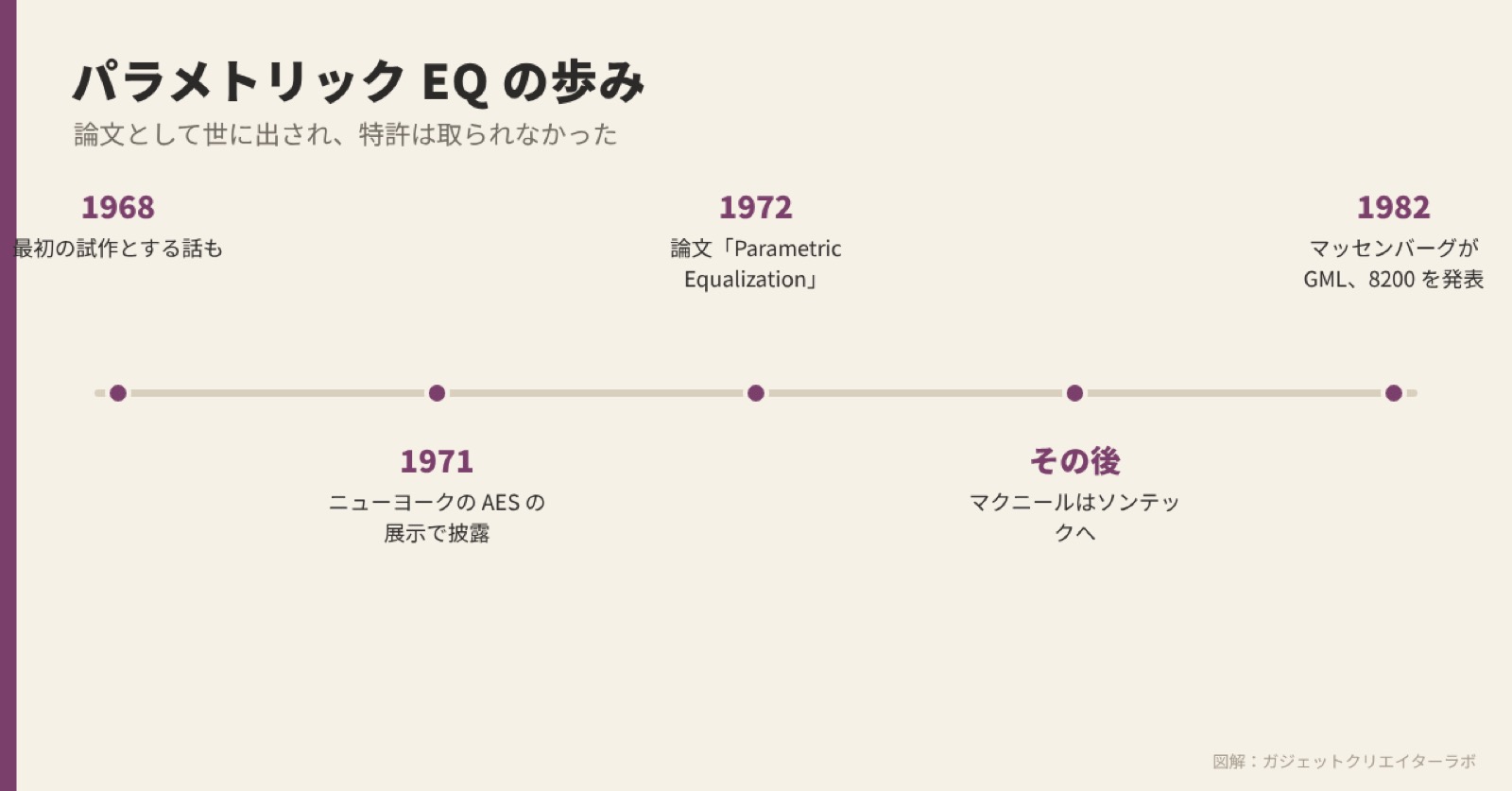
The pair showed their EQ at an Audio Engineering Society (AES) exhibition in New York in 1971. Some accounts say the first prototype was built in 1968.
They made a console module and a standalone unit in a single enclosure. The standalone ME-230 is often described as the first commercially available parametric EQ.
1972: The paper “Parametric Equalization”
In 1972, at an AES convention in Los Angeles, the two presented a paper titled “Parametric Equalization.”
The story goes that they set the type and printed the paper themselves. It helped bring the word “parametric” into widespread use in the audio world.
They never patented it
Here’s an intriguing detail.
Massenburg did not patent the circuit, and he did not trademark the word “parametric.”
Had he patented it, parametric EQ might have belonged to a single company. Instead, the idea spread quickly—to consoles, standalone hardware, and eventually almost every recording program.
The question of who was first
In interviews, Massenburg has said that before starting GML, he designed and built the first commercially available parametric EQ. Accounts vary, though, on the two engineers’ respective roles and on which machine deserves to be called “the first.”
One thing is clear: by turning the idea into working equipment and presenting it in a paper, the two changed how people used EQ.
Chapter 4 — Two different paths
Macneal and Sontec
After ITI, the two went their separate ways.
Macneal continued making parametric EQs at Sontec. Sontec EQs are said to have earned particular respect in mastering—the final stage of preparing music for release on CD or vinyl.
Massenburg and GML
Massenburg, meanwhile, worked on many recordings as an engineer and producer. He kept building equipment, too.
In 1982, he founded GML (George Massenburg Labs), a company named after himself.
Chapter 5 — GML 8200: the fifth-generation answer
1982
GML’s first landmark product was the 8200, released in 1982.
The 8200 is said to have been the fifth-generation refinement of the EQs Massenburg had worked on up to that point.
More than a decade had passed since the ITI days. Years of experimentation had brought the parametric EQ concept to one of its most complete forms.
A transparent, precise sound
The GML 8200 is often described as:
- Transparent, with little coloration
- Precise, allowing fine adjustments
- Stable, even with substantial changes
It isn’t like an old inductor-based EQ that adds its own “flavor” just by passing sound through it. The 8200 is designed to shape sound accurately, just as the engineer intends. That precision as a tool is its defining quality.
GML describes the 8200 as “the standard for parametric equalizers.” That’s the manufacturer’s own claim, but the unit has indeed remained in use at many studios for decades.
Names with a sparse paper trail
The history of parametric EQ sometimes mentions makers such as Lang and ADR. It isn’t clear exactly how their equipment figured in the invention, though, so I’ll leave it at introducing their names.
Chapter 6 — Using parametric EQ today
Here are a few tips for working with parametric EQ.
1. Start by cutting
EQ often sounds more natural when you cut unwanted sounds instead of boosting others. A small reduction in muddiness or harshness can make the rest of the sound easier to hear.
2. How to find a problem frequency
- Set Q to a narrow bandwidth.
- Turn the gain well up.
- Slowly sweep the frequency control from side to side.
- Find the spot where the sound you dislike—an “eeee” or “boing”—jumps out most.
- Lower the gain there to cut it.
This lets you listen for the problem frequency and pinpoint it by ear.
3. Use a wide band for boosts
When you want a brighter or fuller sound, use a wider Q and boost just a little. A large boost over a narrow band can create an unnatural tonal bump.
4. Close your eyes for the final check
When you’re looking at the EQ display, it’s easy to judge by the shape of the curve. For the final check, look away from the screen and listen. Toggle the EQ on and off to make sure it really sounds better.
Epilogue — An invention that became everyone’s
The goal was to change frequency, level, and bandwidth smoothly, without inductors or switches. Young engineers brought that idea to life and presented it in a paper at an audio engineering conference.
They never patented or trademarked it. Before long, the idea had become a tool in studios around the world—and now, on everyone’s computer.
The GML 8200 is one answer refined over a decade.
The next time you grab an EQ point in your recording program, take a moment to remember: that familiar tool began with an idea young engineers introduced in the early 1970s and left free for everyone to use.
Parametric EQ timeline
- 1968: Some accounts say the first prototype was built.
- 1971: Massenburg and Macneal show their EQ at an AES exhibition in New York.
- 1972: They present “Parametric Equalization” at the AES convention in Los Angeles.
- Afterward: Macneal continues at Sontec; Massenburg pursues his own path as an engineer.
- 1982: Massenburg launches GML and introduces the 8200, said to be a fifth-generation refinement.
- Today: Parametric EQ is included in almost every recording program.
References
- Wikipedia (English): “George Massenburg” and “Burgess Macneal”
- Vintage King: “Around the Shop: GML 8200 EQ” and “Sontec MES-432C9 Parametric EQ”
- Related articles on GML in Sound On Sound
- Articles about George Massenburg in Mix and Sound & Video Contractor
- AudioTechnology: “Name Behind the Name: Burgess Macneal”
- Vintage Digital: “The Parametric Equaliser Formally Announced”
Photo credits
- Header image, “GML - George Massenburg Labs (AES 124)” by Hens Zimmerman from Zeist, The Netherlands (cropped) / Wikimedia Commons / CC BY 2.0
License: CC BY 2.0 https://creativecommons.org/licenses/by/2.0/
About the illustrations
- All diagrams in this article were created by Gadget Creator Lab.