The First View on a Silver Plate — The Birth of Photography (Niépce and Daguerre)
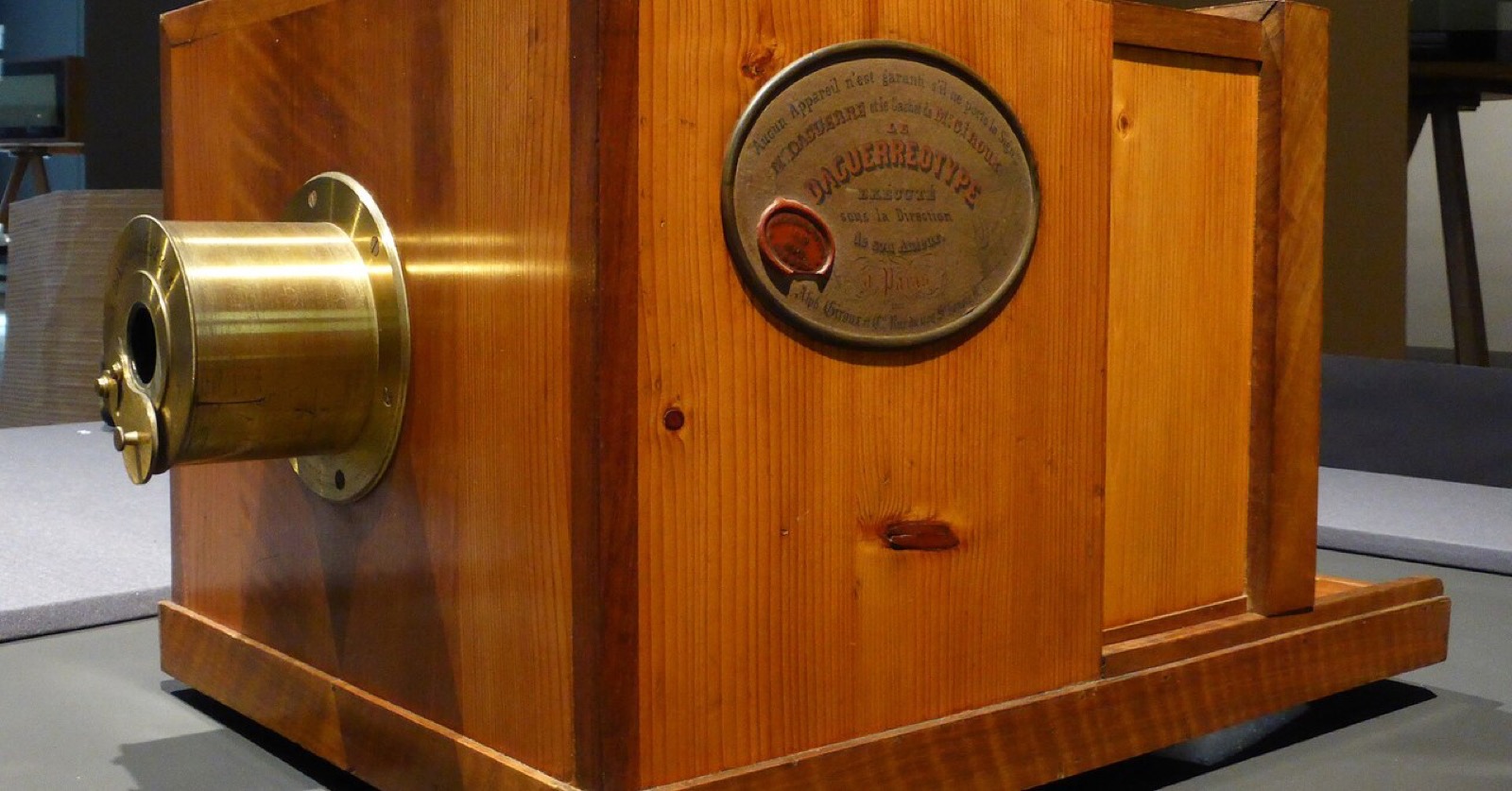
☕ A coffee-length story — about a 20-minute read. A side trip in our camera history series: this time not a company or a camera, but photography itself, all the way back to the day it was born. Our two leads are Frenchmen: Niépce, who ran his light experiments at a country estate, and Daguerre, who worked magic with light in a Paris theatre.
What you will find here:
- When, where and on what the oldest surviving photograph was made
- How Niépce and Daguerre came to join forces
- Why the "daguerreotype" spread around the world so fast
- How those silver plates found their way to Japan at the end of the samurai age
Prologue — Paris, 19 August 1839
Paris, summer 1839. From early morning, people were gathering around the Institut de France on the bank of the Seine.
Inside, the Academy of Sciences and the Academy of Fine Arts were meeting together — a rare event. There was only one item on the agenda.
To make public a way of drawing with light.
The man at the lectern was François Arago, astronomer and member of parliament. He described a method of capturing the scene before your eyes, exactly as it was, on a polished silver plate.
Since the start of the year, rumours had been spreading through Paris about a mysterious plate that could copy a view. But the actual method had been kept secret. On this day, at last, it was revealed.
When the meeting ended, people are said to have rushed to the shops that sold the equipment. Lenses, wooden boxes, silver plates, chemicals. From that day on, all over Paris, people began pointing boxes at the view from their windows, at bridges, at churches.
The method was named after the man who presented it: the daguerreotype. But behind it stood another inventor, one who did not live to see that day.
This is the story of the two of them.
Chapter 1 — The inventor from Burgundy
The brothers' laboratory
Joseph Nicéphore Niépce was born in 1765 in Chalon-sur-Saône, a town in Burgundy in eastern France. His father was a wealthy lawyer, and the family was well known in the town.
As a young man he served in the army and later as a local official. But what truly absorbed him was invention.
Niépce had an older brother, Claude. The two of them shut themselves away on the family estate, dreaming up all sorts of machines, building them and testing them.
In 1807 the brothers invented and patented the Pyréolophore. It ran on the explosions of a burning powder made from plant spores — a very early "internal combustion engine". They are said to have fitted it to a small boat and run it on the river.
They also improved a water pump and an early pedal-less bicycle. There seemed to be no limit to the brothers' curiosity.
An inventor who couldn't draw
Niépce's interest in light began in the 1810s.
In France at that time, lithography — printing pictures from stone — was all the rage. Niépce was fascinated by it too, but there was a problem: he was not much of an artist himself.
Then why not let light do the drawing?
Painters had long used a device called the camera obscura. Fit a small hole or a lens to a dark box, and the scene outside appears inside the box, upside down. Artists would trace that image on paper to make accurate sketches.
What if that image could be kept as it was, without tracing? Niépce's long quest began here.
Images that faded away
Around 1816, Niépce placed paper coated with silver chloride — which darkens in light — inside a camera obscura.
The view from his window rose faintly on the paper. But it was a reversed image, light areas dark and dark areas light: a negative.
Worse, once the paper was brought into the light, the whole sheet kept darkening and the image vanished. He could make an image with light, but he had no way to stop it there.
Niépce began searching for another material. He settled on bitumen, a kind of natural asphalt.
Bitumen hardens when exposed to light and becomes harder to dissolve in oil. The parts hit by light remain; the parts left in shadow can be washed away. With this, an image ought to stay on the plate.
In 1822, Niépce is said to have succeeded in copying an engraving of Pope Pius VII onto a glass plate by this method — laying the engraving over the plate and exposing it to light, much like a contact print. Sadly, the plate was later broken when he tried to make copies from it, and it no longer survives.
Niépce gave his technique a name: heliography, from the Greek for "sun drawing".