The Three-Year-Old Who Wanted to See It Now: Polaroid and Edwin Land
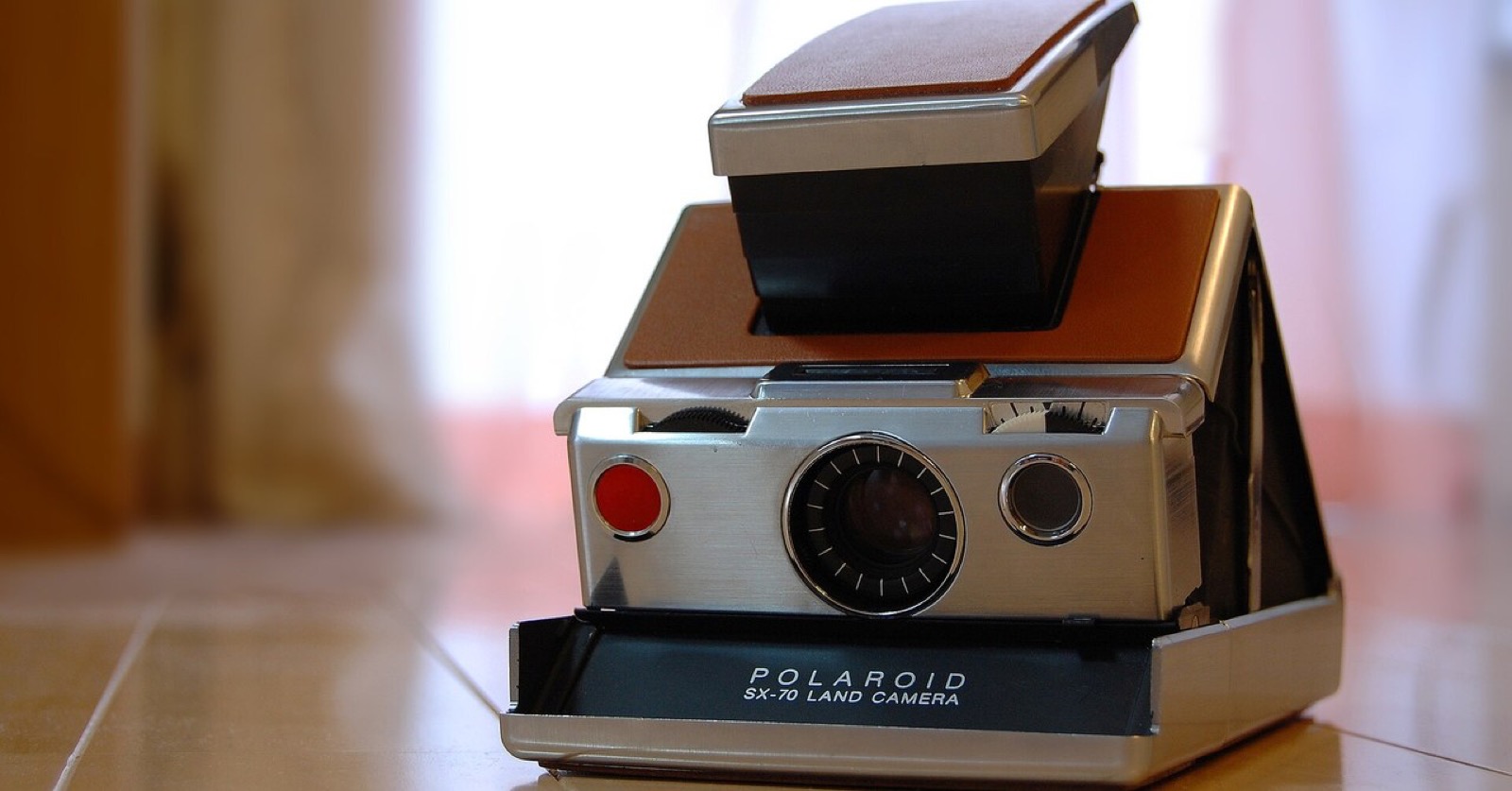
☕ A coffee-length story — about a 15-minute read. This is the tale of how one small girl's question led to a camera that hands you the picture on the spot.
Prologue — A Holiday in Santa Fe, 1943
Winter 1943, Santa Fe, New Mexico, in the American Southwest. A family was spending a holiday in the dry, high-desert air.
The father was a 34-year-old inventor. Camera in hand, he was taking pictures of his three-year-old daughter.
After he pressed the shutter, the story goes, she looked up at him and asked:
"Why can't I see it now?"
In those days, it was normal for days to pass between taking a picture and seeing it. You wound the film, took it to a photo shop, asked for developing and printing, and waited. No grown-up ever questioned that routine. To a three-year-old, it made no sense at all.
Most parents would have said "That's just how it works," and that would have been that. This father was different. He took his daughter's question seriously, as a problem to be solved.
His name was Edwin Land. Under the name Polaroid, he would go on to give people all over the world "pictures you can see right where you took them."
This is the story of a little girl's simple question, and of the father who spent his life answering it.
Chapter 1 — The Young Man Who Left Harvard, and the "Direction" of Light
Sneaking into a laboratory at night
Edwin Herbert Land was born on 7 May 1909 in Bridgeport, Connecticut.
From childhood he was fascinated by light and by how things work. He went to Harvard and began studying optics.
But after his freshman year he left and moved to New York. There was an idea in his head that he simply had to make real.
It was a way to make sheets that use the property of light called polarisation — cheaply, and in large sizes.
Light actually travels while vibrating in many directions. A sheet that let through only light vibrating in one direction could cut the glare off water or window glass. Crystals that did this had long been known, but they were small and expensive, never something for everyday use.
The young man with no laboratory of his own is said to have pored over old research at the New York Public Library and, late at night, slipped into a Columbia University lab to borrow its equipment.
In 1928 he finally found a way. Tiny crystals suspended in a liquid were all lined up in the same direction with a magnetic field, then set in place. The result was a thin sheet that polarised light.
Land later returned to Harvard, but he never took a degree. He would remain, all his life, an inventor without a diploma.
Taking the glare out of headlights
In 1932 Land teamed up with George Wheelwright, who taught physics at Harvard, to set up a laboratory. Wheelwright provided the money; Land invented.
Land's first target was car headlights. On a night road, the oncoming car's lights are so bright you can't see ahead. Put polarising sheets on headlights and windscreens, he reasoned, and you could cancel out just the other car's glare.
He spent years trying to persuade the carmakers. At the 1939 New York World's Fair he borrowed part of a car company's exhibit to show a film, and some 150,000 people are said to have seen it. But the plan meant replacing the lights and glass of every car on the road, and it was never adopted.
Sunglasses, and the war years
What spread instead were more everyday uses.
In 1935 American Optical agreed to buy Land's sheets to make polarised sunglasses. Sunglasses that cut glare off the water were a hit, and the uses spread to desk lamps, 3-D movie glasses and scientific instruments.
In 1937 the company changed its name to the Polaroid Corporation.
When the Second World War came, Polaroid took on military work: goggles to help eyes adapt to darkness, gun sights, and a 3-D photographic technique for spotting hidden enemy positions in aerial photographs. In wartime, the small laboratory grew into a big company.
And in the middle of that war came the holiday in Santa Fe.