A Bass Named for ‘Perfect Pitch’ — Fender Precision Bass
☕ A coffee-length story — about a 14-minute read. This is a story to enjoy, not a research paper. Bassists once hauled upright basses onto night buses. One slab of wood ended that struggle. By the time you finish, you may hear the lowest notes in your favorite songs a little more clearly.
Prologue — The Bass You Couldn’t Hear
It’s the late 1940s, in a dance hall somewhere in America. Onstage, the guitarist turns up a new amplifier while the drummer crashes the cymbals.
Beside them, a bassist struggles with an upright bass nearly as tall as he is. He can pull the strings as hard as he likes, but the sound barely reaches the back of the hall. The louder the band gets, the more the low end that should hold it all together disappears.
After the show, he wrestles the huge instrument into a car and heads for the next town. On rainy days, humidity can keep it from sounding right. In cold weather, he worries the wood might crack.
“If only there were a bass you could hold like a guitar and play loud through an amp.”
Thousands of bassists must have wished for exactly that. In 1951, one man gave the idea a shape. He could barely play guitar or bass himself.
📝 About this story
This story draws on books, interviews, and manufacturer materials I’ve read over the years. I’ve tried to stick to the facts, but I wasn’t there, so some nicknames and commonly repeated stories may be part of the mix. I’ve separated accounts with competing versions into Legend & Lore sections, and listed the references at the end.
Chapter 1 — A Radio Repairman’s Next Invention
Leo Fender
Leo Fender ran a radio repair shop in Fullerton, California. He could barely play an instrument, but he loved listening to musicians. He would find out what was giving them trouble, then solve it with a piece of equipment.
In 1950, Leo introduced an electric guitar shaped like a plank—the guitar later known as the Telecaster. It was a simple, durable instrument: a neck bolted onto a slab of wood, easy to repair. He brought that same idea to the bass with the Precision Bass.
The People Who Tried Before Him
Leo wasn’t the first person to try making an electric bass. Records show that a Seattle instrument maker built an electric bass you could hold in the 1930s. Others tried fitting pickups to upright basses, too.
But none of those attempts caught on. Some were expensive, others unreliable, and the biggest obstacle was the belief that a bass was something you played as an upright.
What made Leo’s invention remarkable wasn’t just the idea. He turned it into a product anyone could buy, play, and repair.
The Precision Bass, 1951
In 1951, Fender released a new instrument.
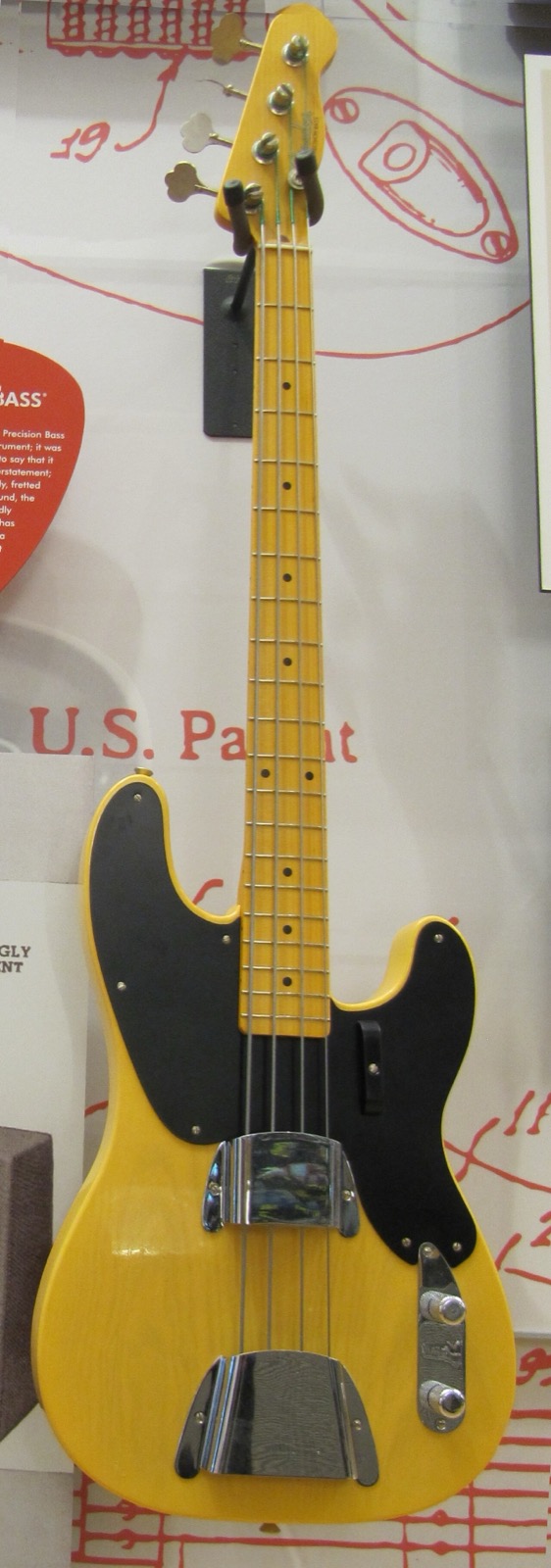
- An angular, plank-like body, like an enlarged Telecaster
- A 34-inch scale length. Fender settled on this length after trying several options, and it remains the electric bass standard today
- One pickup, with two controls: volume and tone
- And frets, which an upright bass doesn’t have
An upright bass has no frets. Learning to play in tune takes years of training your hands to find the right positions.
With frets, you press at a marked position and get a precise pitch. That, people say, is why Leo named it the Precision Bass.
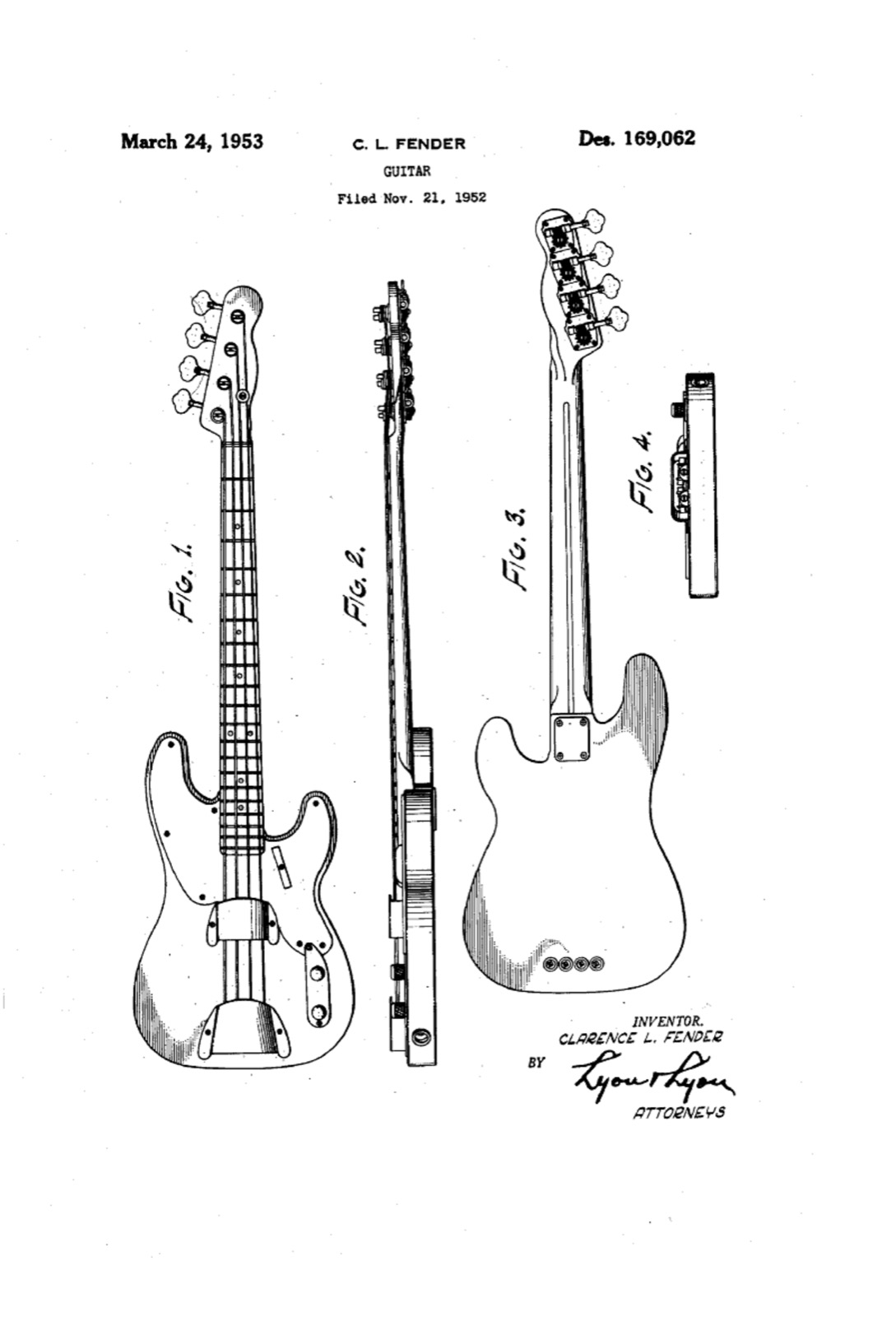
Now let’s see how this “plank” changed the low end in bands around the world.
Chapter 2 — The Day It Became “The Fender Bass”
At First, a Cold Reception
The Precision Bass wasn’t welcomed by everyone when it came out.
Some jazz bassists, proud of their upright basses, reportedly looked down on it: “That plank isn’t a bass,” or “You’re relying on frets?”
Monk Montgomery’s Decision
One of the first musicians to take the new instrument seriously was Monk Montgomery, the older brother of the great guitarist Wes Montgomery. At the time, Monk played bass in the popular Lionel Hampton Orchestra.
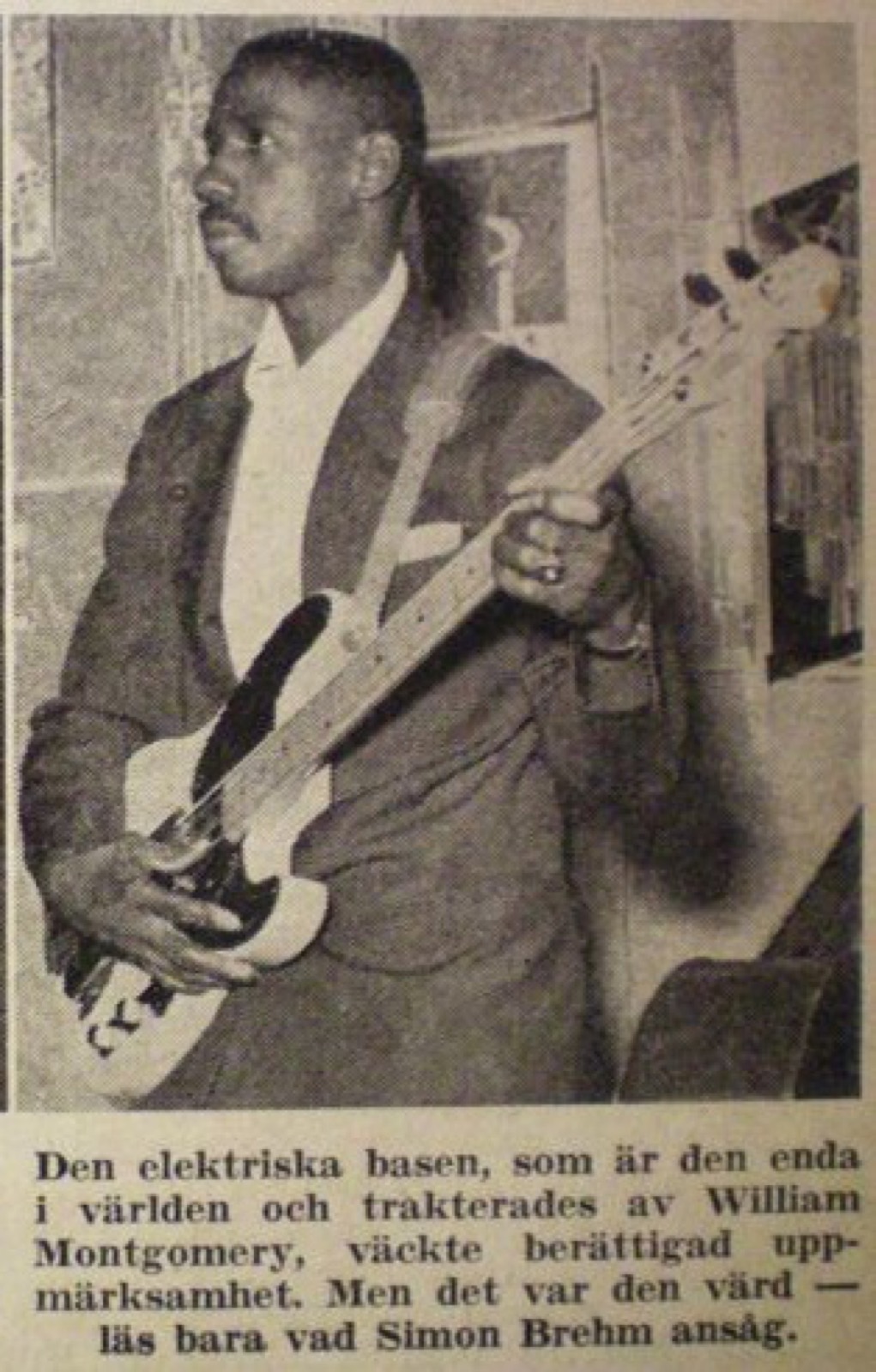
The Hampton band toured big venues and played loud. An upright bass could struggle to cut through. Plugged into an amp, the Precision Bass solved that problem with ease.
A bassist in a famous band was now playing an electric bass onstage, out in the open. Young musicians who saw him began picking up the instrument themselves.
An Amplifier for the Bass
In 1952, Leo went further and released the Bassman, an amplifier designed for the new instrument. It was built to make low notes loud and clear.
Later, guitarists discovered that the Bassman sounded wonderful with a guitar, too. It went on to build a separate legend as a classic rock amp.
When a Brand Name Became the Name of the Instrument
By the mid-1950s, Bill Black, bassist for Elvis Presley’s band, had also switched from upright bass to Precision Bass. Country, R&B, and rock ’n’ roll bands were getting louder, and the electric bass became a familiar sight one band at a time.
Fender made so many of the electric basses around that people began calling the instrument itself a “Fender bass.” The brand name had become a generic term, like “Band-Aid” or “Kleenex.”
For one company’s product name to become the name of an entire kind of instrument tells you how big the Precision Bass’s arrival was.
Chapter 3 — 1957: The Sound Takes Shape
The Precision Bass Is Reborn
In 1957, the Precision Bass got a major redesign.
- Body: Rounded contours, like the Stratocaster, that fit the player’s body and made long sessions more comfortable
- Headstock: The gently curved shape that’s still familiar today
- Pickup: A split-coil design, divided into two sections
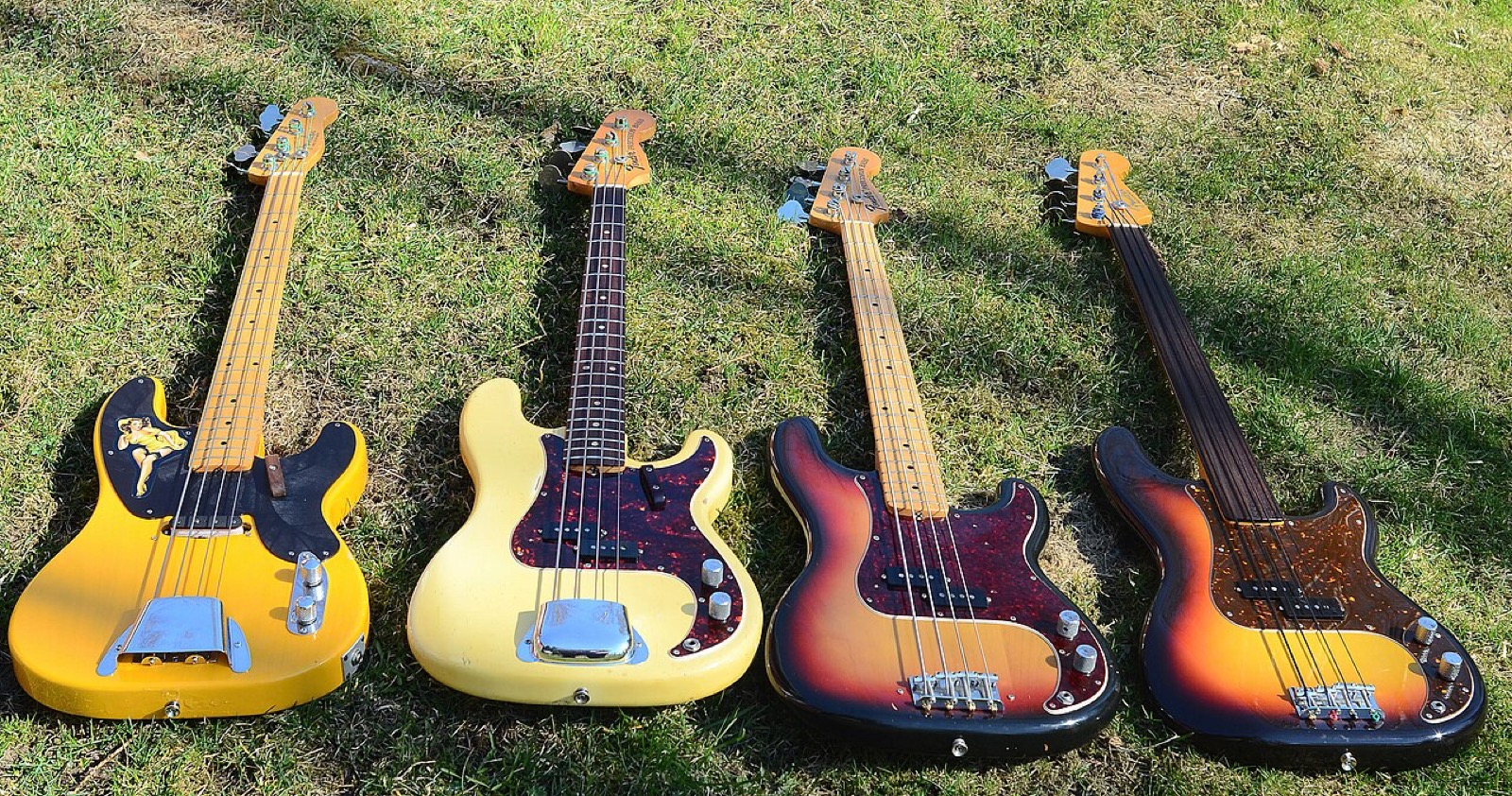
The shape most of us picture when we hear “P-Bass” dates to 1957. Nearly 70 years later, it’s still being made with almost the same design.
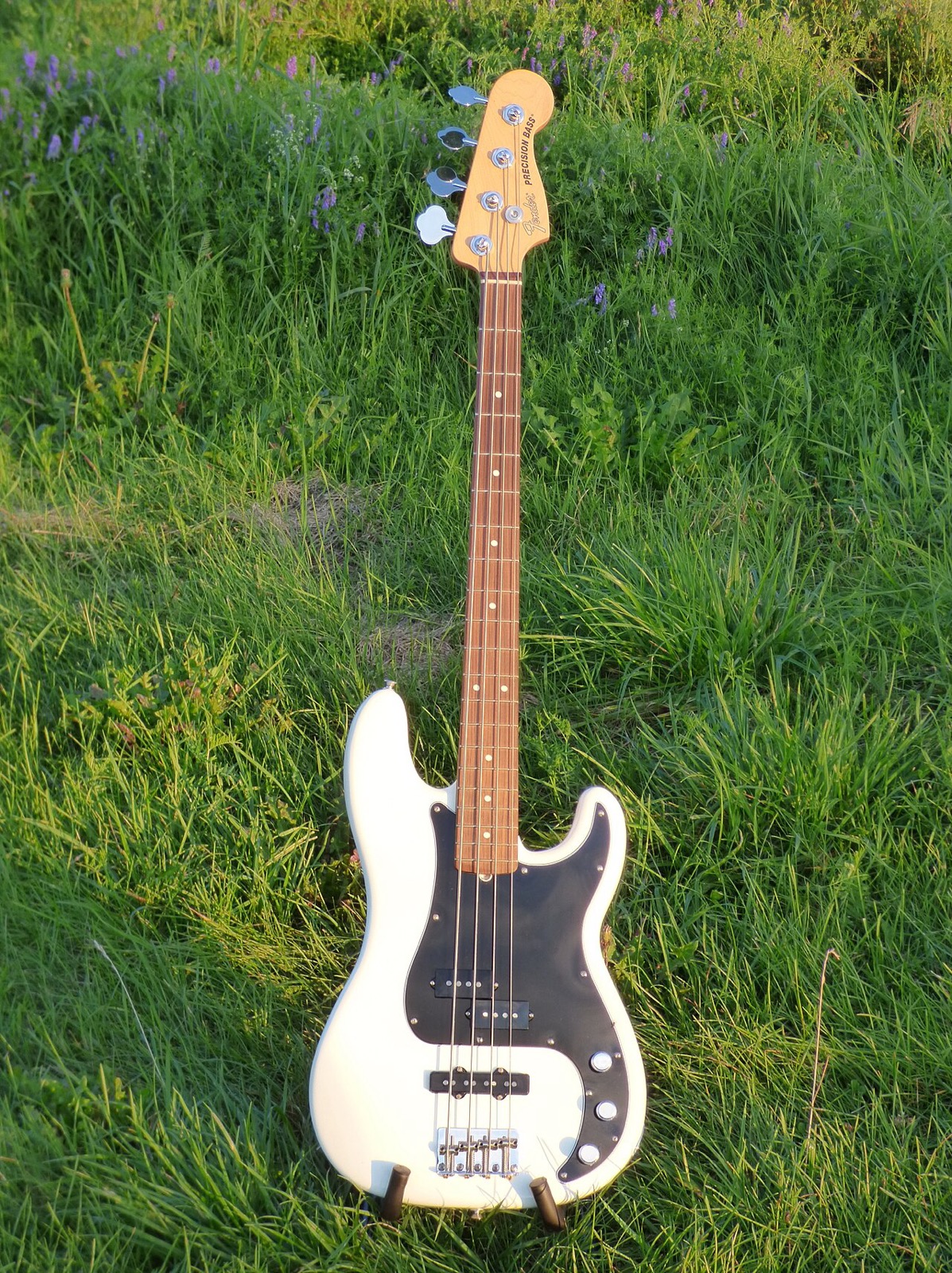
The Secret of the Split Pickup
The split-coil pickup has an interesting design:
- One coil picks up the two lower strings; the other picks up the two higher strings
- The coils have opposite magnetic polarities and windings, so when combined, they cancel hum
Electric instruments tend to pick up a “buzz” from lights and power sources. The split coil reduced that noise while delivering a thick, powerful sound.
A Sound That Has a Place in the Mix
People often describe the Precision Bass sound as a “thump.” It has plenty of low end, plus a strong presence in the frequencies just above it—the range our ears hear clearly.
That made it a favorite in recording studios. Even with drums, guitars, and vocals piled on top, the bass doesn’t disappear; it stays right there. Some engineers say that if you bring them a P-Bass, they won’t have trouble fitting it into a mix.
There are only two controls: volume and tone. With so little room to get lost in settings, the player’s touch and feel come straight through.
Chapter 4 — The Players Behind That Low End
Motown’s “Unknown” Bassist
In the 1960s, the Detroit record label Motown produced countless hit songs. Much of the bass on those records was played by the session musician James Jamerson.
Jamerson’s approach would surprise many bassists today:
- He played almost entirely with one index finger. His friends called it “the hook.”
- He used smooth-surfaced flatwound strings, which he reportedly rarely changed
- He put a piece of foam under the bridge cover to shorten the sustain and mute the sound
That muted, thick tone and the astonishingly agile bass lines he played with one finger gave Motown hits their irresistible groove—the kind that makes your body move on its own.
But session musicians’ names rarely appeared on records at the time. People around the world danced to Jamerson’s bass without knowing who he was.
🎙 Legend & Lore 1 — The Great Performance Played Lying on the Floor
Marvin Gaye’s classic “What’s Going On” came out in 1971. There’s a famous story that on the day Jamerson recorded its bass part, he was drunk and played it while lying on the studio floor.
The resulting bass line is still considered one of the great performances in soul history. The details vary depending on who tells it, so it’s hard to know exactly how much is true. But many of his colleagues say that whatever shape he was in, once he put his fingers on the strings, he made music.
Another Master on the West Coast
Meanwhile, Carol Kaye played bass on countless hits recorded in Los Angeles studios. She played Precision Bass with a pick, supporting pop, television, and film music with a crisp, clearly defined sound.
Jamerson with one finger; Kaye with a pick. The same Precision Bass produced two completely different kinds of great performance.
Rock, Punk, and Heavy Metal
The Precision Bass kept turning up in every kind of music from the 1970s on.
- Donald “Duck” Dunn: Anchored records by Otis Redding and others at Stax, a leading label in Southern soul
- Sting (The Police): Simple, spacious bass lines played while singing
- Dee Dee Ramone (Ramones): Punk’s low end, driving relentless eighth notes with a pick
- Steve Harris (Iron Maiden): Fast fingerstyle runs that gallop like a horse
Different genres, different playing styles. They all chose the same bass because, whatever your approach, it still comes through as a solid bass sound.
Chapter 5 — A Few Notes for Players
Listen for the Low End
If you want to understand the appeal of the Precision Bass, start by listening. Here are a few ways to hear it:
- Motown: Follow the bass instead of the vocals. You’ll hear how much it moves without ever getting in the way.
- Punk: Find the bass’s “thump” beneath the wall of guitars.
- Live footage of a band you love: Look at the bassist’s instrument. You may be surprised how many are holding a P-Bass.
If You’re Choosing a P-Bass
If you’re just starting out or thinking about your next bass, here’s a quick guide to the Precision Bass’s character:
- The neck is on the thicker side: A good fit if you have large hands or like a solid grip
- Simple tone controls: Just two knobs, so you can focus on playing
- Built to hold down the foundation: A natural fit for locking in with the drums and supporting a band
- Strings change its character: Flatwounds give you a thick, muted Motown-style sound; roundwounds bring a brighter rock tone
If you’re torn between a P-Bass and its younger sibling, the Jazz Bass, try asking yourself: do you want to hold things down, or step out front?
🎙 Legend & Lore 2 — What Happened to Leo Fender
In 1965, Leo Fender sold his company to a large corporation. But he didn’t stop making basses.
In the 1970s, he helped develop a new bass called the Music Man StingRay at another company. Later, he continued making instruments at a company named with his own initials. He reportedly kept refining new instruments in his workshop until shortly before he died.
A man who could barely play guitar or bass spent his life building tools for bassists. Thinking about that makes the simple shape of the Precision Bass look a little different.
Epilogue — The Word “Bass”
Before the Precision Bass arrived, “bass” usually meant an upright bass. Today, when most of us hear the word, we picture an electric bass.
In 1951, an inventor who could barely play an instrument made a plank whose name meant “precise pitch.” It made life easier for bassists carrying heavy instruments, sent inaudible low notes to the back of the room, and changed the meaning of the word bass itself.
Next time you listen to a favorite song, give the lowest notes a little extra attention. They may be coming from a Precision Bass whose shape has barely changed in 70 years.
Precision Bass Timeline
- 1930s: Several attempts to amplify a bass electrically emerge, but don’t catch on
- 1950: Fender releases a slab-bodied electric guitar, later known as the Telecaster
- 1951: Precision Bass released, with a 34-inch scale and frets
- 1952: The Bassman amplifier for bass appears
- Early 1950s: Monk Montgomery uses one with the Lionel Hampton Orchestra
- 1957: The body, headstock, and split-coil pickup are redesigned into the familiar form
- 1960: The younger sibling, the Jazz Bass, arrives
- 1960s: James Jamerson plays on countless Motown hits
- 1965: Leo Fender sells his company
- 1971: Marvin Gaye releases “What’s Going On”
- Today: The Precision Bass is still made in nearly the same form
References
- Wikipedia: “Fender Precision Bass,” “Leo Fender,” “James Jamerson,” “Monk Montgomery,” and “Carol Kaye” (English-language editions)
- Fender official website, “Precision Bass History”
- J.W. Black and Albert Molinaro, The Fender Bass: An Illustrated History (Hal Leonard, 2001)
- Allan Slutsky, Standing in the Shadows of Motown (1989)
- Standing in the Shadows of Motown (documentary film, 2002)
Photo credits
- Header image, “Fender Precision Basses” — Don Wright / Wikimedia Commons / CC BY 2.0
- “Fender ’51 Precision Bass, FGF museum” — Mr. Littlehand (derivative: Clusternote) / Wikimedia Commons / CC BY 2.0
- “Fender Precision Bass ’51 patent sketch (D169062)” — Leo Fender / Wikimedia Commons / Public domain
- “Monk Montgomery, Sweden, 1953” — Estrad magazine / Wikimedia Commons / Public domain
- “Fender AP P-Bass” — Niranjan Arminius / Wikimedia Commons / CC BY-SA 4.0
Licenses: CC BY 2.0 · CC BY-SA 4.0