The Man Who Taught the Synthesizer to Remember: Dave Smith and the Prophet-5
☕ A coffee-length story — about a 15-minute read. This is the tale of a young engineer who fell for the Minimoog, built a synthesizer that could remember its sounds, and ended up defining the sound of an era.
Prologue — A Strip of Paper on the Keyboard
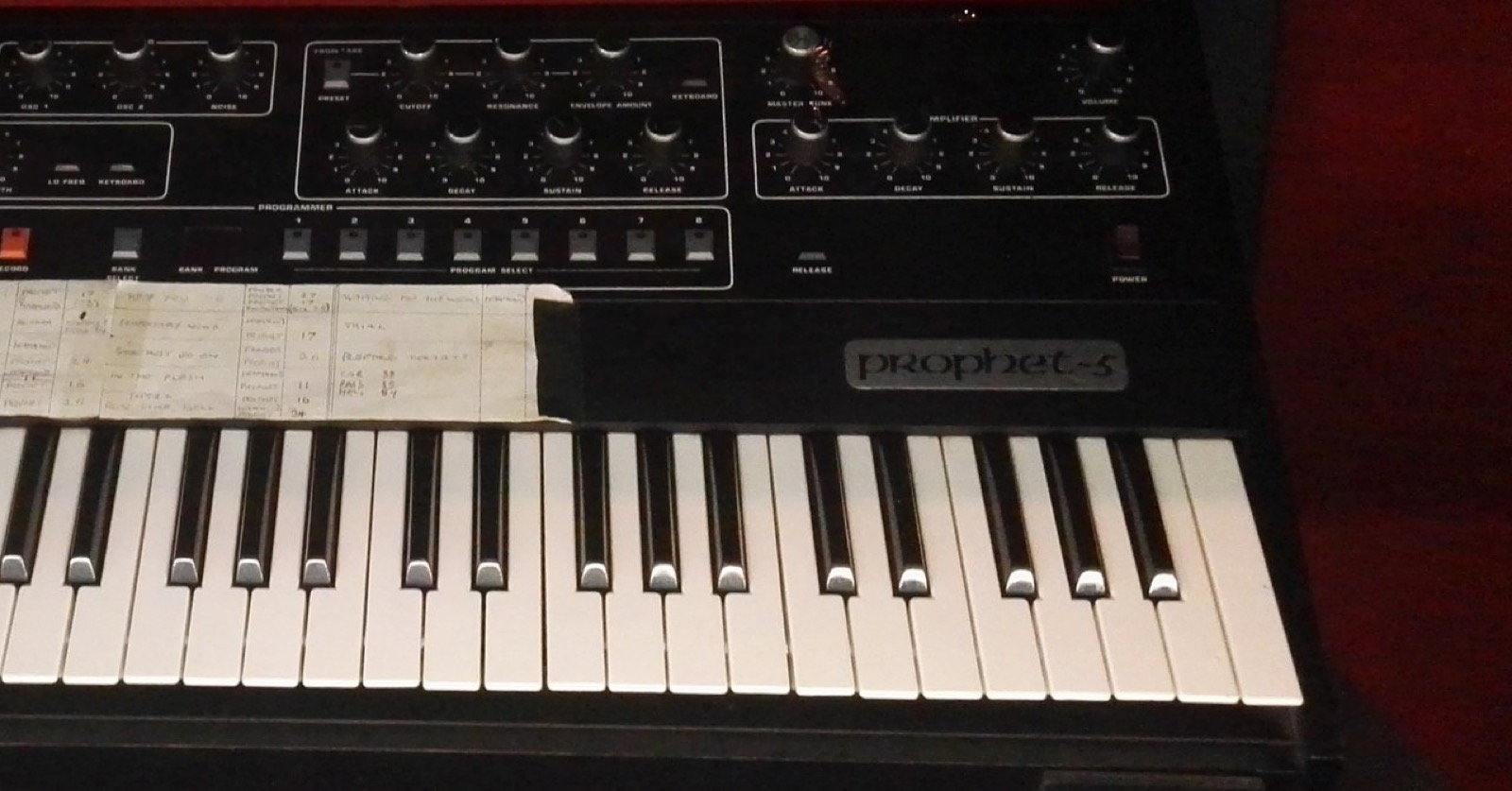
In 1980, Pink Floyd were on the road with The Wall. In front of keyboard player Richard Wright stood a synthesizer with a black panel and a wooden frame.
Just above its keys, a long, narrow strip of paper was taped down. Song titles were written on it by hand: "Hey You", "Comfortably Numb", "Run Like Hell"…
Next to each title were the names of keyboards and a number. "PROPHET 17." "PROPHET 25." "PROPHET 11."
Those numbers were, in all likelihood, the numbers of sounds stored inside the synthesizer. Patch 17 for this song, patch 25 for the next. Press a button, and a sound that had been carefully dialled in earlier came back in an instant.
To us, that is nothing special. On a phone app or the cheapest home keyboard, sounds have numbers, and pressing a button switches between them.
But before this synthesizer appeared, it was anything but ordinary. A synthesizer's sound was the position of dozens of knobs. Want a different sound? Turn every knob again. Want the old one back? Turn them all again.
The instrument that overturned that rule — the one with the strip of paper taped to it — was the Prophet-5. It was built by an engineer from San Francisco.
Dave Smith.
This is the story of the man who made the synthesizer that remembers.
Chapter 1 — A Young Man from San Francisco and His Minimoog
Piano, bass and computers
Dave Smith was born in San Francisco, California, on 2 April 1950. He grew up around the Bay Area, took piano lessons as a child, and played bass and guitar in rock bands in high school.
In 1968 a record caused a stir: Switched-On Bach, an album of Bach played entirely on a Moog synthesizer. Music made from electricity — Smith has said he was fascinated by the sound.
At university, though, he chose engineering rather than music. At the University of California, Berkeley, he studied computer science and electrical engineering. As a student he even wrote a crude program that printed music on a plotter, a machine that draws lines on paper.
After graduating he went to work in the aerospace industry — a long way from music.
A $1,500 Minimoog
In 1972 Smith bought his first synthesizer: a Moog Minimoog. It cost him $1,500.
He later described the Minimoog as a perfect meeting of his musical background and his technical background. Ears raised on piano and bands, a head trained in circuits and computers — the two met inside a single box.
Through an engineer's eyes, though, the Minimoog couldn't do a lot of things. It couldn't play a phrase over and over on its own. It couldn't remember a sound you had made.
From the day he bought it, Smith began to think about boxes that would make the instrument more useful. He studied books on circuits and microprocessors, and built prototypes at night and at weekends.
Sequential Circuits
In 1974 Smith started his own company. He called it Sequential Circuits — a name that simply described what he was making: circuits that send out notes in sequence.
The first product was the Model 600, an analogue sequencer. It lined up sixteen pitches and sent them to a synthesizer one after another. He built it because Moog's own sequencers were too expensive.
He placed a small ad in Rolling Stone, but sold only three or four. "Company" was a generous word: it was really a young man's hobby on the side of his day job.
Yet the name of that little box would one day earn a place in the history of the synthesizer.