Pultec EQP-1A: The Art of Boosting and Cutting
☕ A coffee-length story — about a 9-minute read.
Prologue — The move the manual said not to make
One equalizer manual reportedly carried a warning like this:
“Do not use the boost and cut controls at the same time.”
Boosting and cutting the same range at once sounds pointless. Surely the plus and minus moves would cancel each other out.
But engineers around the world quietly ignored that warning. They discovered that turning both controls together could create a low end that felt bigger and tighter than anything they could get from another EQ.
In time, this “forbidden move” became known as the Pultec trick, a staple of recording.
The equalizer that became world-famous for the very move its manual told you not to make is the Pultec EQP-1A.
About this story
This story brings together books and articles I have read over the years, magazine interviews, manufacturer materials, and accounts from people who knew the period. I have tried to stick to verifiable facts.
- I treat details confirmed by multiple sources as documented facts wherever possible.
- I was not there in person. Because I rely on written accounts, some commonly used industry terms or received wisdom may have made their way in.
- When sources disagree, or a story is told more as legend than fact, I set it apart in a Legend & Lore section.
- The sources I consulted are listed at the end.
Chapter 1 — Two engineers in New Jersey
Two classmates
Eugene “Gene” Shenk and Ollie Summerland were classmates at the RCA Institute of Technology.
After working as an engineer at Capitol Records, Summerland moved into sales for Ampex, the company known for its tape recorders. That gave him an inside view of the recording studio business as it expanded rapidly.
Pulse Techniques, founded in 1953
On February 1, 1953, the two men founded Pulse Techniques, Inc. in Teaneck, New Jersey. The name was shortened to Pultec.
At first, they built specialized tools for engineers, including power supplies for tube equipment and test oscillators.
An order from MGM
The turning point was a single order.
A former Capitol colleague of Summerland’s had moved to MGM, the film studio, where he was setting up a mastering room. He asked Pultec to build an equalizer for the studio.
According to some accounts, the person who put up $250 to help launch the company was also the one who brought in MGM’s EQ order.
One order landed at a small company. It was the beginning of an equalizer that would become one of the most imitated in the world.
Now let’s look at the moment the EQP-1 was born, and at the seven decades that followed.
Chapter 2 — The EQP-1: making up the difference with tubes
A passive EQ and a tube amplifier
The result was the EQP-1 program equalizer. Sources place its release in either 1955 or 1956.
The EQP-1 has two main parts:
- A passive EQ circuit: a network of components such as inductors and capacitors, which shape the sound without needing power.
- A tube amplifier: an amplifier using 12AX7 and 12AU7 tubes to make up for the level lost in the passive circuit.
A passive circuit reduces the signal level as it changes the sound. The tubes bring that level back up. That combination is the foundation of the Pultec sound.
The controls
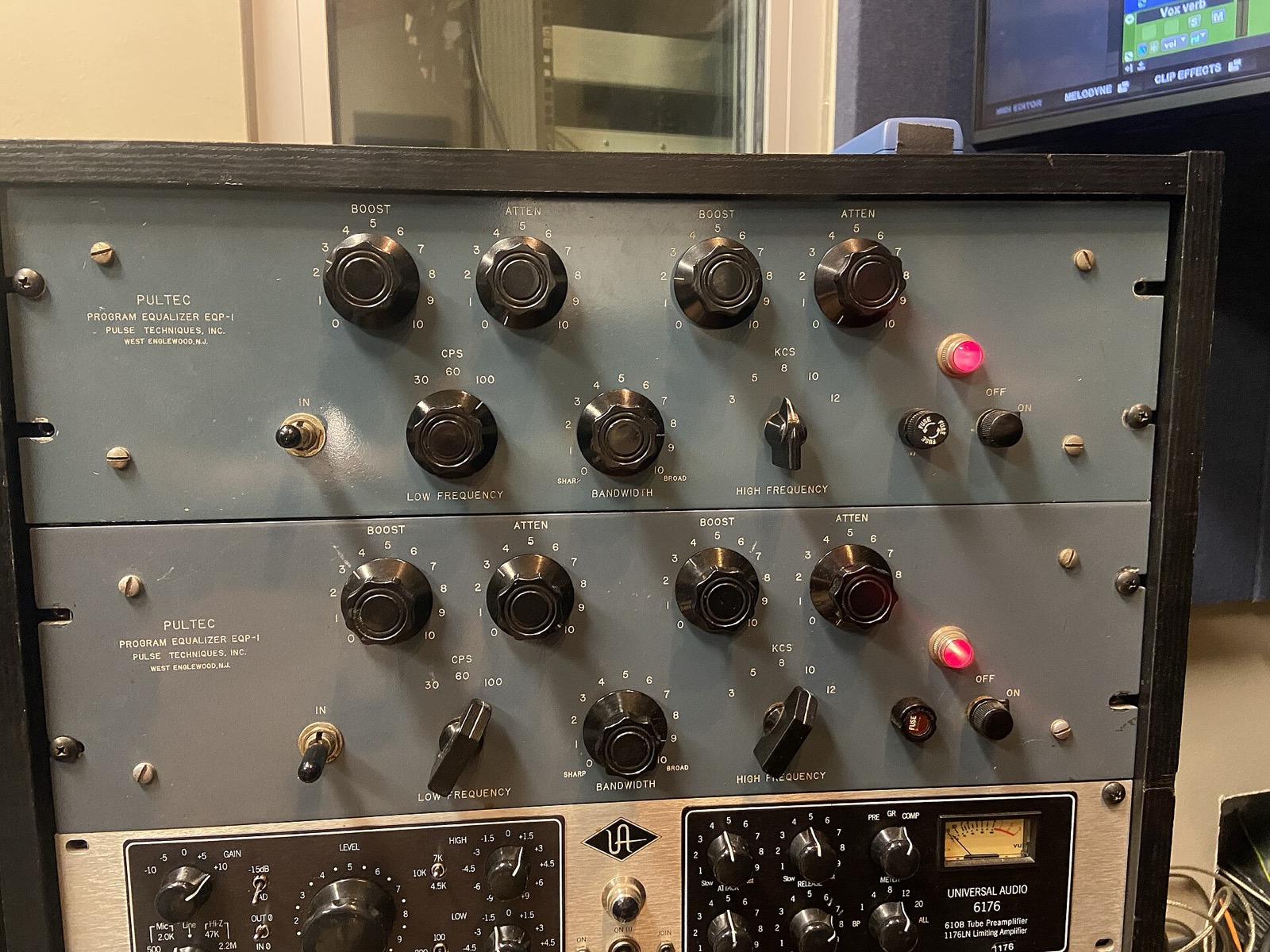
The EQP-1A’s controls are arranged like this:
- Low frequencies: choose a frequency, then use separate controls to boost or attenuate it.
- High-frequency boost: choose the frequency and the width of the effect with the BANDWIDTH control.
- High-frequency attenuation: choose a separate frequency to cut.
The key is that the low end has separate controls for adding and removing energy. That is what leads to the “forbidden move” from the prologue.
Legend & Lore — Was it copied from Western Electric?
A familiar story says that Pultec licensed a design from Western Electric, the American telephone company, and built its equalizer from that design.
There is a competing account. One source says that, contrary to the usual version, Pultec licensed only part of an amplifier circuit from Western Electric; the EQ itself was designed by Gene Shenk.
I found only one source supporting that counterclaim. The honest answer is that it remains unclear exactly how much of the design came from Western Electric.
Chapter 3 — The EQP-1A and thirty years of hand building
The EQP-1A arrives in 1961
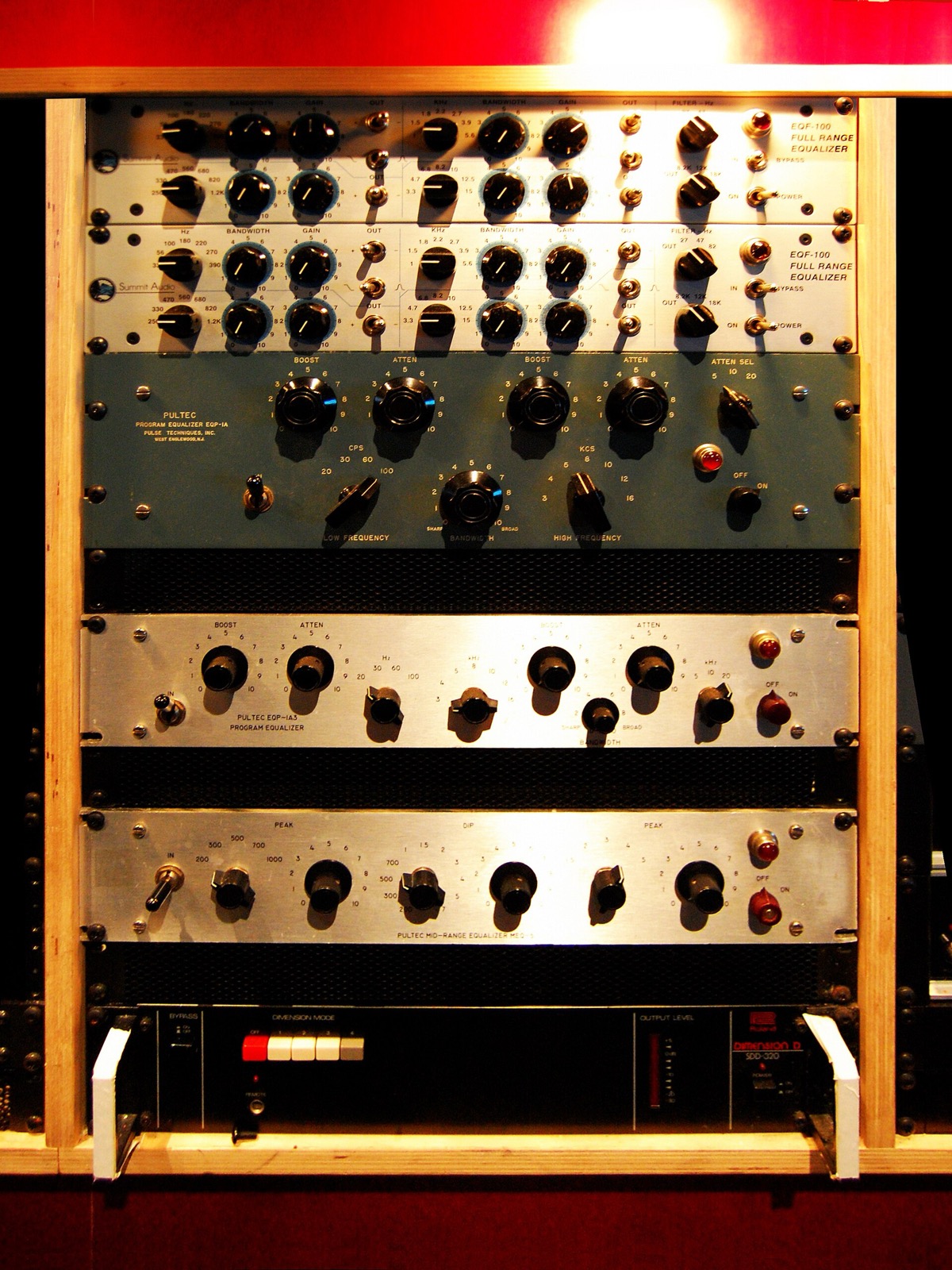
In 1961, the updated EQP-1A appeared. New choices included 20 Hz at the low end and 16 kHz at the high end, giving engineers a wider range of tones to shape.
Later came the EQP-1A3, with a shorter rack format, in 1971, as well as transistor-based models.
Every unit made by hand
Remarkably, Pultec products were reportedly built one at a time by Shenk and Summerland themselves. These were not mass-produced in a large factory. Two engineers made the units by hand, and they found their way into studios around the world.
Pultecs stood in celebrated rooms such as Capitol, RCA, Abbey Road, Decca, and Olympic. In time, the equalizer came to be called a studio standard.
A quiet ending in 1981
Pultec stopped production in 1981. The company is said to have closed because no one could be found to take it over.
For the final chapter, Shenk built 24 EQP-1A3s for producer Tony Bon Jovi. With those units, Pultec’s original production story came to an end.
Legend & Lore — Why does the Pultec trick work?
The low-frequency technique from the prologue—boosting and cutting at the same time—raises a question: why does it have an effect instead of canceling itself out?
The explanation you will often hear goes like this:
- The low-frequency boost and attenuation controls have different curve shapes, even when set to the same frequency.
- Turn both, and a band just below is lifted while the range just above it is dipped.
- The result can make the low end feel fuller while clearing up a range that might otherwise sound muddy.
The manual’s warning was likely there because this was not the intended way to use the controls. An unexpected use can become a defining feature of a classic. The story is much like the “all buttons in” trick on the 1176.
Chapter 4 — A lost classic returns
Vintage prices rise
After production ended, original Pultecs became harder and harder to find. Well-preserved units are said to have sold for more than $6,000.
Copies, official approval, and a return
Many companies responded to the demand for the Pultec sound by making EQs based on the design.
- 1985: Danish company Tube-Tech introduced the PE 1A, built very much along the lines of the EQP-1A.
- 1990: Manley introduced a Pultec-inspired equalizer with Shenk’s permission.
- Warm Audio, Klark Teknik, and many others have also made Pultec-style EQs.
Then, in 2000, an engineer named Steve Jackson contacted Shenk. Over roughly ten years, Jackson studied the original components one by one. He eventually began building Pultecs again under the Pulse Techniques name.
Pultec on screen
- 2005: The EQP-1 entered the TECnology Hall of Fame.
- Companies including Universal Audio, Waves, and Avid have released Pultec plug-ins.
An equalizer born from one order from MGM nearly seventy years ago is now available to anyone on a computer.
Epilogue — Try the move you were told not to make
There were two controls the manual said not to use together.
If engineers around the world had followed the manual to the letter, the Pultec might have remained simply “a well-made old EQ.” But someone must have wondered, “What happens if I try it?” and turned both controls.
That is how a box hand-built by two engineers at a small New Jersey company became a legend.
The next time you use a Pultec, try gently turning both low-frequency controls. Think of it as bending the instruction manual just a little.
Pultec timeline
- 1953: Pulse Techniques, Inc. founded in Teaneck, New Jersey.
- Around 1955–56: The EQP-1 is developed, prompted by an order from MGM.
- 1961: The EQP-1A is introduced.
- 1971: The EQP-1A3 is introduced.
- 1981: Production ends. The final 24 units are built for Tony Bon Jovi.
- 1985: Tube-Tech introduces the PE 1A.
- 1990: Manley introduces a Pultec-style EQ with Shenk’s permission.
- 2000: Steve Jackson contacts Shenk; production later resumes under the Pulse Techniques name.
- 2005: The EQP-1 enters the TECnology Hall of Fame.
References
- Wikipedia, “Pultec” (English edition)
- Pulse Techniques, “A Brief History of the Pultec Company”
- Sound On Sound, “Pulse Techniques EQP-1A” review
- Produce Like A Pro, “Pultec EQ”
- Vintage King, product description for the vintage Pultec EQP-1A
Photo credits
- Header image, “Pultec EQP1”: The Midnite Wolf / Wikimedia Commons / CC0
- “Equalizers - Pultec EQP-1A, EQP-1A3 & Summit Audio EQF-100, Avex Honolulu Studios (edit1)”: Justin De La Ornellas / Wikimedia Commons / CC BY-SA 3.0 (edited by Clusternote)
Licenses:
- CC0: https://creativecommons.org/publicdomain/zero/1.0/
- CC BY-SA 3.0: https://creativecommons.org/licenses/by-sa/3.0/