Ray Dolby — The Man Who Erased Tape Hiss and Changed the Sound of Cinema
☕ A story about the people who shaped music and audio. We follow the makers of instruments and sound equipment, and the events around them. This time, we trace Ray Dolby’s path from reducing tape noise to transforming cinema sound.
💡 What you’ll learn
- How Ray Dolby went from developing Ampex video tape recorders to studying sound
- How Dolby A and Dolby B reduced tape hiss
- How Dolby Stereo opened up cinema sound and led toward surround formats
The Sound That Remains After the Music Stops
When you listen to music on a cassette, you may hear a soft “shhh” before a song begins or during a quiet passage. As the music fades, the noise that had been hiding behind it comes forward. That sound is tape hiss, a constant companion of recording and playback on magnetic tape.
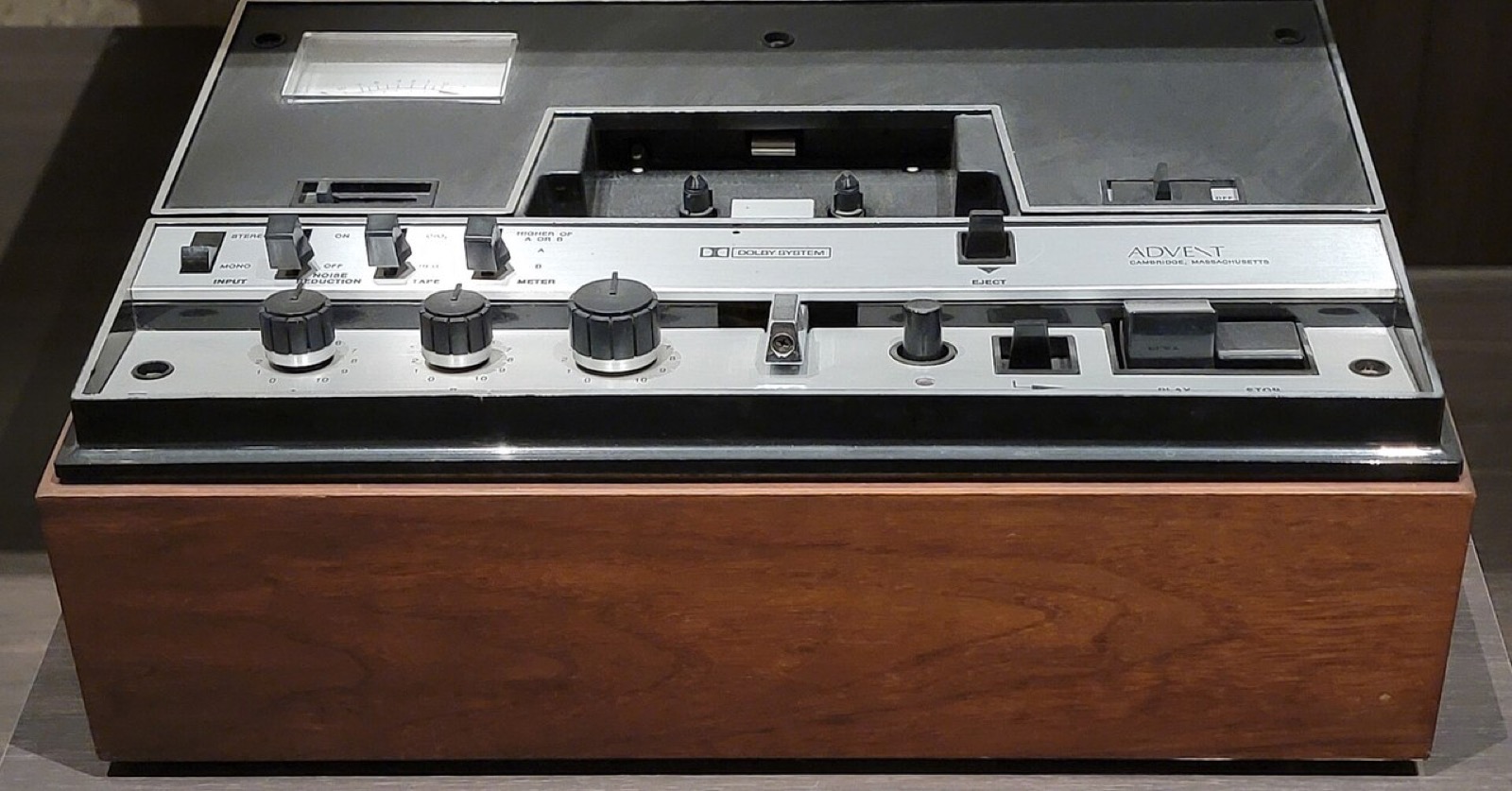
The “DOLBY NR” button or switch on a cassette deck was designed to make that hiss less noticeable. It does not simply remove noise on its own. The system slightly alters the sound during recording, then applies the opposite change during playback to restore it. In the process, noise recorded on the tape is reduced along with the signal.
Ray Dolby brought this idea into recording studios and then expanded it into cinema sound. Born on January 18, 1933, in Portland, Oregon, he did more than make devices that reduced tape noise. He worked to improve the path sound takes between the people recording it, the people making films, and the audience listening in a theater.
Following Dolby’s career shows that one invention did not simply spill over into a new use. He tackled different problems in each setting, reshaping his approach for broadcast video recording, studio recording, home cassettes, and optical sound on film. The button that quieted tape’s “shhh” eventually led to the experience of sound reaching audiences from the sides and rear of a cinema.
Chapter 1 — From a Young Recording Enthusiast to an Ampex Engineer
A Curiosity About How Sound Works
Ray Dolby was interested in sound from an early age and took up piano and clarinet. Playing music and wondering how sound was made and recorded were closely connected for him. He was not content to be only a listener; he became curious about the machinery that handled sound.
As a teenager, Dolby met Alexander Poniatoff, founder of recording-equipment company Ampex, and began working there. Ampex was developing magnetic-tape recording technology. Recording sound on tape was already possible, but reliably recording video in a form broadcasters could use was a much harder challenge.
At the time, television was essentially live. To rebroadcast a program later, stations needed methods such as recording it on film. Video signals carry far more information than audio. Simply running tape at a steady speed past a head, as in a conventional tape recorder, could not capture all that information cleanly.
Ampex engineers therefore developed a system that recorded video signals as diagonal stripes using a rotating head, instead of relying on extremely fast tape speed. From 1949 to 1957, Dolby worked on various Ampex audio and instrumentation products and led the electronics effort for its video tape recorder. Handling the signal, keeping the equipment stable, and meeting broadcast-quality standards all had to come together in one system. That experience shaped his early work.
The Challenge of Recording Television on Tape
Developing a video tape recorder was about far more than building a machine to move tape. If the tape wavered, the picture shifted. Tiny changes in the signal could appear as obvious visual noise. The electronics also had to handle the signal correctly between recording and playback.
The electronic section Dolby worked on was a critical link between magnetic tape and the video signal. He was later recognized for his contribution to Ampex’s video tape recorder. His career did not leap suddenly from music recording to cinema sound. From the beginning, it involved a shared challenge: recording information on tape, retrieving it, and bringing the signal as close as possible to its original state.
In 1956, Ampex introduced its video tape recorder to the broadcast industry. Once video could be recorded and played back on tape, television production and broadcasting changed. Programs could be saved and aired later instead of relying entirely on live transmission. For broadcasters, recording technology became a foundation for a new way to make programs.
The value of this work was not limited to a title or an award. Dolby learned to solve problems from both ends of the process when a signal ran up against the limits of its recording medium. Later noise-reduction systems also had to work at both ends: recording alone or playback alone was not enough. The system had to be designed around what went onto the tape and how it would be restored later.
Studying Physics at Cambridge
In 1957, Dolby graduated from Stanford University and went to Britain on a Marshall Scholarship. He continued his studies at the University of Cambridge, earning a PhD in physics in 1961. Practical electronics and physics research were not separate paths for him. His studies gave him time to understand more deeply the signals that machines and circuits handled.
Dolby later went to India on United Nations work and helped establish a scientific instrumentation laboratory. A story often told about this period says that hearing traditional music recorded there led him to think about ways to reduce noise on recording tape. How could the hiss in quiet passages be reduced without losing the fine detail in the music? That experience is often described as an early spark for what became Dolby NR.
Tape recording stores sound by magnetizing particles in a coating. But the particles and the tape itself are never perfectly uniform. The recorder’s electronics, playback head, and tape transport also affect the signal, leaving a small amount of noise even where there is no intended sound. Recording music at a higher level can make noise less noticeable, but if the level is pushed too far, the tape cannot reproduce the signal properly and the sound distorts.
Record at a lower level and loud sounds are less likely to distort, but the gap between quiet sounds and noise gets smaller. In especially quiet passages, tape hiss can approach the level of the music and become distracting. If the recording medium itself cannot be made quieter, the way the signal is recorded and played back has to change the relationship between music and noise.