From a Guitar Called the "Frying Pan" to the Ring of Twelve Strings: Rickenbacker
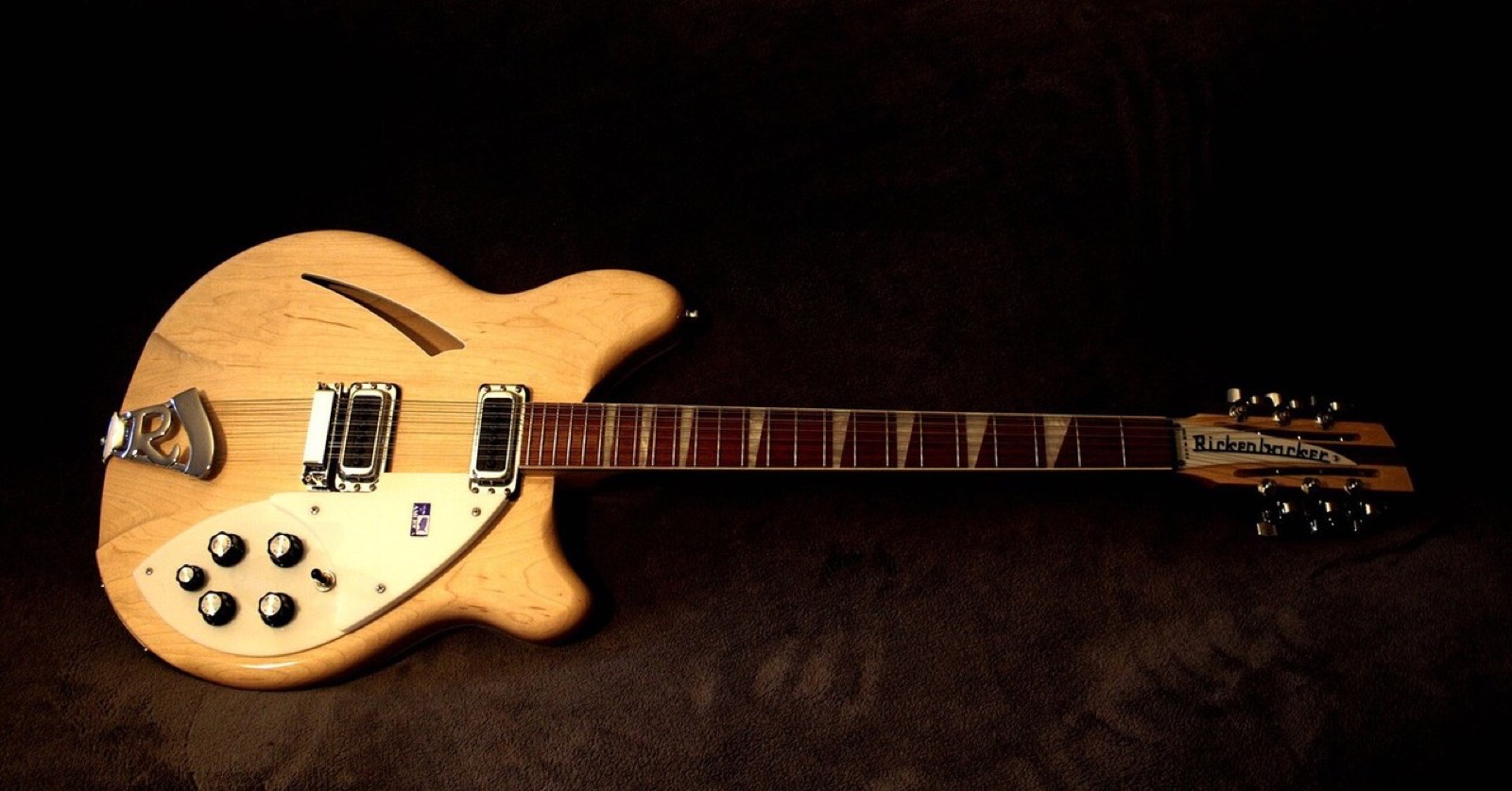
☕ A coffee-length story — about a 15-minute read. A steel guitarist who longed to be louder, and a toolmaker who came from Switzerland. This is the story of the electric guitar company that began with the "Frying Pan" the two of them built.
Prologue — In the Dark of a Movie Theatre
Summer 1964.
Movie theatres across America were showing A Hard Day's Night, starring the Beatles.
The guitar George Harrison was playing on screen looked a little odd.
The headstock was crowded with an unusual number of tuning keys.
And the sound wasn't like an ordinary guitar either. The chords rang out, glittering, almost like bells.
In a Hollywood theatre sat a young folk singer who had come to see the film with his bandmates.
It was Roger McGuinn, who would go on to lead The Byrds.
They reportedly took careful note of the instruments the Beatles were using on screen.
McGuinn then traded in his acoustic twelve-string for the same model of guitar, and the following January he recorded with it. That shimmering sound would later be called "jingle-jangle", and it is said to have become the sound of a new kind of music: folk rock.
The guitar was the Rickenbacker 360/12.
An electric guitar with twelve strings.
But this company's story began more than thirty years before the Beatles.
It began with an instrument that looked like a slab of aluminium, with a round body and a long neck. People called it the Frying Pan.
Chapter 1 — "Make It Louder"
A performer from Texas
George Beauchamp was born in Texas in 1899.
As a young man he toured the vaudeville circuit, playing violin and Hawaiian steel guitar.
The steel guitar is laid flat across the lap and played by sliding a metal bar along the strings.
In the 1910s and '20s, Hawaiian music was a huge craze in America, and plenty of people played this instrument.
Beauchamp had a problem.
His guitar was too quiet.
The instrument you couldn't hear in a band
Bands of the day were full of trumpets, saxophones and drums.
Among them, a guitar — just a wooden box resonating with the strings — inevitably got buried.
Getting a guitar's sound to the back rows of a big theatre was very hard indeed.
Beauchamp moved to Los Angeles and began trying everything he could think of to make the guitar louder.
One of the efforts he was involved in was the resonator guitar, which hid thin metal cones inside the body to project the sound like a loudspeaker.
Beauchamp went on to set up a company called National with John Dopyera, the craftsman behind the instrument, and others.
The metal cones did make the guitar louder.
But Beauchamp believed there had to be a more fundamental answer.
Turn the string's vibration into electricity. Once it was electric, an amplifier could make it as loud as you liked.
Magnets and coils
From the 1920s, Beauchamp had been experimenting with electrically amplified guitars.
How could you turn a string's vibration cleanly into an electrical signal, without picking up all sorts of other noise?
The answer he arrived at was magnets and a coil.
When a steel string vibrates near a magnet, the magnetic field around it wobbles very slightly. Catch that wobble with a coil of fine wire wound round and round, and you get an electrical current with the same shape as the string's vibration.
What Beauchamp came up with was a large horseshoe-shaped magnet arching over the strings.
The strings passed through the magnet's arch.
This was one of the earliest forms of the pickup that would one day be fitted to electric guitars all over the world.