How a 30-Ton Computer Fit in Your Palm — 80 Years of Semiconductors and Computing
☕ A coffee-length story — about a 17-minute read. Enjoy this as a story, not a research assignment. Behind the screen you’re reading right now, billions of “tiny switches” are at work. This is the story of the 80 years it took those switches to go from their invention to fitting in the palm of your hand.
Prologue — 18,000 Vacuum Tubes
In 1946, at the University of Pennsylvania in the United States, silver metal racks filled every wall of a large room.
Inside those racks sat row upon row of vacuum tubes—about 18,000 of them. The machine weighed roughly 30 tons. There are even stories that when it ran, the room grew stiflingly hot and the lights in the neighborhood dimmed.
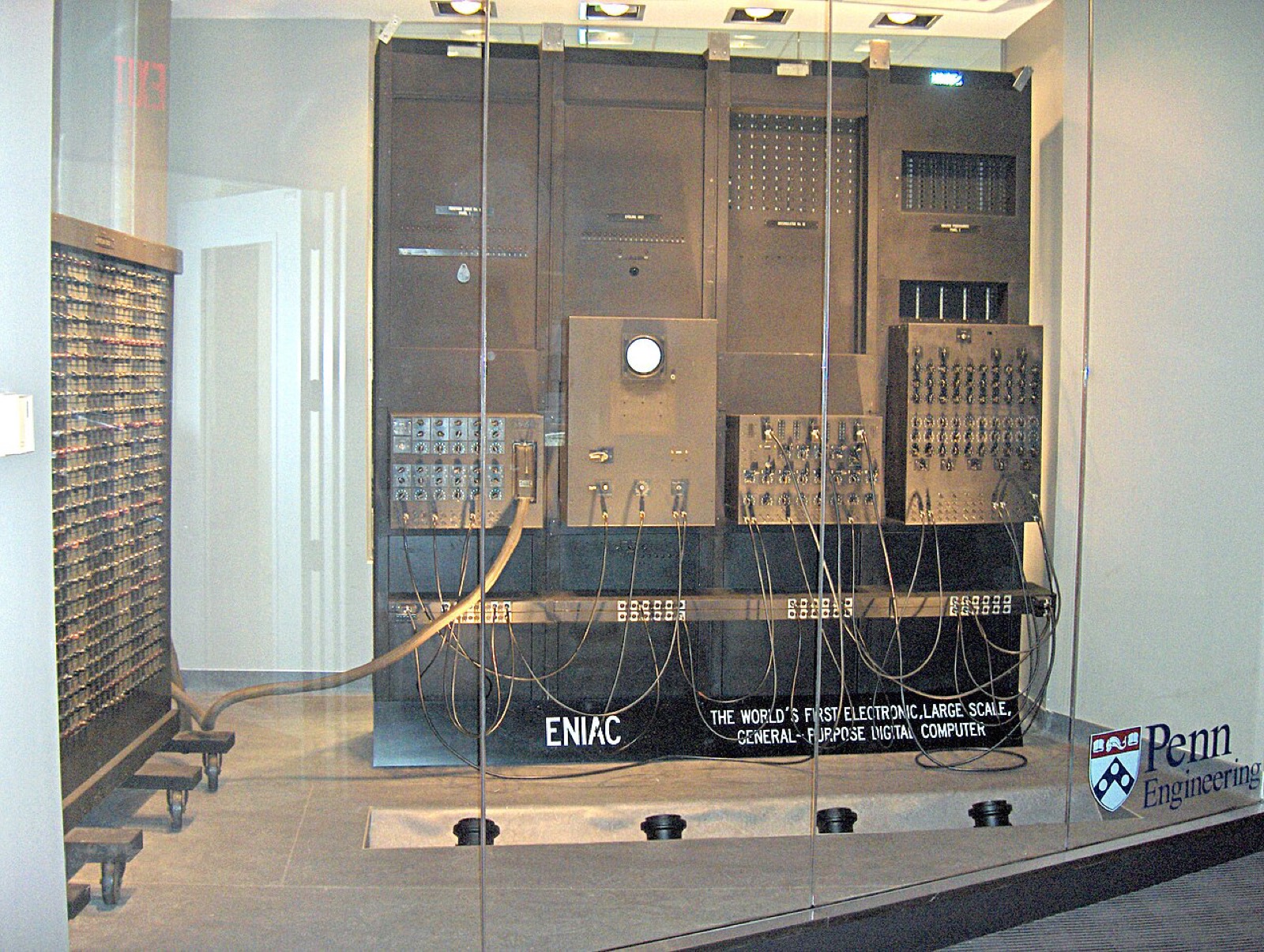
The machine was called ENIAC. It was one of the world’s first general-purpose electronic computers.
ENIAC could calculate artillery trajectories in seconds—work that would take a person days. But it had one serious problem: its vacuum tubes failed all the time.
With 18,000 tubes, at least one would burn out somewhere every day. Engineers spent their time hunting down the bad tube and replacing it.
“If only there were a switch that was smaller, ran cooler, and didn’t burn out.” The answer to that wish was a material with a curious property: the semiconductor.
This is the 80-year story of how a 30-ton computer ended up in your pocket.
📝 About this story
This story draws on books, interviews, and manufacturers’ materials I’ve read over many years. I’ve tried to stick to the facts, but I wasn’t there, so popular names and commonly repeated accounts may have found their way in. I’ve separated stories with competing versions into “Legend & Lore” sections, and listed the references at the end.
Chapter 1 — December 1947, Bell Labs
A material that conducts “halfway”
Broadly speaking, materials fall into two groups. Conductors such as copper and iron carry electricity well. Insulators such as rubber and glass carry very little.
Between them is a curious class of materials. Semiconductors such as germanium and silicon can conduct electricity—or not—depending on the conditions. The word means, roughly, “halfway conductor.”
With the right use of this property, you can switch an electric current on and off, or amplify it. In other words, perhaps a tiny crystal could do the work of a vacuum tube without the glass tube or hot filament.
Three physicists
At Bell Labs, the research arm of the American telephone company AT&T, three physicists were working on that possibility:
- John Bardeen, a brilliant theorist
- Walter Brattain, a gifted experimenter
- William Shockley, an ambitious team leader
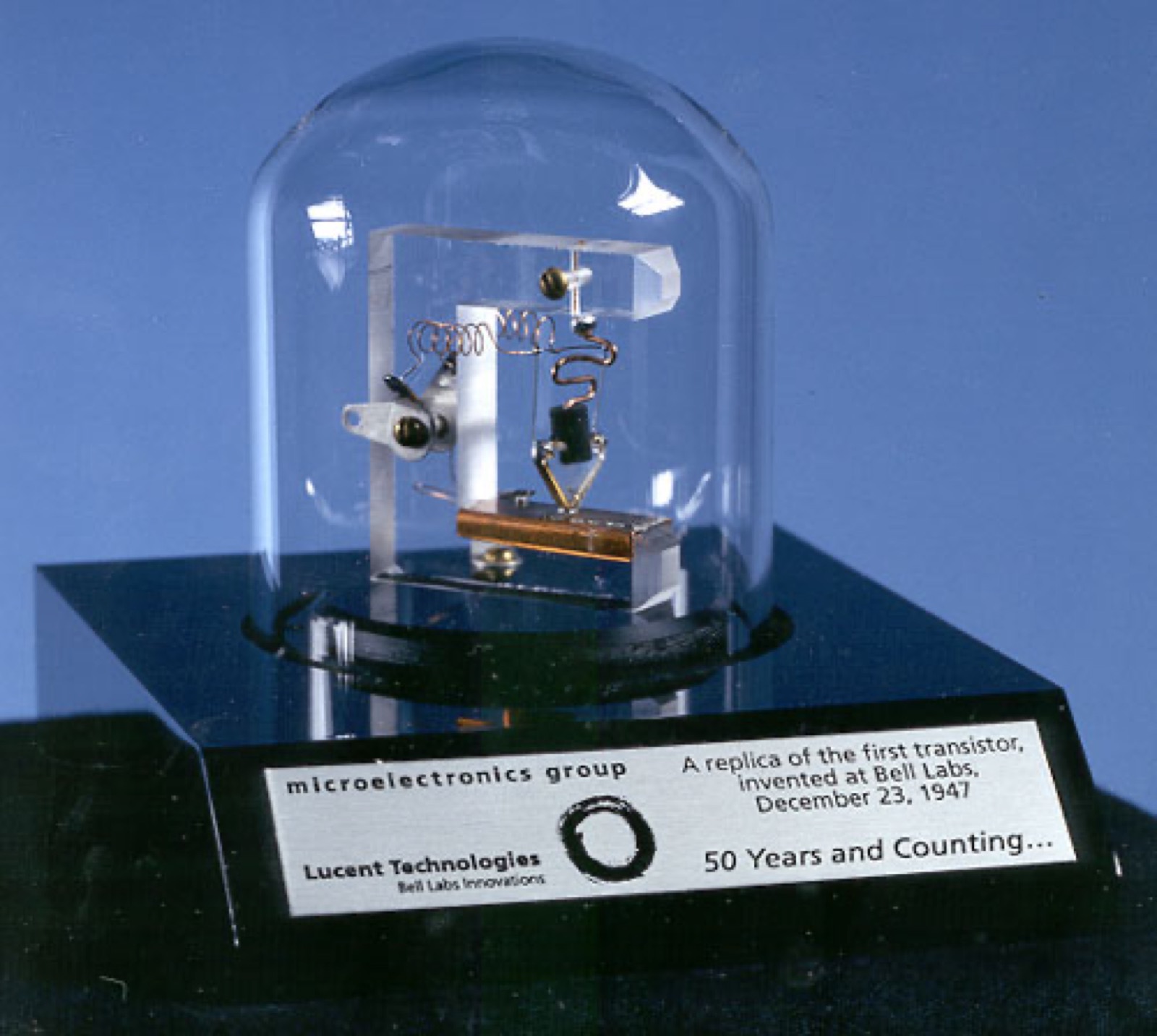
In December 1947, Bardeen and Brattain built an awkward-looking device. They pressed a plastic triangle, with gold foil attached, against a small piece of germanium.
On December 23, they demonstrated the device to laboratory executives. It amplified an audio signal. The world’s first transistor had just worked.
Jealousy sparks another invention
Shockley, who led the team, wasn’t there for the breakthrough. His own subordinates had made a historic invention without him.
Stung, Shockley reportedly spent weeks thinking through the problem on his own and came up with a sturdier, easier-to-manufacture kind of transistor: the junction transistor. This was the design that would later see wider use.
In 1956, all three men received the Nobel Prize in Physics. By then, though, their working relationship had reportedly gone cold.
Now let’s see how this tiny switch became the heart of the computer.