Four Tracks, and the Beatles Worked Their Magic — The Swiss Recorder Studer
☕ A coffee-length story — about a 10-minute read.
Enjoy this as a story, not a research paper. Sgt. Pepper’s was made on a recorder with just four tracks. The machine was built by a Swiss engineer as precise as a Swiss watch.
Prologue: Just Four Tracks
London, 1967. Studio Two at Abbey Road Studios.
The Beatles were making an album that would go on to change the history of rock: Sgt. Pepper’s Lonely Hearts Club Band.
Orchestras, circus sounds, animal calls, Indian instruments—the record layers an astonishing number of sounds, even to ears today.
Yet the machine used to record it had only four tracks. A modern computer can stack hundreds at once, with each part available for editing on its own. In 1967, engineers had to plan carefully around the limited tracks and the practical limits of tape.
How did they fit so much sound onto just four lines? One key was the Studer J37, a tape recorder made in Switzerland.
📝 About this story
This story draws on books, interviews, and manufacturer materials I have read over many years. I have tried to stick to the facts, but I was not there, so some nicknames or commonly told accounts may be mixed in. I separate disputed stories into a “Legend & Lore” section and list sources at the end. The piece is based on published accounts and available company records, rather than firsthand reporting. Where accounts differ, I avoid presenting one version as settled fact. The timeline and product details are included to help place each machine in the company’s history.
Chapter 1: Willi Studer, Radio Enthusiast
Willi Studer was born in Switzerland in 1912.
As a young man, he was fascinated by radio. He sold and repaired radios, then taught himself to design receivers. At 19, he had already started his first company.
In 1948, Studer founded a new company in Zurich, Switzerland. Its first product was not a tape recorder but an oscilloscope, an instrument for seeing electrical signals.
Improving an American Recorder
A turning point came in 1949.
At the time, Ampex tape recorders from the United States were at the forefront of recording. Studer began modifying and improving the Ampex machines he imported.
Around 1950, he brought out Dynavox, a tape recorder of his own design.
The company that would later be called home to “the world’s finest tape recorders” began with repairing someone else’s machines, then making something better with his own hands.
“Studer” and “Revox”
In 1951, Studer created the Revox brand for home tape recorders. The name combines “Re” (return) and “Vox” (voice): a machine that gives a voice back.
Studer was for professional studios; Revox was for music lovers at home. Under these two names, Studer’s recorders spread around the world.
The first professional recorder, the A27, arrived in 1952. It used three motors to move the tape, a precise and stable design.
The story continues with the J37 that supported the Beatles’ magic, the A80 that filled studios around the world, and the home classic Revox A77.
Chapter 2: J37 — The Beatles’ Box of Magic
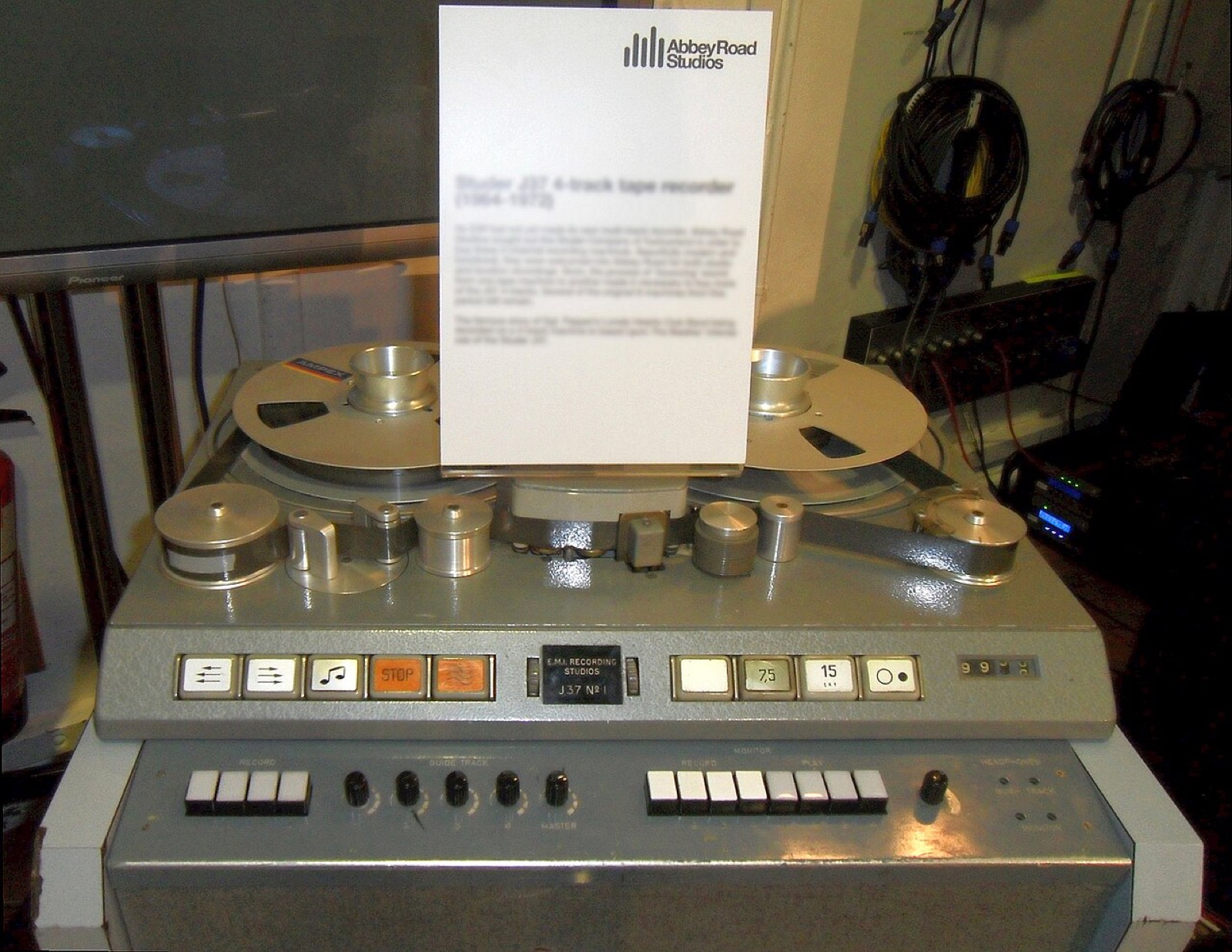
In 1964, Studer released the J37, a recorder that could put four tracks on one-inch tape.
Vacuum tubes worked inside its large, solid frame.
Abbey Road Studios installed the J37, and the Beatles used it to create one new sound after another.
Turning Four Tracks into Dozens
How could they layer so many sounds with only four tracks? The answer was a method called “ping-pong” (bouncing).
- Record drums, bass, guitar, and piano on the four tracks of the first J37.
- Mix those four tracks together and record them onto a single track of a second J37.
- That leaves three tracks free on the second machine.
- Add vocals, backing vocals, and orchestra to those tracks.
Repeat the process, and even a four-track recorder can hold dozens of sounds.
There was a catch: once sounds were combined, they could no longer be adjusted separately. Every bounce meant committing to the result.
It is said that Sgt. Pepper’s took about four months to make, with recording, editing, ping-ponging, and mixing layered together while two J37s were synchronized by hand.
The Birth of ADT
The J37 and the engineers at Abbey Road also helped create another innovation, which we met in the previous chapter: ADT (Artificial Double Tracking).
Recording a vocal twice and layering the takes makes a voice sound fuller. But John Lennon reportedly found singing the same song twice tedious.
So the engineers devised a way to use a tape recorder to delay a single vocal just slightly and layer it over itself. The result had the fullness of a double-tracked vocal, created automatically from one performance. That was ADT.
Howard Massey, a researcher of British recording history, writes that the J37 made the development of ADT possible.
Chapter 3: A80 — A Studio Standard Around the World
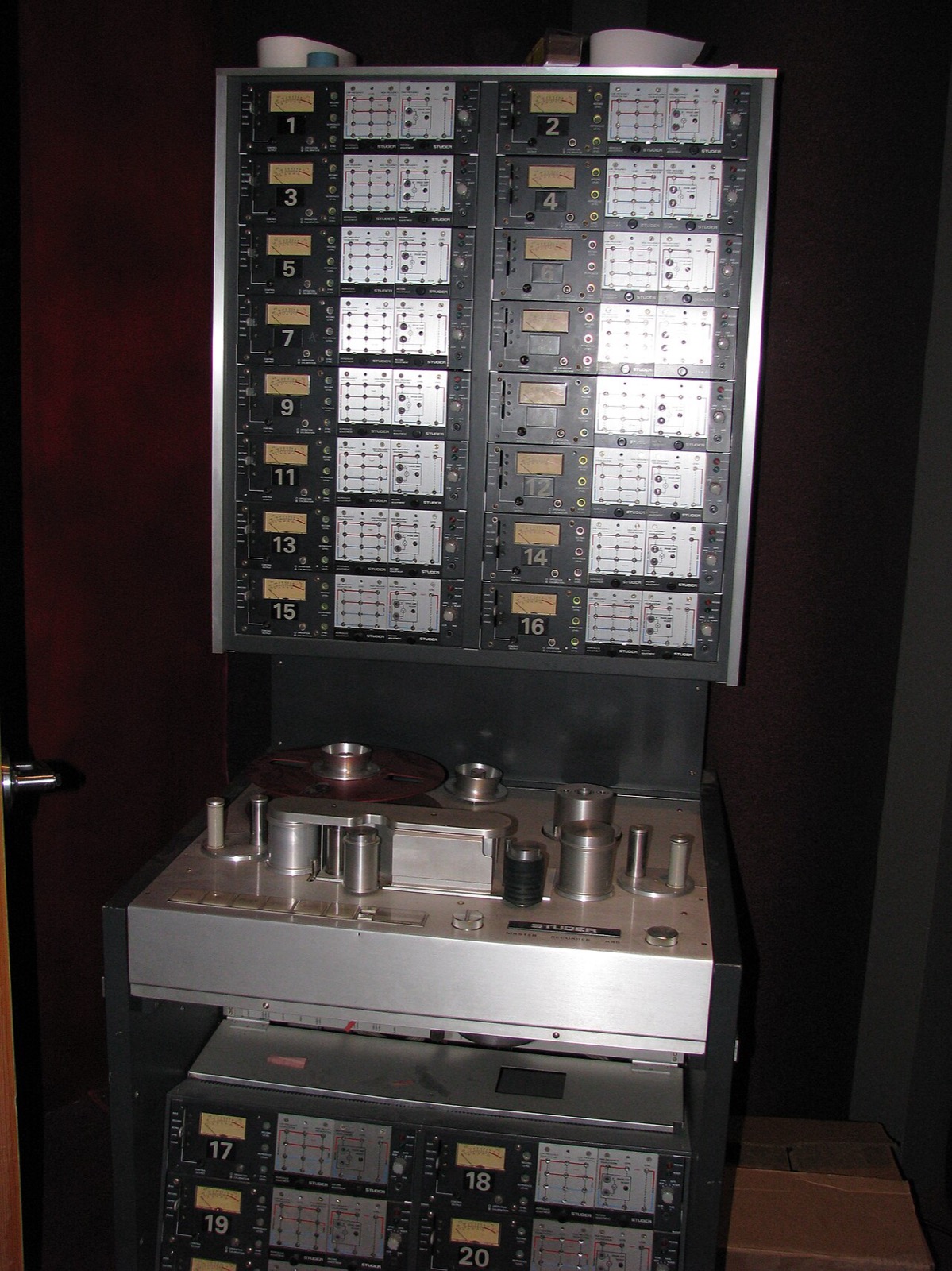
Around 1970, Studer introduced a new recorder: the A80.
Instead of vacuum tubes, the A80 used transistors. Its components were arranged in modules, so a technician could replace just the part that had failed, making repairs easier.
Above all, it was accurate, durable, and sounded good.
The A80 came in versions ranging from two tracks to eight, 16, and 24 tracks. It is said that from the 1970s into the 1980s, nearly every studio in Britain and the United States had an A80 multitrack recorder.
Production continued until around 1988. The A80 became the longest-running and best-selling recorder in Studer’s history.
A Recorder with a Microcomputer
In 1978, Studer introduced the A800. It was presented as the first recorder controlled by a microprocessor.
A computer could handle tape rewinding and stopping at a set point with precision. Analog recording had gained a digital brain.
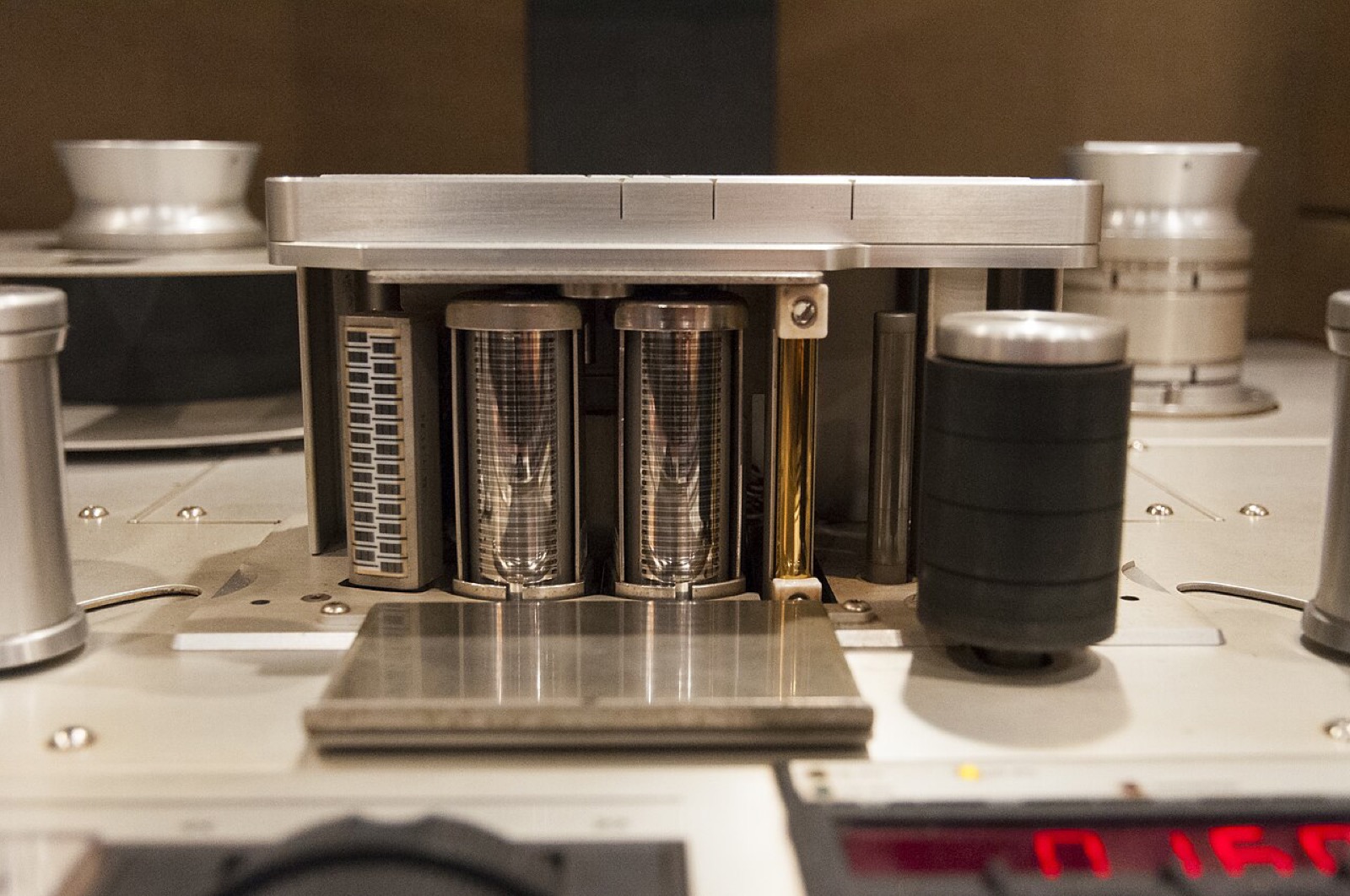
Its successor, the A820, came to be called one of the finest expressions of the analog recorder. It was also cherished for many years in Japanese studios.
Chapter 4: A Home Classic — Revox A77
Alongside the professional Studer line, home-oriented Revox also became a major success.
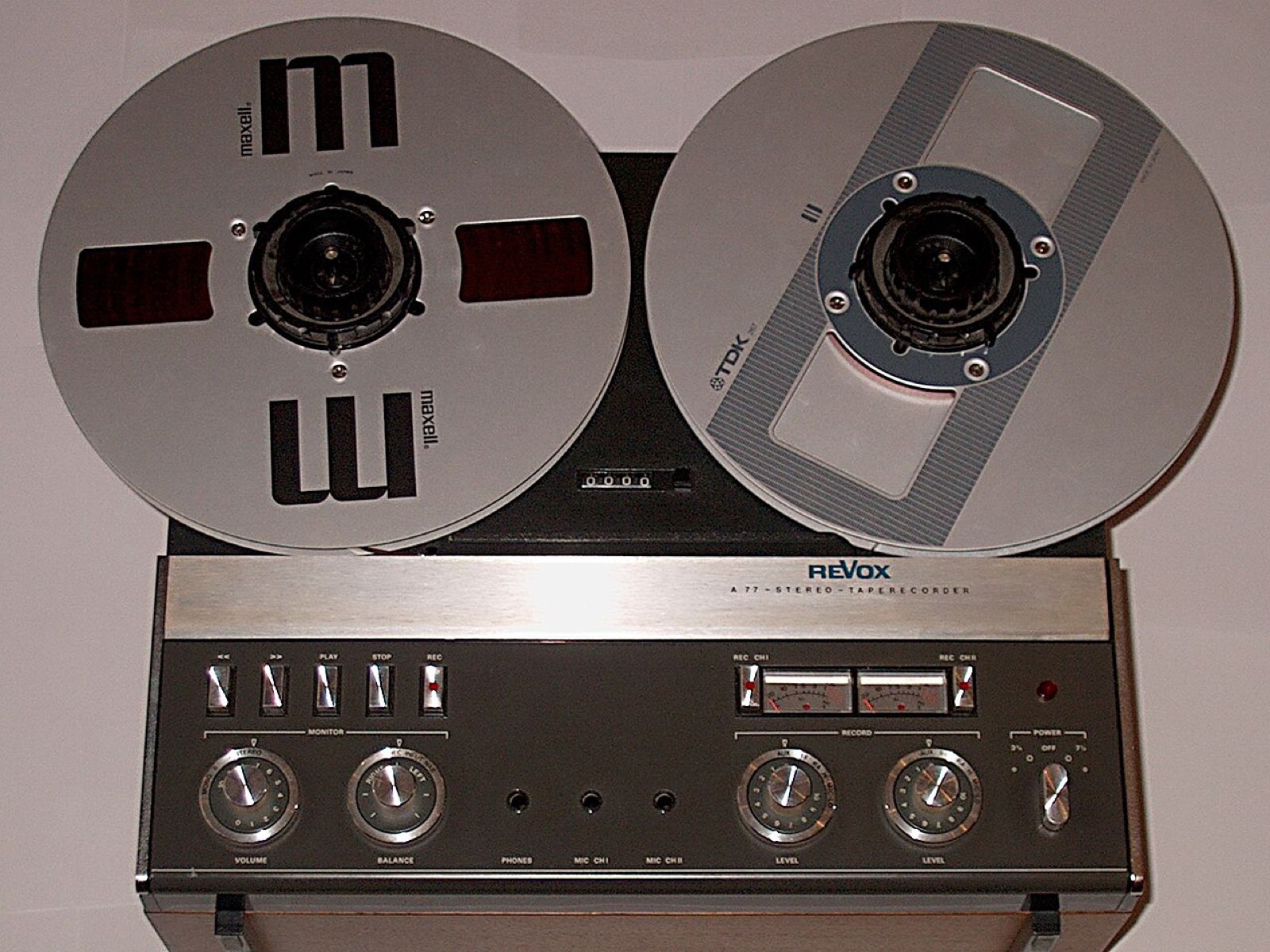
Introduced in 1967, the Revox A77 became a hit, said to have sold more than 400,000 units.
Though designed for home use, it was built to a standard that could hold its own against professional gear. Broadcasters and studios also used it as a convenient recorder.
People recorded records onto tape, captured their own performances, and saved radio programs. In music lovers’ homes, Revox tape reels were always turning.
🏷 Legend & Lore: How Many J37s Did Abbey Road Have?
Accounts differ slightly on how many J37s Abbey Road Studios owned and when they acquired them.
One story says the studio bought four in 1965; another says the Beatles began using them around 1967. What is certain is that the Beatles combined two J37s to create the sound of Sgt. Pepper’s.
Chapter 5: The End of the Tape Era and What Came Next for Studer
In the 1990s, a digital wave swept through the recording world.
Studer made digital recorders, including the D820 and D827, and moved on to developing digital mixing consoles. Introduced in 2003, the Vista series spread around the world as consoles for broadcasters and concert venues.
Meanwhile, the company changed dramatically.
- 1990: A Swiss company acquired the Studer-Revox Group.
- 1994: Studer became part of the American audio giant Harman.
- 1996: Founder Willi Studer died.
- 2018: Harman closed its Swiss operations.
- 2021: Canadian broadcast equipment manufacturer Evertz took over the Studer brand.
The recorder company born in Switzerland now makes broadcast consoles in Canada.
💡 Tip: If You’d Like to Try the Sound of Tape
Today, plugins can recreate the sound of Studer tape recorders. Broadly speaking, tape tends to have these characteristics:
- Loud sounds soften and round off (tape “saturation”).
- Low notes gain a pleasing fullness.
- High notes become a little smoother.
Apply a light touch to drums, bass, or an entire mix, and the sound can come together with a more “record-like” feel. If digital audio sounds hard to you, give it a try.
Epilogue: The Machine That Gives a Voice Back
Willi Studer, the radio enthusiast, died in 1996 at the age of 83. He received a gold medal from the Audio Engineering Society (AES) and an honorary doctorate from ETH Zurich, Switzerland’s renowned science and technology university.
The recorders he built were as precise and durable as a Swiss watch. That precision let the Beatles’ engineers move between two machines and work their magic across four tracks.
“Revox”—a voice given back.
The next time you listen to Sgt. Pepper’s, remember the Swiss-made recorder behind all that bustling sound, giving voices back again and again.
Studer Timeline
- 1912: Willi Studer is born.
- 1948: Founds a company in Zurich and makes oscilloscopes.
- 1949: Begins improving Ampex tape recorders.
- Around 1950: Releases the company’s own Dynavox recorder.
- 1951: The Revox home-audio brand is created.
- 1952: The professional A27 recorder appears.
- 1964: The four-track J37 is released.
- 1967: The Beatles’ Sgt. Pepper’s; Revox A77 home recorder released.
- Around 1970: A80 released (production continues until around 1988).
- 1978: Microprocessor-controlled A800 introduced.
- 1994: Studer becomes part of Harman.
- 1996: Willi Studer dies.
- 2003: Digital Vista console series introduced.
- 2021: Evertz takes over the brand.
Sources
- Wikipedia, “Studer” (English edition)
- PS Audio, “The Wavox Museum: A Monument to Willi Studer and More”
- Howard Massey, The Great British Recording Studios
- Revox, “Revox 1948–1979” (company history)
- Mix (article about the Studer J37)
Photo credits
- Header image, “Studer J37 4-track tape recorder (1964-1972), Abbey Road Studios” (Photo: Josephenus P. Riley / Wikimedia Commons / CC BY 2.0)
- “Studer A80 24-track recorder” (Photo: Jason Meredith / Wikimedia Commons / CC BY 2.0)
- “STUDER A820-24” (Photo: JacoTen / Wikimedia Commons / CC BY-SA 2.0)
- “Revox A77 MkIV” (Photo: Putput / Wikimedia Commons / CC BY-SA 3.0)
Licenses:
CC BY 2.0 https://creativecommons.org/licenses/by/2.0/
CC BY-SA 2.0 https://creativecommons.org/licenses/by-sa/2.0/
CC BY-SA 3.0 https://creativecommons.org/licenses/by-sa/3.0/