The Honda Super Cub — How a Bike Built for Noodle Deliveries Reached 100 Million
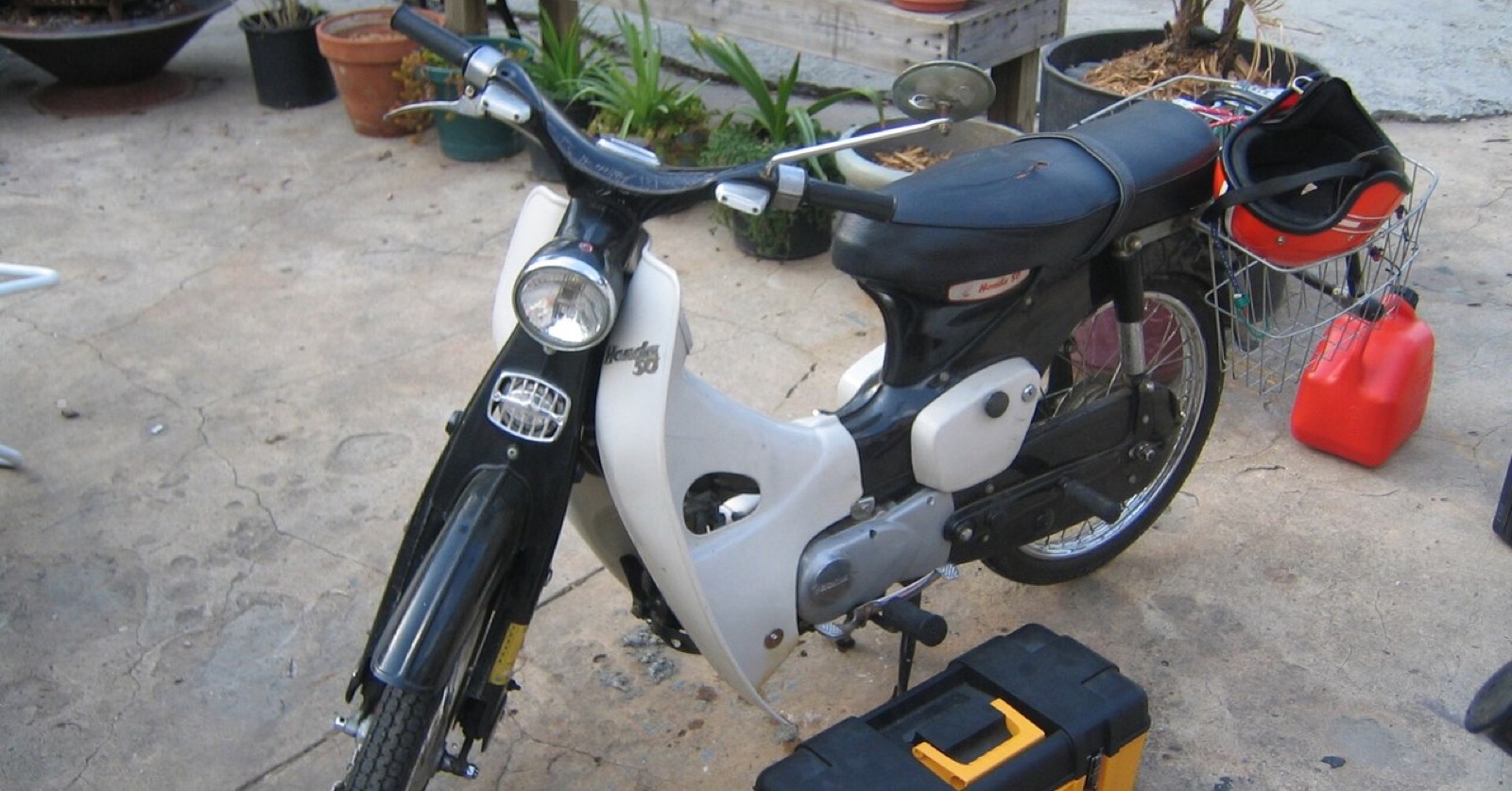
☕ A GC Lab motorcycle history column: a story told through the people and events behind a machine. This time, we trace the beginnings of the Super Cub, a practical bike that became part of everyday life around the world.
💡 What you'll learn
- How Soichiro Honda and Takeo Fujisawa divided the work of engineering and sales
- The user-centered ideas behind the C100's shape and clutch
- How a Japanese motorcycle came to be built around the world and reach 100 million units
Every November, EICMA in Milan fills with new motorcycles. It's a season for the latest electronic controls and fresh designs. But the machines that changed roads around the world haven't always been big or fast.
Introduced in 1958, the Super Cub was a practical motorcycle with a tiny 50 cc engine. It spread beyond Japanese street corners to markets across Asia and roads in the United States. In 2017, cumulative production for the series reached 100 million. One design supported people's mobility across generations and borders.
Behind its birth was a partnership between engineer Soichiro Honda and business and sales leader Takeo Fujisawa. They thought not only about building a high-performance motorcycle, but also about who would use it, where it would be sold, and how production could continue. An idea rooted in a specific job—delivering soba noodles—eventually found its way into everyday life around the world.
Chapter 1 — A Request Inspired by Noodle Deliveries
After World War II, Honda made auxiliary engines that could be attached to bicycles. Adding a small engine let riders travel farther with less effort. Through these products, the company gained experience manufacturing and selling two-wheelers. But Fujisawa's next idea went beyond improving an auxiliary engine.
He envisioned a new small motorcycle that could become the company's next major product. Drawing on his observations in Europe, he believed Japan needed a bike suited to its roads and daily life. It wasn't meant only for riders with specialized skills. Shopkeepers, shoppers, and commuters all needed a machine for everyday travel.
Fujisawa pointed to soba delivery workers as an example. Imagine carrying a tray or a package in one hand while controlling a motorcycle with the other. The usual controls would be awkward. A conventional setup required the rider to pull a clutch lever with the left hand while shifting gears with the left foot—difficult for someone whose hand was occupied.
The story is often retold as a request for a bike that a soba delivery worker could ride one-handed. The point isn't that anyone was encouraging people to ride with one hand. It was a concrete way to frame an engineering problem: reduce the burden of operating the bike for people carrying things as part of their work. The Cub began with a real street-level use case, rather than a set of abstract specifications.
Solving that problem meant rethinking more than the engine. The first Super Cub, the C100, paired a 50 cc four-stroke engine with a three-speed transmission and used an automatic centrifugal clutch, eliminating the clutch lever. As engine speed changes, the centrifugal clutch changes how firmly it engages. The rider could work the throttle with the right hand and shift with the left foot without squeezing a clutch lever.
Automating the clutch may sound simple. In practice, the clutch has to disengage when the rider presses the shift pedal and re-engage smoothly as the pedal returns. Making that mechanism transmit engine power to the rear wheel without a jerky start or shift took substantial development work. The easy controls concealed careful mechanical tuning.
Another defining feature was the low step-through frame. Riders didn't have to swing a leg over a high fuel tank. The shape was intended to be accessible to people in skirts or work clothes, too. A front leg shield protected the rider from wind and road spray, while covers over the engine and mechanical parts gave the bike a friendlier look.
That shape wasn't decoration. It reduced the fuss of adjusting clothes before riding and made everyday trips feel easy. Lowering the step-over motion widened the range of people who could ride. The Cub wasn't a scaled-down version of a big, powerful motorcycle; it was designed as a tool for short, practical journeys.
Soichiro Honda's engineering instinct was to solve everyday inconveniences with machinery. Fujisawa's role in defining the product and how it would be sold was just as important. Honda asked, “Can we build it?” Fujisawa considered, “Will people need it, and can we bring it to them?” Their partnership kept both the workshop and the market in view.