[SUZUKI Motorcycle History] The Oil-Cooled Revolution — The GSX-R750, a 750 as Light as a 400
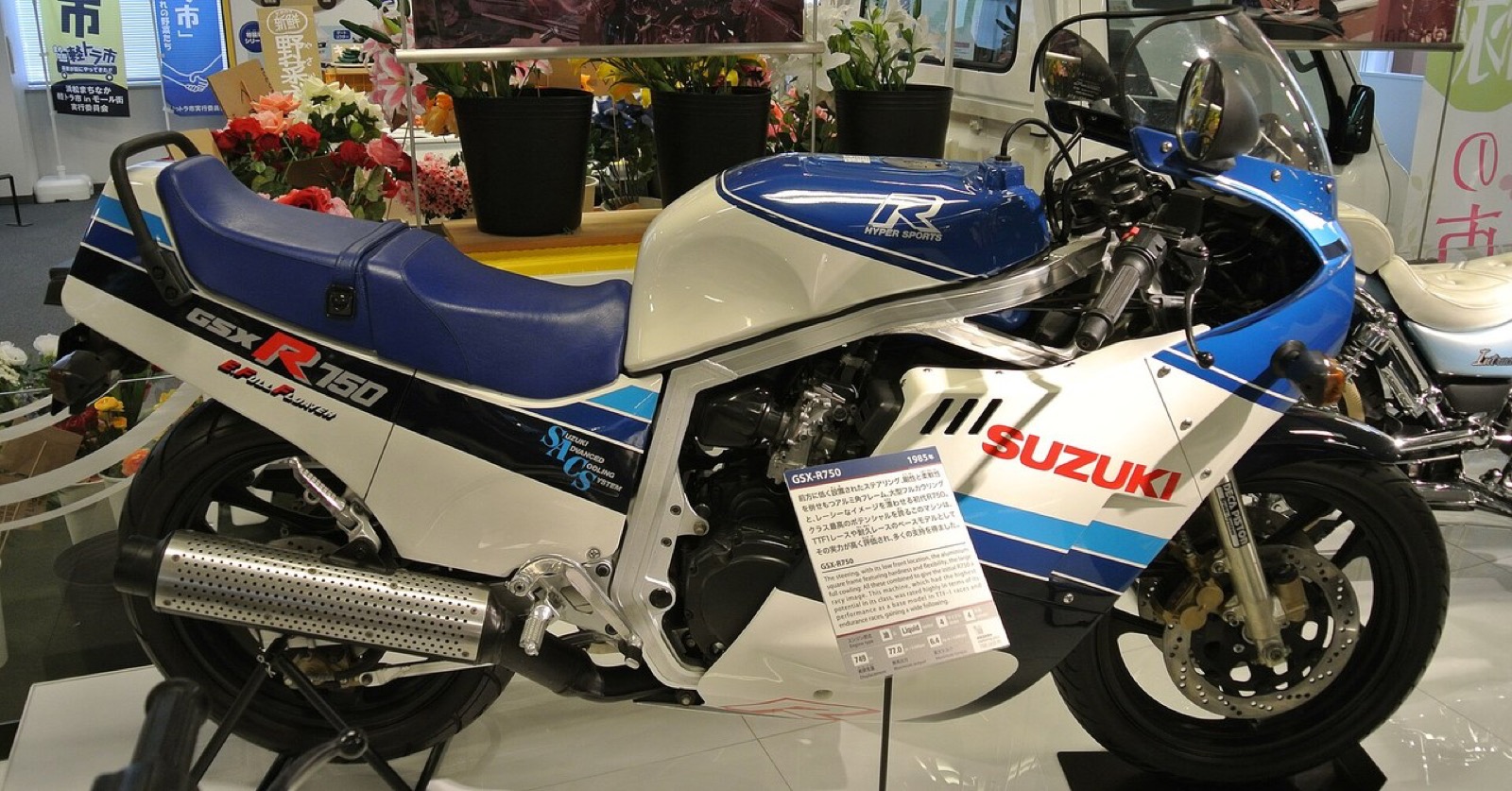
☕ A coffee-length story from GC Lab's "Motorcycle History" series, where we follow machines through the people and events behind them. This time: the Suzuki GSX-R750, which rebuilt the ever-heavier 750 sportbike by starting with one rule — make it light first. It is the story of how Suzuki arrived at an unusual answer: throw away the water and cool the engine with oil.
💡 What you'll learn
- Why 750 cc sportbikes kept getting heavier in the early 1980s
- Why Suzuki chose "oil cooling" over water cooling, and how it worked
- How a road bike with an endurance racer's skeleton changed racing and the motorcycle world
Prologue
Autumn 1984. At the motorcycle show in Cologne, Germany, a single Suzuki sat on display.
Its face had two round headlights side by side — the face of the endurance racers that ran through the night. The fairing was painted blue and white, and the tank carried a big "R." Seen from the side, a frame built from square aluminum tubes shone silver.
It was a 750. In those days, sport machines in this class — "nana-han," or "seven-and-a-half," as they were called in Japan — routinely weighed well over 200 kg. This bike weighed under 180 kg, almost the same as the 400 cc class one step below.
Its name was GSX-R750. On the side of the engine was an unfamiliar word: "SACS." It was the system Suzuki called "oil cooling," which cooled the engine with oil instead of water.
This bike would later be described as the first to bring the idea of the "race replica" to a big-bore motorcycle. Forty years on, the GSX-R name still runs as the flagship of Suzuki's sportbikes.
With 750s getting heavier every year, how did Suzuki's engineers win back lightness? This is the story of an engine cooled by oil.
Chapter 1 — The ever-heavier 750
In the early 1980s, the race for speed in the motorcycle world was heating up.
What every maker went after was engine power. More cylinders, more valves, higher revs. As power rises, so does heat. To get rid of it, maker after maker turned to water cooling.
Water cooling runs channels of water around the engine and cools the warmed water in a radiator. It handles heat very well. But the water jackets, the radiator, the pump, the hoses, the coolant itself — every added part adds weight.
More power also means a frame strong enough to take it. Frames in those days were made of steel tube. Make them stronger and they get heavier. Brakes and tires grew bigger and heavier too. And so 750 cc sportbikes had reached around 220 kg, even dry.
Suzuki had a 750 of its own: the air-cooled four-cylinder GSX750. It was a tough, easy-going engine, but with rivals launching one new water-cooled engine after another, Suzuki had reached the point where it needed its next move.
Honda was opening a new era with a water-cooled V-four 750, Yamaha with a water-cooled engine carrying five valves per cylinder. Kawasaki, too, was chasing speed records with a big water-cooled four.
Everyone was racing toward more power. Suzuki's engineers were looking in a slightly different direction.