The Spinning Tape That Made Echo — From Echoplex to Space Echo
☕ A coffee-length story about a classic piece of gear
About a 12-minute read. Set the research aside and enjoy the story.
That guitar sound—“plink, plink, plink…”—fading into the distance. Before digital gear, a “spinning tape” made that echo.
Prologue — Turn a Knob, Hear the Universe
In a corner of an old studio sits a fairly large box with a green-and-black panel.
Open the lid and brown tape spins around inside. A small motor makes a faint “zzzz…”
Play a single note on a guitar. The sound comes back—“plink, plink, plink…”—growing blurrier as it seems to drift away.
Now turn the knob marked “Intensity” well to the right, and the echoes keep piling up instead of fading. Before long, they become a “whooooom…” like the engine of a spaceship.
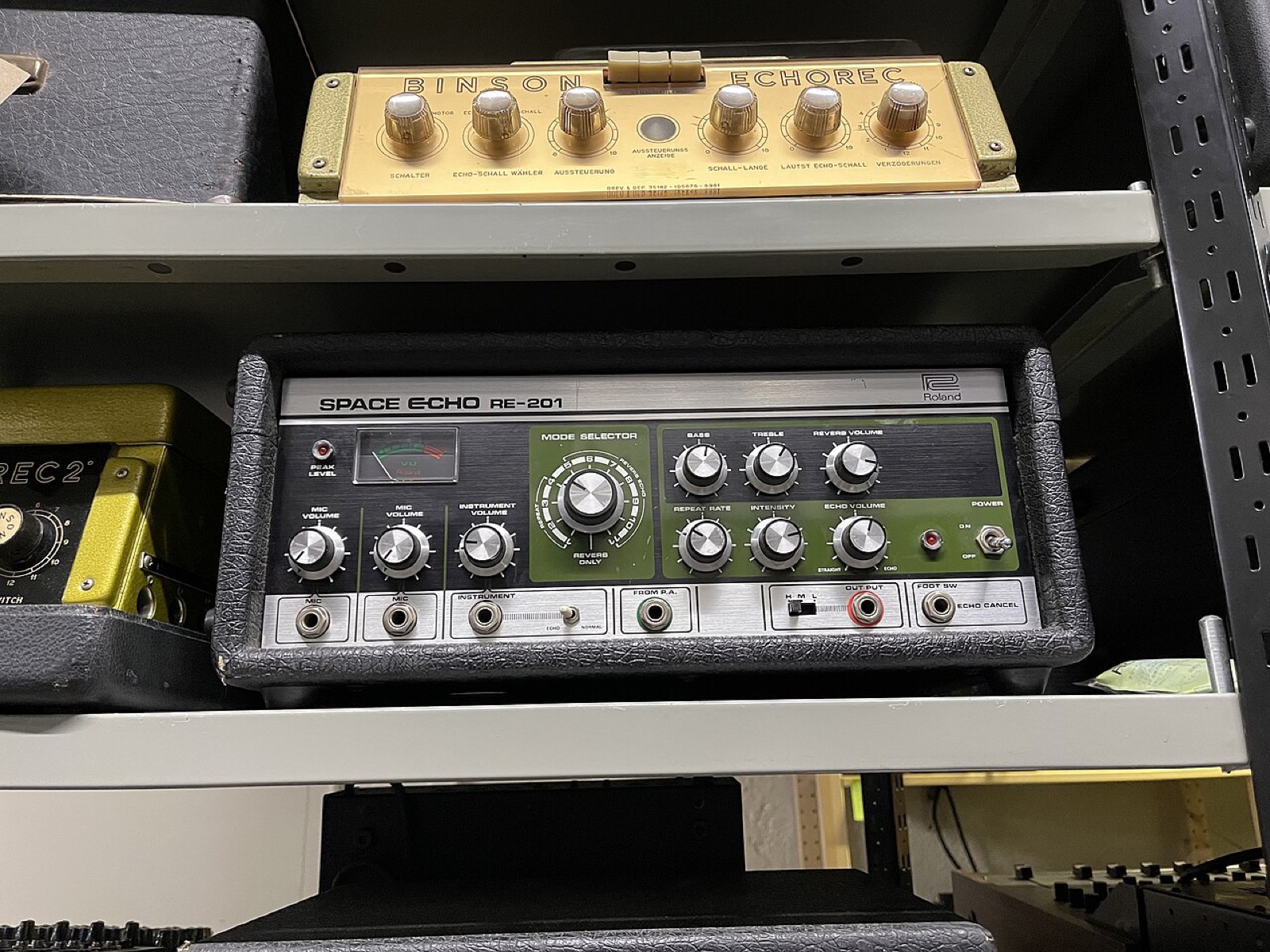
The box is the Roland RE-201 Space Echo. Born in Japan and loved by musicians around the world, it is one of the defining tape echoes.
But its story begins with a guitarist in a small American town.
📝 About this story
This story draws on years of reading books, interviews, and manufacturer materials. I have tried to stick to the facts, but I was not there, so some nicknames and commonly repeated stories may have made their way in. I separate disputed stories into “Legend & Lore” sections and list the sources at the end.
Chapter 1 — A Guitarist in Akron and a Repairman
How Echo Works
The mechanics of tape echo are actually quite simple:
- Record the guitar through a record head onto tape.
- Read the sound with a playback head placed a little farther along the tape.
- The tiny delay between recording and playback becomes the echo.
Feed the playback signal back to the record head and the echo repeats. Finally, an erase head wipes the tape so it can record the next sound.
As long as the tape loop keeps turning, it keeps making echoes.
The Echoplex Is Born
In the 1950s, Akron, an industrial city in Ohio, was home to guitarist Don Dixon, who was trying to build a tape-echo machine of his own.
Dixon was no engineer, though, and he could not get it working properly. So he sought out a man who had placed a newspaper ad offering electrical repairs. His name was Mike Battle, and he lived in Akron too.
Battle was the kind of man who could fix or build just about anything electrical. Over the next several years, he refined Dixon’s machine.
A Playback Head You Could Move
Battle’s key innovation was making the playback head slide back and forth.
Move it closer to the record head and the echo comes back sooner. Move it farther away and the echo takes longer. By moving the head, you could freely change the spacing between repeats.
The tape sat in a loop inside a cartridge. Battle’s brochure reportedly described it as an “endless loop” containing about two minutes of tape.
Around 1959, the machine went on sale as the Echoplex.
(Coming up: how the Echoplex became a guitarists’ favorite, the “golden box” and “iron drum” born in Europe, and the Japanese Space Echo that changed the world.)