Four Tracks on a Cassette Turned the Bedroom into a Studio: The TASCAM Portastudio (TEAC 144)
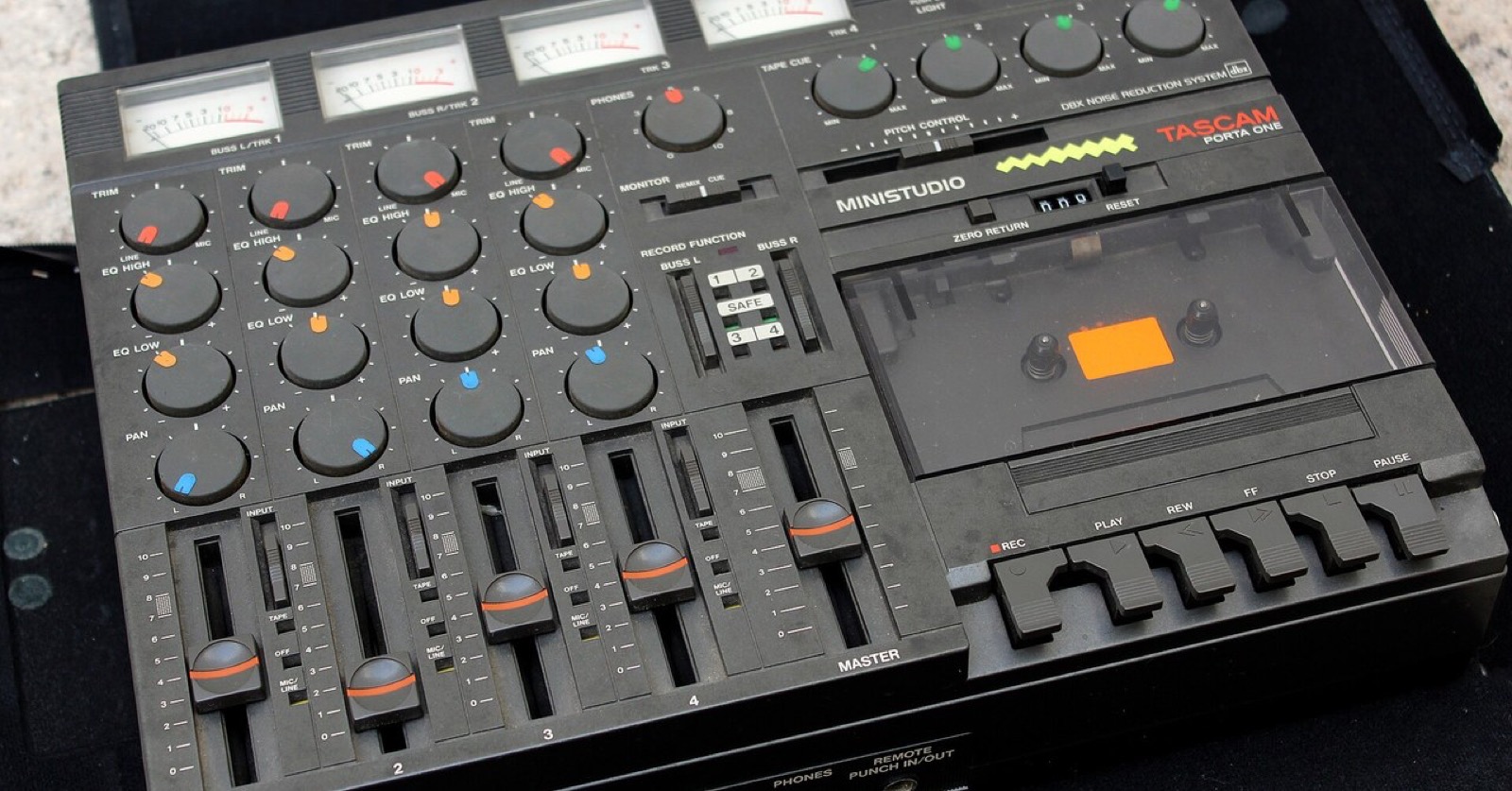
☕ A coffee-length story — about a 15-minute read. This is the tale of a Tokyo tape-recorder company that drew four lines onto an ordinary cassette and turned bedrooms all over the world into recording studios.
Prologue — A Bedroom in New Jersey
The morning of 3 January 1982.
A guitar tech carried some gear into a house in Colts Neck, New Jersey.
His name was Mike Batlan, and he looked after Bruce Springsteen's guitars.
What he brought was not a big studio console, nor a tape machine the size of a refrigerator. It was one box, small enough to sit on a desk, that took an ordinary cassette. And two microphones.
Springsteen sat down in front of it with his guitar and began to sing, quietly.
When he finished, he added harmonica on another line of the same tape. On yet another line, mandolin and glockenspiel.
There was no engineer in the room, no producer, no band.
Just a man singing, a man pressing buttons, and a small box.
The box was called the TEAC 144 Portastudio.
Six months later, the humble cassette recorded that winter would be on sale in record shops all over America.
This is the story of the Japanese tape-recorder company that built that little box.
Chapter 1 — Two Brothers Obsessed with Tape
An aircraft engineer and a home-made recorder
TEAC's story begins in Tokyo in 1953. That August, a small firm called the Tokyo Television Acoustic Company was born.
At its centre was an engineer named Katsuma Tani. He is said to have been an aircraft engineer. With the war over and no more aeroplanes to build in Japan, people with technical skills scattered into radio and audio.
Katsuma had a younger brother.
One day, the brother brought home a recorder he had built by hand: a stereo tape machine with three motors and three heads.
One motor to drive the tape, one to take it up, one for fast-forward and rewind. One head to record, one to erase, one to play back. For its time, it was a serious piece of engineering.
Katsuma was hooked. At the end of 1956, the brothers set up a second company, the Tokyo Electro-Acoustic Company. The two firms later became one, and the English initials of the second gave it its name: TEAC.
Seventy-two hours without sleep
The first recorder the brothers sold to their own design was the TD-102 of 1957.
A call came from America. People from Lafayette Radio, a New York electronics chain, ordered 25 units. For a small company, that was a big order. The staff are said to have kept assembling almost without rest for 72 hours to deliver on time.
In 1958, a sales demonstration was held at the American air base in Tachikawa, outside Tokyo. All 50 machines they brought were reportedly sold on the spot.
A small Japanese recorder had reached American ears.
TEAC went on to build magnetic tape drives for computers under an agreement with IBM, and for the 1964 Tokyo Olympics it worked with NHK on a slow-motion replay video machine.
Recording onto tape. Winding it accurately, reading it back accurately.
TEAC grew by doing that one thing well.