The Unsold Bass Machine That Gave Birth to Acid House: The Roland TB-303
☕ A coffee-length story — about a 15-minute read. A little silver box built as a practice partner for guitarists vanished from the shops in under two years. This is the story of how, in the clubs of Chicago, it became an entirely new kind of music.
Prologue — A Forty-Dollar Secondhand Box
Chicago, the mid-1980s. One of a group of young musicians found a small silver box in a shop that sold used instruments.
The price was about forty dollars. On top of the box were six knobs. Below them ran a row of buttons shaped like piano keys. The manual was in Japanese, which they couldn't read.
They didn't know how the box was supposed to be used. They just hooked it up to a drum machine and let it play. One of them started turning the knobs at random — and the low notes twisted out of shape. Wooow. Gyurrr. A sound nobody had heard before, like a living thing writhing.
"That's it. Keep turning."
A long jam, recorded onto cassette that same day, became the first track of a music that would later be called acid house.
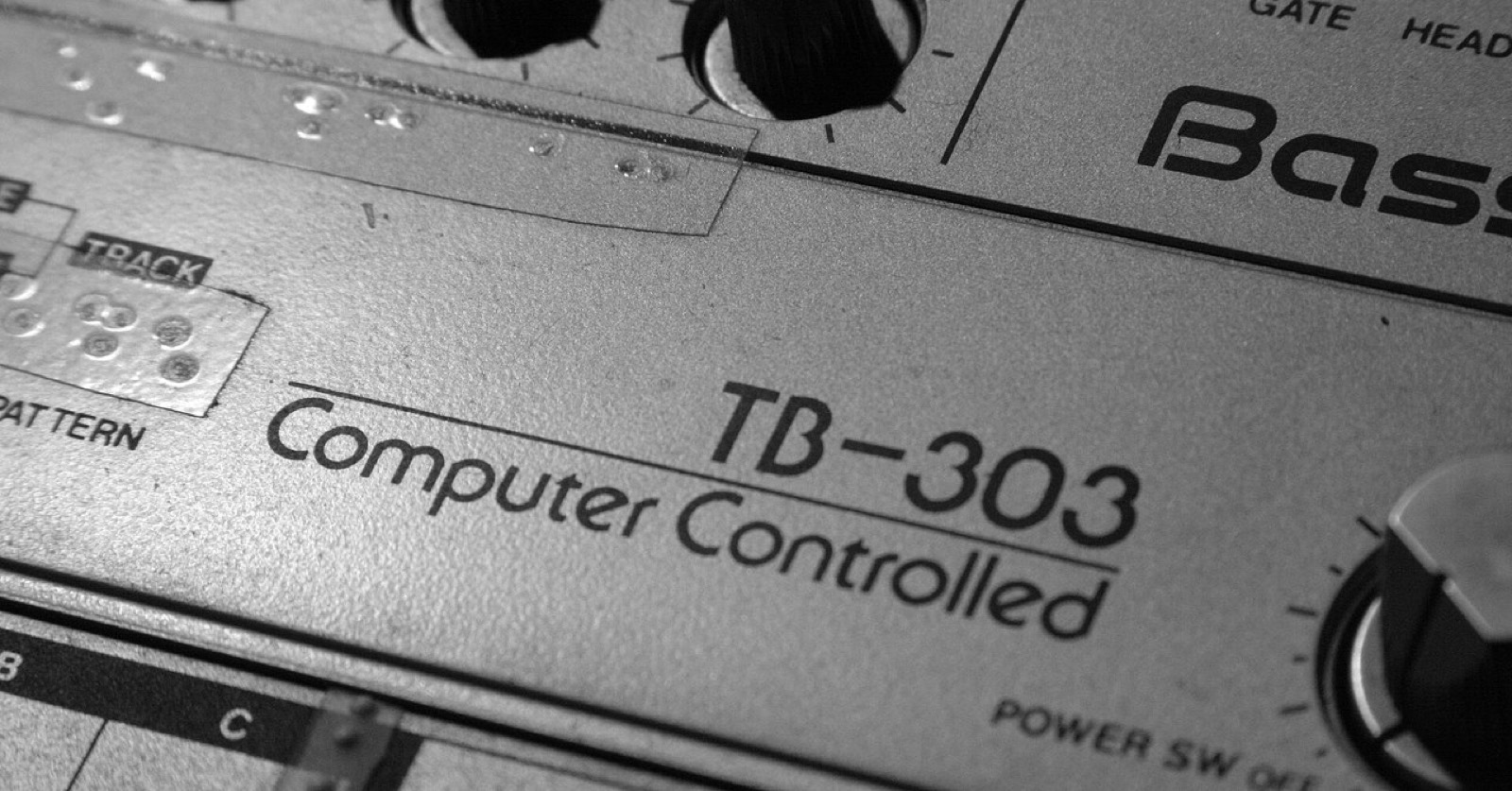
The silver box was the Roland TB-303 Bass Line. It had been made in Osaka, Japan, for an entirely different purpose.
This is the story of how a small bass machine that failed to sell and disappeared went on to repaint the world's dance music.
Chapter 1 — "So You Can Rehearse With a Band, Even Alone"
The engineers in Osaka
From the late 1970s into the early 1980s, a team of engineers at Roland in Osaka was turning out one rhythm machine and synthesizer after another.
Leading that team was Tadao Kikumoto, the Roland engineer whose name would be attached to machines like the TR-808, TR-606, TB-303 and TR-909.
Roland at the time was focused on machines for "people who make music on their own." You could practice at home without bandmates. You could perform solo in a small shop or a bar. For that, all you needed was a machine to play the drums and the bass for you.
A drums-and-bass "backing set"
The idea that came out of this was a pair of small machines.
One was the TR-606, a rhythm machine that played the drums. The other was the TB-303, which played the bass.
The "T" in TB stood for transistor, the "B" for bass. Connected with a dedicated cable, the two ran perfectly together at the same tempo. Both were small enough to carry. Set them side by side on a table, and it was as if a drummer and a bassist were there with you. They were a portable "backing band" for guitarists and singers to practice with, or to take on stage, on their own.
Kikumoto later said the TB-303 was built to imitate the sound of the electric bass. In other words, the model for this machine was always the bass guitar.
1981: release
The TB-303 went on sale in 1981. In the United States it cost $395.
Six knobs ran across the silver body: "Tuning" to set the pitch, "Cut Off" to set how bright the sound was, "Resonance" to sharpen its character, "Env Mod" to set how deeply the sound changed, "Decay" to set how it faded away, and "Accent" to add emphasis.
Below them was one octave of key-shaped buttons. Inside this little machine was a sequencer that remembered what you played. You entered notes one at a time with the buttons, built patterns, and chained the patterns into a song.
Like the TR-808, it ran on analog circuitry. There was just one oscillator, the source of the sound, and you chose between a sawtooth wave and a square wave. You then shaped that sound with the knobs — cutting it back, emphasizing it — until it sounded like a bass.