The German Company That Trusted Vienna’s Craftsmen with a Tube Mic — Telefunken Ela M 251
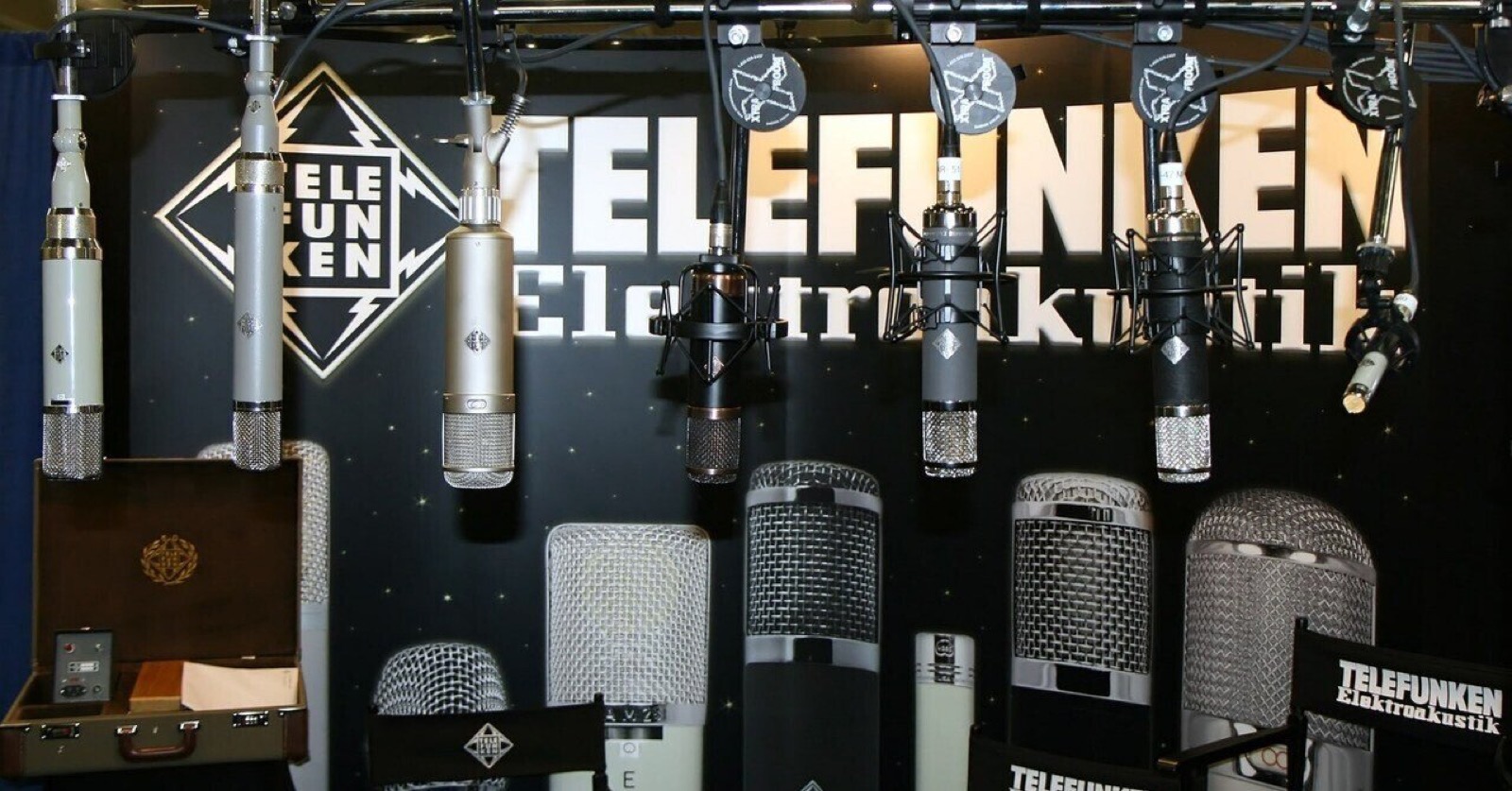
Prologue — The Company That Lost Its Microphone
West Germany, late in the 1950s. A problem had surfaced in the audio division of the major electronics manufacturer Telefunken.
“We’re about to lose our big studio microphone.”
Until then, Telefunken had sold the legendary U47, made by Berlin microphone maker Neumann, around the world under its own name. A silver body, a Telefunken diamond logo. The U47 had been one of Telefunken’s flagship products.
But Neumann began selling products under its own name, and the arrangement came to an end. The microphone that had defined Telefunken’s lineup was about to disappear from the shelves.
Telefunken turned for help across the border, to Vienna, the capital of Austria.
Chapter 1 — AKG, Vienna’s Microphone Maker
A company born in postwar Vienna
AKG was a microphone and headphone maker founded in Vienna after World War II.
AKG already had a tube microphone it was proud of: the C12.
At its heart was the CK12 capsule, the part that captures sound. It used two thin diaphragms mounted back to back, and electrical switching let the user change the direction from which it picked up sound.
“A microphone like the C12, made for us”
Telefunken’s request was simple: build a large studio condenser microphone to replace the U47.
According to the sources, Telefunken approached AKG around 1958. The new microphones were ready in 1959.
They were the Ela M 250 and Ela M 251.
“Ela” is said to be short for the German word “Elektroakustik,” meaning electroacoustics. Telefunken often used the term in model names for its audio equipment.
Chapter 2 — What the C12 Shared, and What It Didn’t
Almost the same parts inside
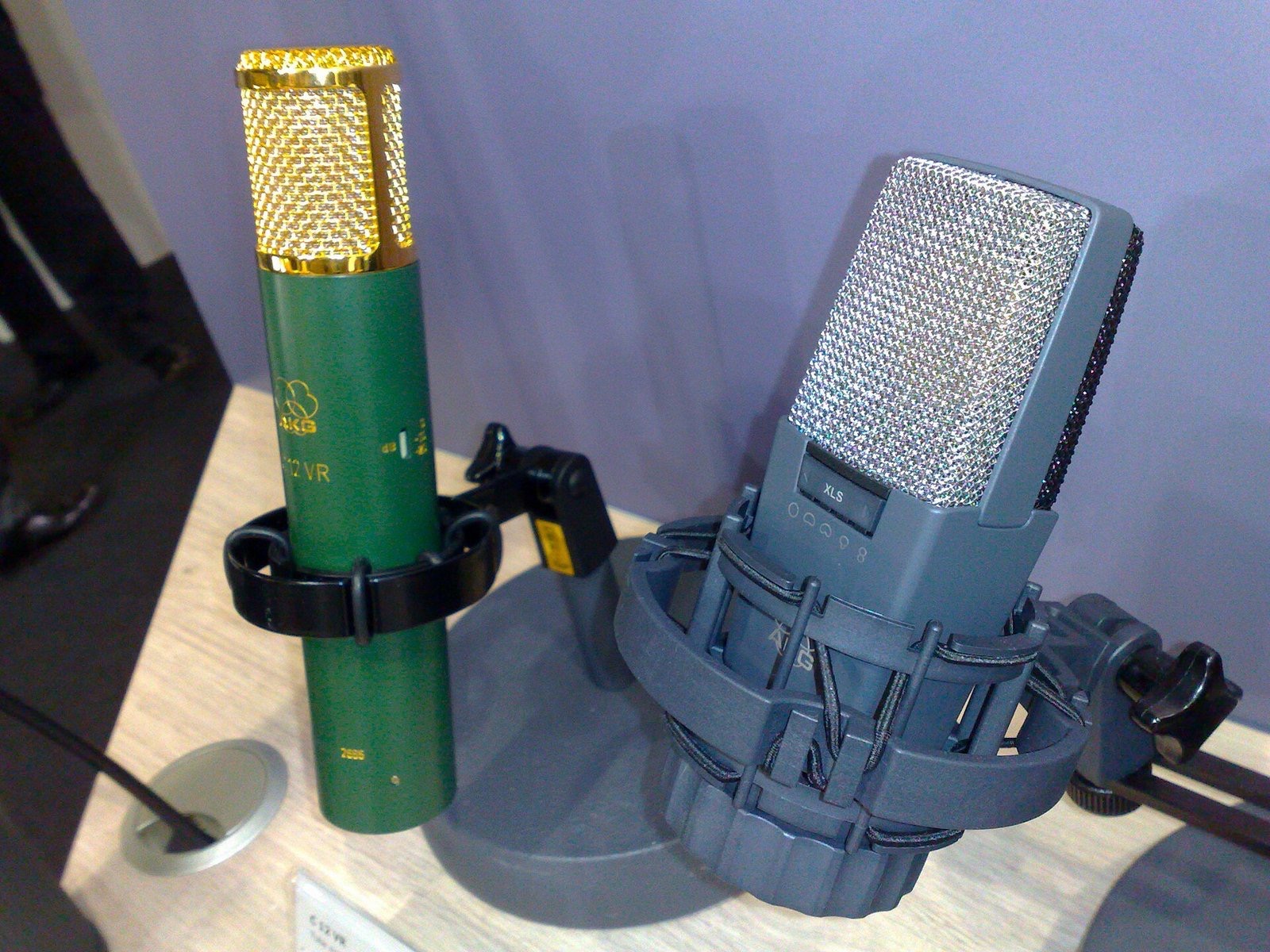
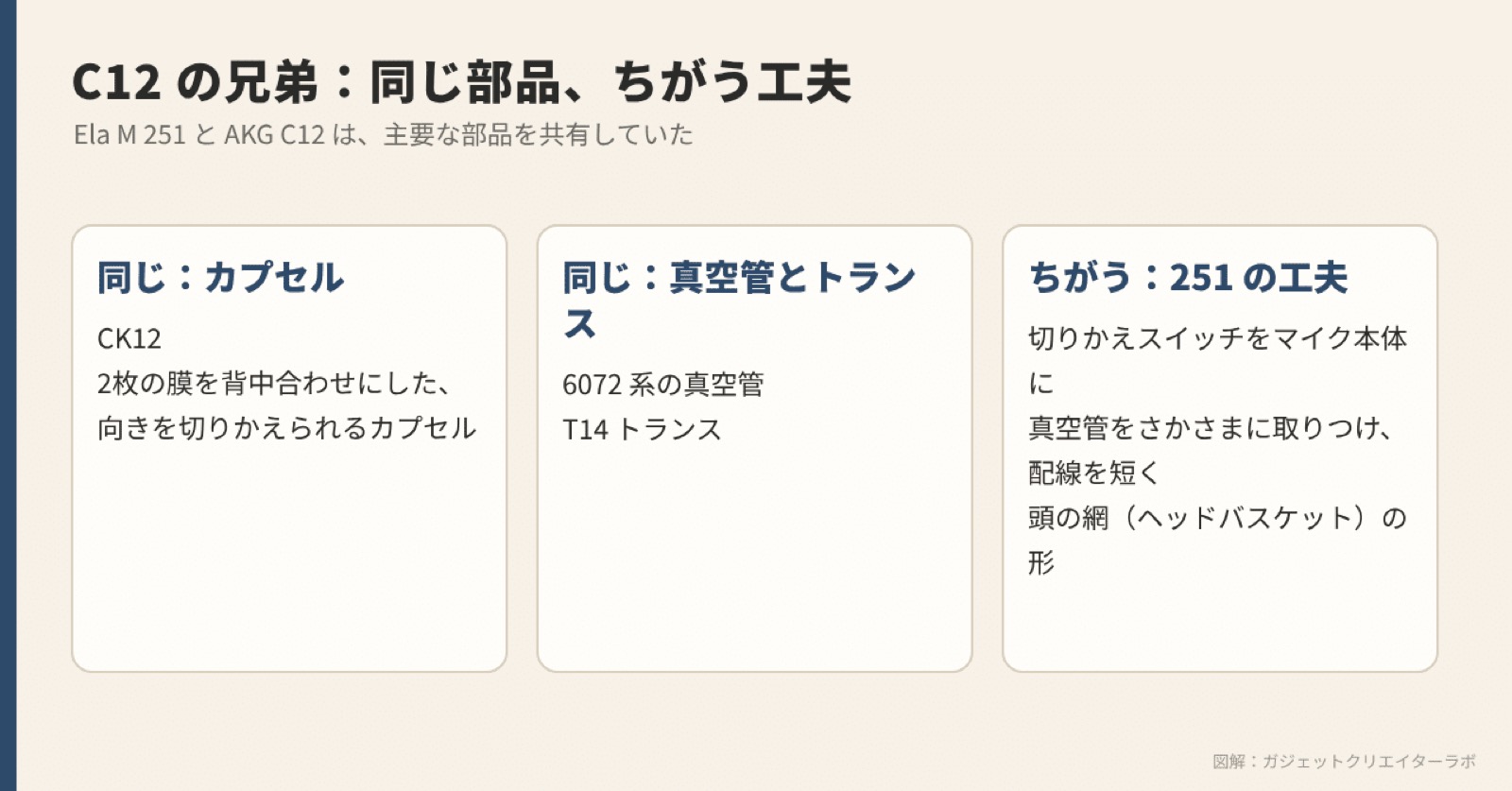
Open up an Ela M 251 and its close relationship to the C12 becomes clear.
- The capsule was the same CK12 used in the C12.
- The tube was from the same 6072 family as the C12’s.
- The output transformer was the same T14 as the C12’s.
In a sense, it was a sibling to the C12.
Still, they didn’t sound the same
Even so, the C12 and the 251 were not identical microphones.
1. The pattern switch moved onto the microphone
On the C12, the switch that changed the pickup pattern was on a separate power supply. The 251 put that switch on the microphone itself. You could change patterns right there, with the mic already set up in front of the singer.
2. The tube was turned upside down
In the 251, the tube was mounted upside down inside the microphone. This shortened the wire connecting the capsule and tube. The thinking was that shorter wiring would be less likely to pick up unwanted noise or smear the sound.
3. The shape of the headbasket
The mesh enclosure around the capsule—the headbasket—also differed from the C12’s. Even with the same capsule, changing the shape around it can change how sound resonates. That enclosure is often said to be part of what gives the 251 its distinctive sound.
The difference between the 250 and 251
The two microphones launched together had different roles.
- Ela M 250: two pickup patterns; designed to go after the U47’s place.
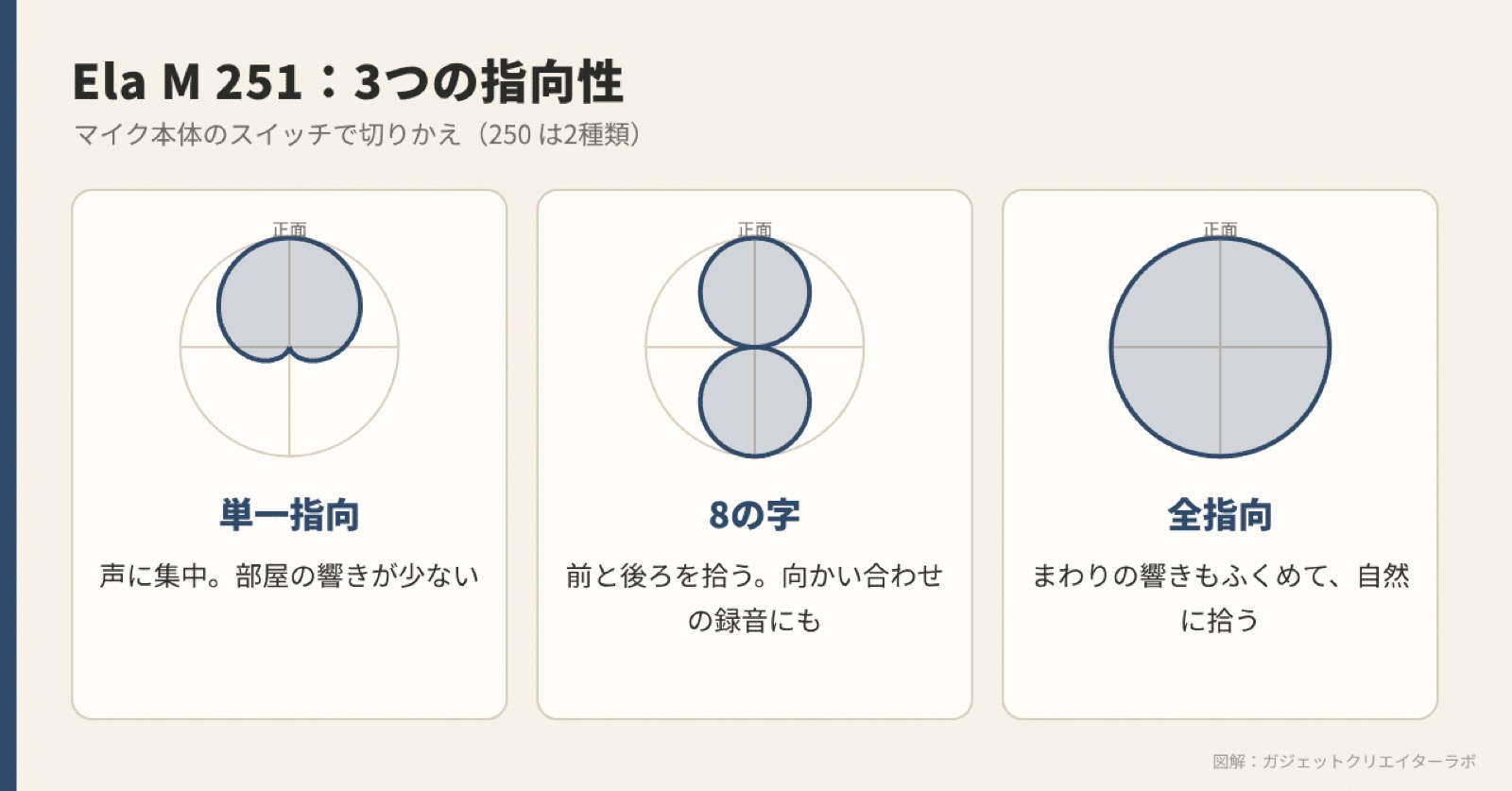
- Ela M 251: three pickup patterns—cardioid, figure-eight, and omnidirectional; closer to the C12.
The model with an “E”
There was also a model with an E at the end of its name: the Ela M 251E.
The E stood for “Export.” The model intended for Germany used Telefunken’s AC701k tube, hard-wired rather than installed in a socket. The export model used the more widely available 6072, which could be replaced through a socket, including outside Europe.
It was a small detail that made sense for a microphone intended for studios around the world.
Chapter 3 — Just Three Years in Production
From 1959 to 1962
The Ela M 250 and 251 were made from 1959 to around 1962—a run of only about three years.
Not many were made, and the tubes and capsules deteriorated over time. Today, very few original examples remain in good working order.
Why did people love it so much?
The 251’s sound is often described this way:
- The highs stretch out brightly, with an airy quality.
- Yet they have less of a harsh edge that can hurt the ears.
- It gently captures even the breath close to a voice.
- The low end has a rich, full weight.
Brightness and softness rarely go hand in hand. The 251 is said to have both, and that is part of its appeal.
Of course, calling any microphone “the best-sounding” comes down to taste. Still, it is true that engineers who have worked with many classic microphones have returned to the 251’s name again and again.
Chapter 4 — Getting Closer to the 251 Sound Today
Finding an original 251 today is almost a dream. But you can still try out the ideas behind its sound with modern gear.
1. Place a “bright” microphone a little farther away
The 251’s appeal lies in the way brightness and softness coexist. When you use a bright-sounding condenser microphone, try standing 15–20 cm from it. Too close, and that brightness can turn harsh.
2. Switch patterns and listen to the room
If your microphone offers three pickup patterns, try switching between them.
- Cardioid: focuses on the voice and picks up less of the room.
- Figure-eight: picks up sound from the front and back, bringing in some room ambience; it can also work for two people facing each other.
- Omnidirectional: picks up the surroundings too, for a natural sound.
In a room with a pleasant sound, a voice recorded in omni can sound surprisingly natural.
3. Reissues and microphones with similar designs
Many manufacturers still make microphones that carry on ideas from the 251 and C12. Some are re-creations of the original design; others are more affordable microphones fitted with CK12-style capsules.
A model name containing “251” or “12” doesn’t tell you everything about its construction or sound. Before buying, listen to samples and comparisons to see whether it suits your voice.
Epilogue — A Classic Born from a Problem
A company lost its flagship microphone and turned to craftsmen across a national border for help. The microphone born from that problem disappeared after only three years—and then became a legend.
A German company’s name, and the skill of Vienna’s engineers. The sound born in that brief overlap remains one of the recording world’s benchmarks.
The next time you hear a recording where a voice seems to float into view, take a moment to remember: behind that voice may be a microphone that connected Vienna and Germany in 1959.
Ela M 251 Timeline
- 1950s: Telefunken sells Neumann’s U47 under its own name.
- Late 1950s: Neumann begins selling under its own name, ending the arrangement.
- Around 1958: Telefunken asks AKG to develop a new microphone.
- 1959: The Ela M 250 and 251 arrive; the export models are the 250E and 251E.
- Around 1962: Production ends.
- Later: Their scarcity and sound make them some of the most expensive vintage microphones.
References
- Mix, “Classic Tracks” — articles related to the Telefunken Ela M 251
- recordinghacks.com, “Telefunken ElaM 251”
- Explanatory articles from ProSoundWeb, Sound Pure, Reverb, and others
- Various explanatory sources on the AKG C12
Photo credits
- Header image, “Telefunken Elektroakustik, AES 2010,” recordinghacks (cropped) / Wikimedia Commons / CC BY 2.0
- “AKG C12VR, C414B-XLS,” Hens Zimmerman from Zeist, The Netherlands / Wikimedia Commons / CC BY 2.0
- Illustrations: created by Gadget Creator Lab.
License: CC BY 2.0 — https://creativecommons.org/licenses/by/2.0/