[Motorcycle History] British Pride and Many Comebacks — Triumph and the Bonneville
☕ A coffee-length story from GC Lab's "Motorcycle History" series, where we follow machines through the people and events behind them. This time: Triumph of Britain, a bicycle company started by a young man from Germany that came back to life again and again after air raids, sell-offs and bankruptcy.
💡 What you'll learn
- How German-born Siegfried Bettmann started "Triumph" in England
- Edward Turner's "Speed Twin" and the "Bonneville" that America loved
- Why the name never disappeared, even when the factory burned and the company fell
Prologue
The night of 14 November 1940, in Coventry, an industrial city in the English Midlands. Air-raid sirens wailed, and German bombers arrived over the city one wave after another. The bombing went on all night, and by dawn the medieval cathedral and rows of factories had been engulfed in flames.
Among them was Triumph's motorcycle factory on Priory Street. A factory that had been building thousands of military motorcycles for the war was wiped out. Not just the buildings: the drawings, the technical records, decades of accumulated work were all lost at once.
Ironically, the company had been started by a young man from Nuremberg, in Germany.
Triumph's history is a series of such "endings." The factory burns, the company is sold to a rival, it is pushed aside by Japanese motorcycles, its workers occupy the factory, and finally it goes bankrupt. Yet every time, someone picked up the name and made it run again. This is the story of a British motorcycle that nearly died many times and kept coming back.
Chapter 1 — A young man from Nuremberg
Siegfried Bettmann was born in 1863 in Nuremberg, in southern Germany. In his early twenties, around 1885, he moved to England and went into business. His first venture was importing and selling bicycles.
Late-nineteenth-century Britain was in the grip of a cycling craze. Bettmann is said to have wanted a name for his bicycles that people of any country could understand. The word he chose was "Triumph." In 1886 the company began calling itself the "Triumph Cycle Company."
The following year, 1887, Mauritz Schulte, also from Germany, joined as a partner. Schulte believed they should not just buy and sell but build their own. In 1888 the two bought land in Coventry, the center of British bicycle making, and the next year began producing bicycles under the Triumph name.
Then in 1902 Triumph released its first motorcycle. The engine was bought from Minerva in Belgium and mounted in a bicycle-like frame; a simple machine. But as early as 1905 Triumph completed a motorcycle whose engine it had designed itself. From then on it built one bike after another with its own engines, and won a reputation for sturdy, dependable work. From borrowing other companies' engines to a maker with a heart of its own: this was its true start as a motorcycle manufacturer.
Bettmann came to be respected not only in business but as a citizen. In 1913 he was elected Mayor of Coventry, the first person not born in Britain to hold the post.
But when the First World War broke out in 1914, the mood changed completely. Bettmann had long since become a British citizen, but because he was born in Germany, he had to step down as mayor. The country of his birth and the country he lived in were now at war.
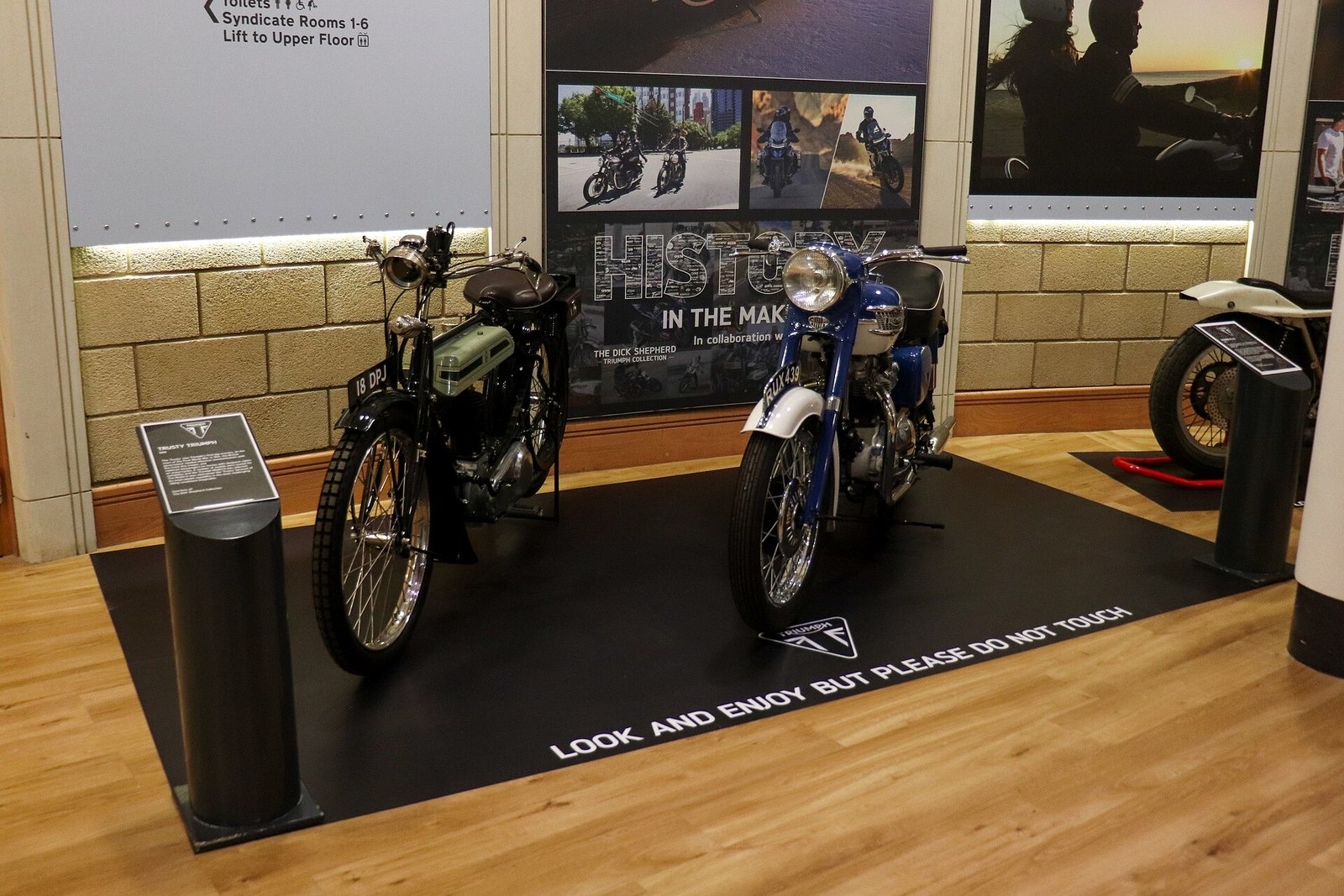
In that war, Triumph motorcycles served with distinction. The "Model H," ordered in quantity by the army, ran across muddy battlefields carrying dispatches and messages, and for its toughness it became known as the "Trusty Triumph." Some 30,000 Model Hs are said to have gone to the military during the war. By the time the war ended, Triumph was Britain's largest motorcycle maker. A company run by a German-born man had kept the British army moving: another irony typical of this company.
In the 1920s Triumph began making cars as well as motorcycles. The cars, later known for British sports cars such as the "Triumph TR," would eventually go their own way as a separate company, but that is another story. In this article we follow the two-wheeled Triumph.