Thirty Kilos of ‘Clean Sound’ on Every Stage — Fender Twin Reverb
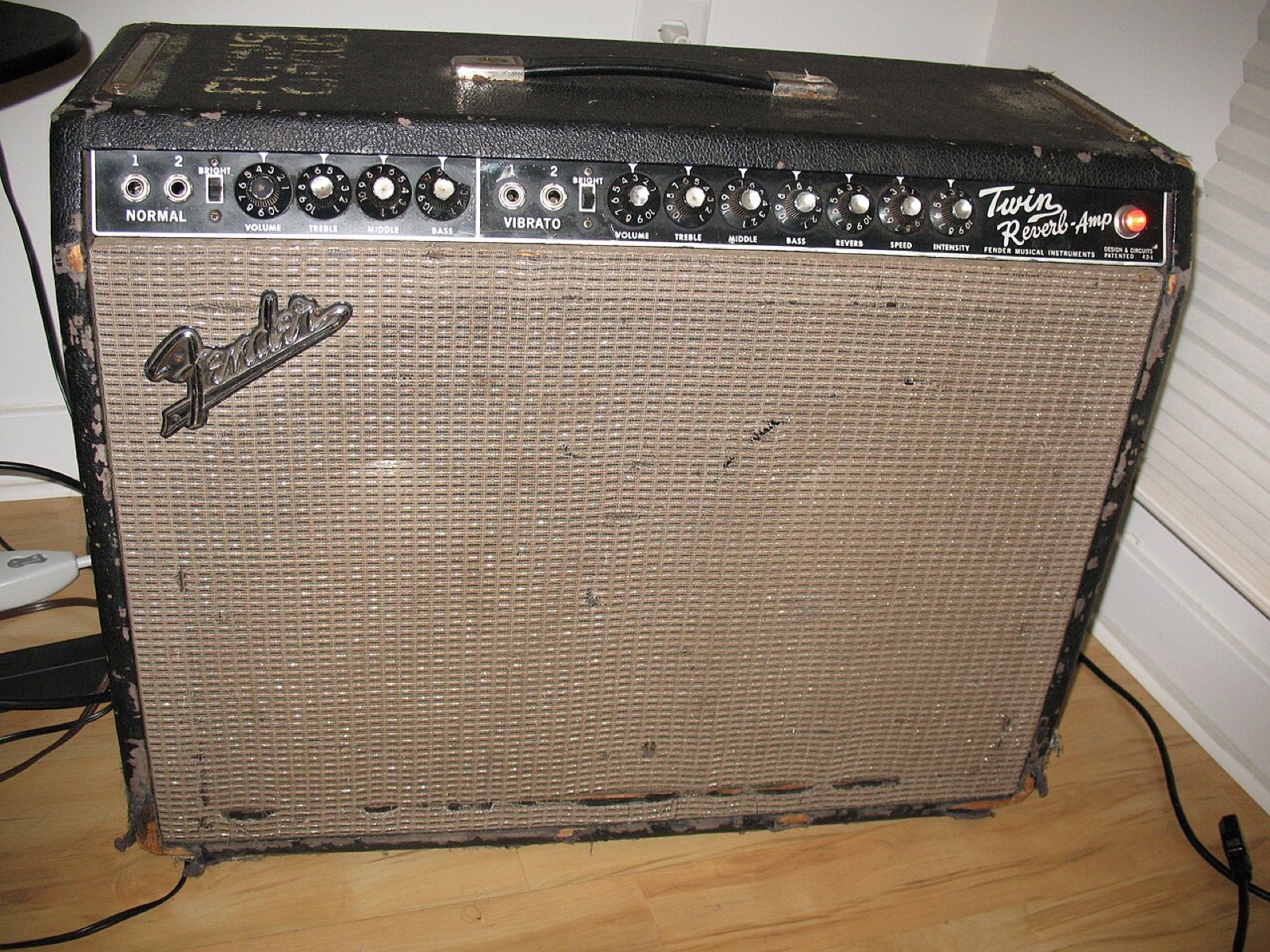
☕ A coffee-length story — about a 10-minute read.
Enjoy this as a story, not a research assignment. It begins with the big silver-and-black amp that always seems to be waiting in the corner of a live house—and asks how that familiar sight came to be.
Prologue — The Two Amps You See Everywhere
Walk into a live house or rehearsal studio in Japan, and you’ll usually find the same pair of guitar amps waiting at the edge of the stage.
One is the JC-120 by Roland, a Japanese company. The other is a big, heavy box with a black panel and a silver grille.
That’s the Fender Twin Reverb.
Try to lift one and your back will let you know about it. It weighs around 30 kilograms. But turn a few knobs and strike a chord, and it all makes sense. Even when the volume climbs, the sound stays clear—bright, sparkling, and clean.
Where did this amp, the yardstick for a “clean sound,” come from?
📝 About this story
This story draws on books, interviews, and manufacturer materials I’ve read over the years. I’ve tried to stick to the facts, but I wasn’t there at the time, so some nicknames and received wisdom may have made their way in. I’ve marked stories with competing versions as “Legend & Lore,” and collected the references at the end.
Chapter 1 — The Twin Is Born
1952: Two Speakers
Our story goes back to 1952 in Fullerton, California. Leo Fender’s company brought out a new amp. Fender was an inventor who couldn’t play guitar himself.
It was called the Twin Amp. The name came from its two 12-inch speakers—a twin pair.
Fender amps of the day came in wooden cabinets wrapped in tweed. The first Twin’s output looks modest by today’s standards, but two speakers made it plenty loud for guitarists back then.
Louder, and Cleaner
The world around the guitar changed fast in the 1950s. Rock ’n’ roll arrived, drums got louder, and venues grew bigger. Country and Western swing bands also needed enough volume to fill dance halls.
Guitarists kept asking for the same thing: “Give us more volume, but don’t muddy the sound.”
Leo Fender listened and kept refining his amps. In 1958, a much more powerful “high-power” Twin appeared. Loud without breaking up: clean sound, turned all the way up. The Twin’s character was taking shape.
Now let’s see what happened when reverb found its way into the Twin.
Chapter 2 — 1963: The Springs Begin to Sing
Springs from an Organ Company
In the early 1960s, Fender turned its attention to a new component: spring reverb, developed by the organ company Hammond.
Send sound vibrations through a metal spring and they travel back and forth before returning a moment later. The result is a reverb, an echo that can feel like a sound bouncing around a large room. The system was originally made to give home organs a church-like sense of space.
Surf Music’s Splash
Fender first released this spring sound as a standalone unit in 1961: the Fender Reverb.
Young Californians were quick to embrace it. Surf guitarists, including Dick Dale, drenched their guitars in reverb and made them crash like waves—ka-shaaang! The spring sound became part of the face of an entire genre.
The Twin Reverb Arrives
Then, in 1963, Fender launched a new amp with that reverb built right in. It was the Twin Reverb.
- Two 12-inch speakers
- About 85 watts of output
- Built-in reverb and tremolo, an effect that makes the volume pulse
- A black panel with black knobs: the familiar “blackface” look
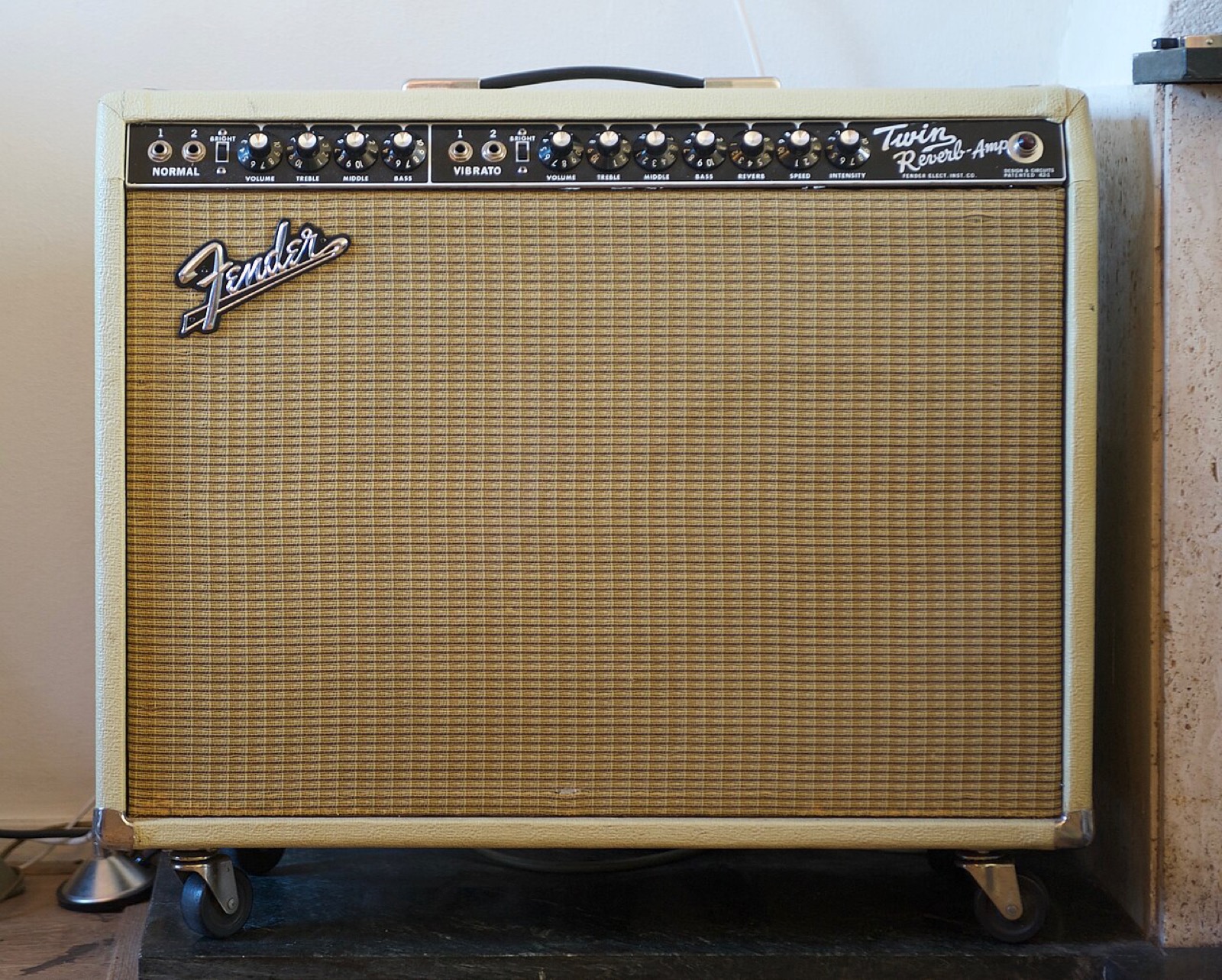
Its circuit was designated AB763. In time, guitarists would treat it as a kind of textbook for clean tone, a design that countless amps would take as a model.
It Says “Vibrato,” but…
The Twin Reverb has a channel marked VIBRATO. But the effect doesn’t change the pitch, as vibrato does; it changes the volume. That’s tremolo.
Meanwhile, the arm on Fender’s Stratocaster is called a “tremolo arm,” even though it changes pitch. Technically, that’s vibrato.
The amp and the guitar have the names swapped. It’s a small, forgiving oddity from Leo Fender’s company, and guitarists still talk about it.
A Quick Note on Using One
Dialing in a Twin Reverb is remarkably simple.
- VOLUME: Start here and bring it up a little at a time.
- TREBLE / MIDDLE / BASS: Shape the brightness and body of the sound.
- BRIGHT switch: Adds some high end and sparkle at low volume.
- REVERB: Sets the amount of spring ambience.
One of the Twin’s defining traits is how hard it is to make it distort just by turning it up. For players who build their sound with pedals, it’s a white canvas that lets any color show through. That’s why it has stayed popular with guitarists who line up effects at their feet.
Chapter 3 — Out of Leo’s Hands
1965: CBS Takes Over
Just two years after the Twin Reverb appeared, Leo Fender—whose health had been failing—sold the company to CBS, a major broadcasting and music corporation.
That same year, CBS also bought the company behind Leslie, known for its rotating organ speakers. Leslie speakers were the perfect partner for Hammond organs, the instruments that had inspired the Twin’s reverb. A curious connection.
1968: The Silverface
Under CBS, the Twin Reverb’s looks began to change. Around 1968, its control panel turned silver. That’s the look people call “silverface.”
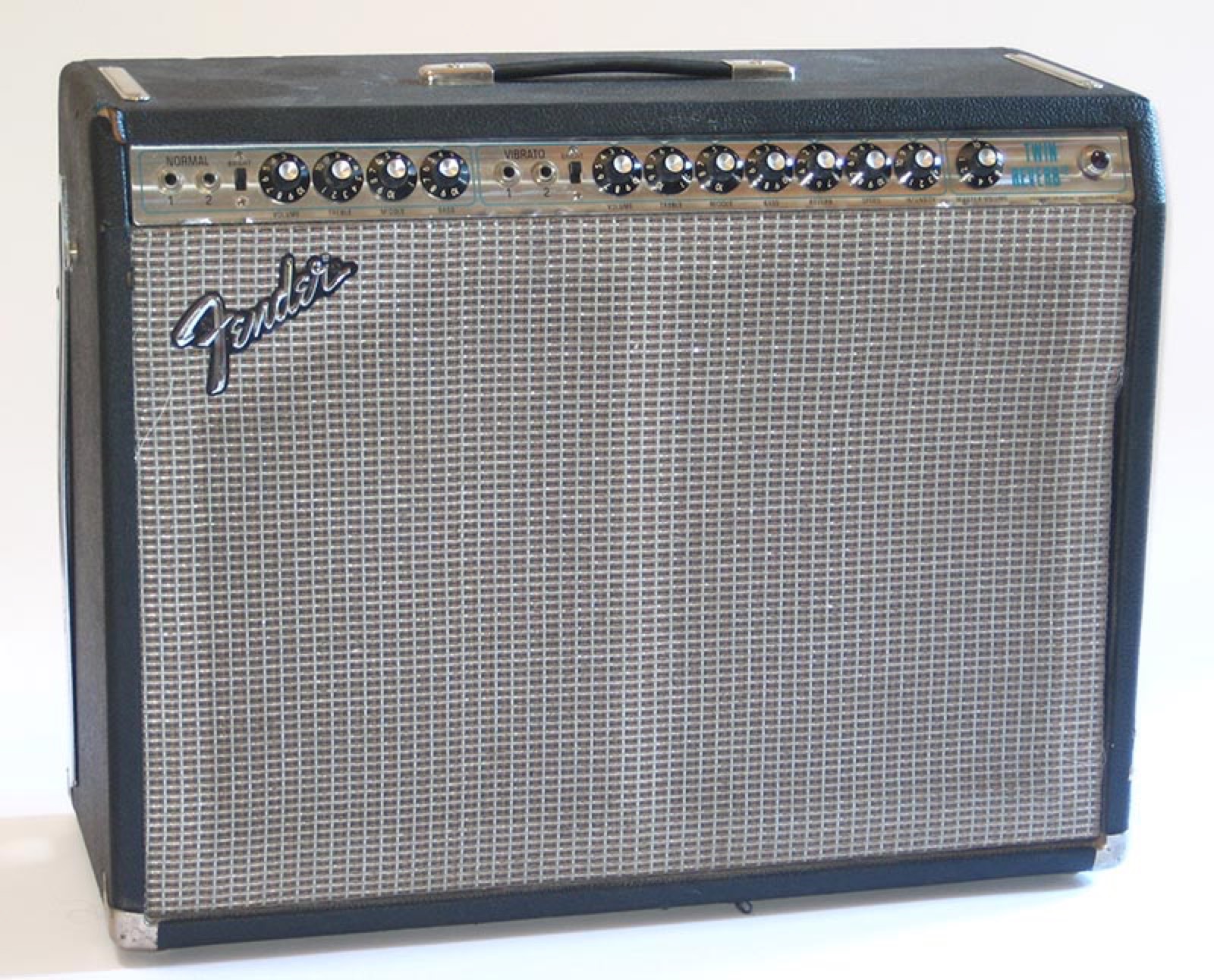
In the 1970s, Fender added a master volume that could be set in two stages. Around 1977, the output was raised to about 135 watts.
🎙 Legend & Lore 1: “Did CBS Make Them Sound Worse?”
You’ll often hear that Fender’s quality declined after CBS bought the company. The same debate comes up around amps: “Blackface is great, but silverface…”
CBS did make changes to cut costs and revise the circuits. But the early silverface models are said to have used circuits that were almost identical to the blackface versions. Plenty of guitarists still love and play silverface Twins today.
Which era sounds best? In the end, that comes down to the player’s ears and taste. Think of it as one of those lively debates that vintage gear inspires.
🎙 Legend & Lore 2: Kick the Amp…
Spring-reverb amps have one slightly troublesome trait. Give an amp a hard jolt and the springs inside can shake violently, letting out a thunderous “K-CHAAANG!”
Stories have circulated for years about fired-up guitarists kicking or rocking their amps onstage to make that sound on purpose. No one seems to know who did it first, but plenty of people have heard it while moving an amp. When you carry a heavy Twin, be kind to the springs.
Chapter 4 — The Strength of Being Everywhere
At Home in Any Genre
The Twin Reverb became less the sound of one particular genre and more of a reference point for every kind of music.
- Country: sparkling Telecaster tones
- Jazz: a full, mellow clean sound
- Funk / soul: crisp, snappy rhythm playing
- Rock: turn up the pedals and let the amp carry that sound to the room
Jerry Garcia of the Grateful Dead is well known for using a modified Twin for many years. Countless other guitarists have played through Twins in studios and onstage.
A Common Language in Japanese Live Houses
In Japan, the Twin Reverb became a fixture in live houses and rehearsal studios—a familiar backline amp.
You could walk into almost any venue and find a Twin or a JC-120. Guitarists didn’t have to haul their own amps around; with a guitar and a few pedals, they could get close to their usual sound. The Twin became a kind of common language among guitarists.
Reissued, and Still Here
In the 1990s, Fender released a reissue called the ’65 Twin Reverb, recreating the blackface-era circuit. It was a hit, and it remains a staple of Fender’s lineup.
Digital amp simulators and plugins almost always include a “Twin” model, too. More than 60 years after its 1963 debut, the circuit is still a model of clean sound.
Epilogue — A Heavy Box with a Light Sound
The Twin Reverb is still waiting for its turn in the corner of a live house.
It’s no fun to lift. Carrying a box that weighs close to 30 kilograms up and down stairs is a workout. But switch it on, play a chord, and you soon forget the weight.
“Make it louder, but keep it clean.” Leo Fender’s answer to the wish guitarists had voiced in the 1950s still rings out from stages around the world.
Next time you spot that silver grille in a live house, take a moment to listen for the springs inside.
Fender Twin Reverb Timeline
- 1952: Fender releases the Twin Amp (tweed, two 12-inch speakers)
- 1958: A higher-output “high-power” Twin appears
- 1961: Fender releases the standalone spring reverb Fender Reverb; it becomes popular in surf music
- 1963: The Twin Reverb is born (blackface, about 85 watts, AB763 circuit)
- 1965: Fender is sold to CBS
- Around 1968: The silverface look arrives
- Early 1970s: Master volume is added
- Around 1977: Output rises to about 135 watts
- 1990s: Reissued as the ’65 Twin Reverb
References
- Wikipedia: “Fender Twin,” “Fender Musical Instruments Corporation,” and “Spring reverb” (English editions)
- Fender official website: ’65 Twin Reverb product page and Fender History
- Richard R. Smith, Fender: The Sound Heard ’Round the World
- John Teagle and John Sprung, Fender Amps: The First Fifty Years (Hal Leonard)
Photo credits
- Header image, “Jon Hammond’s 1965 Fender Twin Reverb Amp with Factory JBL Speakers” — HammondCast / Wikimedia Commons / CC BY 3.0
- “Fender Twin Reverb Blonde” — Paulus 2 / Wikimedia Commons / CC BY-SA 4.0
- “1973 Twin Reverb” — Micahmedia / Wikimedia Commons / CC BY 3.0
Licenses:
CC BY 3.0 https://creativecommons.org/licenses/by/3.0/
CC BY-SA 4.0 https://creativecommons.org/licenses/by-sa/4.0/