So You Want to Sing Covers — A Beginner’s Book from Someone Who Was Tone-Deaf Too
Contents
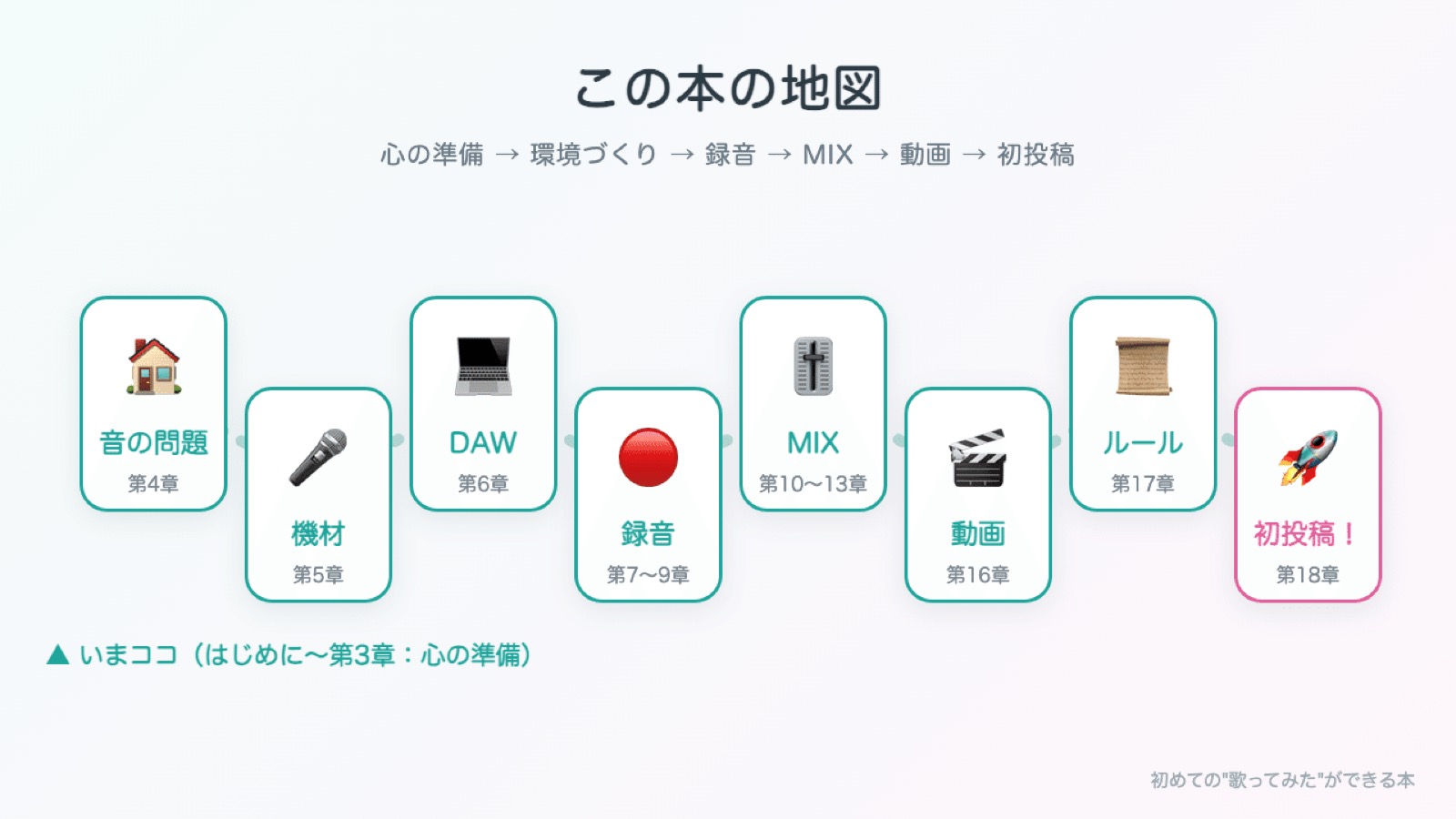
- Introduction — From a Vocaloid Fan Who Started Singing in Secret
- Chapter 1 — You Want to Sing, Even If You Think You’re Tone-Deaf
- Chapter 2 — The Only Difference Is Nerve: Look Up Your Favorite Singer’s Early Videos
- Chapter 3 — “You Can Do It on a Phone.” But That Wasn’t What I Wanted
- Chapter 4 — Solve the Sound-Leak Problem Before You Buy Gear
- Chapter 5 — Gear Has Changed: Good Sound Is Affordable Now
- Chapter 6 — Your DAW Choice Shapes What Comes Next
- Chapter 7 — Let’s Record at Last: One Chorus Is Enough. Experience Your First Setback
- Chapter 8 — Recording Shows You the Hard Part: Of Course It Doesn’t Blend Yet; Mixing Starts at the Mic
- Chapter 9 — Sing One Take Until You’re Comfortable
- Chapter 10 — Time to Mix: Set the Overall Levels Before You Correct Anything
- Chapter 11 — Balance from the Drums with a VU Meter, Then Group Tracks into Buses
- Chapter 12 — Pitch Editing: Fender Studio Pro Includes Melodyne
- Chapter 13 — Editing, Mixing, and Mastering Are Different Jobs. Always Have a Reference
- Chapter 14 — It Doesn’t Have to Be Perfect: Make Seven Songs While You Find Your Way
- Chapter 15 — Save Your Edits for Your Future Self
- Chapter 16 — Make a Video
- Chapter 17 — Copyright and Upload Rules (Read This Chapter)
- Chapter 18 — Upload Your Song, Then Keep Going
- Chapter 19 — Read This When You Feel Like Giving Up
- Afterword — Your Second Story
- Appendix — Glossary and Checklists
Introduction — From a Vocaloid Fan Who Started Singing in Secret
I hope this will be the first book you invest in as you take this seriously.
📖 About this book
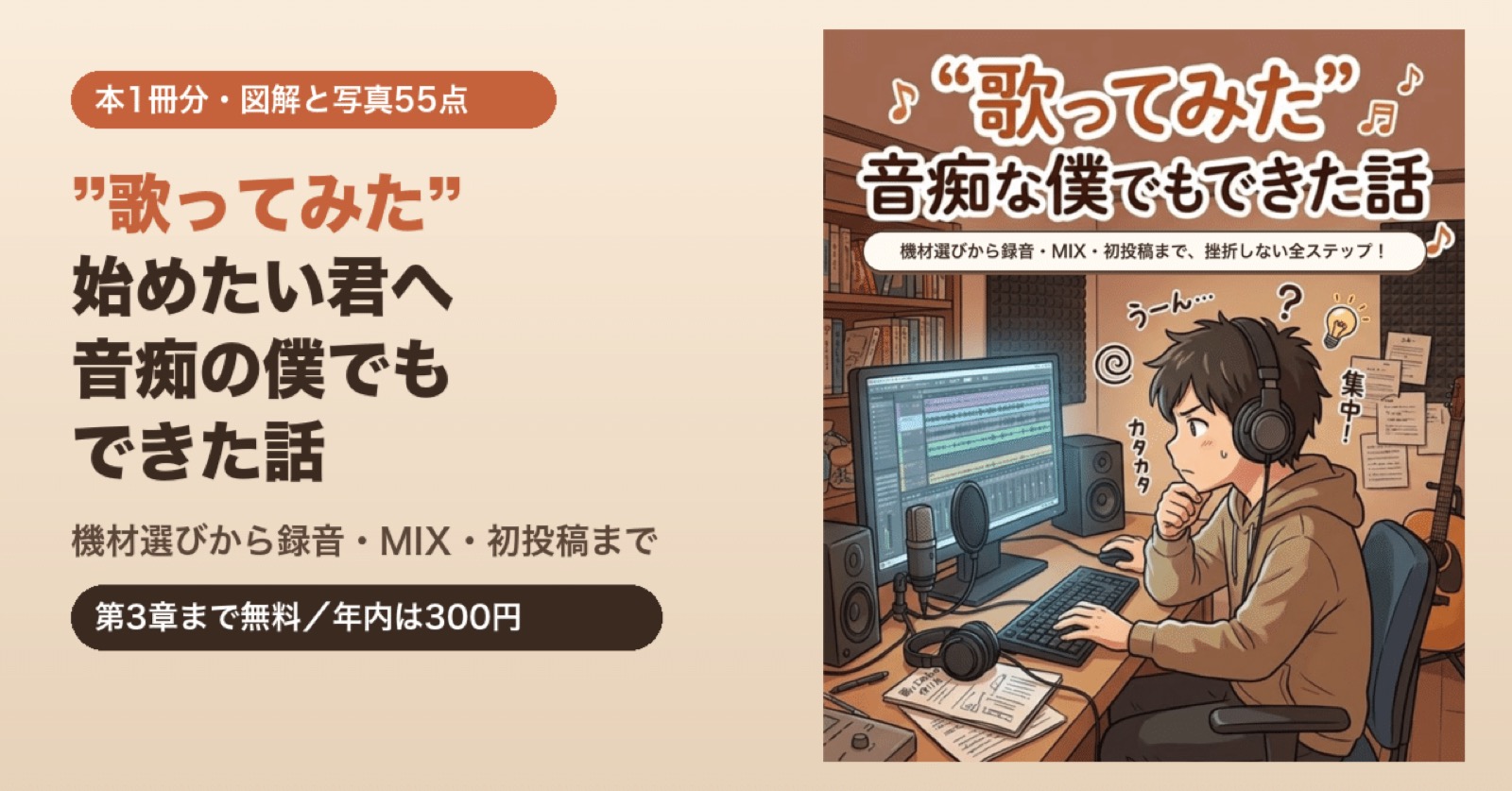
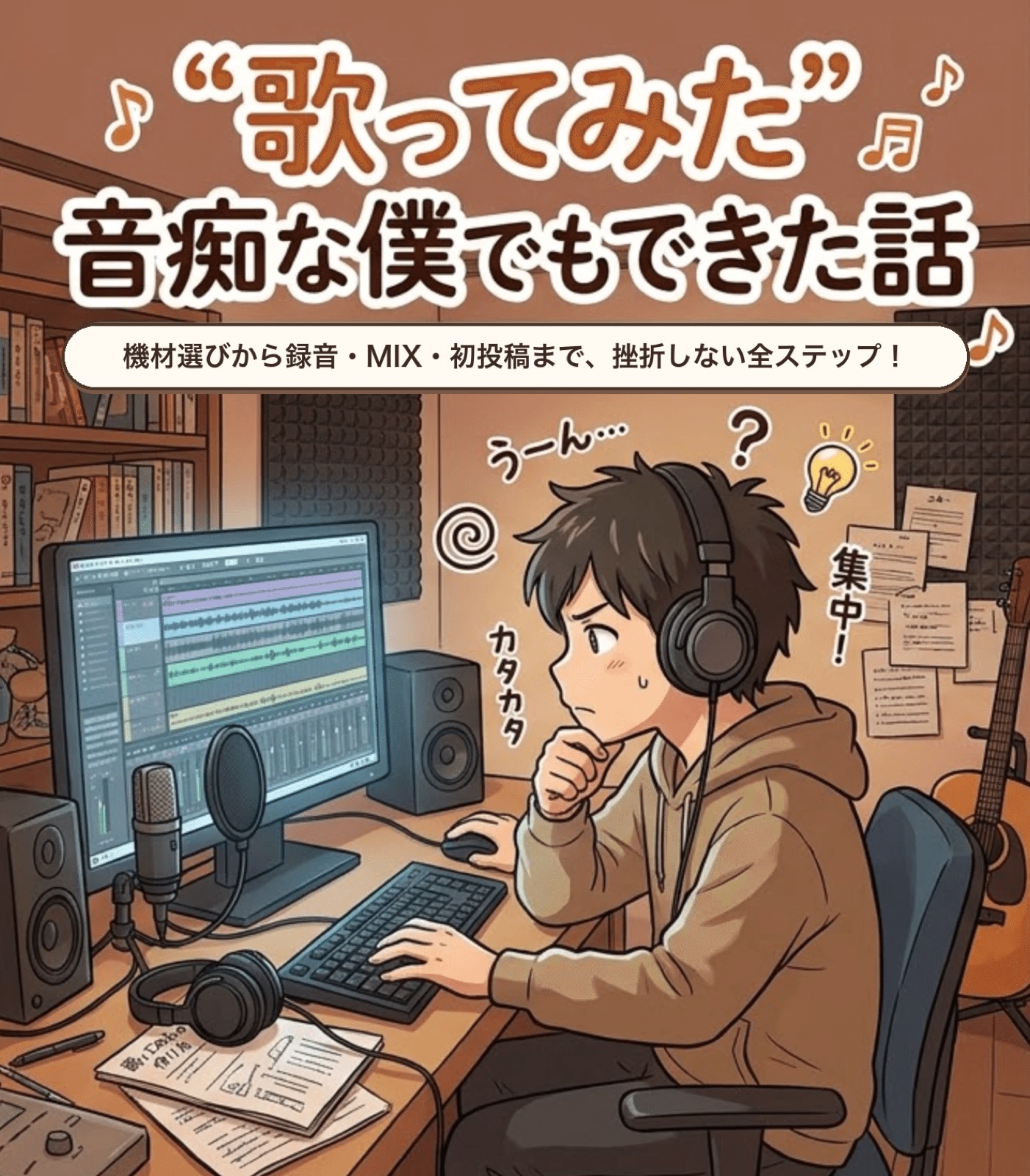
This is a book-length guide. The Japanese original runs to about 75,000 characters—roughly 200 pages in a practical handbook—and includes 55 diagrams and photos. It covers everything you need to make a cover song: choosing gear, recording, pitch correction, mixing, making a video, copyright rules, and uploading your first song.
You don’t have to read it all at once. Use the contents to jump to the chapter you need.
Introductory price: ¥300 through December 31, 2026; the regular price will be ¥500 starting January 1, 2027.
To You, Opening This Book
Hello. Thank you for opening this book.
First, let me introduce myself briefly.
I write columns, and I love Vocaloid music and desktop music production. When a Vocaloid producer I like releases a new song, I listen to it dozens of times that very day. I take one earbud out, then the other, and grin to myself when I discover, “Oh, that sparkling sound was coming from the right.” When a sound catches my attention, I try to recreate it on my own computer and figure out how it was made.
And there’s one more thing. I’ve secretly been making cover songs, too.
I haven’t been at it long. Before I started, though, I spent years away from singing because I was convinced I was tone-deaf. I still wouldn’t call myself a great singer, my view count isn’t impressive, and I’ve hardly told my friends.
But once I discovered the joy of singing a song I love in my own voice, shaping the sound with my own hands, and turning it into a finished piece, I couldn’t stop.
This is the book I wish I could have handed to myself when I was starting out.
The Years I Spent Away from Singing
Let me tell you a little about the past.
When I was in middle school, I sang loudly without giving it a second thought. I was the vocalist in a garage band. I never wondered whether I was good or bad. Singing was fun, and the louder I sang, the better it felt.
People around me rarely said anything. No one laughed at me or told me to stop. I assumed that meant I was doing fine.
Then, for the first time, we recorded ourselves playing and listened back.
I was stunned.
The voice coming out of the speakers sounded nothing like the one I heard in my head. My pitch wandered. The parts I thought I was singing freely sounded strained and out of tune.
In that moment, everything clicked. My friends hadn’t been impressed by my singing when they said nothing. They had simply been kind.
The hardest part was remembering how confidently I had sung. I had stood onstage, repeatedly trying to hype up the audience. No wonder nobody turned around to look.
After that, I couldn’t bear to hear my own voice. A lot of people encouraged me, and I’m truly grateful. But after hearing that recording, their words couldn’t get through to me.
Music gradually drifted out of my life.
Back then, the internet wasn’t as widespread as it is today, and hardly anyone had a smartphone. There were no videos showing you how to fix your pitch and no apps that displayed your pitch on a screen. It never even occurred to me that vocal training was an option.
I decided that singing well was a matter of talent, and that I didn’t have it. I gave up, convinced there was no hope. For years.
I Was the One Who Dismissed It as “Talent”
Years later, around the time YouTube began to take off, I happened to watch a video about improving your pitch.
Ordinary people carefully explained how to listen to notes, match pitch, and practice. One step at a time.
Then a question crossed my mind.
“Had I ever really tried to practice singing?”
“Wasn’t I the one who had dismissed singing well as a matter of ‘talent’?”
I had never practiced. I listened to one recording, decided I had no talent, and shut the door myself.
By then, I was an adult. I could spend some money on a hobby. I had a computer, and I loved Vocaloid music. Before I knew it, I had tools around me that I hadn’t had as a teenager.
So I wanted to try. Just once, and do it properly.
That’s how I started making cover songs.
💬 What I most want you to hear from me
Before you judge yourself, remember that the world you know is still small. I hope the years I spent struggling can become just a few days for you, even if you’re facing the same doubts. That’s why I wrote this book.
The Day I Listened to My Voice Again
There’s a moment I’ll never forget.
After years away, I recorded my singing for the first time and pressed play.
My voice came out of the speakers. I hit Stop immediately.
I couldn’t listen for even one second.
“Wait, that’s my voice?”
“Did I really sing with a voice like that?”
My face burned with embarrassment. I even looked around the room, though I was alone.
If you’re reading this, you may know that feeling, too…I still listen to my own voice hundreds of times as I work. It is hard to believe that I once stopped playback after just one second.
Chapter 1 — I Want to Sing, Even If I’m Tone-Deaf
🎯 The goal of this chapter
To set aside, for a moment, the thought “I’m tone-deaf, so…”
It Starts with “I’m Tone-Deaf”
When people want to start making cover songs, the first obstacle usually isn’t gear or software.
It’s the thought, “I’m a bad singer.”
- You get low scores at karaoke.
- A friend once told you, “Aren’t you a little off-key?”
- You dreaded singing alone for a music class test.
- You felt embarrassed when you heard a recording of your voice.
After experiences like these, it’s easy to think, “Who am I to make a cover song?”
I understand that feeling. As I wrote in the introduction, one recording made me stop singing for years.
But wait a moment.
Wanting to sing has nothing to do with whether you’re good or bad. You hear a song you love and want to hum along. The chorus makes you want to sing out loud. Good singers and struggling singers feel exactly the same thing.
Even if you’re tone-deaf, you still want to sing.
This chapter will gently loosen the weight of the word “tone-deaf” while holding on to that feeling.
What Does “Tone-Deaf” Actually Mean?
We use the word “tone-deaf” casually, but it can describe several different things.
When singing is difficult, the cause is usually one of these three:
- Listening: You can’t quite hear the correct pitch.
- Producing: You know the pitch in your head, but your voice can’t reach it.
- Noticing: You don’t realize while singing that your voice has drifted off pitch.
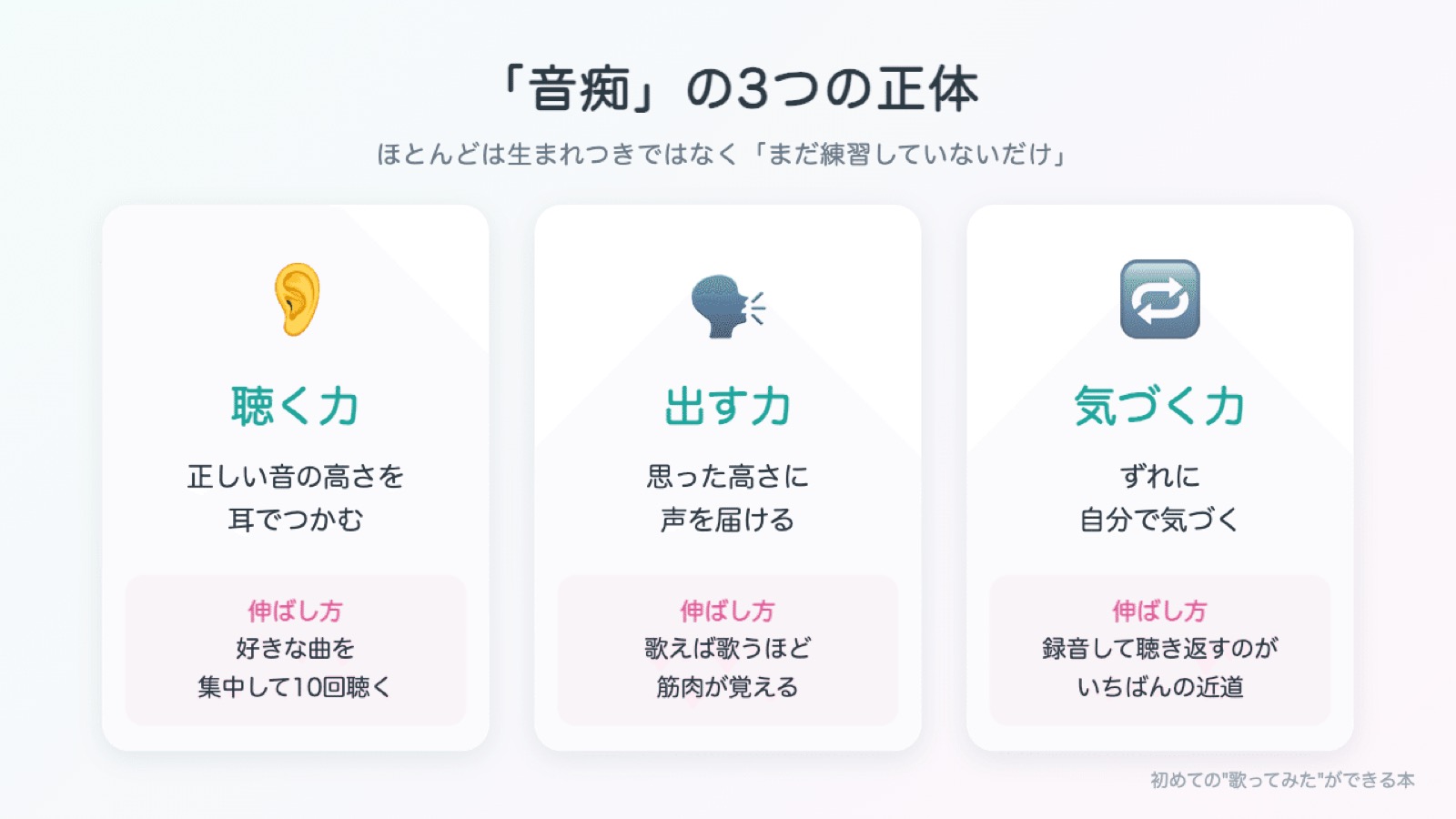
Here’s the important part: people who are born unable to distinguish pitches are said to be quite rare.
Most people who call themselves tone-deaf don’t have an inborn problem. Often, they simply haven’t practiced yet, or haven’t really listened to their own voice.
Your Ear Gets Better When You Listen Differently
When we listen to music, we usually hear the whole song. Drums, bass, guitar, and vocals all arrive as one complete sound.
To sing, though, you need to pick the vocal melody out of that mix.
That takes familiarity, not talent. It’s like picking out a friend’s voice in a crowd. With focused listening, the melody gradually rises above the rest.
Practice Builds Your Voice
Think of the first time you rode a bicycle. Almost nobody can ride straight away. After a few falls, your body starts to learn how to balance.
Singing works the same way. Your voice comes from muscles in your throat and body. Little by little, your body learns how much to shape your throat and how to manage your breath to reach a particular pitch.
The more you use your voice, the more readily it reaches the notes you want. If you don’t sing often, it’s only natural that your voice won’t do exactly what you want right away.
Recording Is the Best Way to Learn to Notice
Making cover songs gives you a powerful ally: recording.
At karaoke, you can’t hear your own voice accurately while you sing. The loud backing track masks it, and you may finish without knowing where your voice landed.
A recording lets you listen again and again:
“Ah, my pitch drops here.”
“The first note of the chorus is a little low.”
“I’m late on the rhythm around that breath.”
Listening to your own voice this way is practice in itself.
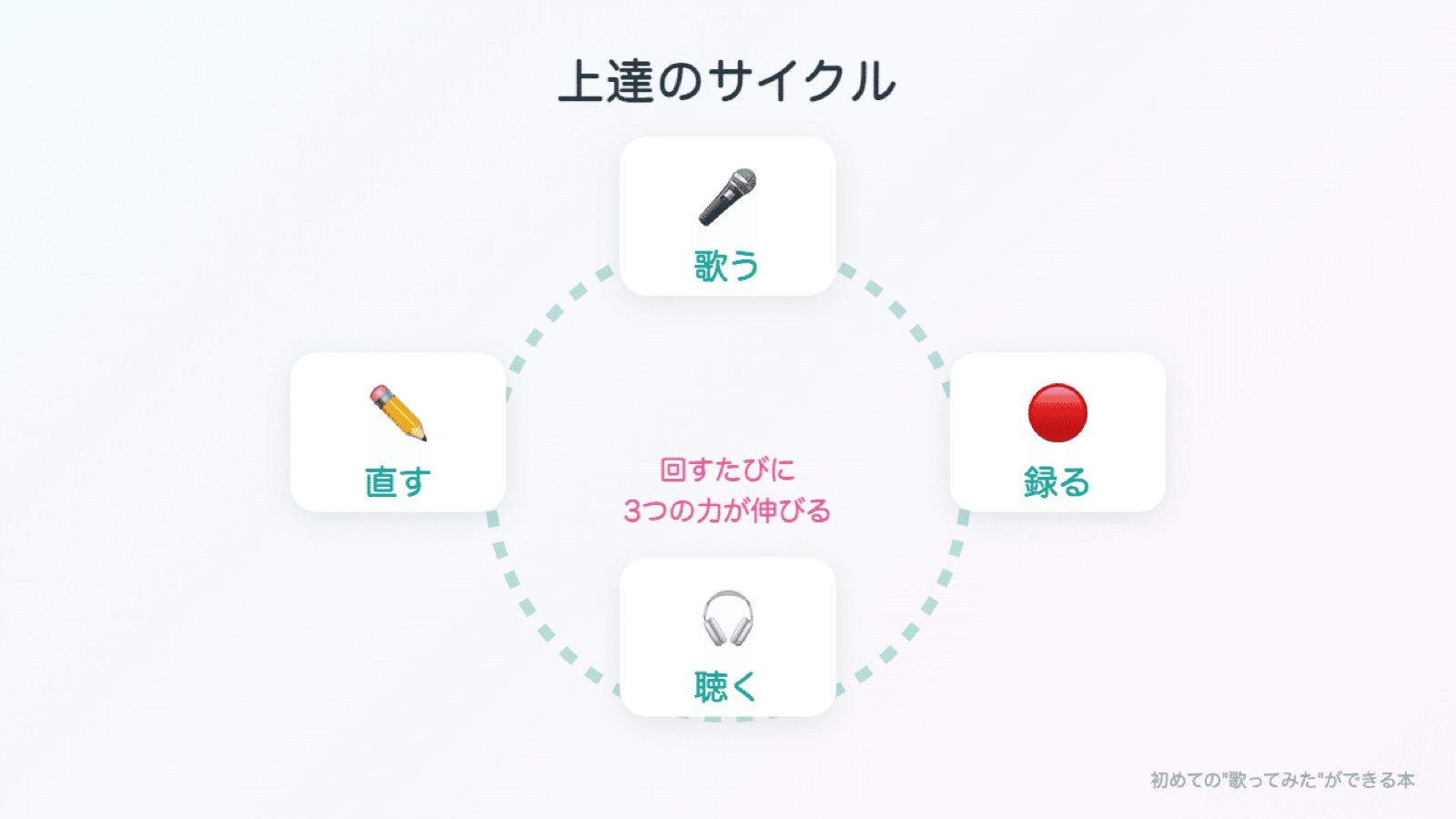
Sing. Record. Listen. Adjust. Each time you repeat that cycle, all three skills improve a little. In other words, making cover songs is itself one of the quickest ways to improve your pitch.
You’re Not the Only One Who Finds Your Voice “Awful”
As I mentioned in the introduction, when I first recorded myself singing, I hit Stop the moment my voice came through the speakers.
I couldn’t listen for even a second. The shock of “Is that really my voice?” and the embarrassment kept my finger away from Play for a while.
I wasn’t unusual. Most people feel something similar the first time they hear their recorded voice. There’s a good reason.
We normally hear our voice through two paths:
- Sound travels through the air from our mouth to our ears.
- Vibrations in our throat travel through the bones in our head to our inner ears.
The sound that travels through bone carries stronger low frequencies. So the voice we think of as “our voice” sounds lower and fuller than it really is.
A recording doesn’t include the part that travels through bone. It captures only the sound through the air, so it can sound thinner and higher than we expect.
If your recorded voice sounds strange, it doesn’t mean your voice is bad. You’re simply not used to hearing it. The good news is that you can get used to it. One day, after listening many times, your recorded voice will sound normal. I now listen to mine hundreds of times while I work. It’s hard to believe I once stopped after a single second.
Cover Songs Aren’t a Contest for Points
Karaoke scoring can be fun. But the score measures how closely pitch and rhythm match a model.
People don’t listen to a cover song for its score. They may like the singer’s voice, feel the singer’s love for the song, remember a distinctive vocal style, or want to cheer someone on because their effort comes through.
Many singers in the cover-song world aren’t technically brilliant, yet people keep coming back to their work. You may already have someone like that in mind.
Think about Vocaloid songs. A Vocaloid voice can be “perfect” in pitch and rhythm, but we still seek out cover versions. Perhaps we want something that only a human voice can give us.
A voice that wavers a little. The sound of a breath. A color that belongs only to that person. These are your strengths, and no score can measure them.
Four Things You Can Do Today
“I understand the reasoning, but I’m still nervous…” If that’s you, here are four things you can try today. You don’t need any gear yet.
1. Listen closely to a favorite song ten times.
Don’t just let it play in the background. Focus on the vocal melody:
- Where does the pitch rise and fall?
- Where does the singer breathe?
- How long are the sustained notes?
- How much space is there between phrases?
This alone will sharpen your listening. Vocaloid songs are especially useful models because the pitch doesn’t waver.
2. Record one line on your phone.
You don’t need to sing the whole song. Record just the first line of the chorus in your phone’s voice memo app and listen back.
At first, like me, you may want to stop the moment you hear your voice. That’s okay. Stop, then listen again the next day. One second on day one, five seconds on day two, the whole line on day three—that pace is plenty.
3. Decide to set the key for your voice.
There’s no rule that says you must sing in the original key. If it feels too high or too low, change it. Singing in a key that suits you can make an astonishing difference.
Vocaloid songs are often written in ranges that are unusually high for a human voice. You’ll sound much better in the key where your voice is at its best than if you strain until it gives out. Some backing tracks have rules about changing the key or making other alterations. I’ll explain how to check those rules in Chapter 17.
4. Pick a favorite song that’s easy to sing for your first one.
I understand wanting to try the song you admire most. Still, choose your first song with a little care. Look for a song you love—that matters most, since you’ll hear it dozens of times—with a manageable range, a moderate tempo, and a length of around three or four minutes.
If you start with extreme high notes or rapid-fire lyrics, you may lose heart before you get to practice recording. Save the difficult songs for your second or third project.
“I’ll Start When I’m Better” Never Comes
Let me leave you with one thought.
If you keep telling yourself, “I’ll start when I’m better,” that day will never come.
The only way to improve is to sing, record, listen, and adjust. That’s exactly what making a cover song involves. The order is the opposite of what you might expect: you don’t start after you get good. You get better because you start.
My first seven songs were all bad. But without making those seven, there would be no eighth song.
If you want to sing, even if you’re tone-deaf, that’s enough to stand at the starting line.
🙅 Things you don’t need to do yet
- Buy a stack of vocal-training books.
- Practice until you can score 90 at karaoke.
- Put off starting until you’ve “fixed” your pitch.
- Begin with the hardest song you admire.
✅ You’ve passed this chapter if…
You can think, even just a little, “It’s okay to start even if I’m not good.”
In the next chapter, we’ll take this a step further. Many singers with big audiences weren’t good from the start. Let’s go and see for ourselves.
Chapter 2 — The Only Difference Is Nerve: Look Up Your Favorite Singer’s Early Videos
🎯 The goal of this chapter
To understand the real difference between “a good singer” and you, and to find the courage behind posting your first song.
Between Us, Plenty of Professionals Struggle with Pitch
In the previous chapter, we talked about how you can sing even if you think you’re tone-deaf. Let’s go a step further.
This may surprise you, but it’s true: plenty of singers who are active today have unstable pitch.
Listen to an untreated vocal, straight from the recording, and you may be surprised by how far off some notes are. Yet the finished songs sound wonderful and reach a wide audience.
Why? One reason is editing and mixing, which we’ll cover in later chapters. A finished cover isn’t the raw recording. Its pitch and timing have been corrected, and its tone has been polished.
But there’s an even bigger reason.
The One Difference Between Them and You
The difference between a good singer and someone who hasn’t started yet isn’t singing ability.
It’s nerve.
It’s whether you pressed Upload even though you weren’t good yet, felt embarrassed, and were scared.
That small difference separates where you are now from where they are. People who post get reactions. Some will be encouraging; others may sting a little. Each one becomes material for the next song, and they improve bit by bit.
People who never post get no response at all. They never get the material that helps them improve.
The Trap of “I’ll Post It When It’s Finished”
Many people fall into this trap:
“I’ll fix it a little more before I post.”
“I don’t like this part, so I’ll record it again.”
“I’ll study mixing a bit more first.”
Before long, the computer fills up with “almost finished” songs, and the Upload button remains untouched. I understand the feeling.
But there’s something you should know: a work isn’t finished until you release it.
You may think your song is only a 70 out of 100, then discover that someone loves an unexpected part. Or you may learn from listeners that there’s a weakness you hadn’t noticed.
You’ll improve much faster by releasing a 70 and aiming for a 75 on the next song than by spending months chasing 100 on your computer. And it’s much more fun.
How I Posted Even Though I Had No Nerve
I sound confident writing this, but I’m not a bold person. Quite the opposite—that’s why I do this quietly.
I was able to post because I changed one thing in my thinking. Instead of “I’m releasing a great song,” I told myself, “I’m leaving a record of where I am now.”
If you’re trying to release something great, the bar keeps moving higher. But if you’re leaving a record of yourself today, then showing yourself as you are today is exactly right. If you’re not good yet, it’s a record of you before you got good.
That thought made my finger a little lighter on the Upload button.
My first seven songs still sound bad to me. But because those seven imperfect records are lined up, I can clearly see how I’ve changed. They’re among my most valuable possessions.
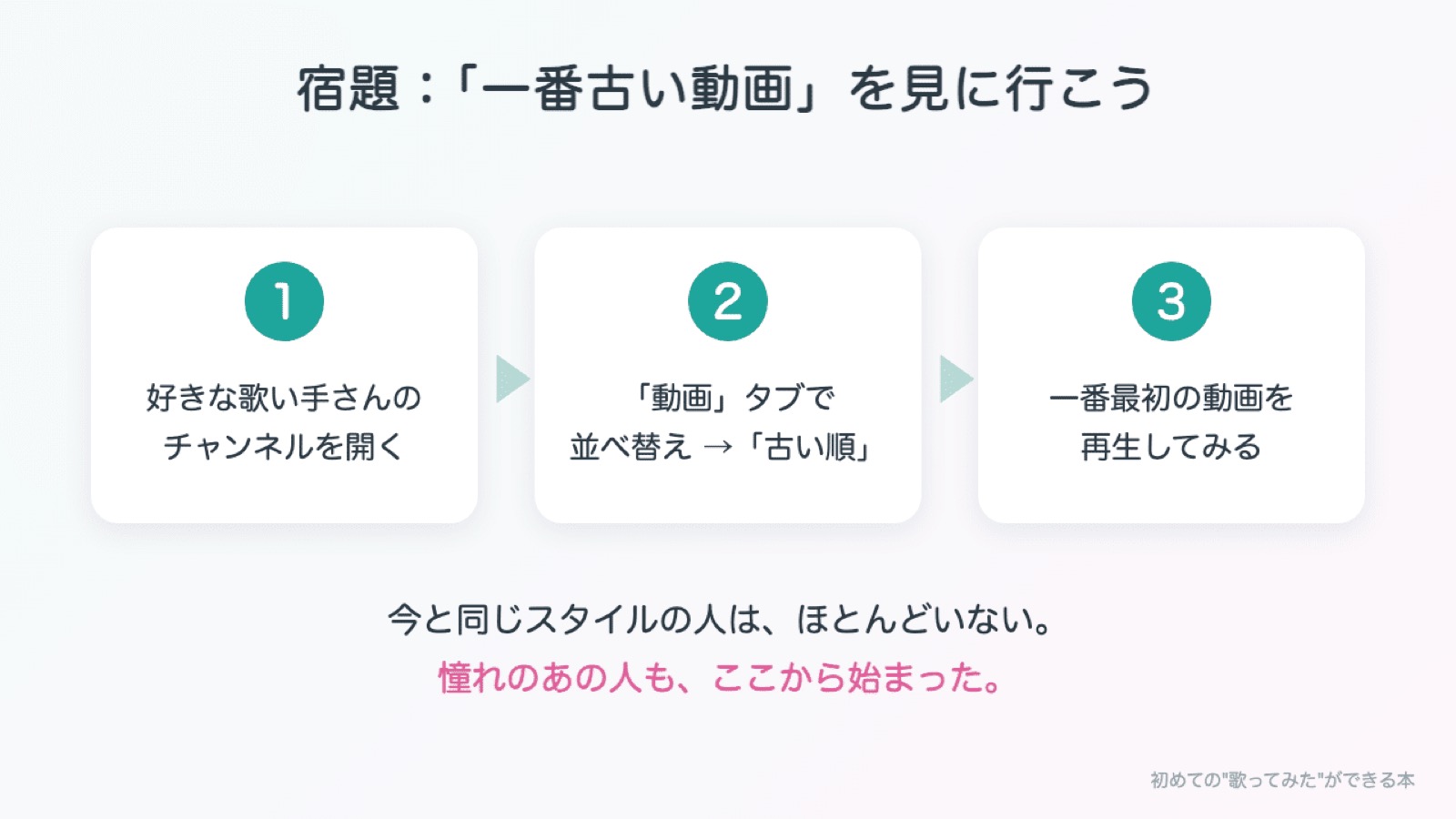
Homework: Find Your Favorite Singer’s Oldest Video
I have one assignment for you, and it’s one of the most important in this book.
Find the oldest video posted by the singer you like most.
It’s easy:
- On YouTube, open the person’s channel and choose the Videos tab.
- Sort by oldest.
- Play the very first video.
On Nico Nico Douga, sort the person’s uploaded videos by the earliest posting date.
Well? What did you think?
- Their voice sounds completely different from how it does now.
- The audio quality is surprisingly poor.
- Their singing feels awkward.
- Honestly, they’re pretty rough.
You probably had one of those reactions.
Almost nobody sounds the same at the start as they do now. Some singers began with videos so rough you might wonder, “Is that really the same person?”
The singer you admire began there, too.
What You Can Learn from Old Videos
Don’t stop at “That’s bad” when you watch an old video. It’s full of clues about the road ahead. Compare the first video with the latest one and look for:
- Voice: Did they start by singing from the throat, then gradually use more of their whole body?
- Sound quality: Around which video did their recording setup change?
- Mixing: When did the vocal start to sit more naturally with the backing track?
- Song choices: What did they start with, and how did their choices expand?
- Video: Did they start with a single still image? How did that change?
If you can, watch the first ten or so videos in order. You’ll see them change little by little, but surely, from one song to the next.
That’s proof that they learned something with every song and carried it forward. You’re going to do exactly the same.
Start to Become Your Ideal Self—But Not Today
Here’s something important.
You’re starting to make cover songs because you want to become the person you imagine. You want to sing like the person you admire and share your own voice with that kind of sound.
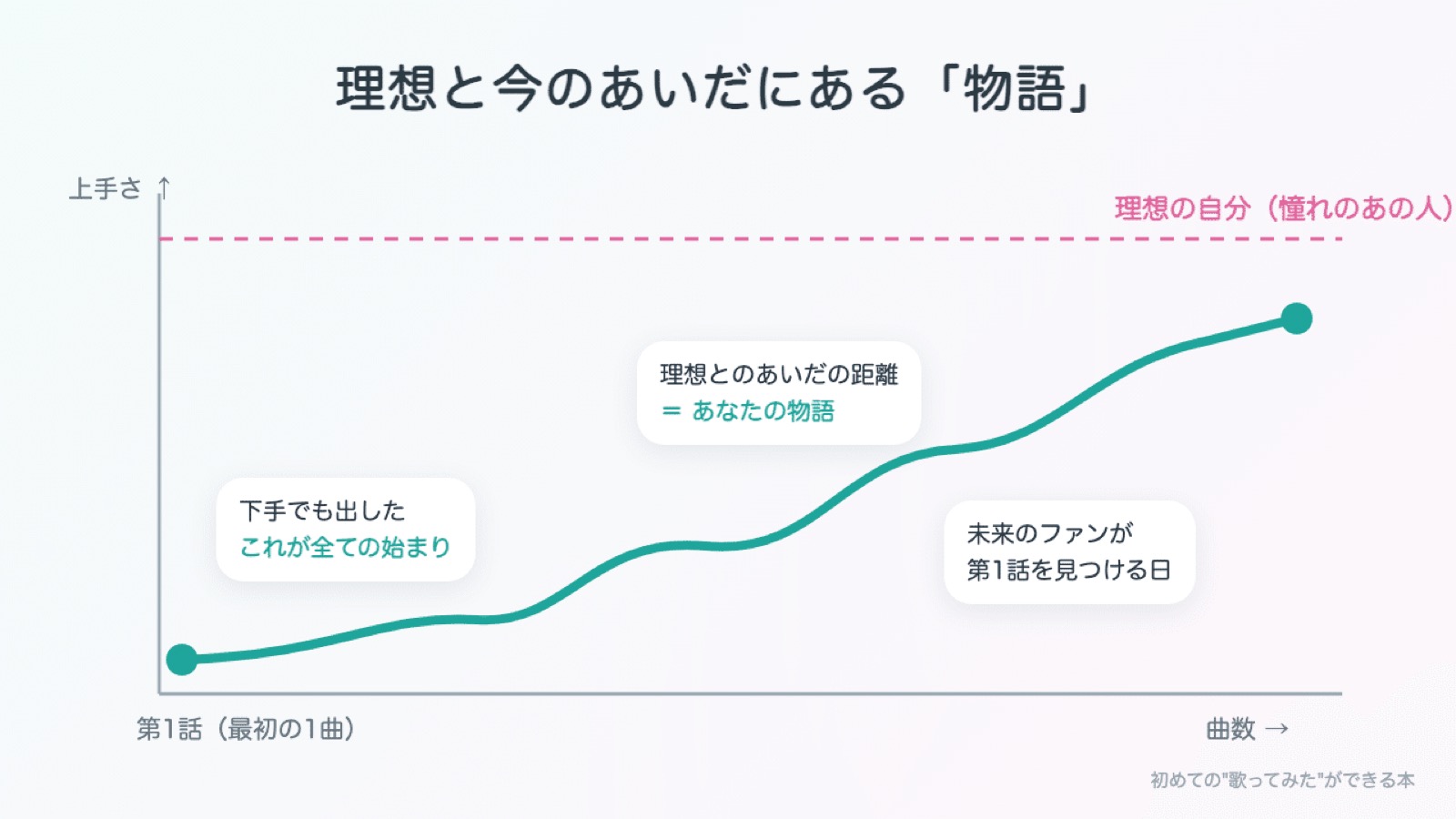
But that ideal version of you isn’t here yet.
Nobody reaches their ideal with the first song. Probably not even by the tenth.
That’s why you work at it.
There will always be a distance between your ideal and where you are now. That distance gives you a reason to think, “Next time, I’ll do this better,” and it’s where the joy of improving comes from.
If you could do it exactly as you hoped from the beginning, you might get bored quickly. You can keep going because you haven’t reached it yet. That’s what I believe.
Why Do Popular Singers Keep Their “Bad Old Videos”?
After watching the old videos for your assignment, you may have wondered, “Why don’t they delete those videos when they’ve become so good?”
Of course, each person has their own reasons. But I think those old videos are part of their story.
What might a fan think when they find one? They don’t just laugh and say, “That’s bad.” They may think:
“They started here.”
“They worked so hard.”
“That’s why their singing now moves me so much.”
Because the old, rough videos are there, today’s skill shines even brighter. Listeners come to love the singer along with the story of their growth.
The hero of a story doesn’t start out strong. They’re weak, they fail, and they keep moving forward—that’s why we want to root for them.
Singers are the same.
Your Story Has Already Begun
So I have one request: make your first song as if it were Episode 1.
Episode 1 is supposed to be rough. That’s when the main character is at their weakest.
But without Episode 1, Episode 2 can’t begin. Someday a fan in your future may find that first song and say, “They started here.”
This book is here to help you begin writing your own story. It isn’t a book about copying good singers. It’s here to help you turn the first page of a story only you can write.
💡 A small suggestion
Write down the date you post your first song. When you look back six months or a year later, it will be your own anniversary.
Nerve Comes Later
“But I don’t have the nerve,” you may be thinking.
That’s okay. The nerve I mean isn’t a personality trait you’re born with. It comes from preparation and experience:
- Knowing what to do.
- Knowing it’s okay to make mistakes.
- Knowing someone else has walked this road before you.
When you have those three things, it becomes natural to take a step forward.
It’s Okay to Start Quietly
One more thing: if you don’t have the nerve, start quietly.
- You don’t have to tell your friends or family.
- You don’t have to use your real name or show your face.
- Choose any artist name you like.
- Don’t worry if no one finds your first few songs.
I still prefer to keep things quiet. I do this less to show something to someone else than to shape songs I love with my own voice.
Still, once a song is posted, someone you don’t know may find it and listen. Even a single “like” can mean astonishingly much to the person who made it.
You don’t need a big debut. Start small, quietly, at your own pace. That’s a perfectly good way to make a cover song.
I wrote this book to give you all three things we’ve discussed. By the time you finish reading, I hope your finger will feel a little lighter on the Upload button.
🙅 Things you don’t need to do yet
- Compare yourself to the singer you admire and get discouraged.
- Decide not to post until it’s exactly what you imagined.
- Spend months practicing for the first song.
✅ You’ve passed this chapter if…
You watched your favorite singer’s oldest video and thought, “They started here, too.”
In the next chapter, we’ll talk about what to record with. People often say, “You can make cover songs on a phone.” But that wasn’t what I wanted to do.
Chapter 3 — “You Can Do It on a Phone.” But That Wasn’t What I Wanted
🎯 The goal of this chapter
Understand what you can and can’t do on a phone and a computer, then decide what you want to use.
Is It True That You Can Make Cover Songs on a Phone?
When you look up how to get started making cover songs, you’ll almost always find this claim:
“You can make a cover song with just your phone!”
It’s true.
Today’s phones are remarkably capable. With a recording app, you can sing while playing a backing track. Some apps can add reverb or make small pitch adjustments, too.
You can get started right away, without spending anything. That’s one of the great things about a phone.
So I tried recording on my phone at first, too.
The Person I Wanted to Become Wasn’t Holding a Phone
After I finished recording, I listened back. Honestly, the sound itself was better than I expected. Today’s phones really are impressive. There’s no doubt that you can make a cover song this way.
But something else came to mind:
“This isn’t the person I want to become.”
The version of myself I imagined making cover songs wasn’t singing into a phone. I pictured myself standing in front of a microphone, wearing headphones, looking at tracks lined up on a computer screen, and shaping my voice into a finished piece.
I imagined myself surrounded by gear and focused on sound, just like the singers I admired. That was the picture I had fallen in love with.
A phone could certainly record me. But I wanted to feel cooler doing it.
Because this is a story about chasing a dream.
A Little Romance Isn’t a Detour
“Wanting to look cool? Isn’t that just about appearances?” you might think.
I don’t see it that way. Bringing yourself closer to the person you admire can be the strongest motivation for sticking with something.
Stand in front of a microphone and your back straightens naturally. Put on headphones and a switch flips: “All right, let’s record.” See your tracks lined up on the screen and you feel, “I’m making a piece of work, too.”
That excitement helps you return to the next song, even on days when nothing goes right.
Of course, phones and computers also differ greatly in the ways you can work with sound. Can you adjust the vocal and backing track separately? Can you rerecord only the parts that went wrong? Can you shape the tone in detail? I’ll explain those differences later.
But those weren’t the main reason I stopped using my phone. The person I wanted to become wasn’t on the other side of it. That’s all.
So I stopped recording on my phone. The phone wasn’t bad. It just wasn’t a path toward the place I wanted to reach.
What Matters Is Where You Want to Go
I’d like you to think about this, too: What do you want to do with your cover songs?
- Sing a favorite song casually and share it with friends.
- Keep a record of your voice.
- Make a carefully produced song like the singers you admire.
- Someday, sing an original song or collaborate with a Vocaloid producer.
If you’re drawn to the first option—singing for fun—the phone is a perfect companion. Enjoy it that way. That’s a perfectly good cover song, too.
But if any of the other three stir something in you, I think it’s hard to chase that dream with only a phone. I wrote this book for people like you.
What’s Different Between a Phone and a Computer?
I’ve put the differences in a chart.
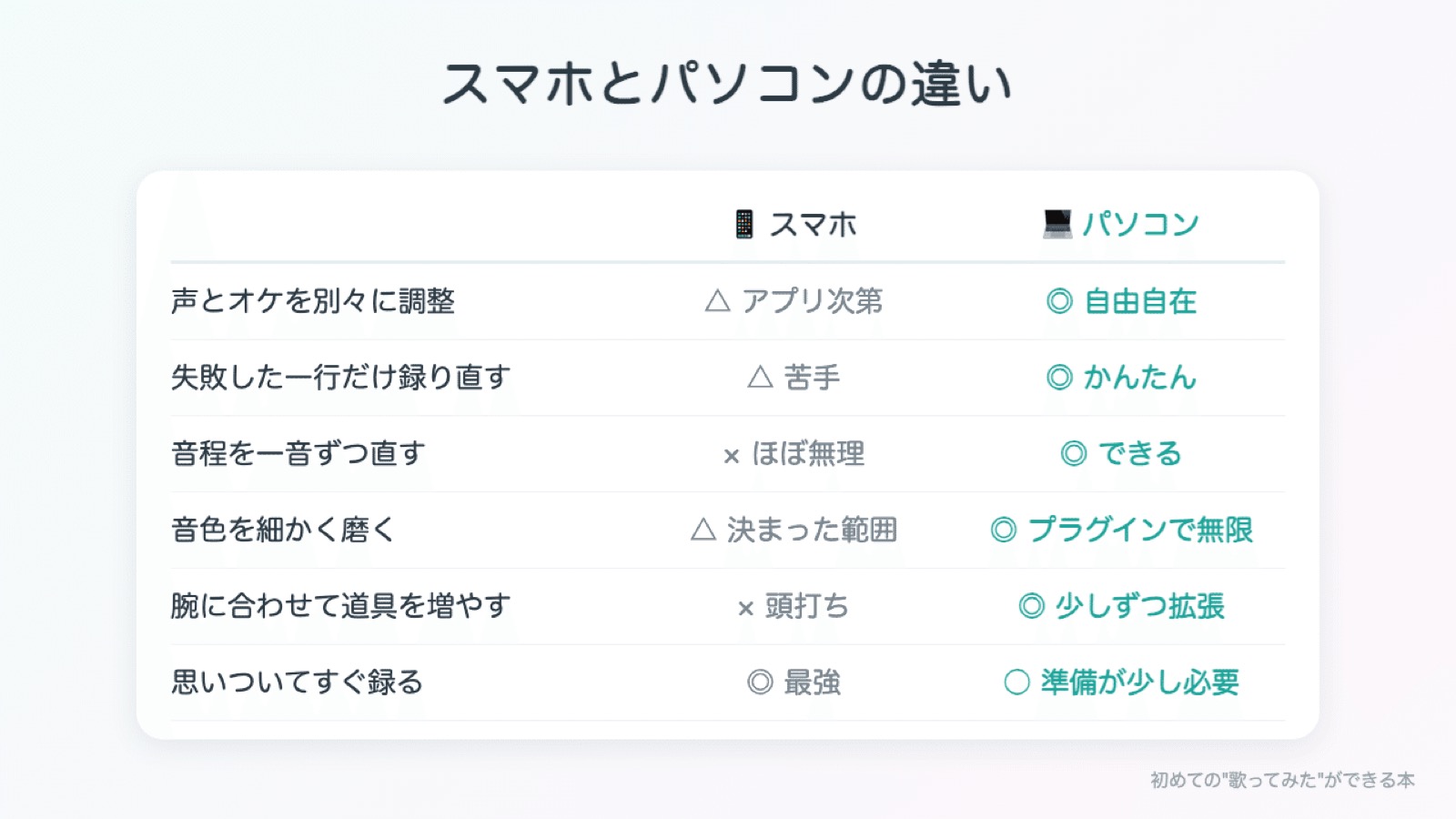
The biggest difference is whether you can go back and fix things afterward.
#### Difference 1: Can You Handle Your Voice and the Backing Track Separately?
When you record on a computer, the backing track and your vocal go into separate “tracks”—containers for audio. You can adjust them freely afterward: “Let’s make just the vocal a little louder,” or “Let’s turn down just the backing track.”
With a simple phone recording, the backing track and your voice may be recorded together. Once they’re mixed together, you can’t separate them again.
It’s like mixing salt and sugar, then asking to remove just some of the salt.
#### Difference 2: Can You Rerecord Only the Part That Went Wrong?
With computer recording software, you can rerecord just one line in the second verse. Keep the parts you sang well and redo the difficult parts as many times as you need.
That makes a huge difference for beginners. You don’t have to sing the whole song perfectly from beginning to end in one take.
#### Difference 3: Can You Shape the Sound Over Time?
On a computer, you can use plugins—tools you add later to process audio—to refine the tone of your voice. You can correct notes one at a time, add sheen to your vocal, and help it blend with the backing track.
That’s how the singers you admire shape their sound. And as your skills grow, you can gradually add tools. Start with free ones, then add plugins used by professionals, one at a time. Your production setup can grow along with you.
Phone apps come with a set range of features. You can’t go much further than what the app provides.
Why “I’ll Start on My Phone” Can Become a Detour
“Why not start on a phone, then switch to a computer if it feels limiting?”
That’s certainly one way to do it. But in my experience, it can easily become the longest route.
Many of the techniques you learn on a phone have to be learned again when you move to a computer. And if you keep finding that the sound on your phone isn’t what you wanted, you may blame yourself instead of the tool: “Maybe I’m just not cut out for this.”
That’s a real shame. The problem may have been the limits of the tool, not your talent.
“But Doesn’t It Cost a Lot?”
You may be thinking, “A computer and all that gear must cost a fortune.”
Don’t worry. This connects to what I’ll explain in Chapter 5: gear has changed. There’s now plenty of affordable equipment that sounds far better than you might have thought possible a few years ago.
Microphones and audio interfaces—the devices that connect a microphone to a computer—are available at accessible prices and can record properly. You don’t need to buy an expensive Mac, either. Often, the computer you already own will work. I’ll explain more in Chapter 5.
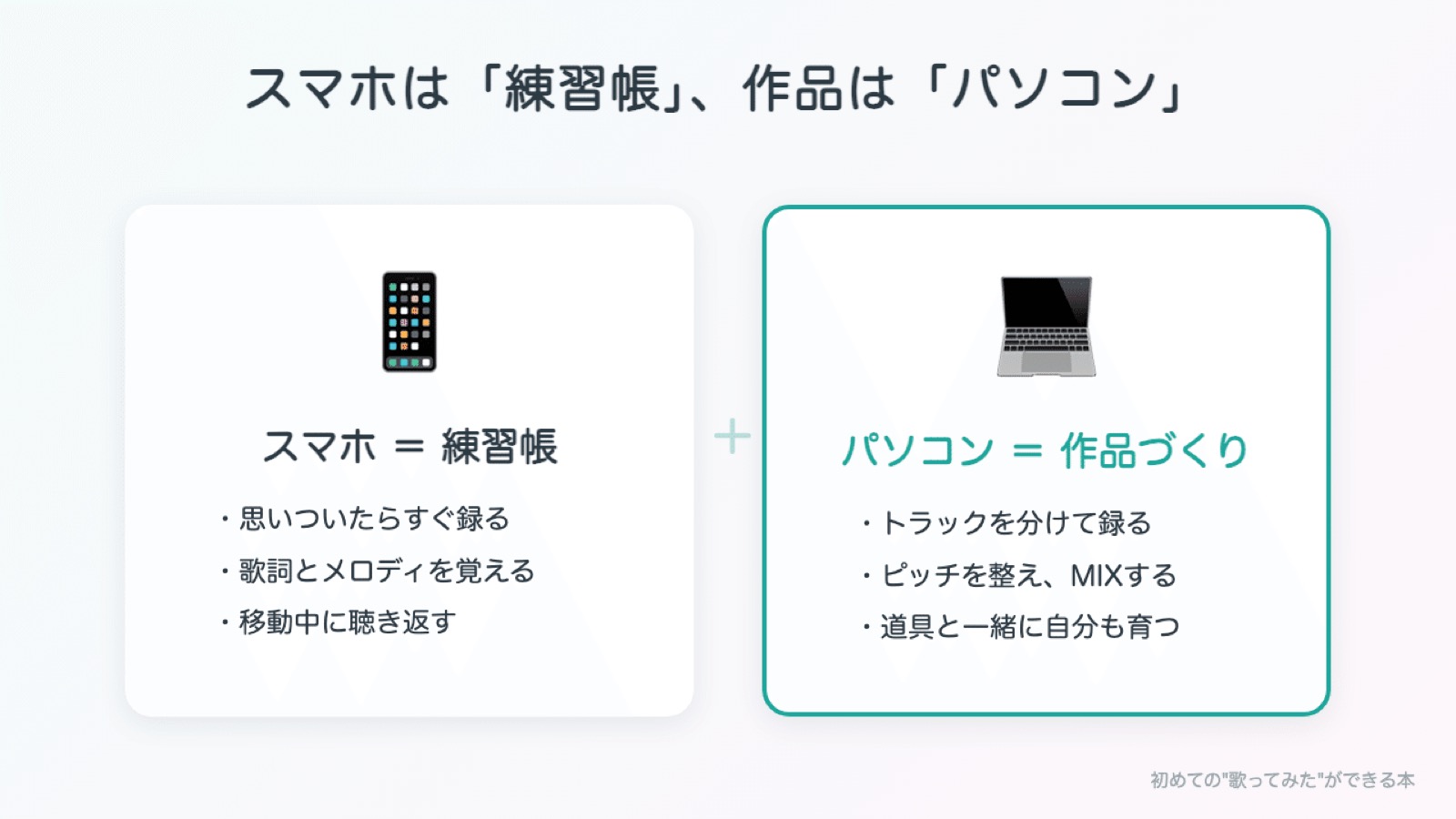
A Phone Is a Great “Practice Notebook”
I want to give phones their due: they aren’t bad tools. They’re excellent for practice.
- Record and listen back as soon as an idea comes to you.
- Practice over and over to learn the lyrics and melody.
- Listen to your recordings on your commute or on the way to school.
That’s why I recommended recording a phrase on your phone in Chapter 1.
Here’s how I suggest using each: a phone is your practice notebook; a computer is for making finished work.
What This Book Is For
This isn’t a book about making quick, casual cover songs on your phone. It’s about bringing the sound you admire closer with your own hands.
That takes a little preparation. But it’s much easier and less expensive than you might think. Once you have the gear, it can be your partner for dozens or even hundreds of songs as you build your story.
🙅 You don’t need to do these things yet
- Buy an expensive computer or gear right away. (Read Chapters 4 and 5 first.)
- Try and compare lots of phone recording apps.
- Spend hours trying to make a finished product on your phone.
✅ You’ve passed this chapter if…
You’ve decided: “A phone is for practice; a computer is for making finished work.”
I’d like to move on to gear, but there’s a big obstacle many people run into first: sound leaking out. If you sing loudly, your family or neighbors may hear you. In the next chapter, we’ll look at ways to solve that problem.