Garage-Born Classics Within Reach — Warm Audio
Prologue — In My Rack
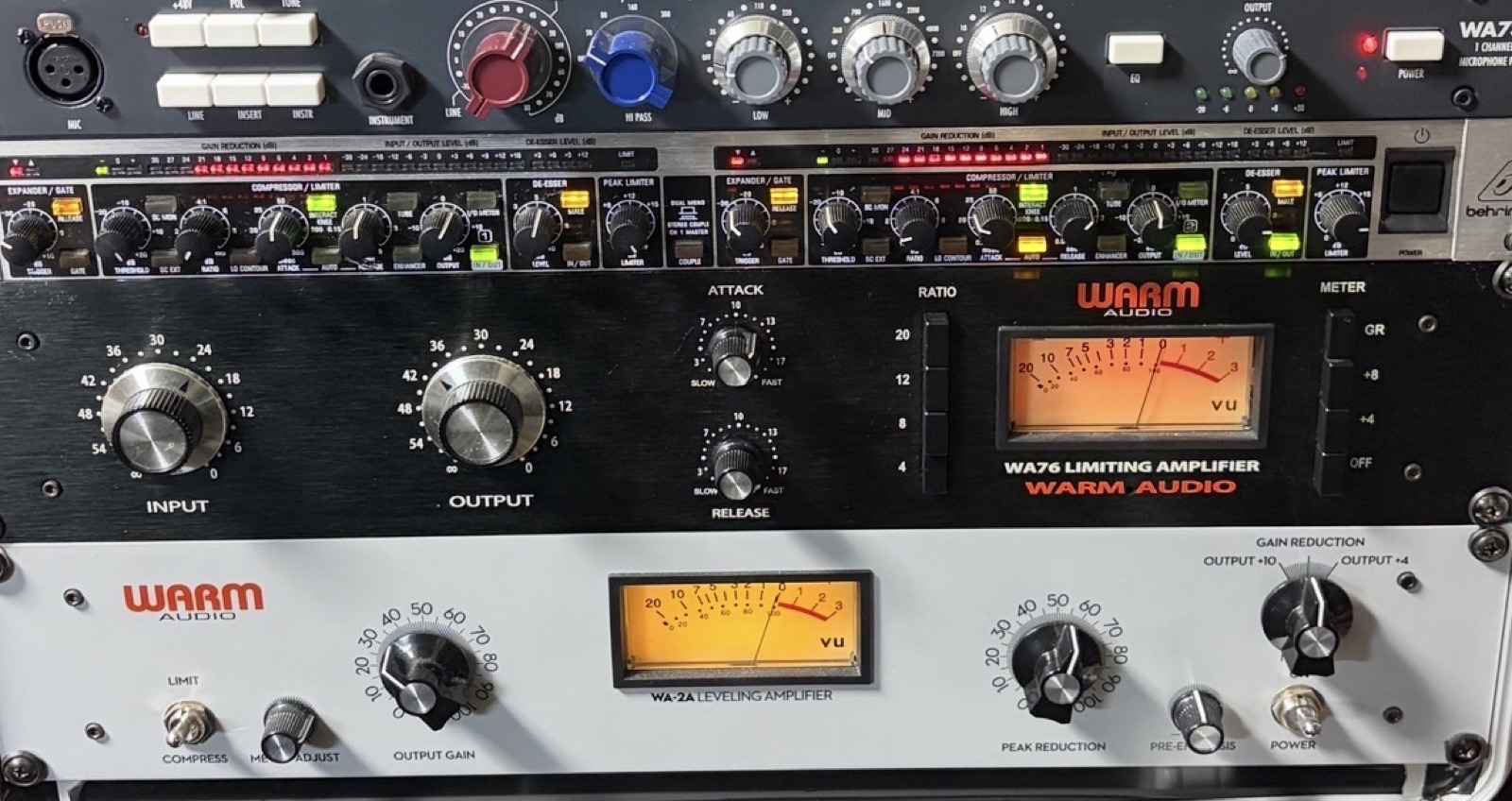
Two compressors sit side by side in my rack.
On the upper shelf is a black panel with a large meter and four small buttons.
WA76.
It’s an FET compressor descended from the legendary 1176 of the 1960s.
Right below it is a curious box with only two knobs.
WA-2A.
It’s a tube compressor descended from the legendary LA-2A, which gently smooths sound with light.
Both panels carry the same logo:
Warm Audio.
Original vintage 1176s and LA-2As now sell for astonishing prices. Someone like me can’t casually line up two of them. But these two were within reach.
How did gear like this come to exist? To find out, let’s turn the clock back about 20 years. Our setting is Texas, USA. A young man is holding a soldering iron in a garage.
📝 About this story
This story draws on the articles, interviews, and company materials I’ve read over the years. I’ve based it on the facts as carefully as I can, but I wasn’t there at the time, so some popular names and commonly repeated stories may be mixed in. I’ve separated accounts with differing versions into “Legend & Lore” sections, and collected the references at the end.
The stories behind the original WA76 and WA-2A designs are covered in separate articles, “The Story of the UA 1176” and “The Story of the LA-2A.”
Chapter 1 — Recording at Sixteen
A Band and an Eight-Track
Bryce Young entered the world of recording at age 16.
He booked a local studio to record with his band. But he just couldn’t accept the sound they got.
“I’ll try it myself.” Bryce started recording on his own, using a Roland eight-track recorder and a USB audio interface. Before long, he was recording other bands, working at a local studio, and taking on mixing jobs while attending college.
Hearing the Difference in a College Studio
The turning point came in a college studio.
There was a high-end Avalon 737, a channel strip that combines a mic preamp, compressor, EQ, and more in one unit.
Bryce plugged a cheap microphone he had into the 737.
The sound suddenly felt bigger and more professional.
It was the same inexpensive mic, yet the gear connected to it changed the sound so dramatically. Bryce says he began to understand why so many engineers revered vintage equipment he had once wondered was “so expensive for a reason.”
The Real Thing Was Too Expensive
But gear like that cost a lot.
Vintage classics could run from several thousand dollars to tens of thousands, and even new high-end gear was beyond the reach of many young musicians and emerging engineers.
“What if more people could get that sound?”
That thought sent Bryce to the garage.
Now let’s follow the story of how a young man in a garage built a company that would bring “classics within reach” to studios around the world.
Chapter 2 — A Garage and eBay
Building Kits and Selling Them
Around 2007, Bryce started a side business in his home garage.
He assembled DIY kits based on the circuits of vintage microphone preamps and began selling them on the online auction site eBay.
He lined up parts in the garage, picked up a soldering iron, and built each unit by hand. It was also a way for Bryce to investigate the secrets of “the real sound” for himself.
The Trap of Cheap Parts
Along the way, Bryce learned something important.
Cheap parts could make the sound of a vintage circuit surprisingly weak.
Even when built to the same schematic, a circuit could sound completely different if the quality of its transformers, capacitors, and other components changed. The sound of a classic lived not just in its circuit diagram, but in the parts themselves.
“Could You Sell Me Just a Few?”
Bryce decided to take a bold step.
He contacted manufacturers that made high-quality components directly. “Could you sell me a small quantity?” he asked. He even requested small changes to the specifications to bring the parts closer to components that were no longer being made.
It would have been no surprise if a manufacturer had turned down a young man working out of his garage. But some agreed to help. Bryce has said he was surprised himself.
Recognizing the Demand
While selling kits on eBay, Bryce noticed something else:
A lot of people wanted a professional sound but couldn’t afford the real thing.
Building every unit one at a time in a garage couldn’t keep up. He needed a way to make more, reliably.
Chapter 3 — 2011: The WA12
Warm Audio Is Born
In 2011, Bryce founded Warm Audio in Austin, a music city in Texas.
The company’s goal was clear: make professional recording gear accessible to musicians and aspiring engineers.
An Orange Panel
The first product was the WA12 microphone preamp.
It was a compact, half-rack-width mic preamp with a bright orange panel that was instantly recognizable.
Bryce’s attention to detail was inside, too. The input and output transformers were high-quality units made by American company CineMag. From the very first product, he applied the lesson he had learned in the garage: “The parts determine the sound.”
The price was $449. For a proper transformer-based mic preamp, that was remarkably affordable.
The “Warm Formula”
Warm Audio calls its approach the “Warm Formula.”
- Study the sound of classic gear that people want.
- Reproduce that sound faithfully at a price far below the competition.
- Make the business work by selling in volume, rather than earning a large profit on each unit.
The high-end gear market had traditionally been about selling small quantities at high prices. Warm Audio chose the opposite approach.
🎙 Legend & Lore ①: “The Future Is in Plugins”
When Bryce was starting Warm Audio, he says people at music retailers told him:
“The industry is moving toward plugins. Hardware is yesterday’s news.”
In the early 2010s, computer-based plugins were advancing quickly. Affordable software emulations of classic gear were becoming available.
Bryce saw it differently. “People are choosing digital because real hardware is too expensive. If they could get the real thing at an affordable price and get a similar sound, they’d choose the real thing.”
Whether that prediction was right may be answered, at least in part, by Warm Audio’s growth since then.
Chapter 4 — Classics Within Reach
Moving Into Compressors
After the WA12 succeeded, Warm Audio began releasing one piece of gear after another inspired by classic designs.
The products closest to me are two compressors.
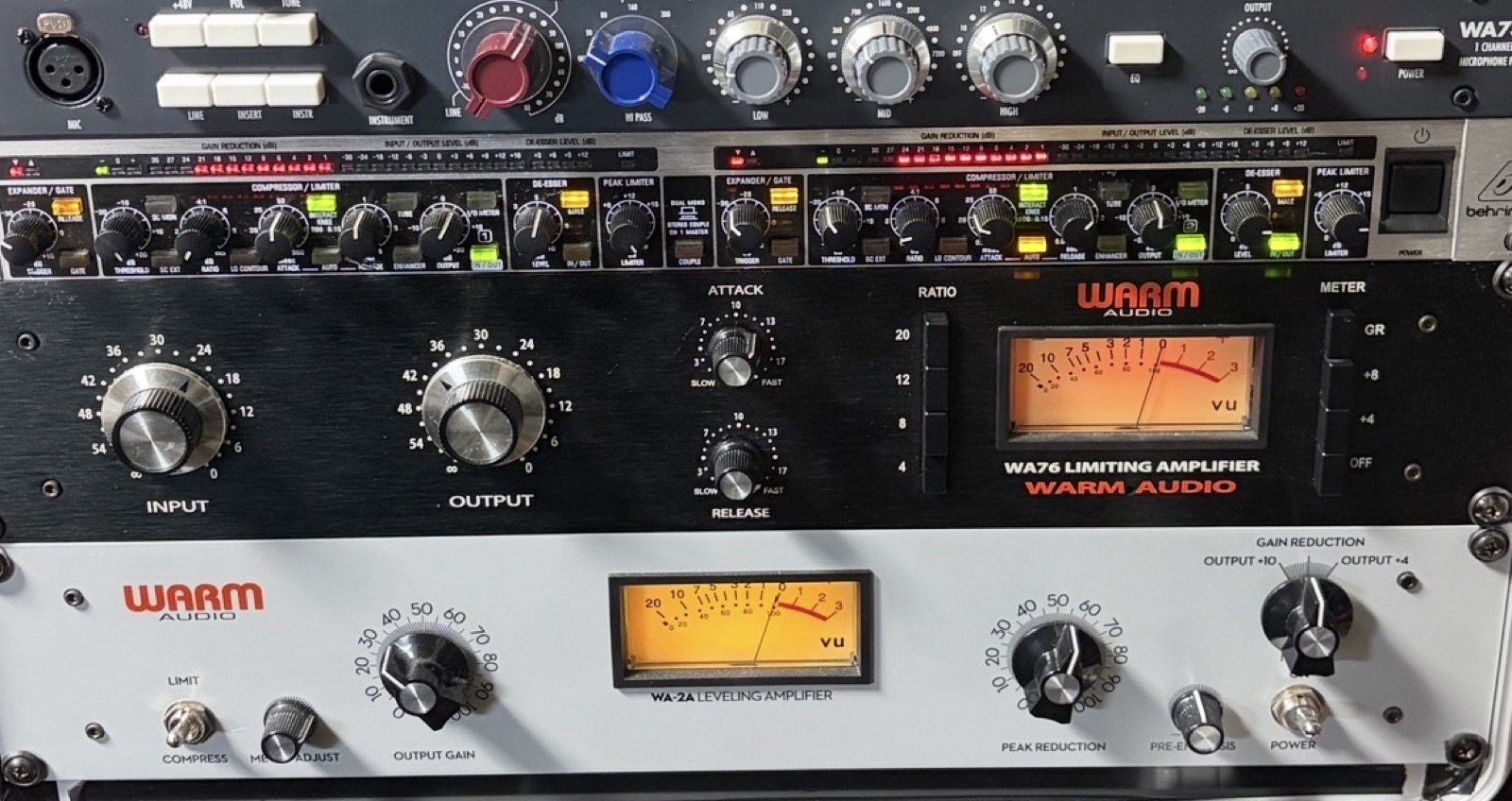
WA76: an FET compressor descended from the 1176. Four RATIO buttons, INPUT and OUTPUT knobs, ATTACK and RELEASE controls, and a large VU meter. It carries on the 1176’s hands-on feel almost exactly.
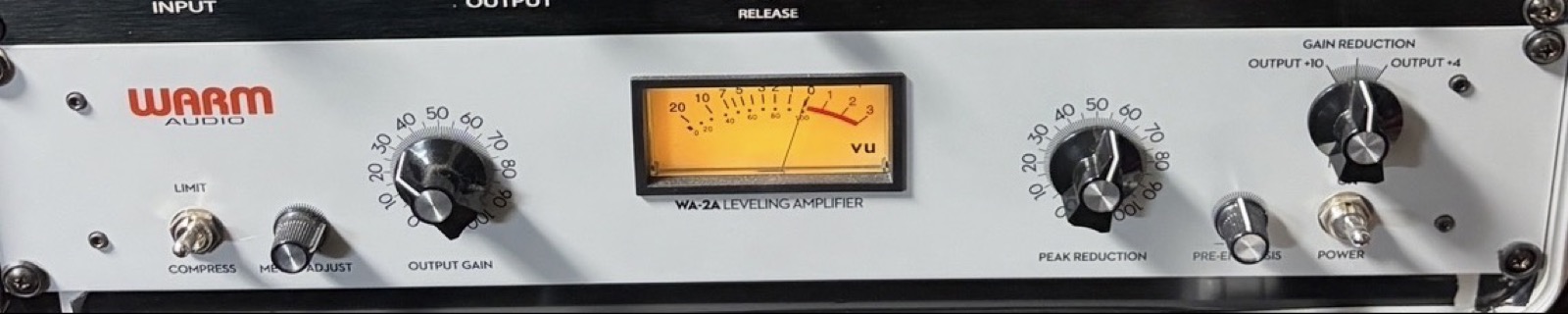
WA-2A: a tube-and-optical compressor descended from the LA-2A. You shape the sound with just two knobs: PEAK REDUCTION and GAIN. A PRE-EMPHASIS knob for adjusting its response to high frequencies is a distinctive feature of the WA-2A.
Entering the Microphone Market
Warm Audio also moved into microphones.
- WA-87: a large-diaphragm condenser descended from Neumann’s classic U 87. It arrived in 2016 and drew a lot of attention for its accessible price. An updated R2 version followed.
- WA-47: a microphone descended from Neumann’s legendary U 47 tube mic.
- WA-251: a tube microphone descended from the legendary Telefunken ELA M 251, designed by AKG.
Vintage U 47s and ELA M 251s can sell for the price of a car. Warm Audio offered a chance to experience something in that tonal direction at an accessible price. Its microphones quickly spread among people recording at home. (The stories of the U 47 and U 87 are covered in “The Story of Neumann”; the 251’s story is in “The Story of AKG.”)
EQ, Then Bus Compression
Warm Audio’s lineup continued to grow.
- EQP-WA: an EQ descended from the Pultec EQP-1A, a classic tube equalizer.
- WA73: a mic preamp and EQ descended from the Neve 1073.
- Bus-Comp: a compressor descended from the bus compressor in SSL consoles.
Pultec, Neve, SSL. The lineup brings together descendants of nearly all the classics covered in this series.
Guitar Pedals
In recent years, Warm Audio has also focused on effects pedals for guitarists. Its lineup includes pedals inspired by legendary overdrives and vintage phasers. In 2026, the company also introduced its MOD Series, designed to fit neatly on pedalboards.
Chapter 5 — One Unit at a Time in Austin
How Production Works
Warm Audio gear is designed, developed, and tested at the company’s headquarters in Austin, Texas. To make large quantities reliably, the company also works with overseas factories.
The young man who once assembled units one at a time in a garage knew he needed a way to make more. His answer was to design the products himself and manufacture them at scale with trusted factories.
Opening and Checking Every Unit
Even with that system, Warm Audio says it doesn’t skip one particular step.
According to the company, each unit is opened, powered on, and inspected by hand at its Austin headquarters before shipping.
Making gear affordable while maintaining quality: this is Warm Audio’s answer to balancing the two.
A Five-Year Warranty
Warm Audio products come with a five-year warranty. Even at an accessible price, the company expects its gear to be used for a long time. That, too, reflects its desire to deliver “the real thing.”
🎙 Legend & Lore ②: Why the Names Look So Similar
WA76, WA-2A, WA-87, WA73… Warm Audio product names look very much like the names of the classics that inspired them.
Many classic circuits designed in the 1960s and ’70s are no longer covered by active patents, and building new gear based on those circuits is common. But product names and brands such as 1176, LA-2A, and U 87 still belong to their original manufacturers.
So Warm Audio adds its own initials, “WA,” to names that make the inspiration immediately recognizable. (Manufacturers and fans have a range of views on this approach.)
“Bring the tonal character of the real thing within reach of people who can’t buy the original.” You could say that even the naming reflects Warm Audio’s straightforward approach.
Chapter 6 — In Practice: How I Use the WA76 and WA-2A
Let’s step away from the company’s story for a moment. Here’s how I actually use the WA76 and WA-2A I own. I hope this is useful if you have the same gear or are thinking about buying it.
Pairing “Fast” With “Slow”
The WA76 and WA-2A are very different compressors.
- WA76: reacts very quickly and catches the sharp peaks in a sound.
- WA-2A: reacts slowly and smooths out the overall sound.
Putting the two in this order, WA76 → WA-2A, is a classic vocal recording technique. The WA76 quickly controls sudden changes in vocal level, and the WA-2A gently evens out the overall performance. Applying a little compression with two units can sound more natural and bring the vocal forward better than pushing one unit too hard.
WA76 Tips
- Turning ATTACK and RELEASE to the right makes them faster. This trips up a lot of people at first. (I turned them the wrong way plenty of times before it clicked.)
- For vocals, start with a RATIO of 4 or 8.
- Watch the meter and start with about 3–6 dB of gain reduction on the loudest parts.
- Pressing all four RATIO buttons—the so-called “all-buttons-in” mode—can give room mics on drums a raw, powerful sound.
WA-2A Tips
- Start with GAIN turned down, then gradually raise PEAK REDUCTION.
- Stop when the meter moves a little on the loudest parts.
- Finally, use GAIN to set the output level.
With only two knobs, there’s very little to get lost in. “Before you have time to think, the sound is already there.” That’s the WA-2A.
Keeping It Working for Years
Analog gear like the WA76 can drift out of adjustment over time. If the meter or the amount of compression starts to feel off, it may be time to check the calibration.
I adjust my WA76 myself with just one multimeter. I’ve laid out the procedure in detail, with photos of the actual unit, in a separate article.
The New WA76
The WA76 series was refreshed in 2024. The lineup now includes two-channel versions of the WA76-A series, inspired by early 1176 models, and the WA76-D series, inspired by later models.
The black-panel WA76 I own is now considered an “old model.” Even so, I still think the old version’s simple design has a charm of its own.
Chapter 7 — From a Garage to a Group
Supporting the Music Industry
What began in a garage has become a brand whose products sit on music store shelves around the world.
The Warm Audio team has now taken on another challenge: launching Audio Collective Group, a parent company intended to support the growth of brands across the music industry.
The group includes Warm Audio; German analog gear maker Tegeler Audio; Japanese guitar maker Tokai; and brands such as RockNRoller, which makes equipment carts. Warm Audio says it will continue operating as an independent brand as before.
And leading both Warm Audio and Audio Collective Group is the young man from that garage: Bryce Young.
Epilogue — Classics Within Reach
A 16-year-old boy who wasn’t satisfied with the sound of a local studio. A young man who heard an inexpensive mic transformed by high-end gear in a college studio. A young entrepreneur who built kits in a garage, sold them on eBay, and asked component manufacturers for help.
He didn’t set out to make cheap gear. He wanted to make gear that put the sound of the real thing within reach.
Today, the WA76’s meter still moves in my rack, and the WA-2A gently smooths the sound. More than half a century after engineers in the 1960s created those classic sounds, they’re ringing out in a small home studio like mine.
The bridge that made this possible was built by a young man with a soldering iron in a Texas garage.
Warm Audio Timeline
- Around age 16: Bryce Young begins recording on his own after recording with his band.
- College years: He hears the difference professional gear can make when he uses an Avalon 737 in a college studio.
- Around 2007: He assembles vintage-style mic preamp kits in his garage and sells them on eBay.
- 2011: He founds Warm Audio in Austin, Texas. The first product is the WA12 ($449).
- 2010s: Warm Audio releases one classic-inspired product after another, including the WA76, WA-2A, WA-47, and EQP-WA.
- 2016: The WA-87 arrives.
- Late 2010s–2020s: The lineup expands with the WA73, Bus-Comp, guitar pedals, and more.
- 2024: The WA76 series is refreshed (WA76-A / WA76-D series).
- 2026: The Warm Audio team announces the parent company Audio Collective Group.
References
- Warm Audio, “What’s the story behind Warm Audio?” (official blog)
- Warm Audio official website (product information and warranty)
- MusicTech, “Warm Audio team launches Audio Collective Group to scale and support music industry brands”
- Music Connection, “Warm Audio”
- Sound On Sound (WA76 series review)
Photo credits
- Header image, WA76: Photo: the author
- WA76: Photo: the author
- WA-2A: Photo: the author