[YAMAHA Motorcycle History] The Most Fun 1000 cc for Winding Roads — The YZF-R1, Bringing Track Technology to the Street
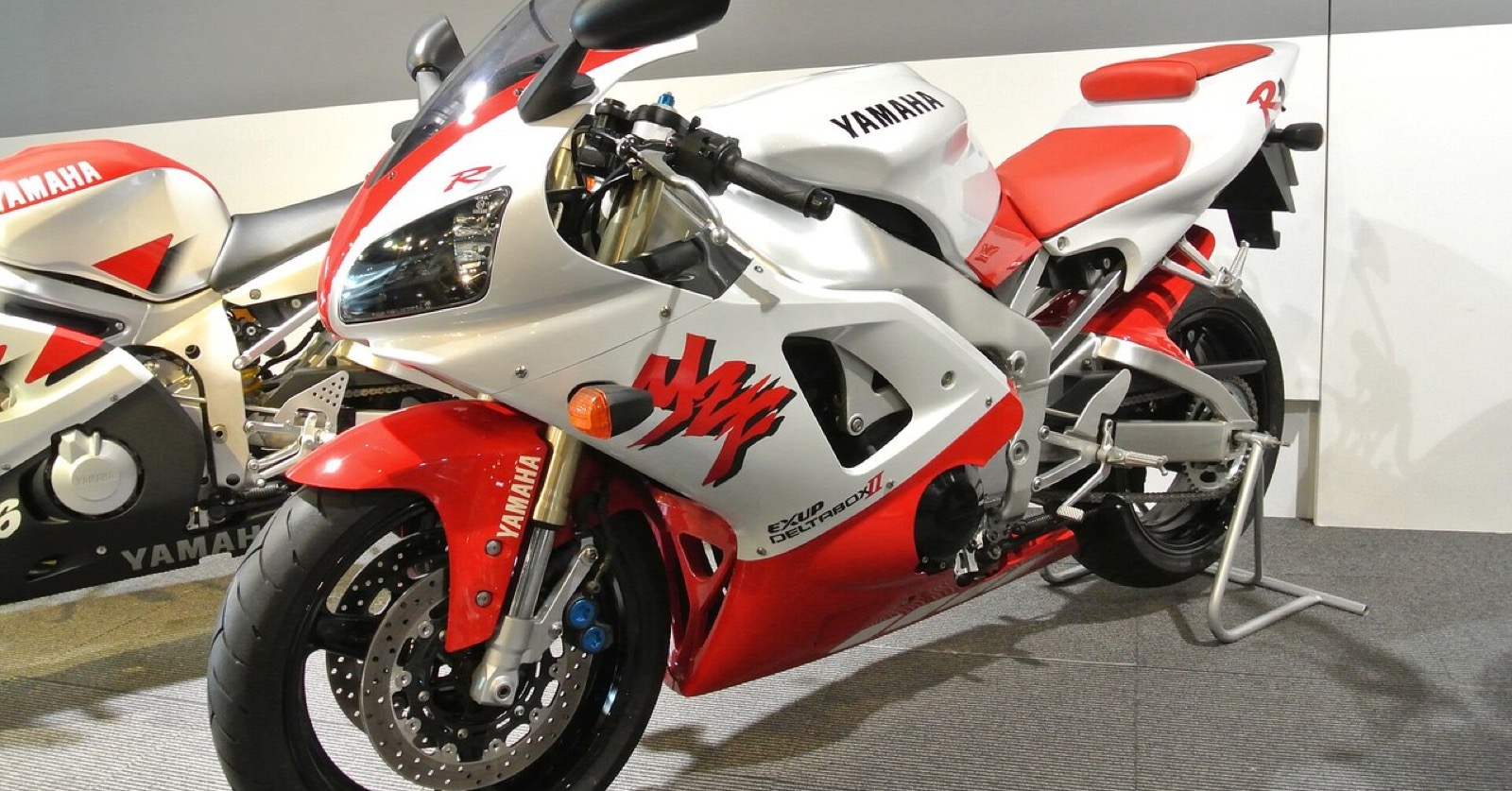
☕ A coffee-length story from GC Lab's "Motorcycle History" series, where we follow machines through the people and events behind them. This time: the Yamaha YZF-R1, born in 1998 as a "litre bike for mountain roads," which went on to carry MotoGP technology onto the street.
💡 What you'll learn
- Why Yamaha built a 1000 cc bike from a clean sheet, in an era when 750 cc was the yardstick for speed
- The "triangle" inside the engine that made 177 kg and 150 hp possible
- How the crossplane crank and electronics turned the R1 into a machine for both road and track
Prologue
Autumn 1997, the motorcycle show in Milan, Italy. On the Yamaha stand sat a bike nobody had seen before.
Two narrow, upswept headlights. A short, tightly wrapped body. The letters "R1" on the side. When the numbers were announced, the journalists gathered around could hardly believe them: 998 cc and 150 hp, yet a dry weight of just 177 kg. It was about as light as a 600 cc sports bike, and it made the power of the biggest class.
The YZF-R1 went on sale in 1998, and orders poured in from around the world. Waiting lists were said to run to six months. Rival makers scrambled to rework their next models, and within a few years the sportbike landscape had been redrawn.
But the people who built this bike were not aiming at a racetrack podium. Their goal was the litre bike that was the most fun on a winding mountain road. From there, the R1 would go on to inherit the heart of a MotoGP machine and become a bike whose real home was the circuit. This is that journey.
Chapter 1 — The 750 cc era, and the verdict "too Spartan"
In the mid-1990s, the yardstick for a fast motorcycle was 750 cc.
In the World Superbike Championship, raced on machines based on production bikes, four-cylinder engines were capped at 750 cc. For every maker, the most important sportbike for winning races was a 750. Bikes over 1000 cc were usually built as heavy, relaxed machines for covering long distances fast on the highway.
That convention was shaken by Honda's CBR900RR, which arrived in 1992. It was a 900-class bike, but its chassis was astonishingly light and it flicked into corners. Many riders fell for this new kind of fun: big, yet light.
Yamaha had big sportbikes too: the FZR1000, and in 1996 the YZF1000R Thunderace. Inside Yamaha there was a serious debate about whether to follow the CBR. Some of the test team were completely won over by its lightness. But the conclusion was "too Spartan." Lightness, they argued, is not decided by weight alone; what matters is that the rider can enjoy the bike with confidence. The Thunderace was finished as a calm, composed machine.
Yamaha had a long-held idea of its own. Beyond the highway, it valued the winding mountain road, which it called the "secondary road," and being fun to ride there. Second or third gear, around 100 km/h: that, the thinking went, is where riders spend the most enjoyable time.
Yet European magazines didn't make much of a fuss over the Thunderace, and it was seen as a sport-touring bike. The Thunderace itself would later become a long-lived, much-loved fast tourer around the world, but as "Yamaha's fastest sportbike," it left something to be desired.
Next time, Yamaha would have to build something far bolder. That feeling was in the air.