[YAMAHA Motorcycle History] It Began with "This Is the Last Two-Stroke" — The RZ250
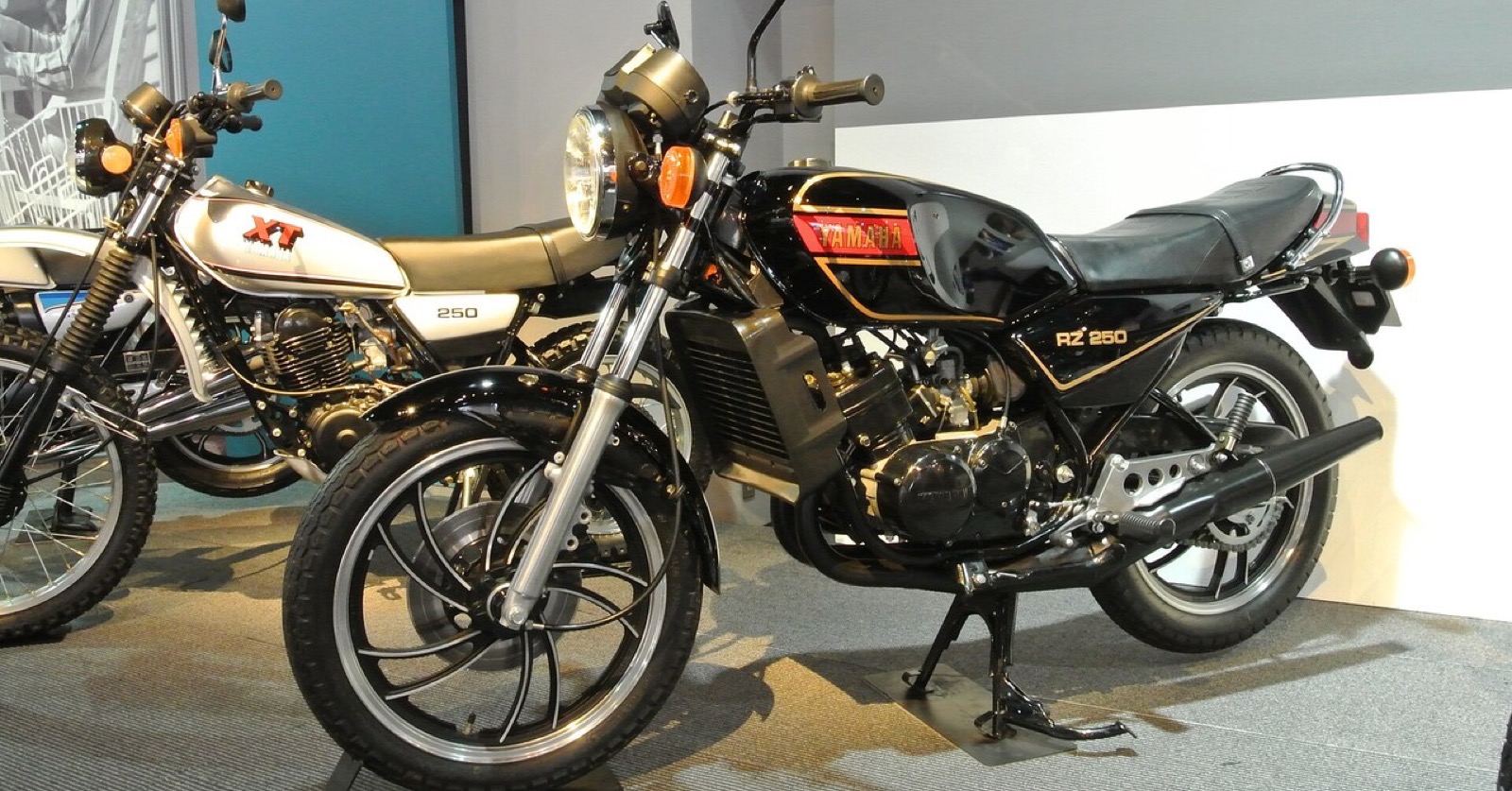
☕ A coffee-length story from GC Lab's "Motorcycle History" series, where we follow machines through the people and events behind them. This time: a bike built in the belief that "this may be the last two-stroke sports bike," which turned out to be not an ending, but the start of a huge boom.
💡 What you'll learn
- Why, in an age of emissions rules, Yamaha's engineers built a two-stroke sports bike anyway
- A racer's engine, a 13 kg frame, and a suspension born in motocross
- Why the bike meant to be "the last one" lit the fuse of a motorcycle boom
Prologue
October 1979, Harumi, Tokyo. The Yamaha booth at the 23rd Tokyo Motor Show was packed. In the middle of a crowd so dense you could barely move stood a single 250 cc motorcycle.
A white fuel tank with a pearl-like sheen. Light cast wheels shaped to evoke flames. Exhaust pipes that swelled in several stages and swept up toward the tail. And in front of the engine, a large black radiator: the sign of an engine cooled not by air, but by water.
Its name was the RZ250. It wasn't even on sale yet, and readers of a motorcycle magazine had already voted it the number-one Japanese bike of the year. After the show, dealers across the country were flooded with orders. At test-ride events around Japan, lines formed of people who couldn't even fit into the venue.
Yet the engineers who built this bike carried a certain resolve in their hearts: "This may be the last two-stroke sports bike."
How did a bike built as the last of its kind become the beginning of an era? This is the story of the engineers who created the RZ250.
Chapter 1 — Headwinds for the two-stroke
Yamaha grew up with the two-stroke engine. From its very first motorcycle, the YA-1, Yamaha bikes charmed people with the light, eager acceleration and high-pitched exhaust note of the two-stroke. In racing, too, two-stroke Yamahas fought for the top of the world.
The late 1970s, when the RZ was being developed, were the very peak of that era. American rider Kenny Roberts, riding Yamaha's two-stroke YZR500, won the world championship in the biggest class, 500 cc, three years running from 1978 to 1980. On the racetrack, the two-stroke Yamaha was the fastest thing in the world.
Off the racetrack, however, exactly the opposite was happening.
In the 1970s, strong headwinds had begun to blow against two-strokes on the road.
They came from emissions rules set by the US Environmental Protection Agency. By its nature, a two-stroke engine tends to give off unburned fuel and oil smoke. As the rules tightened, two-stroke sports bikes were pushed out of the American market.
Yamaha's main two-stroke sports bike was the air-cooled RD400. In 1979, Yamaha released a version of the RD400 with emissions countermeasures. But meeting the rules meant an unavoidable drop in power.
Tadashi Okamura, chief of engine design, later looked back on that time. As the RD400's countermeasures went on, he said, he felt a nagging frustration that the good things about the two-stroke were steadily being lost. Every time they met the rules, a little more of the two-stroke's character was shaved away. For an engineer, it was galling.
Then word came from Europe: "There are many riders in Europe who want a pure two-stroke sports bike."
That news lit a fire in the engineers. Those who moved were the engineers of the Third Engineering Division, responsible for two-stroke sports bikes. It was a project born not of orders from above, but of the passion of the engineering department.
Hideo Hashimoto, chief of chassis design, remembers what the project leader told him: "This is the last two-stroke sports bike." Those words, he says, set him on fire. If this was to be the last, then let's build the culmination of everything Yamaha knows about two-strokes. That was how development of the RZ began.