[YAMAHA Motorcycle History] The “Red Dragonfly” Built by a Piano Company — Genichi Kawakami, the YA-1, and the Birth of Yamaha Motor
☕ A coffee-length story from GC Lab's "Motorcycle History" series, where we follow machines through the people and events behind them. This time: how a company famous for pianos and organs built a motorcycle, and how a single "Red Dragonfly" gave birth to Yamaha Motor.
💡 What you'll learn
- Why a musical-instrument maker jumped into motorcycles as the very last entrant
- How the YA-1 started from the DKW RT125 and found a shape of its own
- How races on Mount Fuji and Mount Asama changed a brand-new company
Prologue
February 11, 1955. At Nippon Gakki's new Hamana factory, not far from Lake Hamana in Shizuoka Prefecture, about eighty employees lined up on both sides of the main gate.
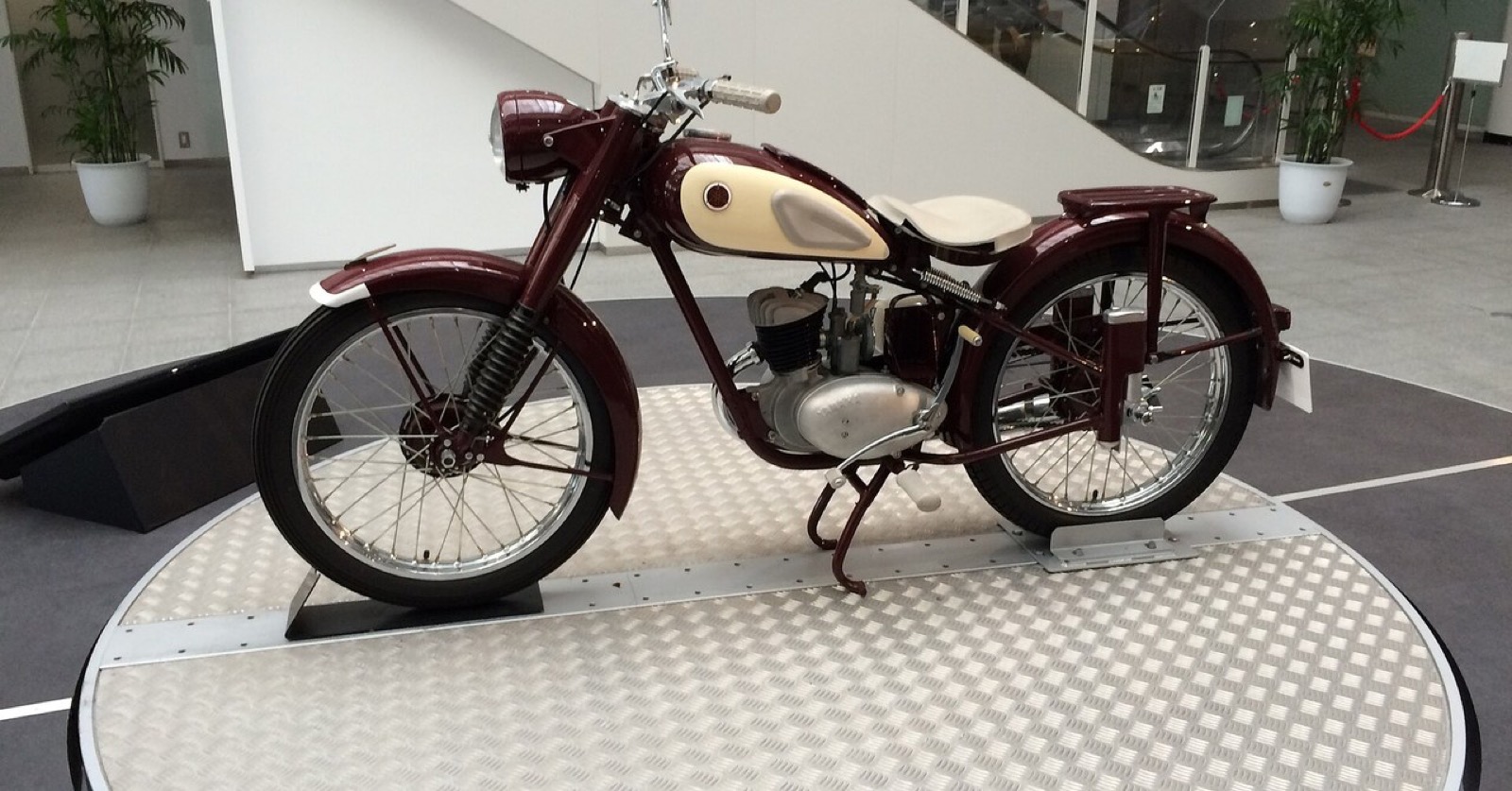
Rolling out through that gate was a single motorcycle. Its fuel tank was cream, its frame a chestnut brown. In an age when motorcycles were almost all black, it must have stood out. At the handlebars was the head of engineering, and he was riding it to a dealer in the city of Hamamatsu. The whole staff had come out to see off the first production machine.
The motorcycle was called the YA-1. The company that built it was best known for pianos and organs. Before long, people started calling this slender machine the "Red Dragonfly," and that summer the motorcycle division was spun off as a new company: Yamaha Motor.
Why would a musical-instrument company build motorcycles? And why would it step in last of all, at a time when more than two hundred makers were crowding the market and the shake-out had already begun? This is the story that began with one red dragonfly.
Chapter 1 — A company that began with an organ repair
The story starts long before motorcycles, in Hamamatsu in 1887.
That year, an American-made organ broke down at an elementary school in Hamamatsu. The man asked to fix it was Torakusu Yamaha, who had been repairing medical equipment and other instruments. Torakusu didn't stop at the repair. He studied how the organ worked, and then built one himself.
The story goes that, to have his organ judged, Torakusu and a partner carried it on a shoulder pole over the Hakone mountains all the way to Tokyo. The verdict from the experts was harsh: it was out of tune. Torakusu stayed in Tokyo to study music theory, went back to Hamamatsu, and built it again. His second organ passed, and orders began to come in. Faced with something broken, he studied how it worked, built one, and when that failed, learned more and built it again. That stubbornness would carry over, more than half a century later, into building motorcycles.
This was where Yamaha began. In 1897, Nippon Gakki Co., Ltd. was founded with Torakusu as its first president. Organs, then pianos: Hamamatsu's instrument industry grew from here. The company's emblem combines three tuning forks, the tool used to set a pitch. It is the same mark you still see on the tanks of Yamaha motorcycles today.
In 1927, Kaichi Kawakami was brought in from outside to run the company. Then, during the war years of the Showa era, Nippon Gakki was ordered by the government to make propellers for military aircraft. Carving wood, shaping it, finishing it without the slightest warp: the woodworking skills honed on instruments carried straight into propeller making. Thin boards were glued together in layers and carved to precise angles. For craftsmen who had made piano soundboards and organ parts, it was an extension of a conversation with wood they already knew well. Later the company made metal propellers too, and its factories filled with some 1,000 machine tools.
In 1945 the war ended, and so did the propeller work. Instrument making resumed, but most of the machine tools brought in for the war were left sitting idle.
In 1950, Kaichi's son Genichi Kawakami took over as president at the age of 38. How could those sleeping machines be put to use? Could instruments alone carry the company into the future? Those questions never left the young president's mind.